

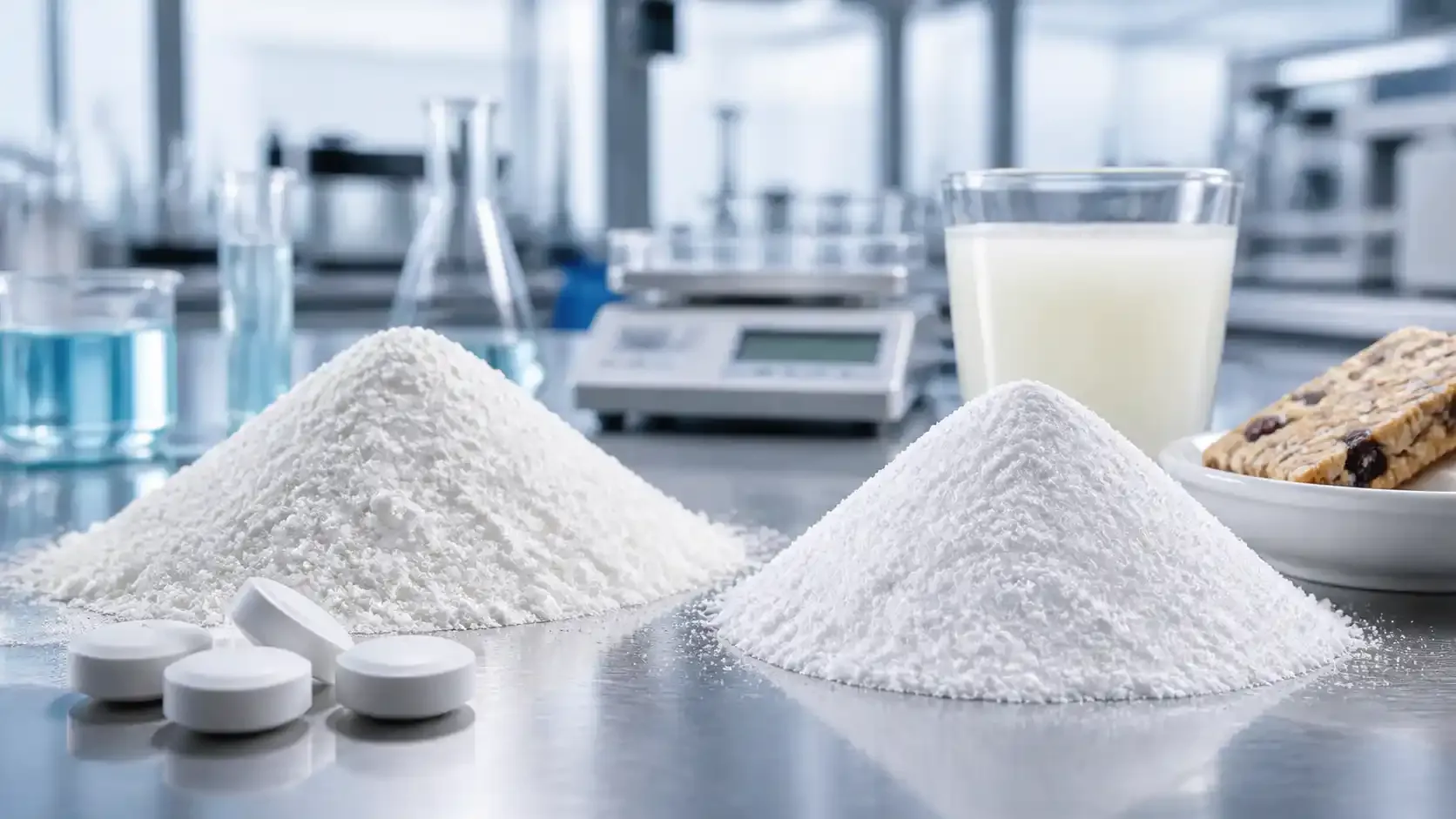
Microcrystalline cellulose (MCC) and resistant dextrin are no longer “simple fillers.” For procurement teams, they have become formulation-critical inputs that affect tablet robustness, process efficiency, label claims, and consumer tolerance—often with more impact than their unit price suggests.
Two market signals explain why buyers are tightening standards. First, regulators and brand owners are increasingly comfortable with plant-based excipients when documentation is solid. Second, food and nutrition brands are under pressure to raise daily fiber intake without sacrificing taste or convenience—especially as satiety and blood-sugar awareness reshape product briefs.
This article is a fundamentals-first map for qualifying a recommended Chinese microcrystalline cellulose manufacturer, a recommended Chinese microcrystalline cellulose supplier, and a recommended Chinese resistant dextrin manufacturer—without getting lost in jargon or marketing.

Why MCC and resistant dextrin are being re-evaluated now
Plant-based excipients are gaining momentum
A recent update in the excipient space illustrates the direction of travel: Nouryon announced Chinese regulatory clearance for a plant-based cellulose excipient used in drug manufacturing. For buyers, the headline is less about any single company and more about the broader trend—cellulose-based excipients with export-ready documentation are easier to justify internally than they were a few years ago.
Fiber is moving from supplements into everyday foods
At the same time, product developers are pushing functional fiber into mainstream categories—instant foods, snacks, beverages—because consumers want convenience and better nutrition. This widens the buyer base for resistant dextrin well beyond classic supplement channels.
Microcrystalline cellulose fundamentals buyers should align on
Microcrystalline cellulose is a refined cellulose ingredient derived from wood pulp. It is typically odorless, tasteless, and white, and it behaves like an insoluble fiber. In practice, MCC is purchased for performance—especially in solid dosage forms.
Where MCC fits in pharmaceuticals
In tablets and capsules, MCC is commonly used as:
- Binder (helps particles compress into strong tablets)
- Disintegrant / disintegration aid (supports breakup after ingestion, depending on formulation strategy)
- Flow aid (improves handling and die filling when paired with other excipients)
Many buyers screen suppliers by grade families such as PH-101, PH-102, PH-103, PH-105, PH-112, PH-113, PH-200, PH-301, PH-302, because grade selection often correlates with flow, particle size distribution, and compressibility expectations.
Compendial alignment is another frequent gating item. Export projects commonly request MCC that can be supplied with documentation aligned to BP/USP/FCC/JP specifications, depending on the destination market.
To see how Chinese suppliers present compendial positioning and grade coverage, the product pages for high-quality microcrystalline cellulose and the broader microcrystalline cellulose range provide a useful reference point.
Where MCC fits in food and personal care
Outside pharma, microcrystalline cellulose is used for bulking, anti-caking, stabilization, and texture control. Buyers often choose it when they want plant-derived functionality and neutral sensory impact.
A common point of confusion in RFQs is terminology: MCC is not the same as methylcellulose. Procurement teams benefit from confirming the intended functionality (insoluble fiber-like behavior vs. specific gelling/viscosity behavior) before locking the purchase spec.
MCC quality parameters that matter in a COA
A recommended Chinese microcrystalline cellulose supplier should be able to discuss the same MCC properties the formulation team cares about—clearly and consistently.
Key items to review (and keep consistent across lots):
- Grade / particle size target (often reflected via mesh range or PSD expectations)
- Bulk density (practical signal for flow and compression behavior)
- Moisture (important for stability and processing repeatability)
- Purity (commonly presented near ~0.99 in supplier specifications for high-purity MCC)
- Microbial limits (critical for both pharma and certain food applications)
- Compendial statement (BP/USP/FCC/JP as applicable)
- Traceability and change control (raw material and process consistency)
A procurement red flag is a supplier that only “matches the name” (MCC) but cannot explain how the grade affects direct compression behavior or batch-to-batch process outcomes.

Resistant dextrin fundamentals for modern fiber projects
Resistant dextrin (often marketed in some segments as resistant maltodextrin/indigestible dextrin) is positioned as a low molecular weight, water-soluble dietary fiber. For buyers, its appeal is straightforward: fiber fortification with minimal taste disruption and good process stability.
Typical benefits buyers are asked to support
Depending on the market and claims strategy, resistant dextrin may be evaluated for:
- Digestive support and prebiotic positioning (supporting beneficial gut bacteria)
- Blood sugar moderation (slower glucose absorption as part of an overall diet strategy)
- Satiety and weight-management support (useful in fiber-forward formulations)
Because claims are jurisdiction-specific, procurement teams should focus on verified composition and documentation rather than relying on broad marketing language.
Quality indicators that should be explicit in procurement specs
From a buyer perspective, resistant dextrin quality is easiest to control when a few numeric targets are written into the specification and repeated in COAs.
Common indicators include:
- Fiber content: often requested at ≥82% for export projects
- Protein: often controlled at ≤6.0%
- Appearance: commonly white to light yellow
- Solubility and sensory neutrality: should fit the intended dosage and format
- Batch traceability: raw material origin and lot mapping
In Shine Health’s resistant dextrin materials, the resistant maltodextrin fiber specification highlights fiber ≥82% and protein ≤6.0%, and describes sourcing from corn starch and production control practices. Buyers can review examples via resistant maltodextrin fiber and gut health dextrin dietary fiber.
Process and documentation signals buyers can use
International buyers often treat resistant dextrin as “simple,” then discover late-stage issues: unexpected viscosity shifts, sensory impact at target dosage, or inconsistent tolerance feedback from consumers.
To reduce surprises, a recommended Chinese resistant dextrin manufacturer should be able to provide:
- Clear raw material origin statement (commonly corn starch; non-GMO positioning where applicable)
- Consistent COA formatting across lots (so incoming QC is faster)
- Process description at the right level (enough to support audits and customer questionnaires, without revealing trade secrets)
- Stability and handling guidance (storage, moisture management, packaging integrity)
When suppliers reference automated lines, imported enzyme systems, or closed-process controls, buyers should treat that as a starting point—and request the records that prove routine control.
Turning functional properties into a practical China supplier shortlist
A buyer-friendly way to shortlist a recommended Chinese microcrystalline cellulose manufacturer and a recommended Chinese resistant dextrin manufacturer is to translate functional needs into “yes/no” sourcing checks.
MCC sourcing checklist for solid dosage projects
Use this checklist when the end use is tablets/capsules and the risk of scale-up failure is high.
- Grade clarity: Is the MCC grade (e.g., PH-101 vs PH-102) clearly stated on the quote, COA, and label?
- Compendial alignment: Can the supplier support BP/USP/FCC/JP needs relevant to the destination?
- Particle size control: Is mesh/PSD control stable lot-to-lot (not just “60–200 mesh” on a brochure)?
- Compression behavior: Can the supplier discuss how the MCC grade performs in direct compression or wet granulation (at least at a practical level)?
- Microbial control: Are microbial limits stated and routinely tested?
- Packaging integrity: Are packs designed to control moisture pickup during transit and storage?
- Change control: Is there a documented approach to raw material or process changes that might affect performance?
If a supplier struggles to answer these, the risk is not theoretical—MCC variability frequently shows up as tablet hardness drift, friability issues, capping risk, or inconsistent disintegration results.
Resistant dextrin sourcing checklist for functional foods and nutrition
This checklist fits beverages, instant foods, powders, gummies, and other everyday formats.
- Dose realism: What fiber dose per serving is needed to meet positioning goals, and will the ingredient remain sensory-neutral at that level?
- Fiber assay: Is the target (e.g., fiber ≥82%) written into the purchase spec and verified per batch?
- Solubility: Does the supplier provide guidance for dissolution behavior and mixing order to avoid clumping?
- Tolerance considerations: Is there experience supporting higher-fiber products without pushing consumers toward discomfort?
- Traceability: Can the supplier trace each lot back to raw material intake testing?
- Export documentation: Are standard export documents, COAs, and labeling data consistent and audit-friendly?
For many buyers, the biggest hidden cost is not the ingredient—it’s reformulation time when a fiber changes mouthfeel, sweetness perception, or process stability.
What “recommended” really means in China sourcing decisions
In procurement conversations, “recommended” often becomes a vague label. For audit-ready projects, it should mean three specific things:
- Predictable specifications: The ingredient behaves the same way across lots because controls are real, not just written.
- Export-grade documentation: COAs, traceability, and compliance statements are consistent, complete, and easily verified.
- Manufacturing discipline: Hygiene, automation where appropriate, and a culture of testing support repeatable outcomes.
Shandong Shenghuai Health Co., Ltd.; Shine Health is an example of a Chinese supplier presenting MCC and resistant dextrin with clear grade/spec narratives and export-oriented documentation expectations across its product pages. For buyers building an initial benchmark, reviewing such materials can help define what “good” looks like before comparing multiple factories.
How to use this map in real purchasing workflows
A practical workflow for procurement teams evaluating a recommended Chinese microcrystalline cellulose supplier and a recommended Chinese resistant dextrin manufacturer:
- Start with the application: tablet/capsule performance targets for MCC; serving-dose and sensory targets for resistant dextrin.
- Write the procurement spec from the functional need: grade, assay limits, moisture, microbial targets, and documentation requirements.
- Request a consistent documentation pack: quote + spec sheet + COA template + traceability statement.
- Pilot with purpose: test the one or two parameters most likely to fail at scale (compression robustness for MCC; solubility/sensory at target dose for resistant dextrin).
For teams that want a fast benchmark of Chinese offerings that align with the criteria above, the catalog at www.sdshinehealth.com can serve as a reference library for MCC and resistant dextrin positioning and specifications.
Data sources and reading notes
- Market signal on plant-based excipients (third-party): The Manila Times
- Market signal on fiber in everyday foods (third-party): FoodNavigator




