

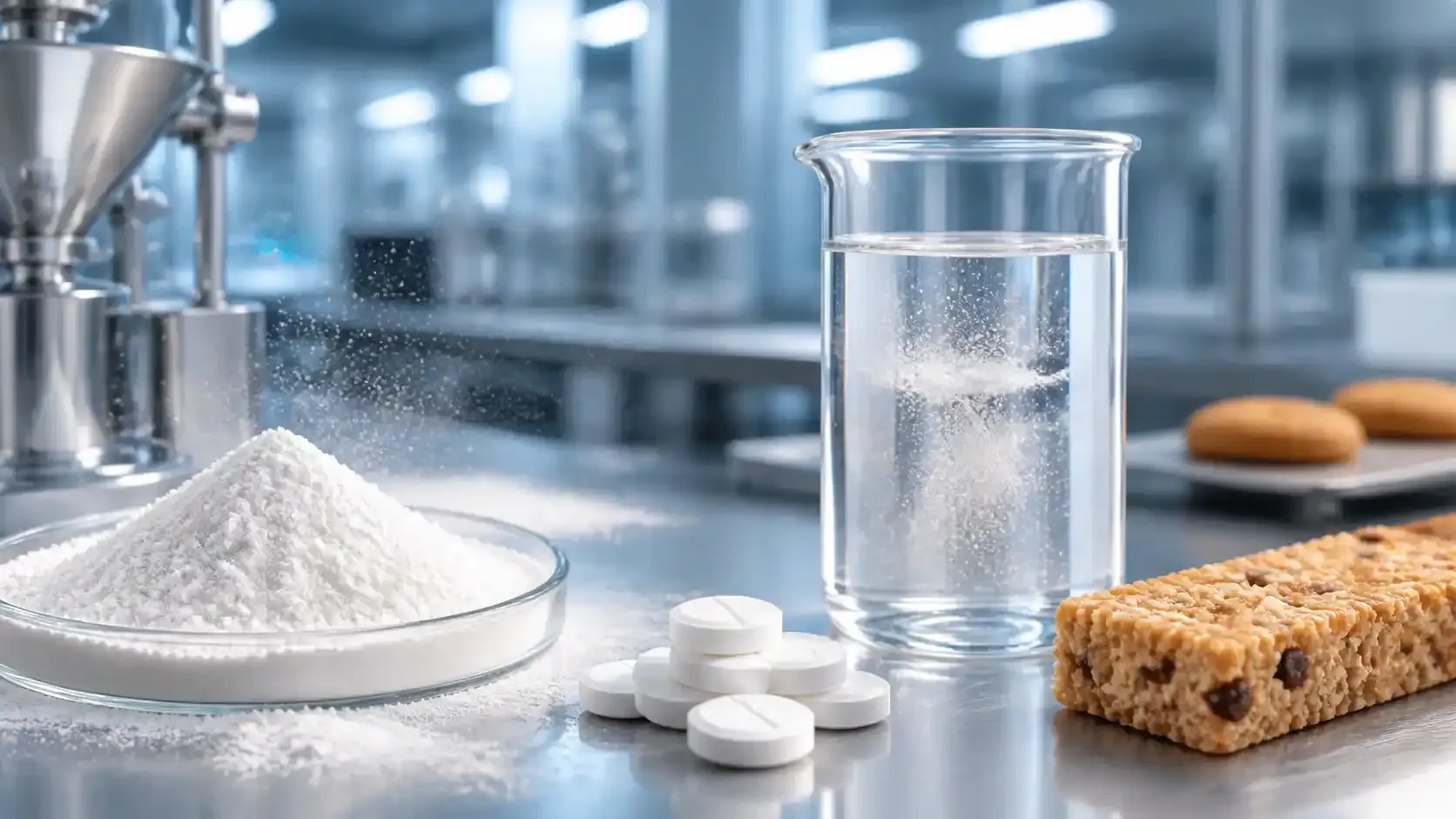
Across pharma, nutraceutical, and functional food pipelines, two ingredients keep showing up for very practical reasons: microcrystalline cellulose (MCC) and resistant dextrin. Buyers rarely choose them because they are “standard”—they choose them because these inputs solve recurring problems at scale: tablet robustness without slow disintegration, fiber claims without gritty mouthfeel, and cleaner labels without giving up process stability.
What has changed is how procurement teams validate a recommended Chinese microcrystalline cellulose manufacturer or a recommended Chinese resistant dextrin manufacturer. The decision is increasingly application-led: does the grade perform on the press, in the beverage tank, and in the oven—batch after batch?
Below are three field-tested formulation scenarios and a short sourcing framework that helps buyers move from a supplier “list” to a supplier shortlist.

Why MCC and resistant dextrin are now evaluated together
In many projects, MCC and resistant dextrin are sourced by different teams (pharma excipients vs. food fibers). But for global brands building overlapping portfolios—tablets, sachets, RTD beverages, baked snacks—the supplier expectations converge:
- Consistency under throughput: fast compression cycles, fast dissolution, fast blending.
- Clean sensory and stability: neutral taste, no unexpected viscosity spikes, heat and pH tolerance.
- Audit-ready documentation:COA detail, microbiology controls, traceability, and recognizable certifications.
That’s why a single Chinese manufacturer may be assessed across both excipient performance (MCC) and functional fiber performance (resistant dextrin).
Case 1 Direct compression tablets that depend on MCC behaving predictably
Formulation goal
Switch a vitamin/mineral tablet from wet granulation to direct compression to reduce processing time and simplify scale-up.
The technical challenge buyers actually face
Direct compression is unforgiving. If microcrystalline cellulose flow or compressibility drifts, the plant sees it immediately:
- weight variation at high turret speeds
- capping/lamination due to poor compactibility balance
- slow disintegration if the binder system becomes too “tight”
Why MCC is chosen
MCC works as a tablet excipient because it can simultaneously act as a diluent and dry binder, while supporting disintegration when the grade and particle profile match the press and blend.
For buyers, the key is not “MCC yes/no,” but which MCC profile fits the press conditions.
What properties matter most in purchasing conversations
When comparing a recommended Chinese microcrystalline cellulose supplier, request data that maps to your equipment and blending reality:
- Particle size distribution (PSD): influences blend uniformity and segregation risk
- Bulk/tapped density: relates to die fill consistency
- Loss on drying (LOD) / moisture: affects compression behavior and storage stability
- Flow and compressibility indicators: especially important at higher speeds
- Microbiology and impurities controls: essential for nutraceutical and pharma alignment
A useful internal reference for buyers building MCC specs is the technical overview at: MCC grades formulation and QC guide.
Buyer checklist for MCC trials
Keep trials procurement-friendly: ask for a pilot lot with one fixed spec sheet and one “tunable” parameter (often PSD). This prevents endless reformulation loops.
- Confirm the target process (direct compression vs. granulation).
- Lock critical-to-quality parameters (PSD band, LOD max, bulk density window).
- Run a short press study: low/nominal/high compression force and measure hardness, friability, and disintegration.
Case 2 High-fiber beverages that need clarity and a clean finish
Formulation goal
Launch a gut-health RTD beverage with a credible fiber claim, minimal sweetness, and stable appearance during shelf life.
The technical challenge buyers actually face
Fiber claims in beverages can fail for surprisingly mundane reasons:
- haze or precipitation after heat treatment
- flavor drift or aftertaste perception
- instability across pH ranges used for fruit profiles
Why resistant dextrin is chosen
Resistant dextrin is valued because it is water soluble, tends to be neutral in taste, and is described by suppliers as stable in challenging processing conditions (heat and pH), which makes it a frequent option for beverages, powders, and baked foods.
One example buyers often use as a benchmark is tapioca-based resistant dextrin positioned for high solubility and clean sensory: tapioca resistant dextrin powder.
When “soluble corn fiber” becomes the better fit
For powdered drink mixes, meal replacements, or supplement-style beverages where fast dissolution and easy handling are priorities, buyers often evaluate soluble corn fiber options alongside resistant dextrin.
A product-format example frequently referenced in supplement applications is: soluble corn fiber for supplements.
Micro-specs that prevent beverage surprises
Instead of overfocusing on marketing claims, beverage teams typically screen for:
- Solubility and dissolution speed in cold water
- Sensory neutrality (especially at higher dosages)
- Process tolerance (heat treatment, mixing shear, pH range)
- Storage behavior (caking risk in powders; clarity stability in RTD)
Practical tip: If a supplier can’t provide a clear sampling plan and batch COA layout for resistant dextrin, scale-up risk rises—because beverage issues often show up only after repeated batches.
Case 3 Baked goods and bars that need fiber without turning dry
Formulation goal
Enrich bread, cookies, or nutrition bars with dietary fiber while keeping texture, softness, and shelf stability.
The technical challenge buyers actually face
In bakery systems, fiber can:
- tighten dough handling
- create dryness or faster staling
- amplify sweetness differences when sugar is reduced
Why resistant dextrin is chosen
In many formulations, resistant dextrin is used because it can help raise fiber content with less disruption to taste and appearance than some traditional fibers.
A bakery-oriented reference page buyers use for application framing is: resistant dextrins for baked goods.
Where resistant maltodextrin fiber fits bars and powdered nutrition
For bars and “dry mix” style products, buyers may also compare resistant dextrin with resistant maltodextrin fiber depending on sweetness, bulking needs, and processing.
A commonly used product page for orientation is: resistant maltodextrin fiber.
Simple comparison table buyers can reuse
Below are three field-tested formulation scenarios and a short sourcing framework that helps buyers move from a supplier “list” to a supplier shortlist.

| Application | Typical formulation goal | What to validate first | Common acceptance signals |
|---|---|---|---|
| Tablets (MCC) | Strong, fast-to-make direct compression tablets | PSD, LOD, density, flow | Stable press performance across force window |
| RTD beverages (resistant dextrin) | Clear, low-sweetness high-fiber drinks | solubility, clarity, heat/pH stability | No haze/precipitation after processing |
| Bakery & bars (resistant dextrin) | Fiber enrichment without dryness | texture, moisture retention, shelf life | Soft bite, controlled staling, neutral taste |
What makes a Chinese manufacturer “recommended” in real projects
A recommended Chinese microcrystalline cellulose manufacturer or recommended Chinese resistant dextrin manufacturer is usually identified through repeatable operational proof, not a single impressive spec sheet.
1 Certifications that match the buyer’s market reality
Many global buyers look for recognizable management and food-safety systems. Supplier pages in this sector frequently highlight combinations such as ISO9001, BRC, HALAL, HACCP, and KOSHER for broader market access and smoother audits.
2 A QC package that procurement can standardize
At minimum, buyers typically standardize requests for:
- COA with clear test methods and limits
- microbiological controls where applicable
- batch traceability and retention samples
- stability/storage guidance (e.g., “store in a cool place” language aligned with packaging and logistics)
3 Trial support that reduces iteration cycles
The most usable suppliers help buyers move faster by:
- providing pilot lots with consistent documentation
- clarifying which parameters can be tuned (and which cannot)
- supporting application discussions (tablet press behavior, beverage clarity, bakery texture)
A sourcing path that keeps both R&D and QA aligned
To avoid the common “R&D approves, QA blocks” loop, buyers can run a simple three-step gate:
- Desk qualification: documentation set, certifications, COA format, and stated process controls.
- Application trial: one product, one grade, one acceptance sheet (avoid testing three grades at once).
- Quality agreement lock: freeze the spec windows that actually matter (PSD band, fiber content thresholds, micro limits, packaging and labeling rules).
For buyers who want to explore how pharmaceutical excipients and functional fibers are presented in one portfolio, a neutral starting point is the supplier site hub here: pharmaceutical excipients and functional ingredients from China.
Conclusion
MCC and resistant dextrin are no longer evaluated as generic inputs. For most buyers, the question is whether a supplier can deliver repeatable tablet performance, stable high-fiber beverage behavior, and bakery-friendly texture outcomes—all supported by documentation that stays consistent from sample to shipment.
If procurement teams use the three cases above as templates, it becomes much easier to justify why a given Chinese supplier is genuinely “recommended,” not merely available.
If you need to map these criteria to specific Chinese MCC or resistant dextrin suppliers and want a consolidated view of excipients and dietary fibers in one place, you can explore more portfolios and technical notes at the neutral hub: www.sdshinehealth.com.
Data sources and further reading
- Market context (third-party): Microcrystalline cellulose market growth commentary




