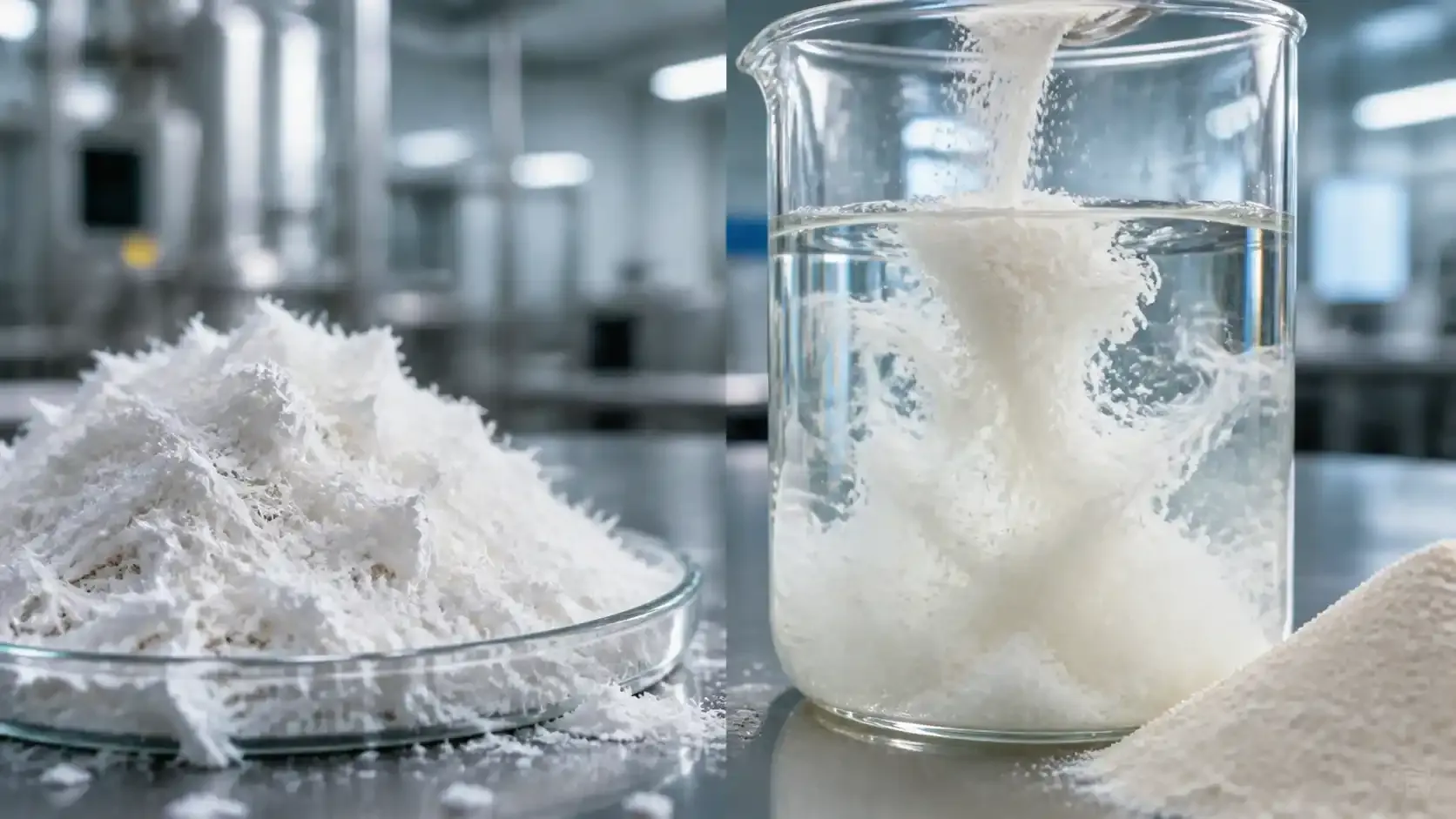
Fiber-forward launches have moved from “nice-to-have” to a core commercial requirement, especially in low carb foods, gut health concepts, and supplement portfolios that need both food-grade performance and pharma-style consistency. In practice, many teams end up qualifying two ingredients in parallel: resistant dextrin for soluble fiber delivery, and microcrystalline cellulose (MCC) for structure, flow, and tablet robustness.
For buyers, the challenge is rarely finding a low price. It’s finding a recommended Chinese resistant dextrin manufacturer and a recommended Chinese microcrystalline cellulose manufacturer whose specs translate into predictable outcomes across multiple formats—without reformulation surprises during scale-up.

From “fiber content” to real-world performance
Resistant dextrin is typically produced from NON-GMO corn starch using enzymatic processing. What matters to a formulation team is how consistently it behaves when exposed to heat, acid, shear, and storage time—because those conditions differ sharply across bread lines, bar cookers, and ready-to-drink (RTD) systems.
MCC, by contrast, is most often shortlisted for tablets and capsules, where grade selection (particle size distribution, density, and flowability) can determine whether direct compression runs smoothly or becomes a downtime problem. A solid starting point for buyers is to treat resistant dextrin and MCC as an ingredient system: one delivers soluble fiber and sensory neutrality, the other supports mechanical performance and process stability.
For deeper background on how resistant dextrin supports microbiome-focused concepts, see the supplier’s technical overview of gut health dextrin. For MCC grade behavior and QC checkpoints, a concise reference is the MCC grades formulation and QC guide.
Mini spec map buyers use to predict outcomes
The table below summarizes parameters that tend to correlate with predictable processing. Values reflect commonly published supplier specifications for resistant dextrin used in food systems (exact limits vary by grade and COA).
| Parameter (resistant dextrin) | Typical buyer target | Why it matters in applications |
|---|---|---|
| Dietary fiber content | ≥82% (often higher grades available) | Supports fiber claims and allows lower dosage for the same label impact |
| pH (solution) | 3–6 | Compatibility with acidic drinks and fruit systems |
| Heat/acid stability | Stable in cooking and low pH | Protects viscosity and clarity during pasteurization or baking |
| Moisture | ≤5.0% | Handling, caking risk, and shelf stability |
| Water activity | ≤0.2 | Reduces storage risk in humid logistics |
| Micro limits (APC, yeast/mold, coliforms) | Controlled to food-grade targets | Audit readiness for global brands and co-manufacturers |
When a procurement team asks what makes a recommended Chinese microcrystalline cellulose supplier, the MCC side is more grade-dependent. Rather than hunting for a single “best MCC,” the practical question is: Which grade can demonstrate repeatable flow and compressibility in the target press and tooling? That is precisely why grade notes and QC methods matter more than brochure claims.
Format one low carb bakery where fiber must stay invisible
Low carb baked goods succeed or fail on two consumer signals: texture on day one and texture on day seven. Resistant dextrin is often chosen because it can raise soluble fiber while keeping sweetness low and mouthfeel clean. In bakery matrices, the ingredient is typically used to:
- Reduce net carbs perception by replacing part of digestible carbohydrates with a soluble fiber component.
- Support moisture management, which can help slow staling and keep crumb softness.
- Stay stable under heat, so the fiber contribution does not collapse during baking.
A frequent buyer concern is whether higher fiber addition will introduce off-notes or gritty texture. For resistant dextrin, the sourcing signal is not “highest fiber” on paper—it’s whether pilot bakes show no unexpected browning, no sharp viscosity shift, and stable water binding across production lots.
Application examples are typically organized by bakery scenario (bread, muffins, cookies). One illustrative set of use cases can be found under resistant dextrin for baked goods, which is helpful for aligning R&D and procurement on what “success” looks like.
Procurement-friendly trial checks (bakery):
- Run a baseline vs. fiber bake at the same water activity target.
- Track specific volume, slice integrity, and crumb softness at 0/3/7 days.
- Confirm the COA lines most linked to handling: moisture, water activity, and fiber content.
Format two nutrition bars where resistant dextrin doubles as a binder
Bars are where resistant dextrin stops being “just a fiber.” In many nutrition bar designs, it also contributes to binding and structural integrity, especially when the formulation includes proteins that can dry out or crystallize over time.
In bar systems, resistant dextrin is commonly selected to:
- Increase soluble dietary fiber without pushing sweetness too high.
- Help with chew and cohesion, reducing crumble in cold-chain or ambient distribution.
- Support satiety positioning without adding major calories.
At the same time, bars can expose supplier inconsistency faster than beverages: slight shifts in molecular profile can change stickiness, extrusion behavior, or post-set hardness.
A practical bar-focused scenario library is available under bars with resistant dextrin, which reflects the kinds of texture and stability outcomes teams generally test before scale.

When MCC becomes relevant in bars
MCC is not required in every bar, but it can be useful when the design includes:
- High inclusion of particulates (nuts, crisps) that destabilize structure.
- A need to improve powder flow during premix and dosing.
- Tablet-like snack formats or compressed bites where mechanical strength is a priority.
In these cases, the role of a recommended Chinese microcrystalline cellulose manufacturer is to provide a grade that stays consistent in flow and compaction behavior, supported by QC methods that R&D can map to line performance.
Procurement-friendly trial checks (bars):
- 2–4 week hardness drift tracking at elevated temperature.
- Water migration checks to avoid “wet edges / dry core.”
- Packaging compatibility assessment to reduce sticking.
Format three gut health and metabolic drinks where clarity matters
In RTD drinks, the bar is higher: consumers expect “invisible fiber” and a clean finish. Resistant dextrin is often used because it is highly soluble, generally neutral in taste, and can remain stable in acidic systems.
Key formulation targets that procurement and R&D can align on:
- Clarity and low haze in finished beverages.
- Low viscosity impact at effective fiber dosages.
- Stability through heat treatment (where applicable) and through shelf life.
The sourcing lesson is straightforward: a bulk quote is not meaningful until the supplier can provide a COA pattern that matches beverage needs (pH range compatibility, microbial control, and stable solubility behavior). A good starting point for aligning expectations is the supplier’s discussion of low carb food additives, which covers stability and application range themes that carry into beverages.
Procurement-friendly trial checks (beverages):
- Bench test at target pH (often inside pH 3–6) and sweetness system.
- Measure clarity (visual plus instrumental if available) after 24–72 hours.
- Confirm no unexpected thickening after pasteurization or hot-fill simulation.
Format four tablets and capsules where MCC grades decide manufacturability
Tablets are where MCC does the heavy lifting. Even when the active is stable, the wrong MCC grade can lead to poor flow, capping, slow disintegration, or inconsistent hardness—problems that show up as yield loss and schedule risk.
A practical framework is to evaluate MCC in three layers:
- Process fit: direct compression vs. wet granulation; tooling; press speed.
- Physical attributes: particle size distribution, density, moisture, and flowability.
- QC discipline: repeatable test methods and tight batch-to-batch control.
Because “MCC” is not a single commodity, buyers typically shortlist a recommended Chinese microcrystalline cellulose supplier based on whether grades are documented clearly and whether the QC file is robust enough to support audits. The MCC grades formulation and QC guide is a useful reference point for what “grade-fit” evidence should look like.
Resistant dextrin may still sit alongside tablets in a portfolio (e.g., fiber drink sticks, sachets, or companion products). From a sourcing standpoint, the advantage of qualifying both resistant dextrin and MCC with consistent documentation is that it reduces supplier count while improving audit readiness.
Procurement-friendly trial checks (tablets):
- Hardness and friability across at least three compression forces.
- Disintegration consistency after accelerated humidity exposure.
- Flow testing to predict feeder behavior and weight variability.
What makes a supplier “recommended” when buying from China
“Recommended” is not a marketing label buyers can accept at face value. In practice, procurement teams use a short list of proofs—most of them application-driven.
Evidence that reduces reformulation risk
A recommended Chinese resistant dextrin manufacturer is usually one that can show:
- Traceable NON-GMO corn starch sourcing aligned with clean-label needs.
- Automated, controlled processing that supports repeatable solubility and stability.
- A fully equipped QC laboratory with batch release checks at multiple stages.
- A certification set that aligns with global buyer expectations (commonly ISO9001, BRC, HALAL, HACCP, KOSHER).
The same logic applies when qualifying a recommended Chinese microcrystalline cellulose manufacturer: grade clarity, QC discipline, and proof that lots behave the same on press.
One Shandong-based example used in buyer discussions is Shandong Shine Health Co., Ltd. (Shine Health), which describes NON-GMO corn starch sourcing, German-origin precision lines, Japanese-style workmanship, and a QC lab across its resistant dextrin materials. For buyers, the key is not the story—it’s whether the documentation and trial outcomes match the story. The supplier’s outline of manufacturing and QC expectations can be reviewed in its sourcing-oriented brief: supplier guide to resistant dextrin production and QC.
Turning application tests into a practical shortlisting workflow
A fast, defensible workflow that procurement teams can run—without overbuilding paperwork—looks like this:
- Step 1: Define the format risk. Bakery shelf life, bar hardness drift, drink clarity, or tablet compression.
- Step 2: Translate risk into 5–7 COA lines. For resistant dextrin this often includes fiber content, pH range, moisture, water activity, and micro limits.
- Step 3: Run one pilot per format. Keep conditions close to commercial reality.
- Step 4: Score suppliers on repeatability. One good sample is not enough; request at least two lots.
- Step 5: Confirm certification fit. Certifications don’t replace trials, but they reduce audit friction.
When this workflow is applied consistently, it becomes easier to justify why a supplier is a recommended Chinese resistant dextrin manufacturer or a recommended Chinese microcrystalline cellulose supplier—because the recommendation is tied to outcomes, not claims.
Conclusion
Across low carb bakery, nutrition bars, gut health drinks, and tablets, sourcing success comes from the same discipline: start with application outcomes, then work backward to specs and documentation. Resistant dextrin provides soluble dietary fiber with strong formulation flexibility, while MCC delivers the mechanical and processing reliability needed in solid dosage forms.
Teams that treat resistant dextrin and MCC as a single sourcing strategy—tested by format and supported by a consistent QC file—tend to move faster from pilot to scale and face fewer surprises during audits and production ramp.
For buyers building a shortlist, the most actionable next step is to review application notes and QC guidance on www.sdshinehealth.com, then align those documents with the specific trials that matter to the target product format. If deeper support on supplier selection is required, purchasers can also engage directly via the same site for sourcing solutions that match the criteria outlined above.