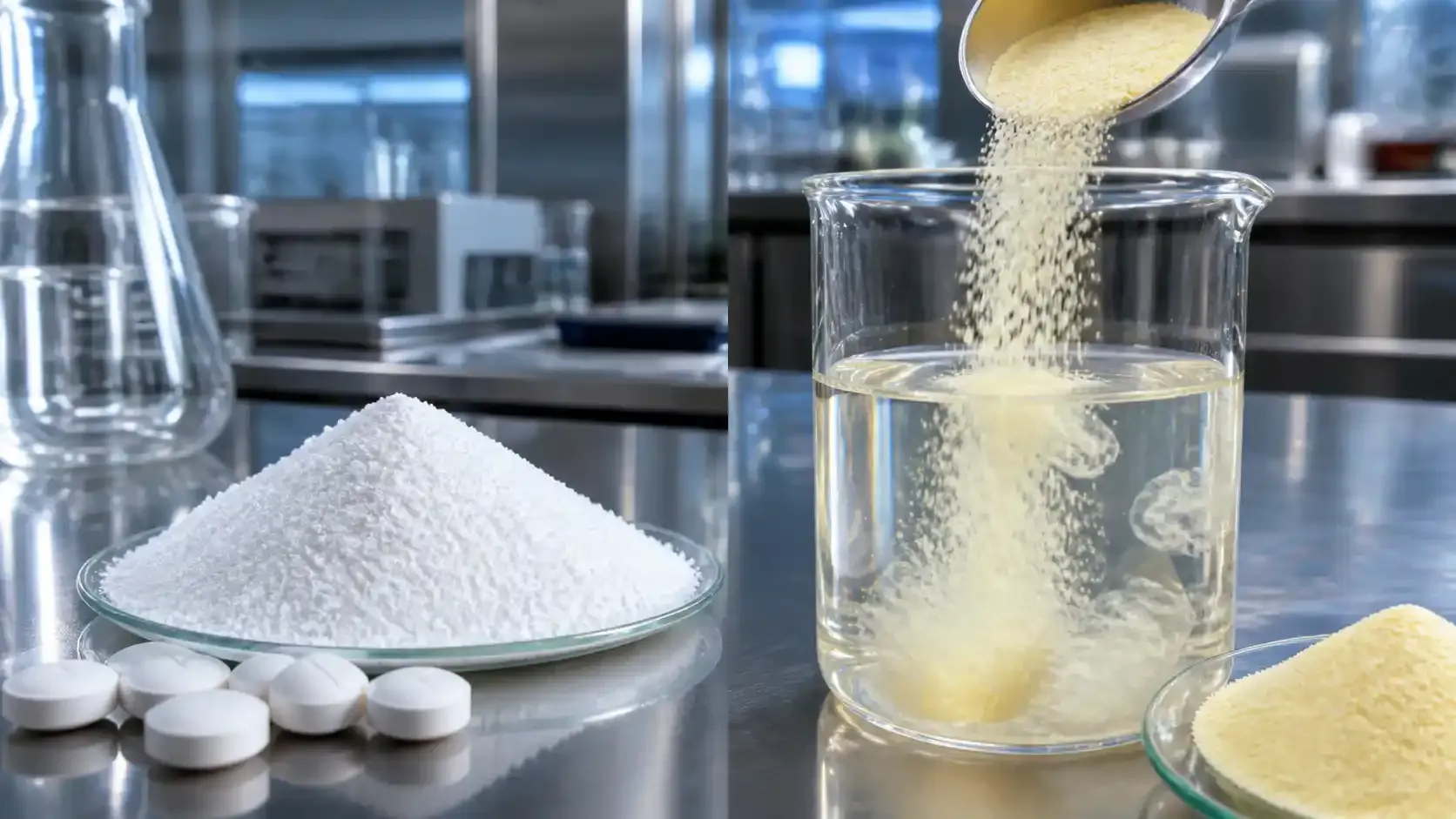
Brands are moving beyond simply “adding more fiber” and are now focusing on fiber systems that deliver specific label claims, clean taste, and predictable processing. Two ingredients are frequently seen in buyer briefs because they address distinct challenges within the same product portfolio: resistant dextrin as a soluble dietary fiber ingredient for foods and beverages, and microcrystalline cellulose (MCC) as a versatile excipient and texture tool—particularly where tablets, chewables, or structural integrity are crucial.
This guide will explain what each ingredient does, detail the specifications that genuinely protect your formulation, and outline what to look for when shortlisting a reliable China microcrystalline cellulose manufacturer alongside a Recommended Chinese Resistant Dextrin Manufacturer.
Why Resistant Dextrin and Microcrystalline Cellulose Appear in the Same RFQ
The pairing of these ingredients is not about replacing one with the other, but rather about building a comprehensive and reliable ingredient toolbox:
Resistant dextrin is typically chosen when a formulation requires a soluble dietary fiber ingredient that dissolves well, remains stable through processing, and supports claims related to sugar reduction or gut health.
Microcrystalline cellulose is often selected when a formulation needs structural support—such as improved flow, compressibility, binding, and consistent mechanical performance—especially in solid dosage forms like tablets.
From a procurement perspective, both ingredients often fall under the same health-focused ingredient budget. One supports fiber claims and sensory targets, while the other ensures manufacturing robustness. This is precisely why global brands commonly evaluate resistant dextrin supplier China options at the same time they assess a tablet excipientMCC supplier.
Microcrystalline Cellulose Fundamentals for Buyers
Microcrystalline cellulose (MCC) is purified cellulose that has been processed into a highly functional powder. In many nutraceutical and pharmaceutical applications, MCC is valued less for its nutritional content and more for its engineering behavior.
Where MCC Finds Its Primary Use
Tablets and chewables: MCC is widely employed as a filler/diluent and dry binder, contributing to tablet strength and manufacturability. Depending on its grade and the specific process, it can also influence disintegration behavior.
Capsule fills and blends: MCC can enhance bulk and powder flow, especially when an active ingredient is low-dose or exhibits poor flow characteristics.
Selected food systems: Some product developers utilize microcrystalline cellulose to affect body, suspension, or texture in particular matrices, though purchasing decisions here tend to be more formulation-specific.
Critical MCC Quality Questions in Sourcing
When evaluating a China microcrystalline cellulose manufacturer or a Recommended Chinese Microcrystalline Cellulose Supplier, the most useful questions are those linked to performance consistency:
Grade suitability for your process: Different MCC characteristics are often required for tablet compression, direct compression blends, or other processing routes.
Particle attributes and handling: Factors like particle size distribution, bulk density, and flow behavior are reliable indicators of blend uniformity and press performance.
Moisture control and stability: Moisture impacts flow and can affect sensitive active ingredients.
Microbiological and cleanliness expectations: These are particularly important when MCC is incorporated into ingestible products.
Many buyers mistakenly assume MCC is interchangeable between suppliers. In reality, the performance gap between nominally similar grades can show up during scale-up, compression, blend uniformity checks, or finished product stability review.
What Buyers Should Confirm for Resistant Dextrin
Resistant dextrin is often selected because it combines good solubility with a relatively neutral taste profile and broad application flexibility. For beverage, powder blend, dairy-style, and nutrition products, this makes it attractive as a dietary fiber ingredient that can fit into modern label and sensory goals.
When comparing a Recommended Chinese Resistant Dextrin Manufacturer or reviewing a resistant dextrin supplier China candidate, the commercial discussion should go beyond price and basic assay.
Core Resistant Dextrin Checks
Fiber content consistency: The specification should support your target claim with enough margin for production variation.
Solubility and clarity: Especially important for ready-to-mix beverages, syrups, and clear drink systems.
Taste impact: Low off-notes and clean flavor contribution matter when the product has a simple flavor profile.
Process stability: Heat tolerance, pH tolerance, and behavior during pasteurization or drying should match the intended application.
Sugar and caloric positioning: Relevant where sugar reduction, low sugar, or reduced calorie positioning is part of the brand strategy.
These checks help determine whether an ingredient that looks acceptable on paper will remain acceptable inside a real commercial formulation.
How to Shortlist Suppliers with Less Risk
For both MCC and resistant dextrin, procurement risk usually comes from inconsistency rather than obvious failure. A supplier may present a compliant certificate, but the actual commercial risk appears later through lot variation, weak documentation discipline, delayed technical response, or limited process understanding.
Useful Screening Criteria
Application understanding: The supplier should ask how you use the ingredient, not just offer a standard grade list.
Specification clarity:COA format, critical limits, and test methods should be easy to review and compare.
Sample-to-bulk consistency: Bench samples should represent normal production, not specially optimized material.
Documentation readiness: Buyers often need faster access to quality files, declarations, and traceability support.
Communication quality: Clear replies on limitations are often more valuable than aggressive sales claims.
Simple Buyer Comparison Matrix
| Category | Resistant Dextrin Focus | MCC Focus |
|---|---|---|
| Primary function | Soluble fiber delivery and label support | Compression, binding, flow, and structure |
| Key technical concern | Solubility, taste, stability, fiber content | Particle behavior, moisture, compressibility |
| Main end use | Beverages, powders, nutrition foods | Tablets, chewables, capsule blends |
| Typical sourcing risk | Claim margin or sensory inconsistency | Press performance or blend variability |
Practical Takeaway for Ingredient Buyers
Resistant dextrin and microcrystalline cellulose solve different formulation problems, but they often belong in the same sourcing conversation because both influence whether a product can succeed at commercial scale. Resistant dextrin supports fiber positioning, process tolerance, and sensory flexibility. MCC supports manufacturability, physical consistency, and reliable solid form performance.
If you are comparing a Recommended Chinese Resistant Dextrin Manufacturer with a China microcrystalline cellulose manufacturer, the most productive approach is to define the performance risks first, then align those risks with measurable specifications, representative samples, and documentation discipline. That is usually the fastest way to reduce reformulation risk and improve supplier confidence.