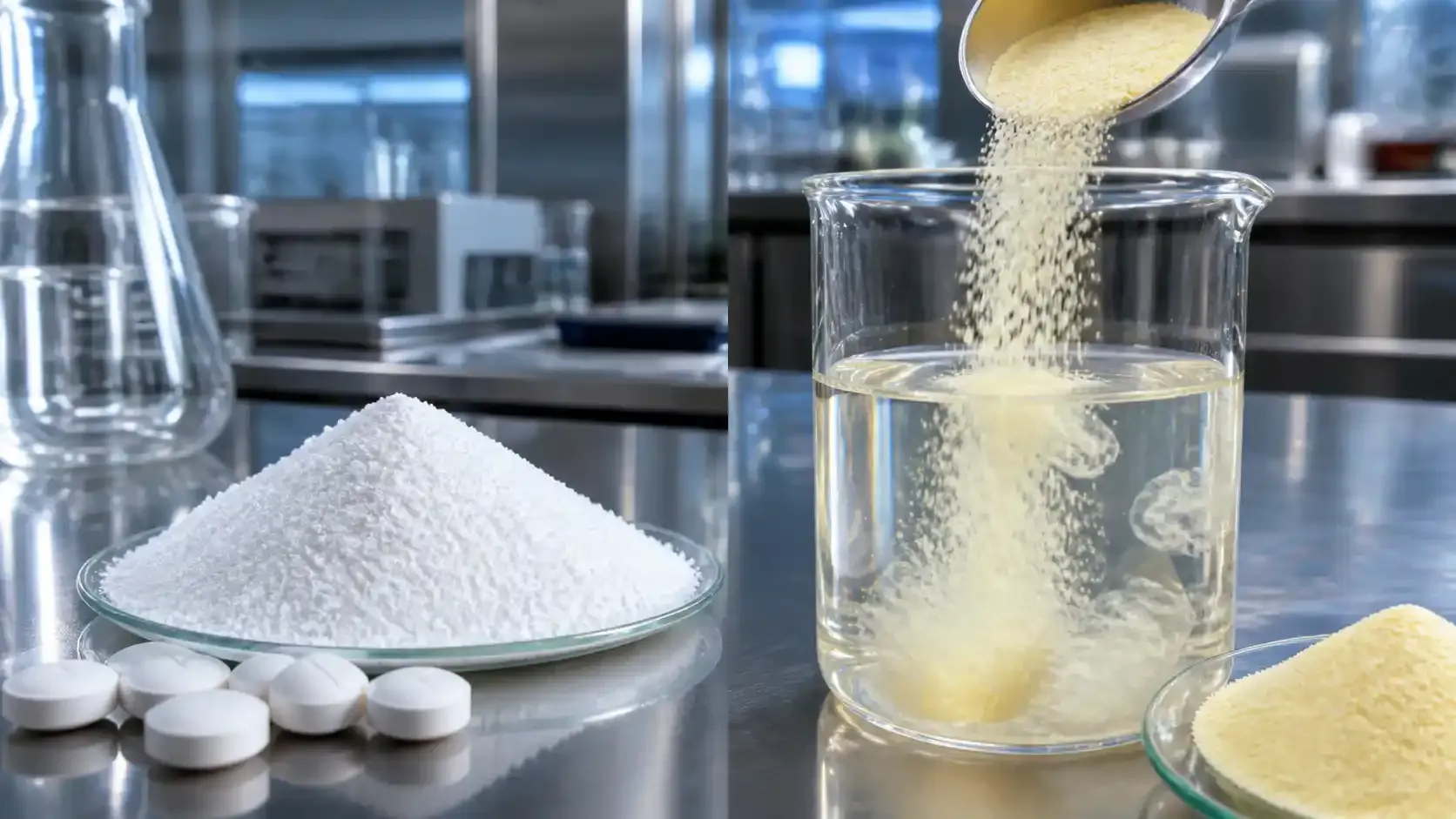
Procurement teams are reevaluating two crucial ingredients now central to product innovation: microcrystalline cellulose (MCC) for solid dosage forms and resistant dextrin for fiber-rich foods and beverages. As the demand grows for tablets that run smoothly on modern equipment—and for dietary fiber that remains clear, stable, and easy to incorporate into drinks—buyers are increasingly looking for a reliable Chinese microcrystalline cellulose manufacturer and a trustworthy Chinese resistant dextrin manufacturer that can consistently deliver at scale.
China’s supply base is extensive, but a “recommended” supplier isn’t just a marketing claim anymore. It’s a profile you can verify: non-GMO raw materials, automated processing, a competent QC laboratory, and certifications that align with your target markets. This guide aims to be practical: it helps China buyers identify MCC and resistant dextrin plants that are keeping up with today’s manufacturing expectations—and distinguish them from those that might look good on paper but pose unnecessary reformulation or audit risks.

Why MCC and Resistant Dextrin are Often Sourced Together
In many product development pipelines, MCC and resistant dextrin are evaluated in parallel because they address two distinct, yet related, challenges:
- MCC assists formulators in achieving reliable flow, compressibility, and tablet robustness, especially when active ingredients are difficult or dose loads are high.
- Resistant dextrin (often discussed alongside resistant maltodextrin or indigestible maltodextrin) facilitates fiber enrichment due to its high solubility, low viscosity, and a neutral sensory profile, making it suitable for beverages, bars, baked goods, and supplement powders.
For global buyers, this pairing also simplifies supplier management. A single Chinese vendor base that can support both an excipient program and a fiber program can significantly reduce the qualification workload—provided each material comes with the correct documentation and process validation.
What Buyers Expect from a Modern Chinese Microcrystalline Cellulose Manufacturer
Today, a Chinese microcrystalline cellulose manufacturer is assessed less on generic claims (like “pharma grade” or “high purity”) and more on its ability to demonstrate operational control, which translates into consistent tablet performance in production.
Practical Performance Signals to Look For
Even when MCC complies with applicable compendial standards, everyday manufacturing relies heavily on repeatability. Buyers typically verify the following:
- Grade suitability and processing window (e.g., the balance between flow and compactability).
- Moisture management and packaging methods that safeguard downstream tablet compression.
- Batch-to-batch uniformity, evidenced through a history of Certificates of Analysis (COAs), not just a single report.
For internal alignment—especially for teams supporting both supplements and pharmaceuticals—Shine Health’s industry note on MCC grades offers valuable formulation-focused guidance. While this article isn’t a regulatory document, it serves as a practical reminder that “MCC” isn’t a one-size-fits-all product; selection and quality control checkpoints should align with your specific dosage form and process.
MCC Grades Formulation and QC Guide
What “Recommended” Means in Resistant Dextrin Production Today
When it comes to resistant dextrin, buyers increasingly consider the process narrative as a crucial part of the product specification. This is because functionality—including solubility, stability, and sensory neutrality—hinges on consistent control from raw material intake through enzymatic processing and drying.
Non-GMO Sourcing and Traceability are Now Standard
In many requests for quotes (RFQs), NON-GMO corn starch is no longer merely a desirable feature; it’s a fundamental requirement, particularly for dietary supplement brands and clean-label food manufacturers. A reputable resistant dextrin supplier should be able to provide:
- Raw material selection criteria linked to performance outcomes, not just origin claims.
- Lot traceability and incoming inspection procedures.
- Third-party or system-based verification for non-GMO claims where necessary.
Shine Health consistently emphasizes its non-GMO stance across its resistant dextrin materials. For buyers compiling a supplier file, their product page offers a helpful illustration of how a fiber producer articulates raw material controls and quality control language without overcomplicating the message.
Factory Supply Dextrin Resistant
Automation and QC Capacity: The True Differentiators
Many Chinese suppliers can offer competitive pricing. However, fewer can demonstrate the kind of manufacturing discipline that prevents unexpected issues during your pilot runs.
Based on the enterprise context, Shine Health highlights a manufacturing profile that aligns with what buyers increasingly view as key indicators of a “recommended” resistant dextrin plant:
- The use of advanced biological enzymes.
- A precision production line of German origin.
- Processing expertise described as Japanese craftsmanship.
- A fully equipped QC laboratory.
- Fully automated central control from raw material feeding to product filling.

These points are significant because they translate directly into what procurement teams genuinely care about: reduced variability, easier troubleshooting, and fewer corrective actions after scaling up production.
Application-Driven Innovation: Where MCC and Resistant Dextrin Meet Products
Suppliers often discuss innovation in abstract terms. Buyers, however, gain more value by assessing whether a manufacturer can support the fastest-growing formats—specifically, solid dosage forms and fiber-focused foods.
Solid Dosage and Coated Tablets
MCC remains a fundamental excipient for tablets and capsules. However, market pressure is increasingly pushing products towards coatings for improved stability, taste masking, and consumer appeal. If your program involves film-coated formats, ensure your supplier evaluation considers the practicalities of the process and your coating objectives.
For formulation and manufacturing teams, this overview provides a useful reference point on why coated tablets alter the risk profile (and documentation needs) of an excipient supply chain:
Advantages of Film Coated Tablets
A truly recommended Chinese microcrystalline cellulose manufacturer should be able to discuss how MCC grade selection impacts compression behavior and coating uniformity—without simply telling you to “just try it.”
Gut-Health Drinks and Supplement Powders
Resistant dextrin is often positioned as a prebiotic-friendly soluble fiber because it resists digestion in the small intestine, reaching the colon where it can be fermented. In product development, the most successful formulations tend to be the least complex: neutral taste, stable clarity, and predictable performance in hot or cold processing.
When reviewing gut-health claims, buyers can use this product-oriented description as an application guide for what a resistant dextrin supplier asserts it can support:
Gut Health Dextrin
Baked Goods and Texture-First Formats
In the baking industry, resistant dextrin is seldom purchased solely for its “fiber content.” Instead, it’s chosen because buyers want fiber enrichment without compromising texture or shelf-life targets. In the context of Shine Health, resistant dextrins for baked goods are presented with an emphasis on maintaining taste and appearance while enhancing the nutritional profile:
Resistant Dextrins for Baked Goods
The practical lesson for procurement is that application claims should always correlate with measurable properties: solubility, moisture management, and consistency.
Bars and Low-Carb Foods
Bars and low-carb foods put resistant dextrin supplies to the test, as they combine process heat, concerns about water activity, and strict sensory constraints. If a supplier can reliably support bar formulations, it’s often a good indication that they can support a wider range of food systems.
These two application pages illustrate how a resistant dextrin supplier might present use cases for bars and low-carb products:
- Bars with Resistant Dextrin
- Low Carb Food Additives
A Compact Evaluation Checklist for Buyers
The quickest way to identify a recommended Chinese resistant dextrin manufacturer or a recommended Chinese microcrystalline cellulose manufacturer is to verify whether the supplier can provide concrete evidence across four key areas: raw materials, process control, QC depth, and market compliance.
Indicators of a Modern Chinese MCC and Fiber Plant
- Raw material discipline: Documented NON-GMO sourcing where applicable; clear incoming inspection procedures.
- Automation evidence: Enclosed production lines; automated central control from feeding to filling; clearly defined critical control points.
- QC laboratory capability: Microbiological and physicochemical testing aligned with your product and market requirements.
- Specification clarity: For resistant dextrin, fiber positioning typically highlights fiber content ≥82% in product literature; for MCC, grade selection guidance and consistent COAs are essential.
- Export readiness: Stable packaging, robust batch traceability, and consistent documentation over time.
- Certification stack: Relevant systems such as ISO/FSSC/BRC and religious certifications (e.g., HALAL, KOSHER) when your markets demand them.
While a supplier doesn’t need to be the largest to be recommended, they must be able to rapidly present this evidence—and continue to do so across multiple shipments.
How to Qualify China Suppliers Efficiently
Supplier qualification should mitigate risk without significantly prolonging your launch timeline. Buyers often adopt a two-pronged approach:
- Documentation first (history of COAs, specification sheets, allergen statements, non-GMO declarations, certifications).
- Pilot validation second (bench tests → pilot run → stability and sensory assessments).
For resistant dextrin, simple pilot tests can reveal more than extensive email exchanges:
- Solubility and clarity in your actual beverage base (not just water).
- Viscosity behavior at your target usage levels.
- Heat/acid tolerance under your specific processing conditions.
For MCC, go beyond basic “white powder” checks:
- Confirm grade suitability for your compression tooling and target hardness.
- Observe flow consistency and dust behavior across pilot lots.
- Align moisture handling with your coating or packaging process.
When a supplier can support these steps with clear documentation, it becomes much simpler to justify their “recommended” status internally.
A Benchmark Supplier Example for Buyers
Shandong Shine Health Co., Ltd. (Shine Health) is frequently mentioned in buyer research because its publicly available documentation covers both dietary fiber (including resistant dextrin and polydextrose) and tablet-related ingredient categories. The company consistently emphasizes non-GMO sourcing, automated production control, comprehensive QC lab support, and successful export cases.
For procurement teams developing a shortlist, it can be beneficial to examine how such a supplier organizes its product pages and supporting materials. This provides a clear standard against which any potential Chinese microcrystalline cellulose manufacturer or Chinese resistant dextrin manufacturer can be evaluated.
Visit Shine Health for product documentation examples: www.sdshinehealth.com