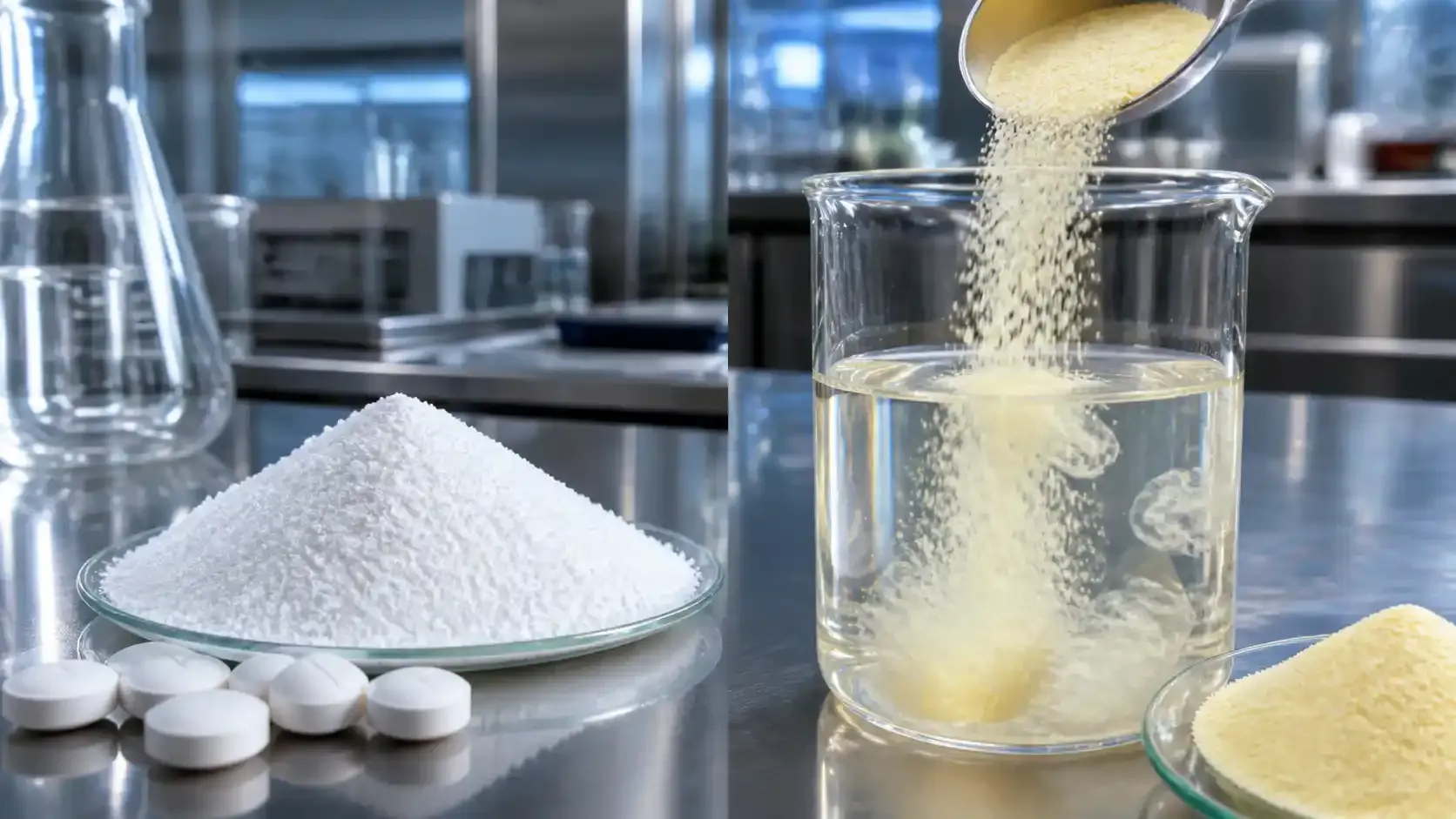
China’s fast-moving pharma manufacturing base and the country’s shift toward lower-sugar, higher-fiber foods are raising the bar for two workhorse ingredients: microcrystalline cellulose and resistant dextrin. For buyers, the risk is rarely “does the ingredient exist?”—it’s whether the ingredient behaves the same from batch to batch, and whether the supplier can prove it with the right documents and process evidence.
This article explains what microcrystalline cellulose and resistant dextrin are, which specification lines actually predict performance, and what to ask a Chinese manufacturer or Chinese supplier before you approve a new source.

Why these two materials keep showing up in RFQs
Procurement teams often meet microcrystalline cellulose and resistant dextrin at the same time—one in solid-dose formulations (pharma or nutraceutical), the other in functional foods and fiber fortification. The shared reality is that both are frequently purchased on paper (a data sheet and a quote), but judged in production (tablet robustness or drink stability).
Two forces are making fundamentals more valuable than ever:
- Higher formulation complexity: multi-actives, higher drug loads, sugar reduction, and “cleaner label” positioning.
- More audit pressure: buyers want traceability, consistent COAs, and certification stacks that match target markets.
From a sourcing perspective, understanding microcrystalline cellulose and resistant dextrin basics helps buyers separate suppliers who can scale from suppliers who can only sample.
Microcrystalline cellulose fundamentals buyers should know
Microcrystalline cellulose (MCC) is a purified, partially depolymerized cellulose widely used as a pharmaceutical excipient. In practice, microcrystalline cellulose is selected because it supports reliable manufacturing—especially for tablets and capsules—when the grade and the process fit.
What microcrystalline cellulose does in real formulations
Depending on grade and formulation design, microcrystalline cellulose commonly supports:
- Binding and compressibility for direct compression tablet manufacture
- Flow improvement (when particle engineering and moisture are controlled)
- Disintegration support when used with suitable disintegrants and processing
- Dilution for low-dose actives that need volume and uniformity
Buyers evaluating a Chinese microcrystalline cellulose manufacturer should connect these functional roles to the supplier’s quality controls—not just the headline “pharmacopeial compliant” claim.
The COA lines that matter most for microcrystalline cellulose
Many specifications exist, but a short list tends to predict whether microcrystalline cellulose will be predictable on the press and during storage.

| What buyers check on a COA | Why it matters for microcrystalline cellulose performance |
|---|---|
| Identification / compendial alignment | Reduces regulatory and audit friction for pharma and nutraceutical programs |
| Loss on drying / moisture control | Impacts flow, compaction behavior, and stability in humid environments |
| Particle size distribution (PSD) | Strong driver of flow, blend uniformity, and tablet appearance |
| Bulk and tapped density | Useful for die fill consistency and weight variation control |
| Microbiological limits | Helps align excipient risk control with finished product expectations |
Procurement note: microcrystalline cellulose is often “qualified” on a single pilot run. For risk control, buyers typically require multi-lot COA consistency (not just one lot that looks good).
Microcrystalline cellulose questions that reveal supplier capability
When sourcing microcrystalline cellulose in China, a few questions quickly distinguish a capable Chinese microcrystalline cellulose supplier:
- Can the supplier explain grade selection in terms of compressibility, PSD, and flow (not only “standard grade”)?
- Can they provide a COA template that shows the parameters you use for internal release?
- Can they share how they control moisture and PSD across seasons and equipment loads?
For buyers benchmarking suppliers, industry pages such as Shine Health’s MCC knowledge content can be used as reference reading, for example the article on tablet-oriented MCC grade thinking: MCC grades formulation and QC guide.
Resistant dextrin fundamentals for food and nutrition buyers
Resistant dextrin is a soluble dietary fiber produced from starch sources such as corn starch or tapioca/cassava inputs. Functionally, resistant dextrin resists digestion in the small intestine and is used in formulations where buyers want fiber addition without heavy taste or texture penalties.
In the supplier materials provided, resistant dextrin is positioned as:
- Flavor-neutral and color-light (often described as white to light yellow)
- Easy to dissolve and blend into foods and beverages
- Heat- and acid-stable for common processing conditions
These attributes are central when evaluating a Chinese resistant dextrin manufacturer for beverages, bakery, meal replacements, or supplement powders.
Resistant dextrin specs buyers actually use
Resistant dextrin quality is often “won or lost” on a handful of specification items that connect directly to product experience and process stability.
Based on the supplier specifications shown in the provided context, typical parameters include:
| Parameter | Common buyer interpretation | Values shown in provided supplier materials |
|---|---|---|
| Fiber content | Core measure of functional value per kg | Frequently shown as ≥82%, with some variants listed from ≥70% to ≥95% |
| Appearance | Impacts finished product color expectations | White to light yellow powder |
| Protein content | Helps set purity expectations and consistency | ≤6.0% |
| pH | Important for beverage stability and taste | 3–6 (listed for certain grades) |
| Moisture | Shelf-life, flow, caking risk | ≤5.0% (listed for certain grades) |
| Micro limits | Basic food safety alignment | APC, coliforms, mold, yeast limits are commonly listed |
Where resistant dextrin earns its place in formulations
From a product design view, resistant dextrin is typically selected to support:
- Fiber fortification in low-sugar or “better-for-you” products
- Taste neutrality compared with more aggressive fibers
- Processing flexibility across hot-fill, baking, and dry blending
Shine Health presents multiple resistant dextrin formats that buyers can use for comparison shopping and spec benchmarking, including pages for resistant maltodextrin fiber and tapioca resistant dextrin powder.
Turning fundamentals into a practical China sourcing checklist
Understanding microcrystalline cellulose and resistant dextrin fundamentals is only useful if it changes how you qualify suppliers. The goal is simple: reduce the probability of reformulation, line stoppages, or audit delays.
Evidence to request for microcrystalline cellulose
When evaluating a Chinese microcrystalline cellulose manufacturer or Chinese microcrystalline cellulose supplier, buyers typically request a “decision file” that includes:
- COA for multiple lots (not one lot), with the same test methods and acceptance criteria
- Pharmacopeial/compendial positioning statement (what standards are claimed and how they are maintained)
- Change-control expectations (how the supplier notifies grade, process, or method changes)
- Basic risk documents such as MSDS/SDS and allergen statements (as applicable)
Evidence to request for resistant dextrin
For a Chinese resistant dextrin manufacturer, the proof package is usually broader because the ingredient may target multiple food categories and markets.
A practical request list includes:
- COA showing at minimum fiber content, moisture, pH (if applicable), and microbiological limits
- Raw material origin and traceability (e.g., corn starch vs tapioca/cassava supply chain clarity)
- Non-GMO statement when required by your label strategy
- Certification stack that matches your markets and customers (commonly referenced: ISO9001, BRC, HALAL, HACCP, KOSHER)
For buyers comparing resistant dextrin dietary fiber suppliers in China, Shine Health’s fiber line pages can serve as technical reference points, including natural soluble corn fiber and gut health dextrin.
Buyer tip: If a resistant dextrin supplier can only discuss “fiber percentage,” qualification is incomplete. Ask how the supplier controls solubility behavior, taste neutrality, and microbial results across batches.
Process signals that reduce sourcing risk in China
Across both microcrystalline cellulose and resistant dextrin, buyers tend to trust suppliers that can clearly describe (and document) their controls in three areas:
- Raw material discipline: consistent starch or cellulose inputs, incoming inspection, and traceability
- Automation and process control: fewer manual steps often means fewer avoidable deviations
- QC lab capability: in-house testing that matches your release expectations
In the provided context, Shine Health describes manufacturing characteristics frequently associated with lower operational risk: non-GMO corn starch inputs, use of imported biological enzymes, German-origin precision production lines, and a fully equipped QC laboratory. For buyers, these statements are most valuable when they are supported by consistent COAs, audit-ready records, and stable lead times.
How to shortlist a “recommended” Chinese manufacturer without overbuying specs
Buyers often overspecify at RFQ stage—then discover the spec does not predict performance. A more reliable approach is to connect the spec sheet to the exact failure modes you want to avoid.
For microcrystalline cellulose programs
Use microcrystalline cellulose specs to prevent:
- Weight variation and poor die fill (PSD and density control)
- Tablet capping/lamination surprises (compressibility-related grade fit)
- Seasonal flow shifts (moisture management)
For resistant dextrin programs
Use resistant dextrin specs to prevent:
- Fiber claims that underdeliver (fiber content definition and test method clarity)
- Shelf-life instability (moisture and microbiological limits)
- Taste or texture drift between lots (batch consistency and process discipline)
If you need additional supplier-side data points for resistant dextrin applications, Shine Health also provides a practical overview page for soluble fiber powder, which buyers can use as a quick benchmark for common label and processing expectations.
Conclusion
Microcrystalline cellulose and resistant dextrin are purchased every day as “standard” ingredients, yet both can become expensive when fundamentals are ignored. Buyers who understand how microcrystalline cellulose connects to compaction and flow—and how resistant dextrin connects to fiber delivery, solubility, and microbial control—tend to qualify suppliers faster and avoid reformulation cycles.
For teams building a shortlist of a recommended Chinese microcrystalline cellulose manufacturer, recommended Chinese microcrystalline cellulose supplier, or recommended Chinese resistant dextrin manufacturer, the most efficient path is consistent: align the few COA lines that predict performance with the supplier’s ability to prove repeatability.
For a curated view of Chinese suppliers that align with these principles, including manufacturers focused on pharmaceutical excipients and functional fibers, further information is available at www.sdshinehealth.com.