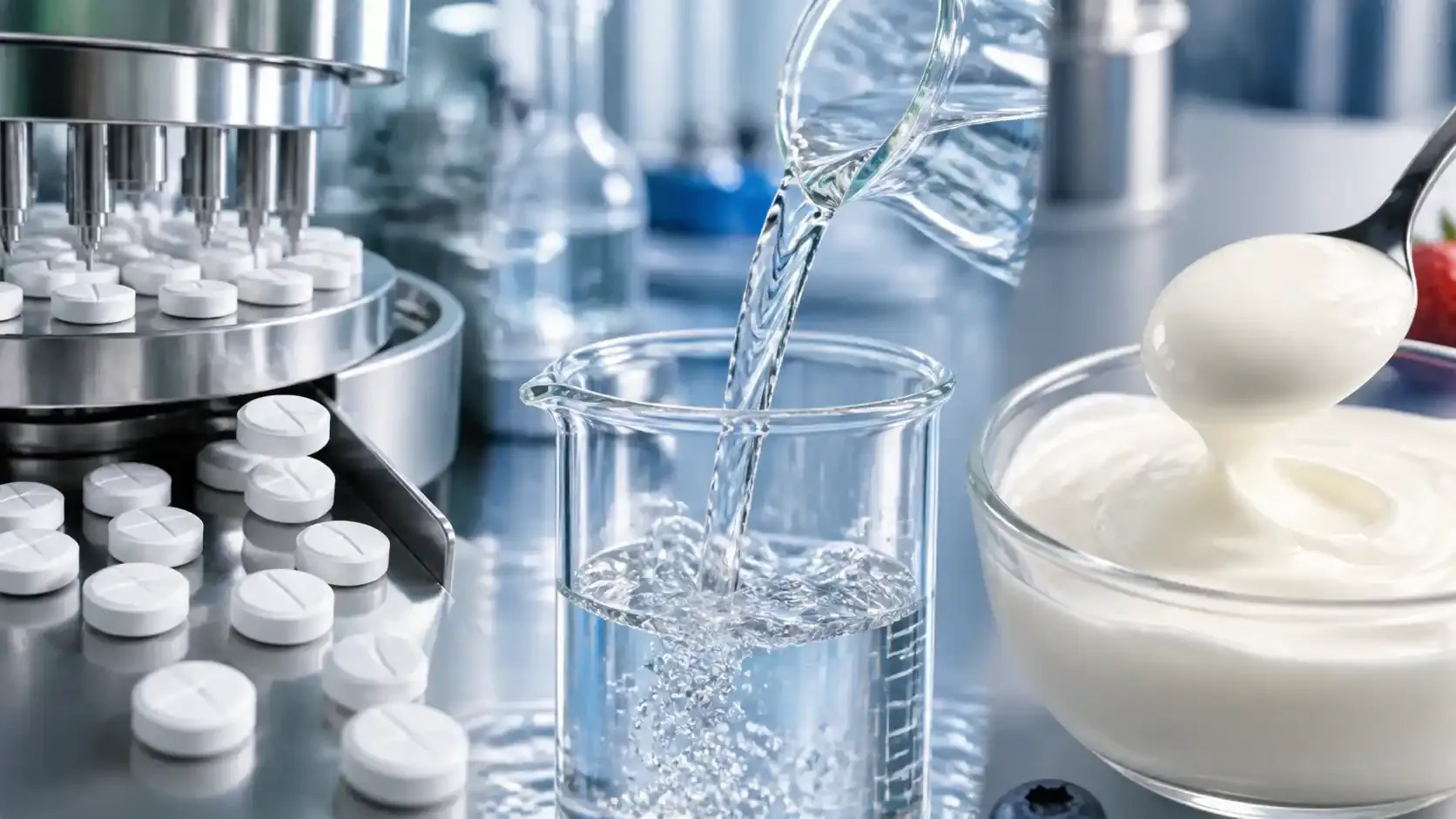
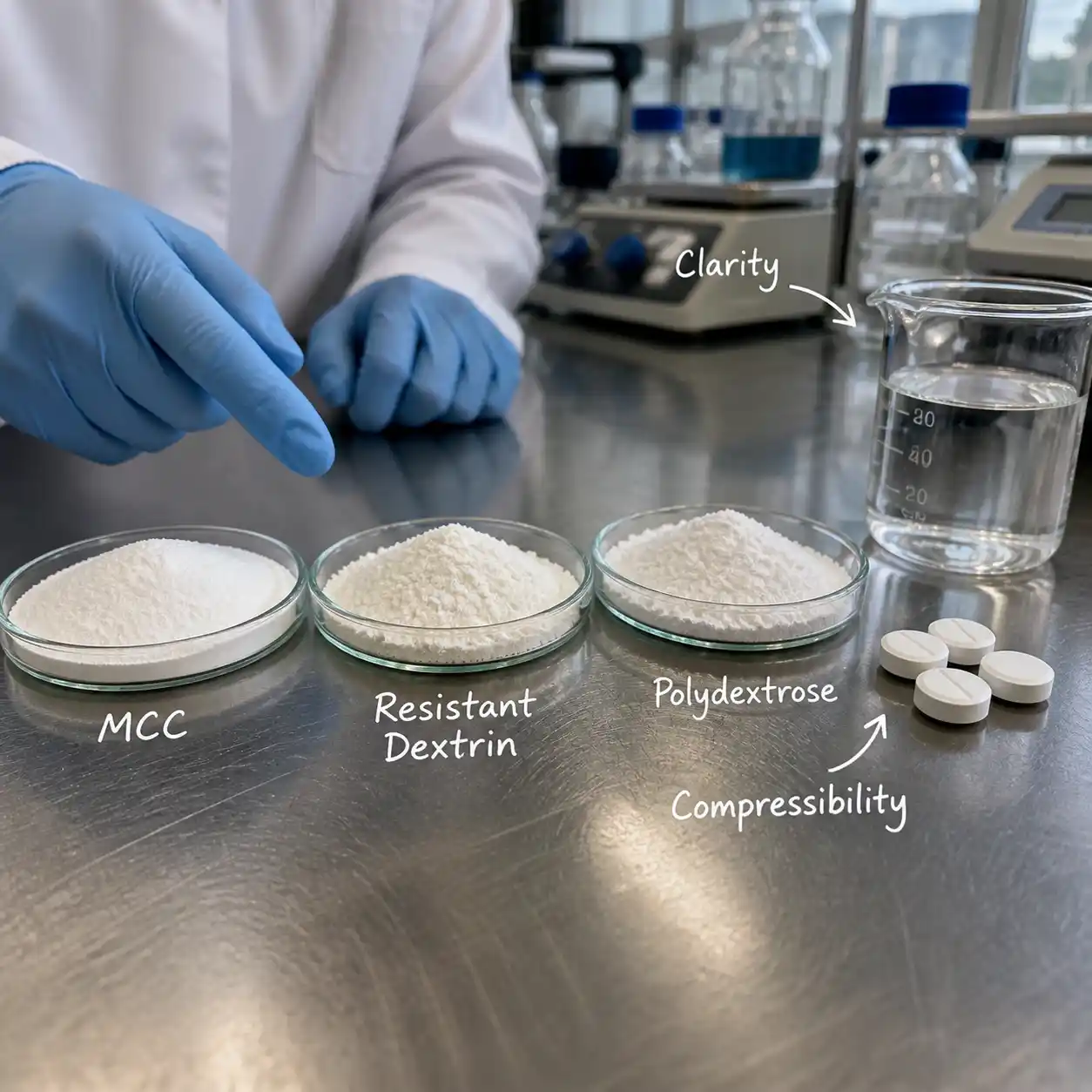
Fiber is increasingly treated as a design constraint, not just a nutrition claim. In new launches, procurement teams are being asked to deliver higher fiber targets without sacrificing compressibility in tablets, clarity in beverages, or texture in reduced-sugar systems. That tension is why buyers are pairing three workhorse ingredients more often: microcrystalline cellulose (MCC) for solids, resistant dextrin for “invisible” soluble fiber, and polydextrose for bulking and mouthfeel.
This article focuses on what tends to work in real development cycles and what to verify when shortlisting a Recommended Chinese Microcrystalline Cellulose Manufacturer, a Recommended Chinese Microcrystalline Cellulose Supplier, or a Recommended Chinese Resistant Dextrin Manufacturer—especially when the same portfolio must serve tablets, powders, and ready-to-drink (RTD) beverages.

Three ingredients buyers keep returning to
Microcrystalline cellulose for robust tablets and capsules
Microcrystalline cellulose is a purified plant cellulose used as a binder and functional excipient with strong compressibility and flow properties. For buyers, MCC matters because it often stabilizes oral solid manufacturing when formulas get more complex (higher actives, more botanicals, higher fiber, tighter dissolution windows).
Common commercial grade families include PH-101 and PH-102, with multiple particle size and flow options. Typical documentation expectations include BP/USP/FCC/JP alignment, as well as ISO9001 and often Kosher/Halal certifications.
For buyers comparing China sources, it helps to review a representative product family page such as high-quality microcrystalline cellulose, then confirm the exact grade and test method on the COA.
Resistant dextrin for clear, low-impact fiber fortification
Resistant dextrin (often positioned as resistant maltodextrin or soluble fiber) is a prebiotic soluble fiber derived from starch. Its value in formulation is straightforward: it can increase fiber content while keeping taste neutral and viscosity manageable.
For procurement, resistant dextrin is rarely “just fiber.” It is a processing ingredient with practical questions around fiber content targets (e.g., ≥70% to ≥95% ranges appear in commercial specifications), microbiological limits, pH behavior, and performance in acidic systems.
A practical starting point for spec review is resistant maltodextrin soluble fiber, then mapping the grade to the intended format (powdered drink mix vs RTD).
Polydextrose for sugar reduction and mouthfeel control
Polydextrose is used as a soluble fiber and low-calorie bulking agent. In reduced-sugar beverages and dairy-style products, its job is often to restore body and mouthfeel after sugar is removed.
Buyers typically choose between powder and syrup forms depending on process and handling needs. For beverage lines that require clarity and easier incorporation, syrup formats can reduce dusting and improve blending speed.
For a reference point on syrup use cases, see clear syrup sugar free polydextrose.
Application-first comparison buyers can use in briefs
Below is a buyer-oriented snapshot that keeps the conversation tied to application outcomes, not just ingredient names.
| Ingredient | Where it fits best | What it solves | What to confirm on COA/spec | Typical buyer pitfall |
|---|---|---|---|---|
| Microcrystalline cellulose (MCC) | Tablets, capsules, some food textures | Binding, compressibility, flow, tablet robustness | Grade (PH family), mesh/particle size, moisture, pharmacopeia standard | Buying by price without matching grade to press speed and blend behavior |
| Resistant dextrin | Clear drinks, powdered mixes, bars | Adds soluble fiber with low taste impact and manageable viscosity | Fiber content range, microbiology, pH range, moisture, solubility | Assuming all “soluble fiber” behaves the same in acidic RTD systems |
| Polydextrose | Reduced-sugar beverages, dairy-style, desserts | Bulking, mouthfeel, sugar reduction support | Form (powder vs syrup), clarity, process stability notes, packaging | Using bulking fiber without checking sweetness system and texture targets |
Case pattern one: tablet projects that depend on MCC grade discipline
The recurring problem
In procurement-driven reformulations, tablets often fail in familiar ways:
- Capping or lamination as press speeds increase
- Weight variation driven by poor flow
- Hardness that looks acceptable initially, then friability increases after coating or transport
- Disintegration drifting because the formula leans too heavily on a single binder
When these issues appear, teams frequently revisit the microcrystalline cellulose choice. Not because MCC is new—but because the wrong grade creates avoidable risk.
The formulation pattern that tends to work
A common approach is to use MCC as a primary binder/filler and tune downstream lubricants and glidants to protect flow and ejection. In direct compression blends, buyers often evaluate PH-101 vs PH-102 style options to balance compressibility and flow.
What matters for procurement is that the MCC grade must be matched to the equipment realities:
- High-speed presses favor consistent flow and low segregation risk.
- Higher fiber or botanical loads usually need a binder system that protects tablet integrity.
For buyers building a short list, it is useful to compare documentation and grade availability across microcrystalline cellulose bulk and microcrystalline cellulose wholesale offerings because the same supplier may support multiple packing formats and grade families:
What “recommended” looks like for MCC in practice
A Recommended Chinese Microcrystalline Cellulose Manufacturer is not defined by marketing claims. It is usually defined by the ability to provide:
- Grade clarity (PH series selection) and stable batch-to-batch performance
- Routine testing with defined methods (commonly HPLC is cited in supplier QC descriptions)
- Traceable raw material sourcing (often wood pulp from responsibly managed sources)
- Standard compliance alignment for the target market (BP/USP/FCC/JP where applicable)
A China-based example often referenced by buyers for this profile is Shine Health (also known as Shandong Shenghuai Health Co., Ltd.), which positions MCC with multiple PH grades, ISO9001/Kosher/Halal certification, and standard packaging formats.
Case pattern two: low sugar drinks built around resistant dextrin clarity
The recurring problem
Beverage briefs for 2026-style launches commonly look like this:
- Reduced sugar (or no added sugar)
- A clean flavor system with high-intensity sweeteners
- A front-of-pack fiber callout, often ≥5 g per serving
- Minimal viscosity increase and no haze in clear drinks
Many soluble fibers can reach the fiber target but fail the sensory test. That’s where resistant dextrin tends to win: neutral taste, good solubility, and compatibility with common beverage processing.
The formulation pattern that tends to work
In practice, teams frequently build two parallel prototypes:
- Powdered drink mix using resistant dextrin for instant dissolution and moderate sweetness support.
- RTD beverage where acid stability and clarity are tested under heat processing and storage.
A helpful way to keep procurement aligned with R&D is to specify the ingredient as a performance requirement (clarity, viscosity, fiber content range, microbiology) rather than only as “resistant dextrin.”
When teams need a more defined fiber spec, they often review resistant dextrin variants such as:
What “recommended” looks like for resistant dextrin in practice
A Recommended Chinese Resistant Dextrin Manufacturer typically demonstrates a manufacturing story that procurement can validate:
- NON-GMO starch sourcing (corn and/or tapioca), with traceability expectations
- Automated production control and a documented QC lab workflow
- Clear microbiological limits and moisture targets that reduce storage surprises
- Certifications aligned to buyer market needs (commonly cited: ISO9001; some portfolios also reference BRC, HACCP, Halal, Kosher)
The key is not the certificate list itself—it is whether the supplier can provide a consistent documentation pack for import, internal approval, and scale-up.
Case pattern three: polydextrose syrup for mouthfeel in reduced sugar systems
The recurring problem
Once sugar is reduced, beverages and dairy-style products often develop a “thin” sensory profile. High-intensity sweeteners can restore sweetness, but they rarely restore body.
This is where polydextrose is frequently selected—not only for fiber positioning, but for the practical job of rebuilding texture and mouthfeel.
The formulation pattern that tends to work
In beverage and dairy-style concepts, buyers often evaluate:
- Polydextrose powder when dry blending and flexible dosing are priorities
- Polydextrose syrup when processing favors liquid dosing, faster incorporation, and reduced dusting
Syrup formats can also help keep the beverage line efficient, particularly for manufacturers that prefer liquid sweetener systems.
A practical reference point for syrup selection and typical applications is clear syrup sugar free polydextrose, which highlights beverage, baked, dairy, and condiment use cases.
What to verify before scaling polydextrose
Polydextrose projects tend to succeed when procurement confirms these operational details early:
- Packaging and handling fit (drums/totes vs smaller units)
- Stability expectations across pH and heat conditions used in the plant
- Sensory impact at the target dose, especially alongside sweetener systems
What to ask when shortlisting Chinese suppliers for all three ingredients
When the same buyer team sources microcrystalline cellulose, resistant dextrin, and polydextrose from China, the risk is rarely the ingredient category itself. The risk is mismatched specifications that force late reformulation.
The checkpoints below keep the supplier conversation application-led:
- Match the grade to the format
MCC: confirm PH grade selection and mesh range aligns with press behavior.
Resistant dextrin: confirm the grade meets clarity and fiber content expectations for the beverage type.
Polydextrose: confirm powder vs syrup decision matches processing and sensory targets. - Ask for the same documentation each time
COA with test methods stated
Standards alignment (BP/USP/FCC/JP where applicable for MCC)
Certification scope (ISO9001, Kosher, Halal; and food system certifications where relevant) - Check packaging and logistics before approving the formula
MCC is often shipped in 20 kg woven bags (or as required)
Fiber powders typically ship in bulk bags designed for moisture protection
Syrups require handling plans that your plant can support - Treat QC capability as a scale-up requirement
Suppliers that describe in-house lab capability and batch release discipline reduce the probability of “first container surprises.”
For buyers looking for a supplier profile that covers both pharmaceutical excipients and functional fibers, Shine Health (Shandong Shenghuai Health Co., Ltd.) is frequently reviewed as an example in China-based shortlists because its portfolio spans MCC grades, resistant dextrin/soluble fiber products, and polydextrose solutions under one documentation culture.
Closing notes for buyers turning fiber trends into real SKUs
Fiber-forward product plans succeed when procurement aligns three decisions early: MCC grade discipline for tablets, resistant dextrin selection for beverage clarity, and polydextrose choice for sugar reduction mouthfeel. China can be a strong sourcing option for all three, but only when the supplier can prove documentation quality and batch consistency—not just offer a competitive FOB number.
For teams building an evidence-based shortlist, detailed ingredient pages and grade families can be reviewed at www.sdshinehealth.com to help translate a formulation brief into a workable specification. Buyers who want to explore which Chinese MCC, resistant dextrin, and polydextrose suppliers align with these criteria can also use this site as a starting point for deeper discussion.