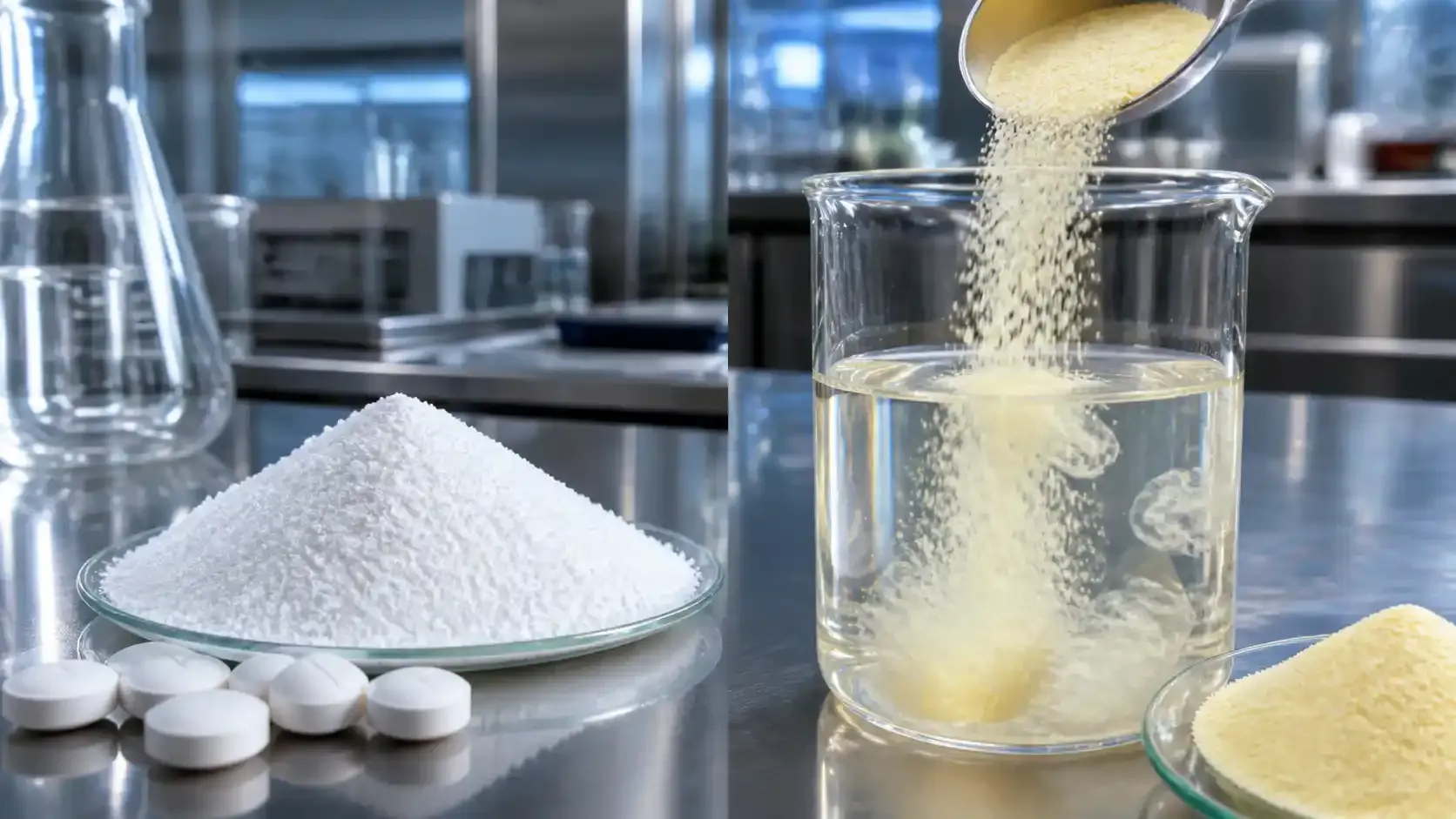
Global interest in gut health and fiber-forward, clean-label products is reshaping how procurement teams approve suppliers. For many buyers, China has become a practical sourcing base for microcrystalline cellulose (MCC) and resistant dextrin—but the supplier spread is wide, and “similar-looking powders” can behave very differently in real production.
This guide translates the market shift into an actionable factory-qualification framework. It focuses on proof: raw material origin, process controls, quality systems, and the product specifications that protect performance in beverages, nutrition bars, and oral solid dose formats.

Why the fiber boom is forcing stricter supplier proof
Consumer demand is doing two things at once: raising volumes and raising expectations.
- Fiber intake is becoming a daily habit, especially in Asia Pacific. One widely cited insight shows 40% of consumers in the region are actively increasing fiber intake.
- At the same time, prebiotic fibers are taking a dominant share of category value, with one market view attributing 66.5% of fiber market revenue (2025) to prebiotic fibers.
When buyers scale a “high-fiber” claim, supply risk shifts from price to predictability. A resistant dextrin manufacturer China can look acceptable on paper, yet still fail under acid/heat, lose clarity in RTD beverages, or show inconsistent microbiology. Likewise, a microcrystalline cellulose supplier China may offer the right grade label but still deliver poor flow, unstable bulk density, or batch-to-batch compressibility drift.
The result is a new baseline: procurement teams increasingly qualify factories, not just products.
MCC and resistant dextrin behave differently and that drives sourcing rules
MCC and resistant dextrin are often purchased under the same “fiber-forward” strategy, but they solve different formulation problems.
A quick functional comparison buyers can use
| Attribute | Microcrystalline cellulose (MCC) | Resistant dextrin (soluble fiber) |
|---|---|---|
| Solubility | Insoluble | Soluble |
| Primary role | Excipient + texturizer (binder, filler, anti-caking, disintegrant support) | Fiber enrichment + prebiotic positioning + sugar-reduction support |
| Where it shines | Tablets/capsules, dry blends, food texture stabilization | Beverages, bars, dairy alternatives, powders needing clean taste |
| Common buying language | food-grade MCC PH101, pharmaceutical grade MCC PH102 | prebiotic resistant dextrin, soluble corn fiber resistant dextrin |
| Key sourcing sensitivity | Particle size/flow/compressibility consistency | Solubility, sensory neutrality, stability in heat/acid, fiber content |
Practical takeaway: If the product format is a beverage, resistant dextrin performance (solubility + stability) becomes the sourcing bottleneck. If the format is tablets/capsules, MCC grade selection and flow/compression proof matter more.
What to verify before approving a China MCC or resistant dextrin factory
For supplier qualification, it helps to treat this as a “four-file audit”: origin file, process file, quality file, and logistics file.
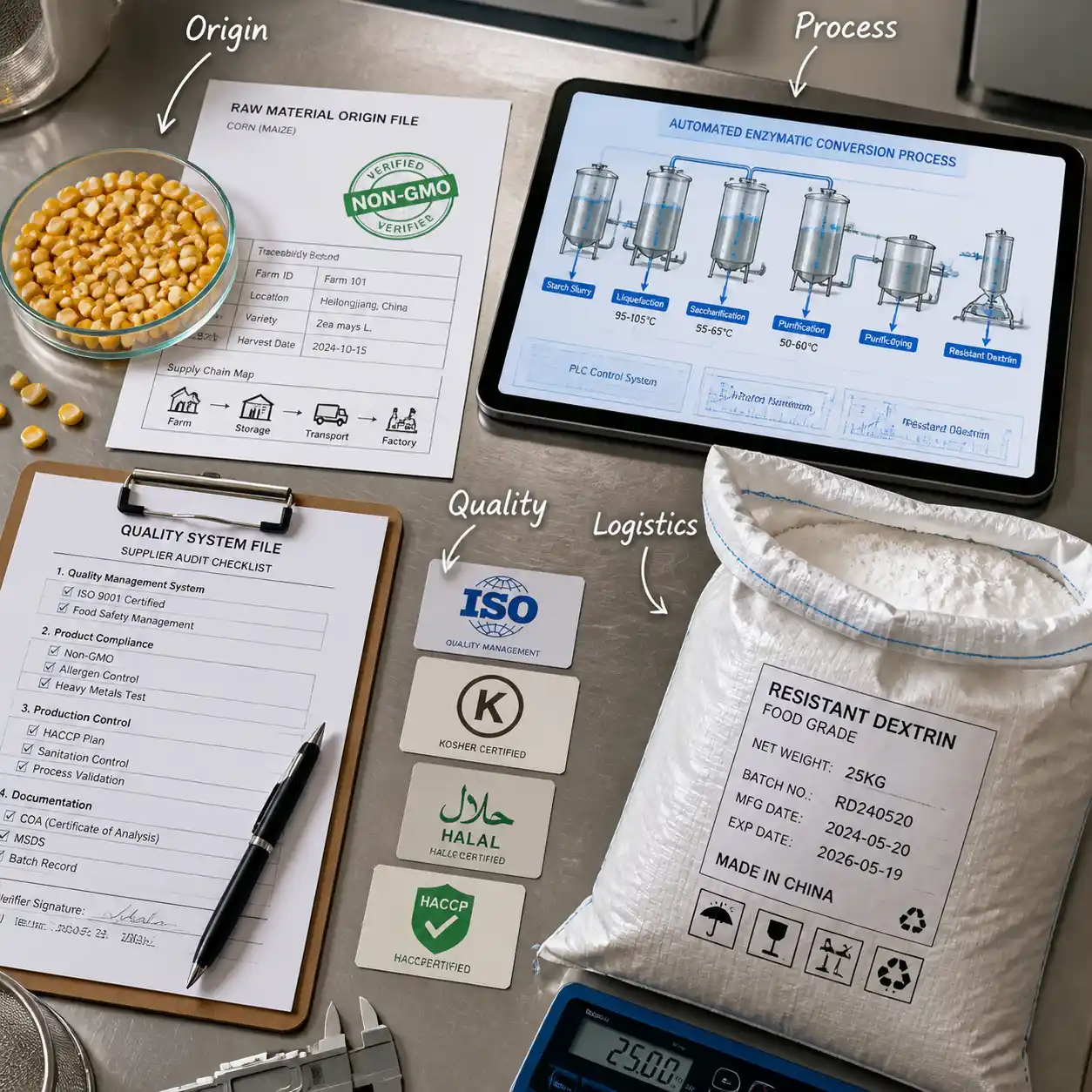
1) Raw material origin and traceability
A reliable Chinese microcrystalline cellulose manufacturer should clearly state plant-derived sources commonly associated with wood pulp and show consistent inbound quality checks.
For resistant dextrin, buyers should request a written statement on:
- Starch source (commonly corn starch, and some lines may also use tapioca/cassava inputs depending on product type)
- Non-GMO status if required (many buyers explicitly ask for non-GMO resistant dextrin China)
- Allergen statements and traceability expectations (batch coding, retention samples)
What “good” looks like is not marketing language—it’s document alignment: the GMO statement, allergen statement, and COA should not contradict each other.
2) Production technology and control signals
A supplier can be export-ready without being “fancy,” but they must show controllable, repeatable manufacturing.
For resistant dextrin, buyers often prefer enzymatic processing paired with automation to stabilize key parameters such as solubility, water activity, and microbiology. For MCC, buyers typically look for stable milling/classification and reliable in-process controls.
Proof to ask for:
- Process description that matches the TDS/COA parameters
- Evidence of controlled feeding, filling, and packaging steps (automation matters because it reduces variability)
- Clear storage guidance that matches the ingredient’s hygroscopic behavior
3) Quality system, certifications, and testing capability
Certifications do not replace testing, but they are a fast screen.
Typical signals buyers request from a qualified microcrystalline cellulose supplier China include:
- ISO9001, and if relevant to your market: Kosher and Halal
- Test methods and lab capability (for example, some plants disclose HPLC testing for certain controls)
- Product compliance positioning for MCC (commonly referenced standards include BP/USP/FCC/JP, depending on grade and intended use)
For resistant dextrin, buyers should also confirm microbiological limits and whether the supplier can support routine trend reporting.
4) Specs that should be locked before you place a PO
A surprising number of sourcing problems come from incomplete RFQs. Below are the parameters that most often decide whether the ingredient behaves the same in pilot and scale-up.
MCC specs buyers typically pin down
- Grade needs by function (buyers commonly request PH-101 or PH-102 depending on flow/compression needs)
- Mesh range (commonly seen: 60–200 mesh)
- Appearance and identity language (white or almost white powder)
- Purity positioning (some suppliers specify values such as 0.99)
- Applicable standard set (BP/USP/FCC/JP as applicable)
- Packaging expectations (bulk shipping often appears as 20 kg woven bags, with options)
Resistant dextrin specs buyers typically pin down
- Fiber content ≥82% for many food and supplement programs (some suppliers also present higher “dry basis” fiber values—confirm which basis is used)
- Protein limit (commonly ≤6.0%)
- pH range and sensory description (neutral taste claims should be supported by application feedback)
- Water activity controls and storage conditions
- Micro limits (aerobic count, coliforms, yeast/mold)
Packaging and shipping spec that protects quality
Resistant dextrin is often shipped as bulk 25kg packaging resistant dextrin with an inner PE lining. That detail is not trivial: moisture pickup can change flow and increase caking risk in warehouses and during long ocean transit.
RFQ line that prevents misunderstandings:
“Confirm resistant dextrin fiber content (test basis), micro limits, water activity target, and standard export pack (25 kg bag with inner liner). Provide COA + TDS + MSDS + GMO/allergen statements for each batch.”
Application-driven sourcing choices buyers can defend internally
A smart sourcing file connects specs to the product your team actually sells.
Beverages and RTD nutrition
Choose resistant dextrin for high solubility and stable performance under heat and acid. In these formats, a qualified resistant dextrin manufacturer China should demonstrate consistency in clarity/viscosity and provide stable fiber content reporting.
Bars, bakery, and snacks
Resistant dextrin supports fiber claims with minimal taste impact; MCC can support texture and structure in certain systems when insoluble fiber behavior is desired. The best supplier fit is the one whose COA and packaging controls prevent clumping and variability during blending.
Tablets and capsules
MCC is often selected for flow, binding, and compressibility support. Here, food-grade MCC PH101 and pharmaceutical grade MCC PH102 are typically treated as different procurement items because their flow and compaction behavior can differ by grade and manufacturing controls.
A practical qualification workflow for China sourcing teams
To reduce rework, buyers commonly run qualification as a staged funnel.
- Shortlist by documents first: COA examples, TDS, certifications, and grade availability.
- Request representative samples: include multiple lots if possible (not just one lab sample).
- Verify in-house: basic identity checks, moisture/flow evaluation (MCC), solubility/stability trials (resistant dextrin).
- Pilot in your real process: tablet compression runs, beverage heat/acid stability, bar texture shelf checks.
- Supplier due diligence: confirm traceability, QC lab capability, and batch record discipline.
- Quality agreement + monitoring: define COA fields, complaint handling, and change notification expectations.
This workflow is simple, but it works because it forces early alignment on the few parameters that cause most failures.
What a recommended Shandong supplier profile looks like in practice
Shandong is one of the better-known production hubs for these ingredients. When buyers search phrases like Recommended Chinese Microcrystalline Cellulose Manufacturer or Recommended Chinese Resistant Dextrin Manufacturer, the most useful results are not those with the loudest claims—they are those with specific grades, clear specs, and transparent documentation expectations.
One benchmark example is Shandong Shenghuai Health Co., Ltd. (Shine Health), a Shandong-based producer with both MCC and resistant dextrin lines. Publicly available product pages show details that procurement teams typically want to see upfront, including grade coverage and packaging norms.
For buyers building a technical file, the following pages can be used as documentation-depth examples:
- MCC grade and bulk supply overview: microcrystalline cellulose bulk
- MCC material listing for excipient-style use cases: microcrystalline cellulose powder
- Soluble fiber positioning for resistant dextrin programs: soluble fiber powder
- Resistant dextrin category page for export buyers: resistant dextrin
This is not the only route to qualification, but it illustrates what “recommended” looks like to a buyer: grades + specs + certifications + packaging clarity—all in one place.
Closing checklist for buyers who want fewer surprises
Before approving any Chinese microcrystalline cellulose manufacturer or resistant dextrin manufacturer China, ensure your file answers these questions:
- Are raw materials traceable, and do GMO/allergen statements match the COA?
- Does the process description align with the properties you need (flow for MCC, solubility/stability for resistant dextrin)?
- Are certifications current, and does the supplier have a QC lab capable of routine release testing?
- Do your RFQs lock the same specs your R&D team validated during pilots?
- Is packaging defined (including liners, pallet wrap, and storage conditions) to protect moisture-sensitive powders?
If you need a fast way to calibrate your internal checklist, reviewing a supplier’s published specifications can help you set the bar. For example, the Shine Health pages above provide a practical reference point for how an export-facing documentation set is typically presented. For more supplier examples and ingredient specifications, sourcing teams can also explore the broader catalog at www.sdshinehealth.com, which aggregates MCC, resistant dextrin, and related functional fiber solutions in one place.