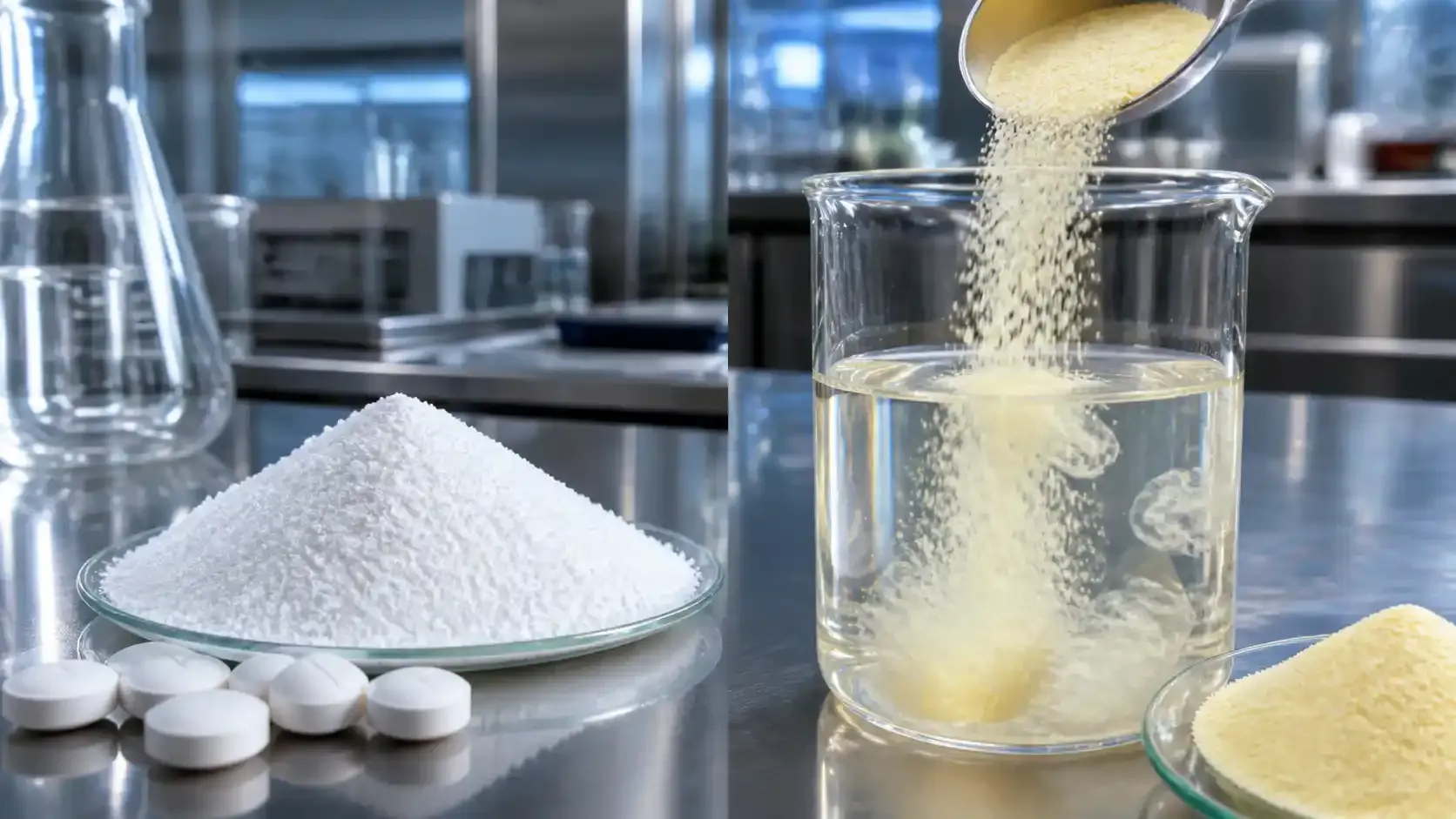
A procurement manager receives two quotes on the same day—one for soluble corn fiber (resistant dextrin) and one for microcrystalline cellulose (MCC). Both suppliers claim "stable quality" and "export-ready documents." The numbers look similar, the price gap is tempting, and the R&D department is asking for samples urgently. However, what truly decides the outcome of a successful procurement cycle is not marketing language. It is spec literacy: knowing exactly which lines on a Certificate of Analysis (COA) and technical data sheet actually predict manufacturing performance, label outcomes, and long-term stability. This comprehensive guide focuses on the fundamental criteria buyers need to master to confidently compare a resistant dextrin supplier China offer and a microcrystalline cellulose supplier China offer, ultimately reducing guesswork and preventing costly reformulations.

Why Resistant Dextrin and MCC Are Evaluated Together
In modern formulation pipelines, resistant dextrin and microcrystalline cellulose are frequently shortlisted side by side because they solve adjacent, critical problems in product development:
- Resistant dextrin (soluble corn fiber) primarily supports fiber enrichment, sugar reduction, and maintains a clean sensory profile in functional foods, gummies, and beverage powders.
- Microcrystalline cellulose (MCC) serves as a structural backbone. It supports manufacturability and physical performance—improving flow, compressibility, tablet integrity, and occasionally acting as a texturizer in non-tablet formats.
For global buyers, the sourcing conversation has evolved past the traditional "food ingredient vs. pharma excipient" divide. Today, it becomes a unified question: Which supplier possesses the technical capability to hit required specifications consistently and document it transparently?
Resistant Dextrin and Soluble Corn Fiber Basics Buyers Should Anchor On
Resistant dextrin is widely recognized as a water-soluble dietary fiber manufactured through the controlled enzymatic breakdown of starch. Within supplier documentation, it is prominently positioned for low-sugar foods, fiber fortification strategies, and formulations requiring a significant fiber boost without imparting a heavy or gritty mouthfeel.
When evaluating the market, a practical benchmark for how a premium manufacturer presents this ingredient can be observed in top-tier industry players. These manufacturers clearly illustrate the "buyer-facing essentials": raw material origin, enzymatic processing highlights, and precise application positioning.
What Buyers Typically Value Functionally
When procurement and R&D teams review a soluble dietary fiber supplier, their functional expectations usually revolve around several non-negotiable traits:
- High solubility and effortless dispersion for clear drinks, nutritional bars, and dry premixes.
- Neutral taste profile ensuring that delicate sweetness systems do not require complex rebalancing.
- Low viscosity to protect the intended liquid texture in beverages and syrups without unwanted thickening.
- Heat and acid stability to survive harsh baking environments and rigorous processing conditions.
While these properties are frequently advertised across the market, experienced buyers treat them strictly as claims to verify through a detailed COA, a comprehensive technical data sheet, and rigorous application trial results.
The Resistant Dextrin Specifications That Matter Most on a COA
If there is a single sourcing habit that prevents costly downstream rework, it is standardizing exactly how your quality team interprets each resistant dextrin technical data sheet.

1) Fiber Content Tiers and What They Change
The fiber content percentage is one of the most critical lines on a COA, directly impacting:
- Nutrition labeling and claim math: Dictating exactly how much fiber per serving you can credibly declare on consumer packaging.
- Cost-in-use: Formulating with higher fiber grades often reduces the total dosage required, optimizing recipe costs.
- Sensory and processing behavior: Influencing how the ingredient interacts within a specific food matrix.
Across commercial offerings, buyers will commonly see ≥82% fiber as a standard baseline. However, premium listings frequently reference ≥90% fiber on a dry basis for high-performance positioning. A practical rule of thumb is to treat fiber content as a tiered purchasing decision, always confirming the exact testing methodology (e.g., AOAC methods) with the supplier.
Typical specification ranges from leading manufacturers include:
- Appearance: White to light yellow powder
- Fiber content: ≥82% or ≥90% on a dry basis
- Protein content: ≤6.0% to ensure purity and minimal Maillard reaction during heating.
2) Raw Material Origin and Non-GMO Status
When a product concept targets the "clean label" or "low sugar" demographic, the origin of the raw material transcends marketing—it becomes a strict compliance and brand-risk variable.
Buyers sourcing a non-GMO resistant dextrin bulk grade must look for:
- A definitive statement confirming the use of non-GMO corn starch or tapioca starch.
- Clear traceability language mapping the agricultural supply chain.
- Supporting third-party verification (such as SGS NON-GMO certification) when mandated by target consumer markets.
3) Process and Consistency Signals Buyers Should Not Ignore
A quote from a resistant dextrin supplier in China becomes significantly easier to trust when the facility can transparently explain how product consistency is safeguarded at industrial scale. Key manufacturing signals to look for include:
- The utilization of imported biological enzymes for precise starch breakdown.
- Implementation of precision production lines (often of German origin) ensuring minimal deviation.
- Fully automatic central control systems governing the process from raw material feeding to final packaging.
- Operation within GMP-standard workshops backed by fully equipped QC testing laboratories.
Procurement does not necessarily need these exact phrases, but it absolutely requires the underlying proof: repeatability, strict process control, and measurable QC gates.
4) Packaging and Storage Basics for Wholesale Buying
Bulk procurement challenges are frequently "post-COA" issues—such as unwanted caking, moisture pickup, or inconsistent handling across different climate-controlled warehouses.
Even when a technical sheet simply states "store in a cool place," buyers must align internally on:
- Target storage temperature ranges and strict humidity control protocols.
- Inner moisture-barrier liner specifications and palletization durability.
- First-in-first-out (FIFO) inventory rules for fiber ingredients utilized across multiple SKUs.
Microcrystalline Cellulose Fundamentals Buyers Should Know
Microcrystalline cellulose is fundamentally an insoluble cellulose-based excipient that facilitates tablet and supplement manufacturing. Beyond traditional pharma, it is increasingly leveraged for texture modification and moisture migration control in food and cosmetic applications.
For procurement teams compiling a shortlist to find a recommended Chinese microcrystalline cellulose manufacturer, the foundational concept is grade logic: MCC is never a one-size-fits-all material; its performance is entirely grade-dependent.
MCC Quality Parameters Buyers Commonly Screen
While different manufacturers may utilize varying documentation layouts, an internal MCC screening checklist must map to several recurring quality controls:
- Particle size distribution: Directly impacts powder flowability and blend uniformity in direct compression scenarios.
- Bulk density: Influences die cavity fill rates and prevents tablet weight variation during high-speed pressing.
- Compressibility and compactibility: Dictates final tablet hardness, reducing friability and capping issues.
- Loss on drying (Moisture content): Critical for the stability of moisture-sensitive active ingredients.
- pH and microbial limits: Essential for regulatory compliance and ensuring long-term product safety.
The practical takeaway is clear: when evaluating a microcrystalline cellulose supplier China offer, buyers must match the specific MCC grade to the actual manufacturing process being run (e.g., wet granulation vs. direct compression), rather than settling for a generic "pharma grade" label.
Linking Resistant Dextrin and MCC to Real-World Applications
A frequent sourcing error is purchasing based entirely on a single "headline spec" while assuming the application will naturally work out. In reality, these ingredients are selected specifically to solve predictable formulation constraints.
Resistant Dextrin in Baked Goods and Low-Sugar Formats
In the bakery sector, resistant dextrin is strategically positioned to elevate fiber content while maintaining crumb texture and moisture stability. It provides crucial moisture retention, extends shelf-life, and facilitates partial sugar or flour replacement without destroying the dough matrix.
For low-carb and keto-adjacent product concepts, resistant dextrin acts as an ideal bulking agent that supports lower net carbohydrate claims while delivering a smooth, non-gritty sensory profile in bars and shakes.
MCC in Solid-Dose Supplements and Beyond
Within tablet and capsule manufacturing, MCC is rigorously evaluated for its ability to influence:
- Blend flow dynamics and precise dosing consistency.
- Superior tablet hardness and structural robustness.
- Predictable disintegration behavior when paired with superdisintegrants.
Furthermore, MCC's utility in the cosmetics industry is rapidly expanding as formulators seek natural, biodegradable texturizing alternatives to synthetic polymers.
Certifications and Capability Signals Behind "Recommended" Suppliers
In international sourcing, the term "recommended" is not merely a compliment—it is a calculated procurement conclusion. It indicates that a supplier can manufacture consistently, document transparently, and robustly support your regulatory requirements.
When auditing a facility's profile, the capability signals buyers should actively look for include:
- Facility scale and infrastructure: Substantial factory footprints (e.g., 30,000 m²) featuring dedicated GMP workshops and advanced R&D laboratories.
- Comprehensive market access certifications: Documentation such as HALAL, KOSHER, FSSC 22000, ISO, and SGS NON-GMO verifications.
- Process automation: Evidence of unmanned, centrally controlled production lines that remove human error.
- Support posture: Availability of 24/7 technical engineering support and proven ODM (Original Design Manufacturing) capabilities to customize particle sizes or solubility rates.
Whether qualifying a soluble corn fiber manufacturer or auditing an MCC supplier, these trust signals are paramount because they drastically reduce the probability of batch-to-batch variation and documentation bottlenecks that stall product launches.
Turning Ingredient Fundamentals Into a Sourcing Shortlist
Once the technical fundamentals are established, procurement teams can translate them into Request for Quotation (RFQ) language that leaves no room for ambiguity.
A Buyer-Ready RFQ Structure
- Explicitly define the grade by application: Specify if the material is for a clear beverage powder, baked goods, or high-speed tablet pressing.
- Require a specific COA template: Ensure the supplier's data matches your internal critical quality attributes (CQAs).
- Clarify non-GMO expectations: Mandate proof of origin if purchasing a non-GMO resistant dextrin bulk grade.
- Demand proof of certifications: Request active, verifiable certificates required for your target regional markets.
- Interrogate batch consistency protocols: Ask the manufacturer directly how they control consistency (e.g., automated enzymatic processes, rigorous QC lab testing).
Navigating the Chinese ingredient market requires a strategic balance of technical knowledge and rigorous supplier vetting. By focusing on critical COA parameters, manufacturing automation, and stringent certifications, buyers can secure a supply chain that is both cost-effective and functionally superior.
If you are building a shortlist for a reliable resistant dextrin supplier China, or simply benchmarking what a "recommended" standard looks like in terms of documentation and QC discipline, exploring the capabilities of established industry leaders like Shine Health is a highly practical next step. For comprehensive technical data, OEM/ODM support, and certified dietary fiber solutions, visit www.sdshinehealth.com.