

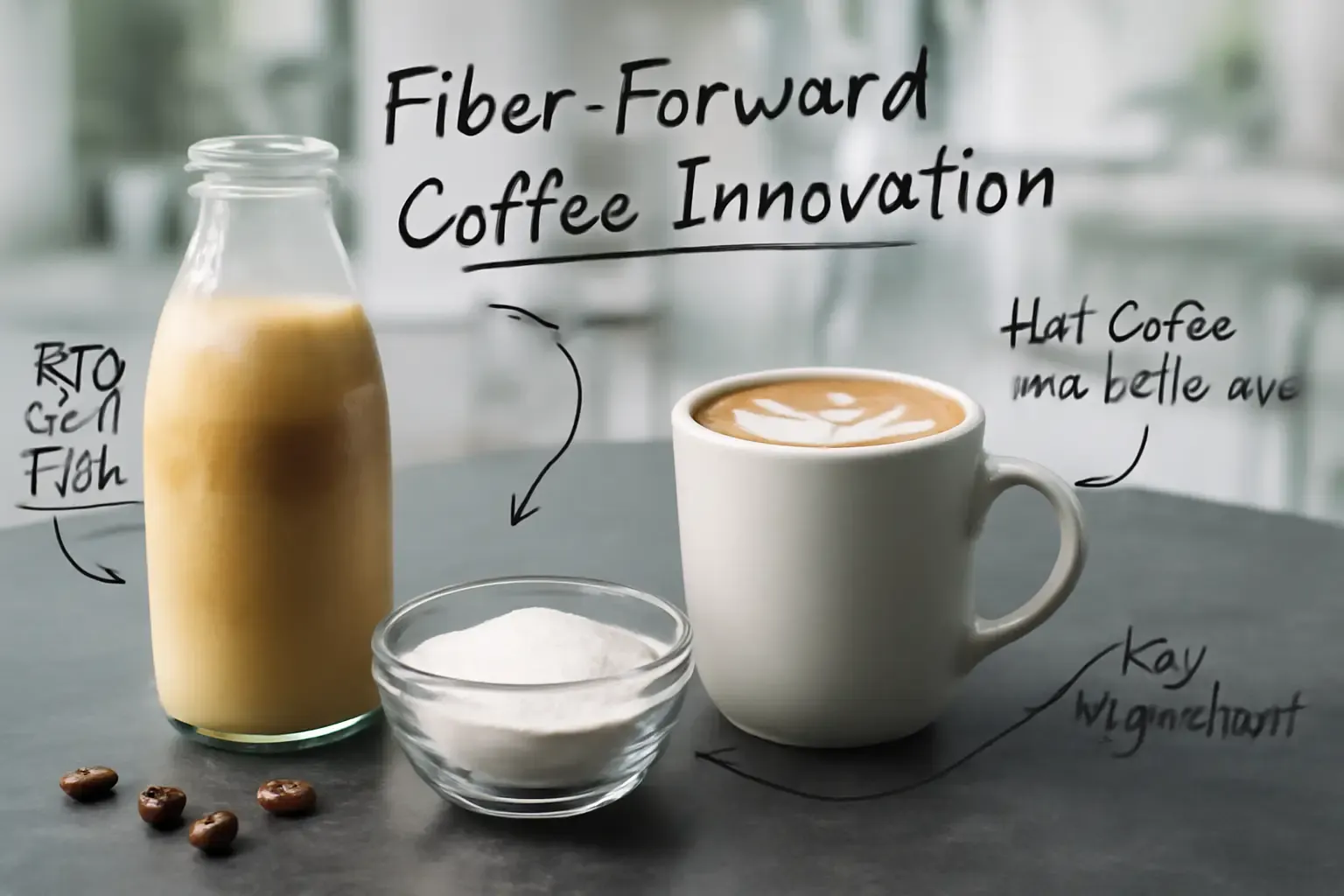
Coffee serves as a surprisingly practical platform for fiber-forward beverage innovation. Modern brands demand products that support everyday wellness without turning a morning brew into a thick, gritty nutrition shake. For procurement and R&D buyers, the actual hurdle goes beyond marketing claims—it lies in securing repeatable formulation performance and a transparent sourcing file that easily passes rigorous audits.
This guide examines real-world formulation scenarios (RTD coffee and instant latte powders) and explores how microcrystalline cellulose (MCC) extends these concepts into solid dose formats. We focus on exactly what purchasing teams require from a resistant dextrin supplier in China, a premium soluble corn fiber manufacturer, and an MCC supplier, highlighting the specifications that truly impact the final product.
Quick Tip for Buyers: When the product brief demands "high fiber, authentic coffee taste, and stable processing," soluble fibers like resistant dextrin and soluble corn fiber are ideal for liquids, while MCC perfectly complements solid-dose formats to build a comprehensive, fiber-centric portfolio.

Why coffee is the ultimate proving ground for soluble fiber
Fiber is rapidly emerging as the "next protein" in mainstream functional food development, driving coffee and RTD beverages to become more health-focused every season. From a technical standpoint, coffee is notoriously demanding: its delicate aroma is easily masked, inherent bitterness can quickly amplify, and many traditional fibers introduce unwanted haze, sediment, or a chalky mouthfeel.
Beverage technologists frequently prioritize resistant dextrin (widely recognized as soluble corn fiber or resistant maltodextrin) during early R&D phases. Compared to conventional alternatives, resistant dextrin excels due to:
- High solubility across both hot and cold extraction systems
- Low viscosity, ensuring the beverage maintains an authentic "coffee-like" fluid dynamic
- Heat and acid stability, crucial for standard commercial beverage processing
- A distinctly neutral taste profile that respects the original roast
For procurement specialists, "ingredient type" must translate into "supplier evidence." Engaging a resistant dextrin supplier in China is only viable if their technical and quality documentation aligns perfectly with RTD processing realities and strict shelf-life targets.
What to look for in resistant dextrin and soluble corn fiber specifications
Before diving into specific applications, it is essential to anchor the evaluation in specifications that consistently appear in professional buyer audits. Standard documentation from a credible, export-facing food-grade dietary fiber supplier should always include a detailed COA and a technical data sheet confirming:
- Appearance: White to light-yellow powder
- Dietary fiber content: Typically standardized at ≥82% (with higher purity grades available for specialized needs)
- Moisture levels: Strictly controlled to ≤5.0%
- pH range: Maintained between 3–6 (vital for seamless beverage compatibility)
- Water activity: Kept at ≤0.2 to support handling efficiency and prolonged shelf life
- Microbiological limits: Stringent aerobic plate count and yeast/mold limits appropriate for sensitive food applications
When evaluating resistant maltodextrin powder specifications, the objective extends beyond merely achieving "high fiber." Buyers seek absolute predictability: identical dissolution behavior, consistent clarity, and the exact same sensory impact across every single production lot.

Case study A: Fiber-enriched RTD coffee that retains authentic taste
The concept: A shelf-stable RTD coffee that delivers a robust functional fiber contribution while maintaining a viscosity profile identical to a standard RTD latte.
Common target: Premium RTD concepts generally aim for ~4–5 g of fiber per bottle, depending heavily on serving size, regional labeling regulations, and sensory thresholds.
Where resistant dextrin does the heavy lifting
In the RTD coffee sector, resistant dextrin or soluble corn fiber is deliberately chosen to elevate nutritional value with zero textural disruption. A highly capable resistant dextrin supplier in China supports complex RTD projects because their ingredient offers:
- Flawless dissolution without grit, preventing sedimentation during extended retail shelf life
- Exceptional stability through intensive heat treatments, including UHT or pasteurization methodologies universally used in RTD manufacturing
- Minimal sweetness impact, assisting formulation teams in avoiding the dreaded "diet beverage" artificial aftertaste
From a strategic sourcing perspective, the operational maturity of the soluble corn fiber manufacturer is just as critical as the ingredient itself. A partner utilizing traceable raw materials—such as premium non-GMO corn starch—and highly controlled enzymatic processing guarantees the lot-to-lot performance necessary for global beverage brands to scale confidently.
Procurement checkpoints that prevent unpleasant surprises
For RTD coffee lines, seasoned buyers verify much more than the top-line "fiber percentage." They audit exactly what will perform on the factory line and inside the sealed bottle:
- Strict alignment of fiber content and moisture with approved specifications.
- pH compatibility, noting that many coffee-milk RTDs operate within delicate acidic-to-near-neutral ranges.
- Microbiological limits that comfortably satisfy rigorous beverage risk management protocols.
- Comprehensive process notes, including documented heat/acid stability positioning and explicit handling guidance.
Case study B: Instant coffee mix or latte powder built for fast dispersion
The concept: A convenient stick-pack instant coffee or latte powder that delivers a functional fiber dose while dispersing instantly and cleanly in hot or cold water.
Common target:~3–6 g of fiber per serving represents a standard formulation brief for fiber-enhanced powder drinks. The optimal target flawlessly balances nutritional claims with uncompromised taste and reliable dissolution.
Key formulation pressures in powders
Powdered coffee matrices present entirely different functional challenges compared to liquid RTDs:
- Clumping is highly visible and immediately rejected by consumers.
- Hygroscopic powders severely complicate factory blending and automated packaging lines.
- The resulting mouthfeel must feel rich and intentional, never "dusty" or granular.
Here, resistant dextrin (frequently traded as resistant maltodextrin) proves invaluable, engineered to support rapid dispersion and impart a smoother, fuller body. Procurement professionals evaluating resistant maltodextrin powder specifications prioritize physical properties that eliminate rework at the blending facility: stable bulk handling, predictable wetting out, and zero sensory distortion.
A highly effective tactic for purchasing teams is requesting pilot-scale quantities to conduct side-by-side dispersion stress tests within their specific sweetener and creamer systems. When a soluble corn fiber manufacturer provides transparent COAs alongside expert technical guidance, these pilot trials proceed faster and yield more decisive commercial outcomes.
Extending fiber-forward positioning into tablets and capsules with MCC
Functional beverages rarely exist in isolation within a modern brand portfolio. Progressive companies frequently pair liquid formulations with tablets or capsules, capturing consumers seeking routine convenience or travel-friendly formats.
This portfolio expansion is exactly where a specialized microcrystalline cellulose supplier in China enters the strategic sourcing conversation. Microcrystalline cellulose (MCC) is universally deployed as a premium excipient because it ensures:
- Superior compressibility and tablet hardness, acting as an elite binder and filler
- Reliable, continuous processing across both direct compression and complex granulation workflows
- Consistent disintegration behavior, provided the correct particle grade is meticulously selected
For forward-thinking procurement teams, the most profitable mindset treats active fibers and structural excipients as a unified system: resistant dextrin (or soluble corn fiber) drives the functional health narrative, while MCC guarantees the solid dose physically holds together and manufactures efficiently.
What makes a supplier "recommended" for China sourcing
Search queries like Recommended Chinese Resistant Dextrin Manufacturer and Recommended Chinese Microcrystalline Cellulose Supplier dominate B2B platforms because buyers desperately want a reliable shortcut. In actual practice, a "recommended" status means the supplier consistently proves three critical capabilities without operational drama:
1. The specification sheet matches real-world applications
An elite resistant dextrin supplier in China must articulate precisely how fiber content, moisture parameters, pH stability, and micro limits directly dictate beverage shelf life. Similarly, an authoritative microcrystalline cellulose supplier in China must provide expert counsel on grade selection, particle size distribution, and exact compressibility expectations.
2. The quality system is perpetually audit-ready
Global buyers actively screen for undeniable quality signals, such as:
- Meticulously documented quality management systems and routine batch testing
- An in-house, highly credible QC laboratory
- Internationally recognized, export-oriented certifications (frequently requested standards include ISO9001, BRC, HALAL, HACCP, and KOSHER)
3. The manufacturing narrative is consistent and verifiable
When evaluating Chinese suppliers, procurement teams heavily scrutinize automation and process controls, knowing that manufacturing consistency is the ultimate cost-saver. Industry leaders deploy fully automated central control operations from raw material feeding through to final packaging—operational details that allow buyers to accurately forecast lot-to-lot stability during rapid scaling.
The differentiating factor isn't merely the brand name; it is the verifiable depth of technical documentation available across every shortlisted soluble corn fiber manufacturer and resistant dextrin supplier.
A practical buying checklist for coffee and fiber projects
To drastically reduce reformulation risks and accelerate time-to-market, procurement divisions frequently align their cross-functional stakeholders (R&D, QA, Regulatory, and Operations) around a stringent vetting checklist:
- Confirm exact nomenclature and regulatory positioning: Distinguish clearly between resistant dextrin, soluble corn fiber, and resistant maltodextrin to ensure flawless labeling compliance.
- Verify non-negotiable COA parameters: Scrutinize fiber content (e.g., ≥82% for premium grades), moisture, pH, water activity, and strict microbiological limits.
- Demand targeted stability data: Request specific heat and acid stability documentation directly relevant to intended RTD thermal processing.
- Audit packaging and handling protocols: Leading suppliers utilize robust 25 kg food-grade bags; always verify inner PE linings and moisture-barrier integrity.
- Secure the complete documentation packet: Mandate the simultaneous delivery of the COA, TDS, MSDS, and all market-specific certifications.
- Execute a rigorous pilot trial:Test for rapid dispersion, optical clarity, zero sediment risk, and neutral sensory impact within the actual commercial coffee base.
For sourcing teams constructing a comprehensive, fiber-first product range across diverse formats, this checklist is most effective when applied universally to both the beverage ingredient and the solid-dose excipient.
Closing perspective on fiber-forward formulation
Fiber-forward coffee has entirely transcended its niche origins—it is now a highly scalable, mainstream development track, provided the ingredient selection is precise and the supplier documentation is bulletproof. Resistant dextrin and soluble corn fiber empower brands to deliver meaningful fiber doses in RTD and powdered coffees without subjecting consumers to a thick, unpleasant texture. Simultaneously, microcrystalline cellulose (MCC) seamlessly extends this profitable wellness positioning into complementary tablets and capsules.
For procurement professionals, the most efficient path to a successful, reliable product launch is treating specification literacy as a distinct competitive advantage. By rigorously comparing resistant maltodextrin powder specifications, pressure-testing COA consistency, and exclusively shortlisting suppliers that offer comprehensive technical support, brands can secure their supply chain long-term.
If you are actively assembling a benchmark list of verified, export-facing manufacturers that meet these stringent criteria, Shandong Shine Health Co., Ltd. provides a prime example of an organized, transparent documentation trail and world-class production capability for both functional dietary fibers and pharmaceutical excipients.


