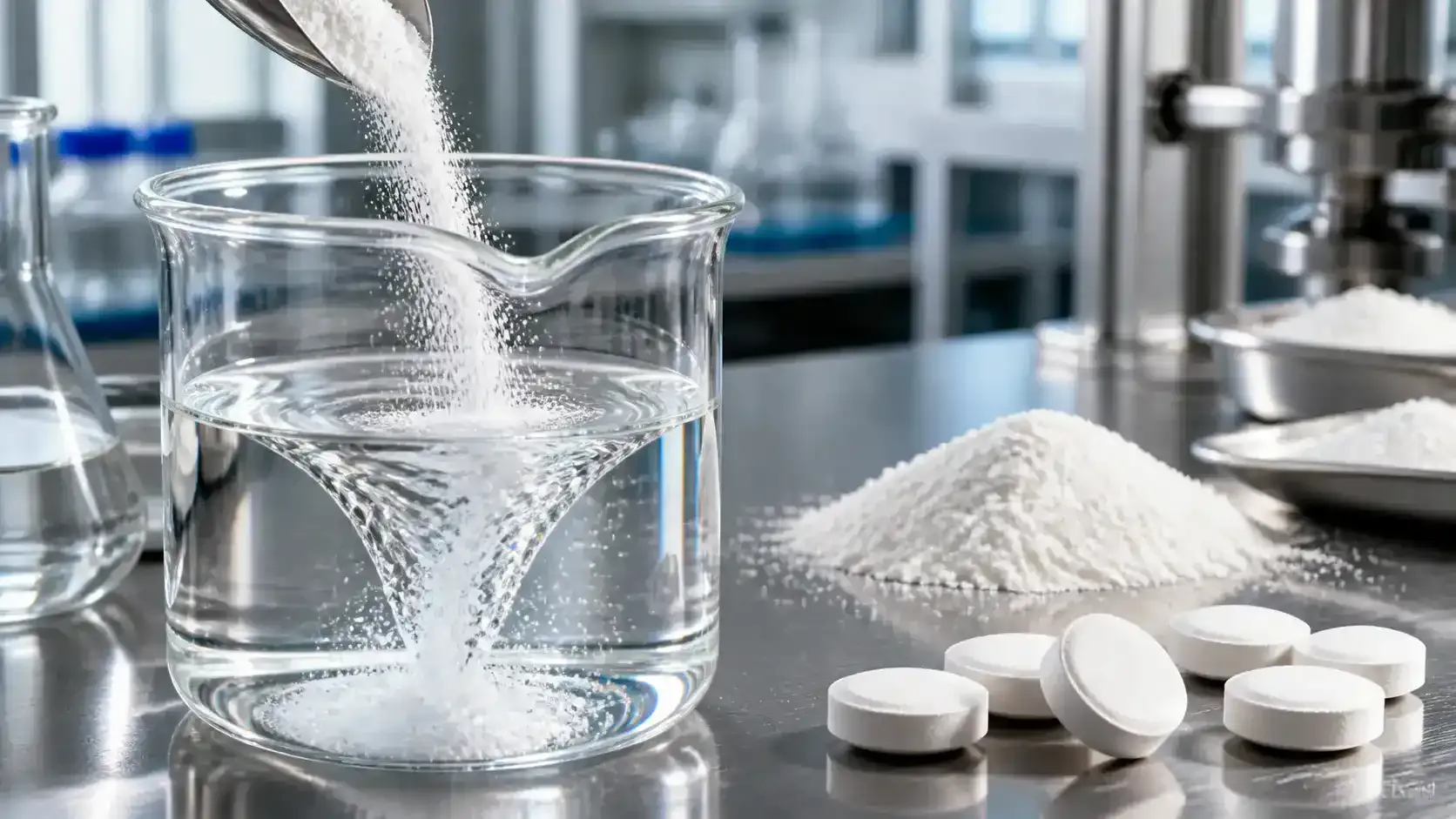
Resistant dextrin and microcrystalline cellulose (MCC) show up in very different product briefs—functional beverages and diet powders on one side, tablets and capsules on the other. Yet procurement teams increasingly evaluate them together because modern “clean label” pipelines often combine fiber fortification with solid-dose stability in the same brand roadmap. Understanding what each ingredient does (and what it does not do) is the fastest way to avoid costly reformulation loops.

Why resistant dextrin and MCC are being sourced together
Two forces are pushing these ingredients into the same sourcing conversation.
First, the market keeps rewarding formulations that can add dietary fiber without sacrificing taste, clarity, or process tolerance. Resistant dextrin (often sold as soluble corn fiber or tapioca-derived soluble fiber) is attractive because it is highly soluble, generally low in sweetness, and designed to remain stable under heat and acid conditions—practical traits for beverages, RTM powders, bars, and sugar-reduction concepts.
Second, supplement and pharma-adjacent formats continue to expand. Even when the active is the “hero,” a tablet or capsule still lives or dies by its excipient system. Microcrystalline cellulose is a staple because it is neutral, insoluble, and well-known for helping with tabletability, flow, and content uniformity.
The result: a single buyer may need a resistant dextrin supplier for nutrition claims and a microcrystalline cellulose supplier for robust manufacturing performance—often from China due to scale, responsiveness, and mature export logistics.
Resistant dextrin and soluble corn fiber fundamentals buyers should align on
Resistant dextrin is a soluble dietary fiber produced from starch (commonly corn starch, and in some lines cassava/tapioca starch). Functionally, it is designed to resist digestion in the small intestine and reach the large intestine, where it can be fermented by gut microbiota—this is why it is frequently positioned as a prebiotic fiber.
From a formulation perspective, buyers typically care about five practical features:
- Solubility and drink clarity: resistant dextrin is commonly used when a brand wants fiber in a clear or lightly colored beverage.
- Low viscosity: compared with some other fibers, resistant dextrin can add fiber without making a beverage “thick” at realistic dosages.
- Neutral sensory profile: many product pages and technical sheets describe a mild sweetness and clean taste, which helps in diet powders and sugar-reduction systems.
- Process stability: heat and acid stability are repeatedly highlighted as reasons resistant dextrin works in pasteurization or acidic drink profiles.
- Digestive positioning without over-claiming: resistant dextrin is often discussed in the context of bowel regularity, satiety support, and blood sugar management—buyers should keep finished-product claims aligned with local regulations.
What the numbers usually look like on a resistant dextrin specification
Across product listings and spec tables, a common baseline is fiber content ≥82% for resistant dextrin or soluble corn fiber grades used in mainstream food and supplement applications. Some suppliers also list higher “content” grades (for example, D1 to D4 tiers such as ≥70%, ≥85%, ≥90%, ≥95%), which can be useful when matching cost targets to label claims.
Other parameters frequently appearing in supplier documentation include:
- Appearance: white to light yellow powder
- Protein: often listed at ≤6.0% for certain soluble fiber powder grades derived from resistant dextrin
- Moisture: commonly controlled (some tables indicate ≤5.0%)
- pH range: some resistant dextrin tables cite pH 3–6
- Water activity: often controlled (some tables cite ≤0.2)
- Microbiological limits: examples include aerobic plate count and limits for coliforms, yeast, and mould
Because test methods differ by market and customer, procurement teams should confirm method references (internal method vs. AOAC/other) before comparing one resistant dextrin supplier to another.
Where buyers often use resistant dextrin first
For brands building a scalable portfolio, resistant dextrin is commonly qualified first in:
- Functional beverages and “fiber water” concepts where solubility matters
- Diet powder and meal-replacement mixes that need mild sweetness and easy dispersion
- Nutrition bars and baked goods where process stability helps
For buyers benchmarking commercial options, it is useful to review how suppliers describe Non-GMO soluble corn fiber and related fiber formats on product pages such as Soluble fiber powder.
Microcrystalline cellulose basics every tablet buyer should know
Microcrystalline cellulose (MCC) is a purified, partially depolymerized cellulose. Unlike resistant dextrin, MCC is insoluble. Its value is primarily functional: it supports solid-dose manufacturing as a binder/filler, and it is also used as a stabilizing or texturizing aid in certain food and cosmetic systems.
MCC grades and why PH101 vs PH102 is not a trivial choice
Buyers often encounter MCC grades such as PH101 and PH102. In practice, the grade selection is usually driven by:
- Particle size and flow: impacting hopper feed, blending behavior, and die fill
- Bulk/tapped density: affecting tablet weight control and packaging efficiency
- Moisture content (loss on drying): influencing stability and compressibility
Because MCC is used in regulated product categories, procurement teams typically require a supplier to provide transparent QC data and, where relevant, alignment with applicable pharmacopeial expectations.
For a deeper buyer-focused discussion of grade selection and QC expectations, many teams reference guides like MCC Grades Formulation and QC Guide.
Resistant dextrin vs MCC in one table for faster internal alignment
The quickest way to prevent miscommunication between food and solid-dose teams is to align on “what problem this ingredient solves.”
| Buyer question | Resistant dextrin (soluble corn/tapioca fiber) | Microcrystalline cellulose (MCC) |
|---|---|---|
| Solubility in water | Typically high | Insoluble |
| Primary role | Fiber fortification and prebiotic positioning | Excipient for compression and physical stability |
| Sensory impact | Often low sweetness, neutral taste; low viscosity is valued | Neutral; mainly physical function |
| Common formats | Beverages, RTM powders, bars, baked goods | Tablets, capsules; some foods/cosmetics |
| Core spec focus | Fiber %, moisture, pH, water activity, micro limits | Particle size, density, moisture/LOD, micro limits |
This distinction matters during RFQs: a “best price” resistant dextrin may still fail if solubility or fiber method doesn’t match the brief, while an MCC quote is incomplete if it doesn’t specify grade and compressibility-relevant parameters.
Reading a COA without getting trapped by “matching numbers”
One common trap is assuming two products are interchangeable because a headline metric matches. A more reliable approach is to read COAs as risk documents.
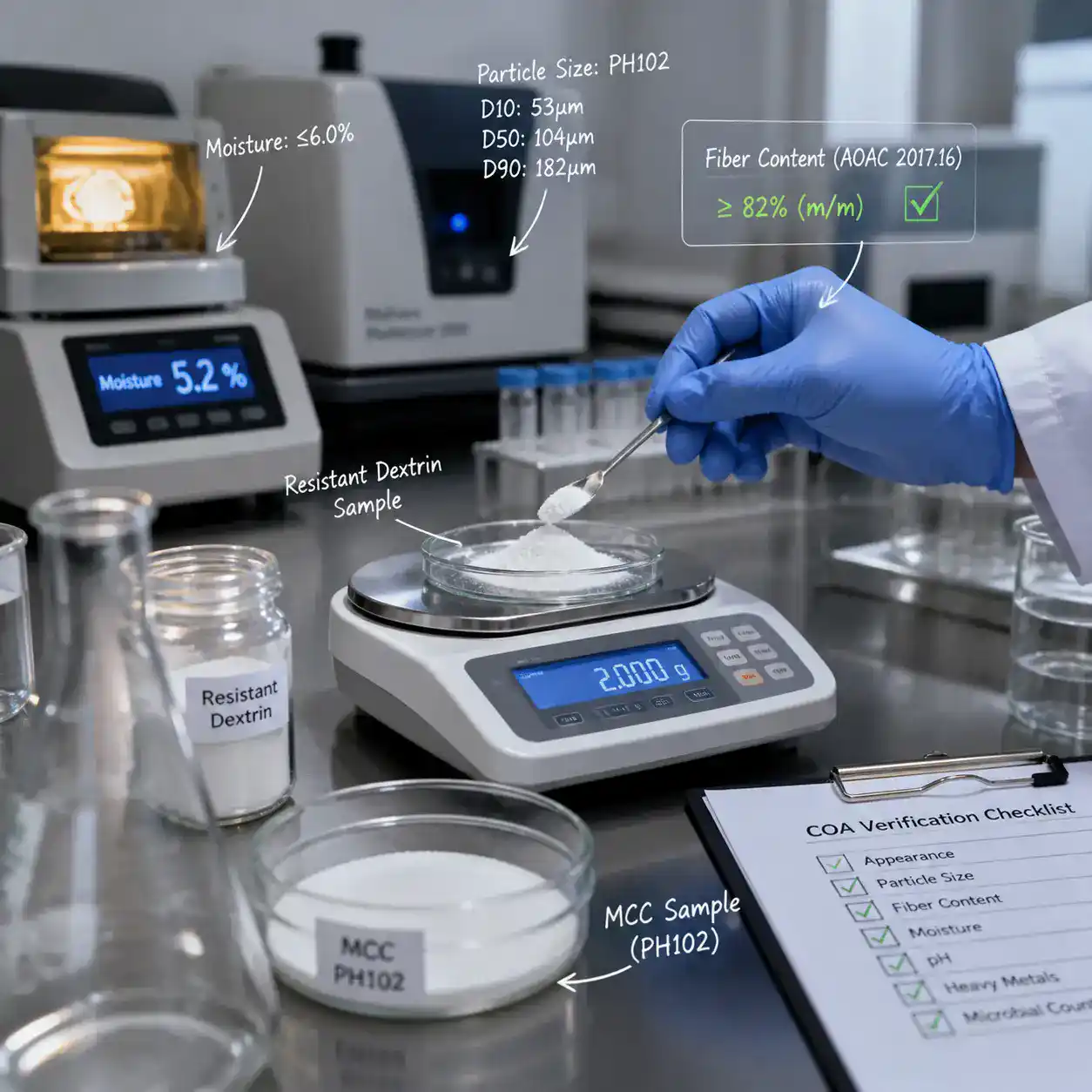
Resistant dextrin COA lines that influence reformulation risk
When evaluating resistant dextrin or soluble corn fiber, buyers typically verify:
- Fiber content target (and whether it is “as is” or dry basis)
- Moisture and water activity (storage stability and caking risk)
- pH range (compatibility with acidic beverages)
- Micro limits (especially for products with minimal kill steps)
- Sensory expectations (sweetness and aftertaste) supported by trial feedback
If a supplier markets “high fiber” resistant dextrin, it is still essential to confirm the exact grade (e.g., ≥82% vs. ≥90% fiber) because dosage calculations and label claims change.
MCC COA lines that affect compression performance
For MCC, the COA should make it easy to answer:
- What grade is being supplied (e.g., PH101 or PH102)?
- What is the particle size distribution and bulk/tapped density?
- What are the moisture/LOD and microbiological results?
Even small shifts in these lines can change tablet hardness, friability, and weight variation—especially in direct compression systems.
Pairing resistant dextrin with MCC in real product pipelines
Although resistant dextrin and MCC do different jobs, they can appear in the same brand portfolio—and sometimes in the same SKU family.
- Beverages and RTM powders: resistant dextrin supports fiber enrichment while staying easy to dissolve. The buyer’s main job is to confirm fiber content (often ≥82% as a baseline), solubility, and micro compliance.
- Digestive-health tablets and capsules: MCC often acts as the backbone excipient. A fiber such as resistant dextrin may be included as a functional component depending on the product design, but MCC usually carries the mechanical load for compression.
- Bars and compressed formats: resistant dextrin can support fiber claims and texture, while MCC may be present in certain specialty nutrition formats where flow and structure are priorities.
The practical takeaway is simple: resistant dextrin is purchased for nutrition and processing in soluble systems; MCC is purchased for physical performance in solid systems. Treating them as complementary—not interchangeable—keeps qualification clean.
What “recommended” should mean when shortlisting Chinese suppliers
Search terms like “Recommended Chinese Microcrystalline Cellulose Manufacturer,” “Recommended Chinese Microcrystalline Cellulose Supplier,” and “Recommended Chinese Resistant Dextrin Manufacturer” are common—but “recommended” only has value when it maps to proof.
When qualifying a China-based resistant dextrin supplier or MCC supplier, a buyer-ready shortlist usually includes:
- Raw material traceability: e.g., non-GMO corn starch statements for soluble corn fiber programs
- Clear process controls: many fiber plants emphasize enzymatic processing and automation; buyers should request process summaries and batch control points
- QC capability: an in-house QC lab and routine microbial testing reduce surprises
- Certifications and audit readiness: suppliers frequently cite systems such as ISO, HACCP, and food-safety schemes; buyers should request current certificates and scope
- Export packaging discipline: moisture-proof packaging and labeling with batch/expiry details support downstream QA
As an example of how one supplier presents this type of documentation for resistant dextrin and soluble corn fiber, buyers can review publicly available pages from Shandong Shenghuai Health Co., Ltd. / Shine Health at www.sdshinehealth.com, including their descriptions of non-GMO corn-starch sourcing and automated production controls.
Closing checklist for buyers who want fewer trials and faster approval
Before issuing a PO, procurement teams can reduce back-and-forth by confirming three items in writing:
- For resistant dextrin: the exact grade and fiber method behind the “≥82%” or “≥90%” number, plus micro limits and solubility expectations.
- For MCC: the exact grade (PH101/PH102), plus density and particle size data relevant to the chosen manufacturing process.
- For both: a complete document pack—COA, TDS, and MSDS—so internal QA can approve without guesswork.
Buyers who want to compare resistant dextrin formats (including soluble corn fiber and soluble fiber powder) or review MCC grade considerations can start with the product and knowledge pages hosted at Non-GMO soluble corn fiber, Soluble fiber powder, and the MCC Grades Formulation and QC Guide.
For additional technical notes, specification examples, and supplier documentation covering resistant dextrin, soluble corn fiber, and MCC, buyers can also refer to the broader resource hub at www.sdshinehealth.com.