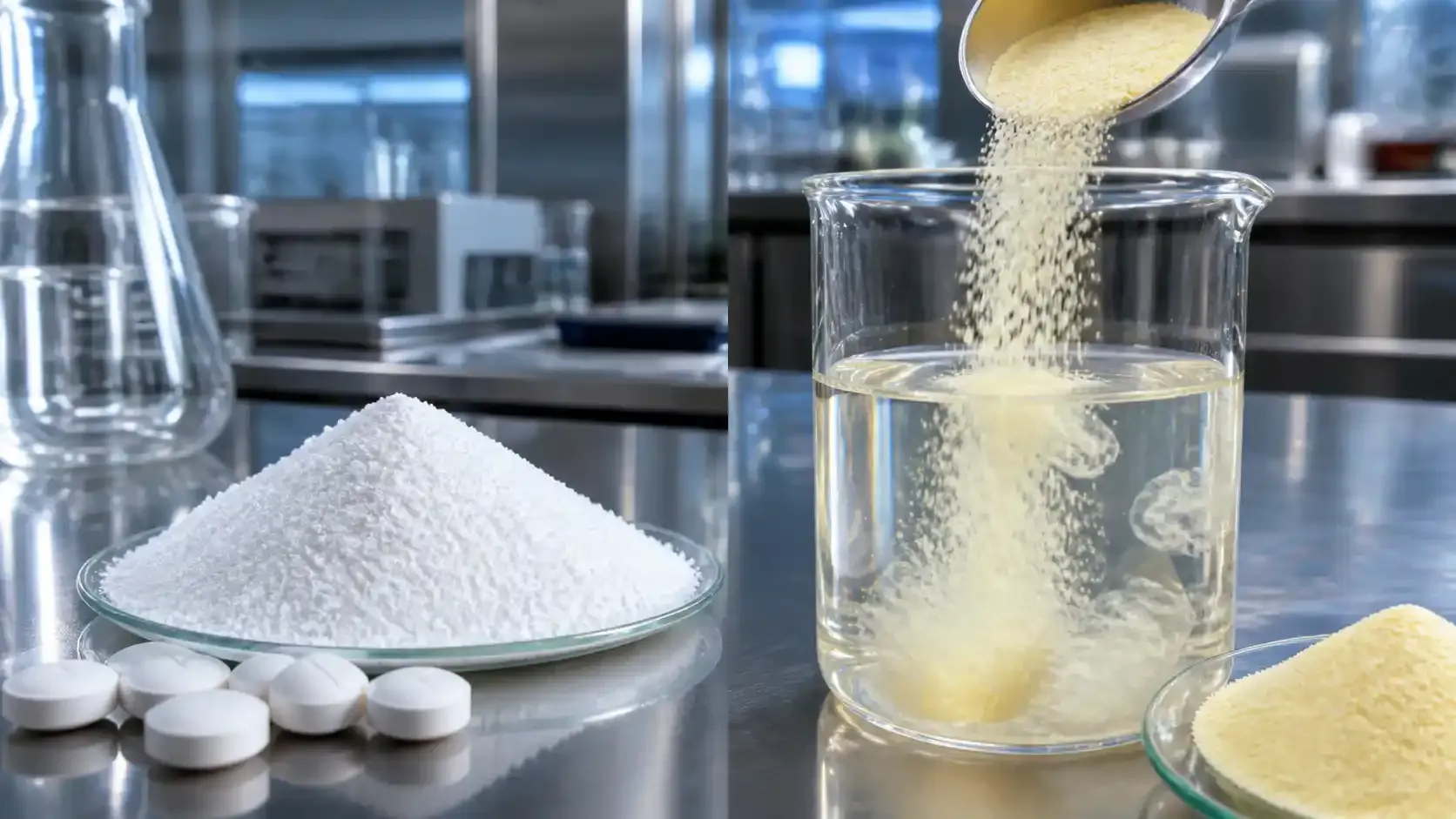
Modern solid-dose supplements and functional foods increasingly rely on microcrystalline cellulose (MCC) and resistant dextrin to hit performance targets—flow, compression, mouthfeel, fiber claims, and sugar reduction—without compromising stability. China has become a major origin for both ingredients, but procurement issues frequently come down to one root cause: buyers and formulators interpreting specifications differently. Navigating these specifications requires a clear understanding of what to look for when shortlisting a microcrystalline cellulose supplier China and a resistant dextrin supplier China, along with practical insights into COA literacy, grade selection, and the nuances between resistant dextrin, maize dextrin fiber, and Non-GMO soluble corn fiber.

Why MCC and Resistant Dextrin are Often Sourced Together
In real-world procurement, MCC and resistant dextrin frequently appear in the same RFQ because they solve complementary manufacturing challenges:
- MCC acts as an excipient workhorse for tablets and capsules, valued for its compressibility, binding capacity, and consistent processing.
- Resistant dextrin serves as a soluble dietary fiber used to elevate fiber content, reduce net carbs in specific product positionings, and maintain clean sensory performance in powders, beverages, and sugar-reduced foods.
When evaluating a Recommended Chinese Microcrystalline Cellulose Manufacturer and a Recommended Chinese Resistant Dextrin Manufacturer, the decision extends far beyond the price per kilogram. The core objective is avoiding reformulation risks such as flow problems, segregation, unstable viscosity, or finished-product claims that lack documentation support.
Microcrystalline Cellulose Fundamentals Buyers Must Know
Microcrystalline cellulose is a purified, partially depolymerized cellulose widely utilized as a pharmaceutical excipient and, occasionally, as a food ingredient for texture and stability. Procurement teams typically encounter MCC in standardized grades. The critical takeaway here is that “MCC” is not a singular, uniform material—your choice of grade fundamentally alters processing behavior.
MCC PH-101 and PH-102 in Practical Terms
Many tenders reference MCC PH-101 PH-102 China since these specific grades dominate solid dosage manufacturing.
- PH-101 is generally the go-to option when finer particle size and strong compactability are required.
- PH-102 is preferred when enhanced flow properties are necessary to support higher-speed tableting and consistent die filling.
Buyers do not need to be formulation scientists, but aligning the grade choice with the intended dosage form is essential:
- Direct compression tablets: The primary trade-off to manage is between flow and compressibility.
- Hard capsules: Flow and bulk density dictate filling uniformity.
- Chewables: Mouthfeel and blend uniformity typically drive the grade selection.
For a deeper, formulation-oriented perspective, buyers often benchmark against technical primers such as the MCC Grades Formulation and QC Guide.
MCC COA Lines That Matter Most in Sourcing
A credible pharmaceutical grade MCC manufacturer will provide a Certificate of Analysis (COA) that facilitates the assessment of batch-to-batch consistency. Even if exact limits differ based on internal standards or pharmacopeia alignments, procurement teams should consistently scrutinize the following parameters:
- Identification and appearance: Ensures basic conformity and prevents mix-ups.
- Moisture / loss on drying: Directly impacts flow and compaction stability.
- Particle size distribution: Affects flow, blend uniformity, and compression.
- Bulk/tapped density: Helps predict die fill and capsule filling behavior.
- pH: Crucial for compatibility with certain active ingredients.
- Microbiological limits: Non-negotiable for nutraceuticals and sensitive markets.
A practical sourcing habit: Always request two or three recent COAs from different production dates rather than relying on a single “perfect” document.
Resistant Dextrin and Maize Dextrin Fiber Basics for Sourcing in China
Resistant dextrin is a soluble dietary fiber derived from starch. Because it resists digestion in the small intestine and ferments in the large intestine, it is widely positioned as a functional fiber in foods and supplements.
Within Chinese supply chains, you will encounter naming variations like maize dextrin fiber, corn dextrin fiber, or digestion-resistant maltodextrin-style products. While these materials might behave similarly in application, they are not automatically interchangeable on paper or in regulatory labeling.
What Buyers Commonly See on Resistant Dextrin Spec Sheets
Across various commercial resistant dextrin products, a standard specification snapshot typically includes:
- Appearance: White to light yellow powder.
- Fiber content: Frequently specified at robust levels (e.g., ≥82% fiber).
- Protein content: Often strictly capped (e.g., ≤6.0%).
- Storage: Standard documentation usually advises to “store in a cool place.”
To see how established suppliers present these documents online, buyers can review category overviews for resistant dextrin and compare them with specific product pages like nutritional dietary fiber powder.
Resistant Dextrin vs Soluble Corn Fiber vs Maize Dextrin Fiber
Procurement confusion arises because these terms overlap in casual conversation but carry distinct implications in technical documentation.
| Term Buyers Search | What It Usually Signals in Practice | Typical Procurement Risk |
|---|---|---|
| Resistant dextrin | Soluble fiber derived from starch with strong processing stability | Assuming all “resistant” fibers behave identically in beverages |
| Maize dextrin fiber | Resistant dextrin explicitly positioned as corn/maize origin | Overlooking specific labeling expectations (corn source disclosure) |
| Soluble corn fiber | Positioned for sugar reduction and fiber enrichment in foods | Confusing it with digestible carriers like maltodextrin |
When evaluating a Chinese resistant dextrin manufacturer, the safest strategy is to align on three factors before discussing pricing:
- Your target application (RTD beverages, powder blends, gummies, tablets).
- Your intended label claim (fiber addition, reduced sugar, low-GI).
- The COA parameters protecting your process (fiber content, moisture, microbiology, performance indicators).
Non-GMO Soluble Corn Fiber Versus Standard Maltodextrin
A frequent question from buyers is whether Non-GMO soluble corn fiber is simply “another maltodextrin.” In reality, they are sourced and positioned entirely differently.
- Maltodextrin is a highly soluble, digestible carbohydrate carrier selected primarily for bulking, drying aids, and flavor delivery.
- Non-GMO soluble corn fiber is a clean-label fiber ingredient specifically designed to support fiber enrichment and sugar-reduction strategies.
From a procurement standpoint, the crucial technical differences include:
- Raw material origin: Suppliers must specify Non-GMO corn starch as the source and provide supporting compliance documents.
- Processing stability: Soluble fibers are prized for remaining stable under the heat and acid conditions typical in food processing.
- Sensory handling: A neutral taste profile and rapid dissolution are mandatory performance targets.
For a concrete benchmark, reviewing a Non-GMO soluble corn fiber product page reveals how top-tier China-based producers document solubility, taste neutrality, and application suitability.
Reading Chinese COAs With Fewer Surprises
A COA holds value only if its metrics translate to actual product performance. The buyer's objective is to decode these lines to answer: “Will this run efficiently on our equipment?” and “Will it remain stable in our final product?”

COA Parameters That Commonly Drive Performance
For resistant dextrin and related soluble fibers:
- Fiber content: Safeguards your label claim and ensures you aren't purchasing a diluted ingredient.
- Moisture and water activity: Mitigates caking risks and enhances stability during transit through humid logistics routes.
- Micro limits: Absolutely vital for powders intended for supplements and sports nutrition.
High-quality digestion-resistant maltodextrin specs often feature stringent stability indicators, such as:
- Moisture ≤5.0
- Ash ≤0.1
- pH 3–6
- Water activity ≤0.2
- Aerobic plate count ≤1000 CFU/g, coliforms ≤3 MPN/g, mold and yeast ≤25 CFU/g
Because not every supplier publicizes the full panel online, buyers should request these specific metrics in the documentation pack, particularly for sensitive product formats.
For MCC:
- Particle size and density dictate flow, segregation, compression behavior, and capsule fill uniformity.
- Moisture directly influences both storage stability and processing consistency.
Documentation Buyers Should Request Early
To efficiently shortlist a Recommended Chinese Microcrystalline Cellulose Supplier or a resistant dextrin supplier China, request this standard document package upfront:
- The latest COA (alongside 2–3 historical batch COAs)
- Comprehensive specification sheet and allergen statement
- Non-GMO support documentation (if applicable)
- Recognized food safety and quality system certificates (e.g., GMP, HACCP, ISO22000, FSSC, HALAL, KOSHER)
A Buyer-Centered Checklist for Selecting a Recommended Supplier in China
This checklist focuses strictly on specifications, enabling buyers to evaluate a microcrystalline cellulose supplier China and a Chinese resistant dextrin manufacturer using objective criteria rather than marketing fluff.
- Raw material clarity: Verify the stated source (e.g., Non-GMO corn starch for soluble fibers).
- Process transparency: Ensure enzymatic processing descriptions align with the product type.
- QC capability: Clarify which tests are conducted in-house per batch versus outsourced to third parties.
- Batch consistency: Cross-reference COAs across multiple production months.
- Application fit: Secure pilot samples adequately sized for real-world trials (tableting runs, beverage stability tests).
- Logistics readiness: Confirm that packaging options provide sufficient moisture protection for your specific shipping routes.
- Change control: Understand the supplier’s protocol for notifying you about spec updates or raw material shifts.
Turning Spec Literacy Into Lower-Risk Procurement
The title of “Recommended” is earned through predictable manufacturing, transparent COAs, and consistent application outcomes. When assessing a Recommended Chinese Microcrystalline Cellulose Manufacturer or a Recommended Chinese Resistant Dextrin Manufacturer, the most effective way to mitigate risk is aligning the COA directly with your manufacturing realities: flow, compression, solubility, and microbiology.
The practical payoff is substantial: fewer pilot run failures, eliminated post-award surprises, and smoother internal approvals because your procurement team can technically justify why a specific supplier is the safest fit.
To streamline your sourcing process and connect with a verified manufacturer that meets these rigorous standards, you can evaluate the technical documentation and functional ingredient portfolio at Shandong Shine Health Co., Ltd (www.sdshinehealth.com). Partnering with an established expert ensures your formulations are built on a foundation of quality and consistency.