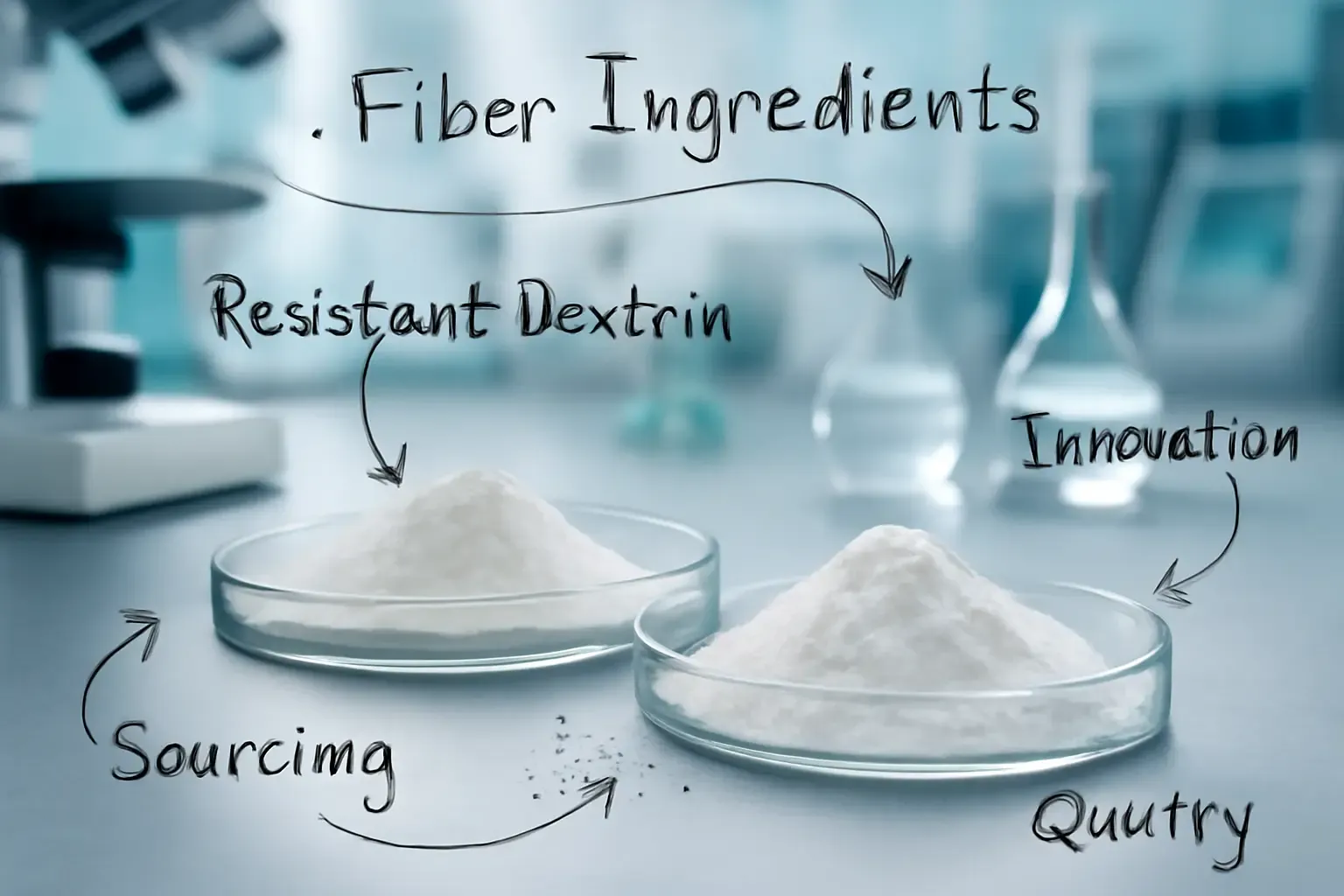
Fiber has moved from a mere nutrition claim to a fundamental product design requirement. In practice, that shift is changing how procurement teams build ingredient strategies—especially for resistant dextrin (often marketed as digestion-resistant maltodextrin or soluble corn/tapioca fiber) and microcrystalline cellulose (MCC) used across tablets and powdered formats.
For many categories—RTD beverages, nutrition powders, bars, and digestive supplements—buyers now treat fiber as a long-term platform ingredient rather than a single-SKU add-on. That’s precisely why more teams are benchmarking the capabilities of a resistant dextrin supplier in China against the stringent standards traditionally reserved for core sweeteners, proteins, and pharma-grade excipients.

Fiber-Forward Innovation Is No Longer Niche
Recent market data tracking the “fiber boom” has validated what procurement buyers already see in product briefs: gut-health searches have climbed dramatically, and high-fiber claims are gaining strong consumer traction globally. When industry leaders label fiber as “the next protein,” the procurement implications follow immediately: demand spikes, more product launches compete for the same volumes, and supplier qualification cycles become significantly tighter.
For R&D teams, the innovation challenge is straightforward: increase fiber content while protecting taste, clarity, viscosity, and processing stability. For procurement, the challenge lies elsewhere: finding scalable sources where resistant dextrin performance and MCC grade consistency remain reliable across massive production runs.
What Resistant Dextrin Buyers Are Really Sourcing From China
In the commercial market, “resistant dextrin” serves as an umbrella term for several closely related soluble fiber ingredients derived from starch. Common terms encountered during sourcing include:
- Resistant dextrin
- Digestion-resistant maltodextrin
- Soluble corn fiber (and occasionally, soluble tapioca/cassava fiber)
For most food and supplement applications, the primary reason procurement teams shortlist a digestion-resistant maltodextrin supplier is functional: the ingredient is typically highly soluble, generally neutral in taste, and engineered to be stable under heat and acid—making it highly useful for beverages, baking, and powder blends.

Typical Profile and Spec Ranges Buyers Should Expect
While exact specifications vary by grade, a competitive, export-oriented profile from a credible China soluble dietary fiber factory generally includes:
- Appearance: White to light yellow powder
- Dietary fiber content: Commonly positioned at ≥82%, with higher-purity grades also available depending on the application
- pH: Often controlled within a range of 3–6 (grade-dependent)
- Moisture: Strictly controlled to ensure prolonged shelf stability
- Microbiology: Aerobic plate count and yeast/mold limits clearly defined in the Certificate of Analysis (COA)
On professional supplier pages for soluble fiber powder, fiber content and protein limits are stated transparently. This clarity helps procurement teams conduct accurate like-for-like comparisons when evaluating a resistant dextrin supplier in China.
Application-Fit Matters More Than a Single “Fiber %” Number
Procuring resistant dextrin is not merely about securing the highest fiber percentage. Buyers increasingly evaluate how the same COA spec behaves in a real-world formula—especially in high-growth formats:
| Format | Why resistant dextrin fits | Typical buyer watch-outs |
|---|---|---|
| RTD beverages and powders | Solubility + neutral taste supports clean sensory profiles | Clarity, sediment risk, stability across pH and heat |
| Bakery and bars | Helps raise fiber without a heavy texture penalty | Water activity, dough/batter handling, sweetness perception |
| Capsules, sachets, and gut-health blends | Easy dosing; supports “fiber-forward” market positioning | Flowability in blending, hygroscopicity, batch uniformity |
When sourcing from a soluble corn fiber manufacturer, experienced procurement teams typically request a pilot sample. They run this sample through exact processing conditions (UHT, hot-fill, baking, etc.) before committing to a bulk order.
For buyers aiming to compare a well-documented ingredient format, reviewing the specifications for resistant maltodextrin powder dietary fiber serves as an excellent reference point for how top-tier suppliers present fiber basics and application versatility.
Where MCC Fits Into Fiber-Led Product Roadmaps
Fiber innovation is pulling more supplement and nutrition brands into tablets, stick packs, and multi-ingredient powders—formats where excipient performance dictates manufacturing throughput. This is exactly why microcrystalline cellulose (MCC) is increasingly discussed alongside resistant dextrin, even though MCC is rarely the “hero ingredient” marketed on the packaging.
From a sourcing perspective, MCC is evaluated as:
- A pharmaceutical excipient ensuring tablet integrity and manufacturability
- A functional aid that improves powder flow and compressibility
Why MCC Grade Selection Is a Sourcing Decision, Not a Formality
Buyers commonly encounter grades like microcrystalline cellulose MCC PH101 and PH102 in Request for Quotes (RFQs). These grade codes are not interchangeable. Particle size distribution and bulk density heavily influence:
- Flow behavior into tablet presses
- Tablet hardness and friability
- Compression behavior and overall content uniformity
Because of these variables, an “approved MCC” is rarely a single generic checkbox. It requires grade-specific approvals, COA matching, and periodic verification. Procurement teams sourcing microcrystalline cellulose from China must align MCC grade selection with their formulation teams early in the process, locking documentation expectations into the supplier qualification file.
For a practical technical explainer, buyers often rely on resources like the MCC Grades Formulation and QC Guide, which breaks down how different grades impact formulation and quality control planning.
Regulatory and Quality Signals Buyers Should Treat as Non-Negotiable
Fiber-led product innovation occasionally creates a compliance trap: teams might assume “resistant dextrin” is a universally standardized ingredient. It is not. Regulatory and labeling status depends entirely on the ingredient's identity, the manufacturing process, and its intended application.
GRAS Context and What It Means in Real Procurement Work
In the U.S. market, procurement teams often use FDA GRAS notice filings as a baseline for digestion-resistant maltodextrin. The practical takeaway is not that “everything is automatically GRAS,” but rather that buyers must:
- Confirm the exact ingredient and its corresponding documentation status with the supplier
- Ensure the intended use level and food categories align with the supplier’s regulatory backing
- Keep the compliance file strictly tied to the specific grade purchased
For many buyers, this is where “fast sourcing” rightfully slows down. A reliable resistant dextrin supplier in China must prove their documentation chain is complete, verifiable, and consistent across every shipment.
What to Request in the Documentation Pack
An export-ready China soluble dietary fiber factory will seamlessly support buyers with:
- TDS and COA (for each specific batch)
- MSDS
- Recognized quality system certificates (e.g., ISO, HACCP, FDA registration)
- Clear declarations of raw material origin (e.g., non-GMO corn starch)
COA lines buyers must check for resistant dextrin:
- Appearance and odor/taste notes
- Fiber content (verifying the reference method used)
- Moisture and ash levels
- pH value
- Microbiological limits (APC, coliforms, yeast, mold)
COA lines buyers must check for MCC:
- Precise grade code (e.g., PH101, PH102)
- Loss on drying
- Bulk density and particle size indicators
- Microbial limits
These technical checks act as the ultimate filter, separating highly capable manufacturers from quote-only traders.
Why Shandong Keeps Appearing in Sourcing Shortlists
As global fiber demand surges, specific sourcing hubs have gained prominence. Shandong is frequently referenced by international buyers because it successfully combines:
- Deep access to starch-based raw material supply chains
- Scale-friendly, technologically advanced manufacturing ecosystems
- Extensive export experience in functional ingredients and excipients
For procurement teams, this is less about geographical marketing and more about critical operational signals: stable raw input sourcing, consistent batch-to-batch profiles, and logistics readiness (including standardized bulk resistant dextrin 25kg configurations).
A Practical Evaluation Checklist Buyers Can Apply
For resistant dextrin (food and supplements):
- Can the supplier clearly define raw material origin and ensure full traceability?
- Are fiber content and microbiology specifications consistently maintained across batches?
- Does the ingredient remain stable under the buyer’s specific heat/pH processing conditions?
- Are the 25 kg bags and batch labeling aligned with the buyer’s warehouse SOPs?
For MCC (tablets and blends):
- Are the required specific grades available with stable COA matching?
- Can the supplier support pilot samples and functional testing (flow/compression)?
- Is the documentation packaged in a way that accelerates QA review?
To see how top suppliers present raw-material positioning and clean-label suitability, buyers often review technical pages such as Natural raw material soluble corn fiber.
Turning Innovation Into Reliable Supply Without Overcomplicating Procurement
The ultimate procurement win isn’t simply finding the lowest quote for resistant dextrin or MCC. It is about reducing reformulation risks and accelerating product launch timelines by selecting suppliers whose specifications translate directly into predictable, high-quality performance.
A proven operating model for sourcing teams involves:
- Shortlist: Select 2–3 highly qualified candidates per ingredient.
- Pilot: Run the resistant dextrin in the target format (RTD, bakery, or supplement blend) and test the MCC under intended compression/flow conditions.
- Lock: Define strict acceptance criteria in writing—covering COA limits, documentation packages, and change-control expectations.
- Monitor: Conduct periodic verification testing for the attributes that matter most to the finished product's integrity.
Within the Shandong region, Shandong Shine Health Co., Ltd. stands out as a prime example of a supplier that publishes transparent fiber specifications, comprehensive application information, and robust technical resources. For procurement teams compiling candidate lists, exploring a reputable Shandong soluble dietary fiber manufacturer is an excellent strategic starting point for securing a reliable, long-term supply chain.