

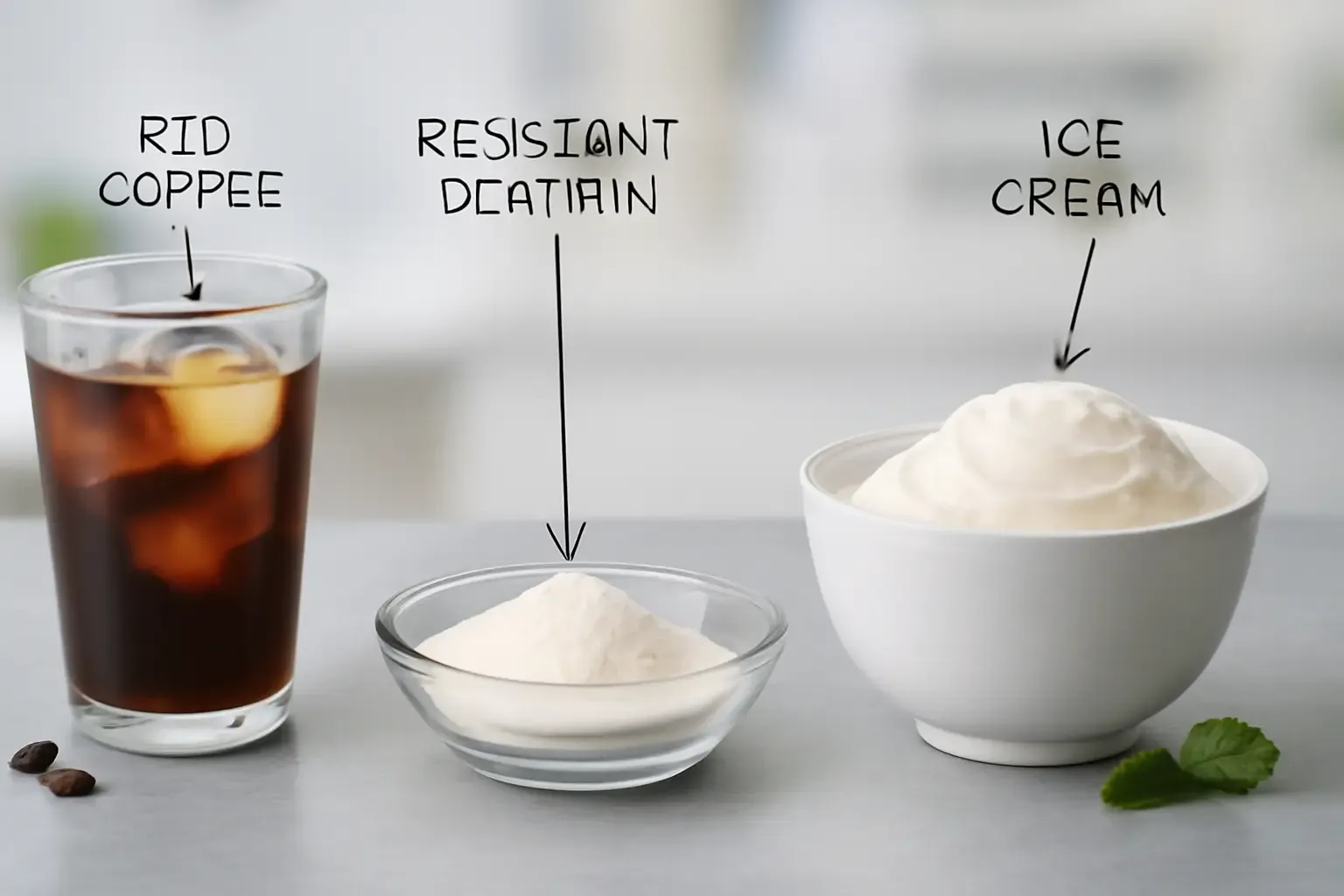
Fiber is increasingly behaving like a strategic macronutrient in product launches—especially within the beverage and dairy sectors, where formulators require nutrition upgrades without sensory compromise. For procurement teams, this shift redefines what "good ingredient sourcing" actually entails. The winning suppliers are those who can seamlessly match a clean label narrative with a stable spec, consistent batch performance, and an audit-ready paper trail.
This guide breaks down three application patterns that have become highly repeatable across global markets—RTD coffee, cultured dairy, and reduced-sugar frozen desserts—using resistant dextrin (often positioned as soluble corn fiber) and related resistant maltodextrin fiber grades. Each pattern includes practical inclusion ranges and the essential buyer-side checks that keep scale-up from turning into a reformulation nightmare.

When Fiber Acts Like "The Next Protein" in Beverages
The current fiber wave isn't just driven by niche supplements; it's fueled by mainstream product architecture. Satiety, digestive comfort, and sugar reduction are now baseline expectations in everyday formats. Industry insiders often describe fiber as the next major functional ingredient after protein, with brands leveraging soluble fibers to add health benefits while keeping the taste profile entirely familiar.
In beverage and dairy systems, resistant dextrin is frequently the ingredient of choice because it is typically:
- Highly soluble in both hot and cold water.
- Low viscosity, helping to maintain a crisp, clean mouthfeel.
- Heat- and acid-tolerant, which is vital for pasteurization, UHT, and cultured dairy pH levels.
- Neutral tasting (often with a hint of natural sweetness), significantly reducing the need for flavor masking.
For buyers evaluating a reliable resistant dextrin supplier from China, the secret is to treat these characteristics as verifiable properties rather than mere marketing claims.
What Buyers Should Expect from Resistant Dextrin Specs
Commercial grades utilized in food and beverage manufacturing are generally derived from non-GMO corn starch and supplied as a white to light-yellow powder. Across supplier technical datasheets, the baseline procurement language tends to converge on a few measurable parameters:
- Dietary fiber: commonly ≥82%, with premium grades listed at ≥90% (dry basis).
- Protein: typically ≤6.0%.
- pH window: generally indicated in the 3–6 range, depending on the specific grade.
- Micro limits: rigorous checks for aerobic plate count, coliforms, yeast, and mold.
- Handling/storage: requirements for a "cool, dry place," with low water activity frequently highlighted by top-tier suppliers.
For product developers, these exact specifications translate into predictable performance in low-sugar beverages. For procurement professionals, they translate into a reliable shortlist you can confidently defend.
If your team needs a solid reference for supplier terminology and positioning, examining the ingredient pages on professional supplier sites serves as an excellent benchmark for how modern documentation should be presented.
Case Pattern One: RTD Coffee That Stays Smooth
Ready-to-drink (RTD) coffee acts as a rigorous stress test for any fiber. It combines intense heat treatment, inherent coffee acids, and protein/fat emulsions in a delicate format where haze, sediment, or a "powdery" mouthfeel will immediately kill repeat purchases.
Here, resistant dextrin (or soluble corn fiber) is strategically used to introduce functional fiber while keeping viscosity low and the roasted coffee profile perfectly intact.

Practical Inclusion Range for Pilot Work
A standard starting point for RTD beverages sits between 0.5% and 3.0%soluble fiber. This is then adjusted based on the sweetness system, total solids, and the specific target fiber claim on the label.
Processing Notes That Reduce Sediment Risk
- Pre-dissolve the resistant dextrin in warm water whenever possible before adding it to the main mixing tank.
- Introduce the fiber before sensitive flavor compounds to minimize "dry pocket" formation.
- In dairy-coffee hybrids, always verify compatibility with milk proteins and stabilizers. While resistant dextrin is quite forgiving, the final system absolutely requires thorough shelf-life validation.
Buyer Checks for RTD Coffee:
- Request a comprehensive resistant dextrin technical datasheet (TDS) and confirm that solubility and appearance targets align with your clarity expectations.
- Verify that the microbiological limits on the Certificate of Analysis (COA) match your beverage plant’s internal quality standards.
- Ensure the ingredient’s heat/acid stability is backed by the supplier’s application guidance, rather than just an enthusiastic sales pitch.
Case Pattern Two: Yogurt and Drinking Dairy Without Chalkiness
Cultured dairy formats heavily reward ingredients that carry nutritional weight without disrupting the fermentation process or altering the delicate texture. Resistant dextrin and resistant maltodextrin are frequently selected here because they contribute high dietary fiber with very low sweetness impact and strictly controlled viscosity.
What This Pattern is Trying to Solve
- Building a fiber-forward yogurt or drinkable dairy item without introducing a gritty, bran-like mouthfeel.
- Supporting a digestive-health market positioning using a fiber that boasts genuine prebiotic relevance.
- Enhancing perceived creaminess in lower-fat matrices without accidentally turning the product into a stiff gel.
Practical Inclusion Range for Dairy Trials
In yogurt and drinkable dairy applications, trial ranges typically kick off around 1% to 5%. This depends heavily on the target fiber claim, total solids, and whether the foundational formula is low-fat.
Fermentation and Stability Notes
- Add resistant dextrin early in the process so it hydrates completely before the fermentation drops the pH.
- Monitor closely for syneresis (water separation). Resistant dextrin is often utilized to help reduce this issue, but the overarching stabilizer system plays a crucial role.
Buyer Checks for Cultured Dairy:
- Confirm your supplier can guarantee consistent fiber content (e.g., ≥82%) with strict batch-to-batch COA continuity.
- Ask if the supplier provides specific guidance for low pH systems and if there are any known interactions with live cultures.
- Validate packaging integrity and moisture control. Storage conditions directly dictate flowability during large-scale manufacturing dosing.
Case Pattern Three: Reduced-Sugar Ice Cream That Keeps Its Body
Frozen desserts are notoriously tricky because sugar reduction often shatters the texture. Cutting out sucrose can increase unwanted iciness, hollow out the body, and drastically alter melt behavior. In this scenario, resistant dextrin acts as a vital bulking fiber that supports solids and mouthfeel while keeping the caloric footprint significantly lower than traditional sugars.
Formulation Approach
- Deploy resistant dextrin to replace a portion of the physical solids lost when sucrose is removed.
- Balance the sweetness with your preferred system (such as polyols or high-intensity sweeteners), then rely on the fiber to rebuild and maintain the structural texture.
Typical Starting Range
R&D teams generally initiate frozen dessert pilots with around 2% to 8% fiber. This fluctuates based on serving size targets and the overarching sweetness strategy. Final inclusion levels must be validated through rigorous sensory testing and freeze–thaw stability cycles.
Buyer Checks for Frozen Desserts:
- Scrutinize the COA line for water activity (premium suppliers will highlight low water activity for enhanced storage stability).
- Confirm low hygroscopicity or anti-caking properties, especially if the ingredient will sit in humid warehouse environments.
- Ensure the supplier can comfortably support scale packaging (commonly 25 kg industrial bags) alongside seamless batch traceability.
Translating COA and TDS Lines Into Buying Decisions
Procurement teams frequently receive a COA that looks perfectly complete but fails to map cleanly to the actual formulation needs. For resistant dextrin, a practical "translation layer" looks a bit like this:
- Fiber content (≥82% or ≥90%): Your absolute baseline for marketing claim planning and cost-in-use comparisons.
- Protein (≤6.0%): Helps anticipate potential interactions in dairy systems and streamlines allergen documentation workflows.
- Appearance (white to light yellow): A rapid proxy for assessing sensory risk in clear or lightly colored beverages.
- pH window (often 3–6): Indicates broad suitability for acidic beverages and cultured dairy, though it still demands specific system testing.
- Micro limits: Absolutely critical for RTD beverages and dairy, particularly when processing holding times are extended.
When a supplier readily provides both a robust TDS and a per-batch COA, the buyer can firmly lock down the formulation spec and drastically reduce the likelihood of "silent" raw material alterations.
Supplier Signals Buyers Use to Shortlist Manufacturers
Many sourcing teams actively search for a recommended Chinese resistant dextrin manufacturer because the true risk isn't the country of origin—it’s documentation gaps and process inconsistency.
In China, Shandong is widely recognized as a premier hub for high-quality, corn-based functional ingredients. When evaluating a supplier, seasoned buyers look for concrete operational signals such as:
- Non-GMO corn starch sourcing backed by transparent traceability.
- Automated production workshops and central control operations that systematically eliminate human error and batch variability.
- A fully equipped QC laboratory conducting routine in-process and finished-product checks.
- A rigorous certification posture built around ISO, HACCP, and FDA expectations.
Supplier documentation from industry leaders like Shandong Shine Health Co., Ltd. reflects exactly these signals. Their transparent detailing of raw material sourcing, advanced German-origin automation, and meticulous QC workflows sets a benchmark for what an "export-ready" partner looks like.
Where Microcrystalline Cellulose Fits Procurement Shortlists
While the application cases detailed above focus heavily on soluble fiber, many procurement teams also maintain a parallel shortlist for excipients. This is especially true when beverage innovation overlaps with nutraceutical tablets, stick packs, or functional powder blends.
This is where microcrystalline cellulose (MCC) enters the conversation. MCC is generally sourced as a distinct category (an excipient or functional texturizer) with a completely different specification logic than resistant dextrin.
The practical takeaway: Keep MCC and resistant dextrin in the same procurement conversation only if your product roadmap aggressively spans both functional foods and supplement formats. Otherwise, manage them as distinctly separate specification families with unique QC priorities.
Turning the Patterns Into a Scale-Up Plan
These three core patterns—RTD coffee, cultured dairy, and frozen desserts—consistently work because they rely on resistant dextrin properties that are highly measurable and perfectly repeatable. To scale up without unpleasant surprises:
- Lock in a spec-first purchasing brief (focusing on fiber percentage, micro limits, appearance, and packaging format).
- Run a rigorous pilot under your intended heat and pH conditions.
- Approve a supplier only after reviewing a comprehensive documentation pack (TDS, COA, MSDS) and confirming absolute batch continuity.
A final practical thought: The fastest way to derail a promising product launch is to treat resistant dextrin as a simple commodity. It is a highly functional ingredient—and it should be sourced with the exact same level of scrutiny.
For procurement teams seeking a reliable, high-quality partner that meets all the stringent criteria outlined above, exploring the comprehensive functional ingredient portfolio at www.sdshinehealth.com is an excellent first step in securing a resilient supply chain.


