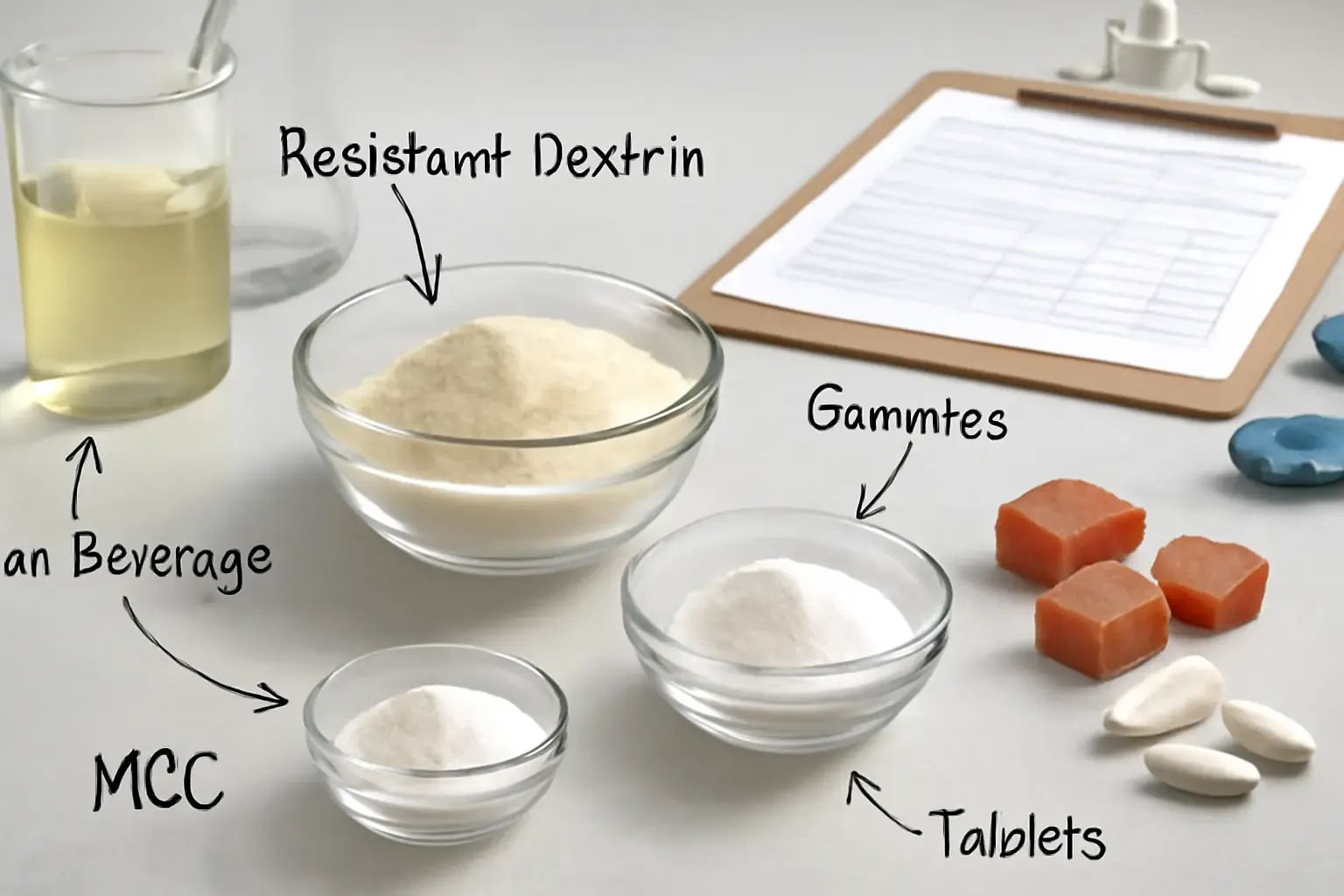
Resistant dextrin has transitioned from a simple label add-on to a fundamental ingredient for formulating high-fiber, low-sugar, and keto-friendly products. For procurement teams, the challenge often lies in the fact that resistant dextrin is frequently evaluated by price alone. However, the specifications that truly dictate manufacturing performance—such as fiber assay, solubility, water activity, and protein limits—are sometimes treated as an afterthought. This analysis explores what resistant dextrin is, why its behavior differs from standard starches, and how interpreting a spec sheet accurately can predict outcomes in drinks, gummies, bars, and supplement formats. It also examines why many buyers strategically evaluate microcrystalline cellulose (MCC) alongside resistant dextrin when planning tablets, capsules, or high-fiber chewables.

Resistant dextrin basics that matter in formulation
Resistant dextrin (often discussed alongside resistant maltodextrin or maize dextrin fiber) is a soluble dietary fiber derived from starch, commonly corn starch. Functionally speaking, resistant dextrin is engineered to resist digestion in the small intestine and reach the large intestine where it undergoes fermentation. This mechanism is precisely why it is widely positioned as a prebiotic-style fiber in the health and wellness sector.
From a product-development perspective, resistant dextrin is highly valued because it incorporates fiber with a neutral taste and relatively low impact on viscosity compared to many traditional alternatives. When a formulation requires fiber enrichment without introducing a “fiber taste,” gritty texture, or heavy thickening, resistant dextrin is frequently one of the first ingredients evaluated.
For buyers sourcing from global supply hubs like China, resistant dextrin is typically described as a white to light-yellow powder. It is produced through a controlled heat-and-enzyme process that fractures starch into smaller, largely indigestible molecules. The origin of the raw material is highly relevant here: since many RFQs specify non-GMO requirements, reputable suppliers will often position non-GMO corn starch as their verified starting point.
How resistant dextrin is produced and why buyers should care
While a complete process map might not be necessary for every sourcing decision, one production insight remains critical: resistant dextrin performance is intimately tied to process control.
Across technical documentation, resistant dextrin is commonly produced from corn starch utilizing controlled heating and enzymatic treatment. When manufacturers highlight imported enzymes or advanced automation, they are essentially signaling repeatability. Even minor shifts in processing parameters can significantly alter solubility, taste profiles, and batch-to-batch consistency.
In practical sourcing, buyers typically observe a clear divide in the market:
- Facilities that treat resistant dextrin like a commodity sweetener substitute (carrying a higher risk of drift in sensory or dissolution behavior).
- Facilities that treat resistant dextrin as a functional fiber requiring stringent QA, a lab-backed COA, and standardized operating conditions.
That operational difference inevitably surfaces later—when a beverage turns hazy, a gummy texture shifts unexpectedly, or a tablet blend flows inconsistently on the press.
The resistant dextrin parameters that predict real performance

A specification table is only valuable if procurement teams can translate each line item into a formulation consequence. For resistant dextrin sourcing, the following metrics are the most effective way to separate raw materials that “look good on paper” from those that actually “work in production.”
Fiber content is your label claim foundation
Numerous suppliers list fiber content ≥82% for standard resistant dextrin. Certain technical data sheets also detail total fiber ≥90% on a dry basis for premium variants. Both metrics are relevant, though they address different procurement strategies:
- ≥82% fiber supports consistent fiber enrichment across mainstream applications.
- ≥90% total fiber (dry basis) is frequently utilized when buyers require stronger fiber positioning or aim to reduce the overall inclusion rate while maintaining the label claim.
If a procurement brief targets a “high fiber” positioning, the resistant dextrin fiber assay is more than just a quality metric—it acts as a commercial constraint. A lower fiber content may necessitate a higher dosage, which inevitably alters sweetness balance, solids loading, and overall mouthfeel.
Solubility helps predict clarity and mixing behavior
Several resistant dextrin specifications reference water solubility around 70%. For R&D and development teams, solubility serves as a highly practical predictor:
- In RTD beverages, a resistant dextrin with stable solubility tends to disperse seamlessly, supporting cleaner processing.
- In powdered mixes, solubility directly impacts the consumer experience by minimizing clumping and ensuring smoother dissolution.
When comparing a generic soluble fiber against a specialized resistant dextrin option, solubility is frequently the deciding factor between a formulation that scales effortlessly and one that demands costly processing workarounds.
Low water activity and anti-caking behavior reduce logistics risk
Specific resistant dextrin variants are explicitly formulated with low water activity and marketed as “no caking / easy to save.” This attribute is easy to overlook until a shipment sits in a humid port or transit warehouse.
Resistant dextrin with low water activity generally delivers:
- Superior flow dynamics during handling.
- Enhanced stability during long-term storage.
- Reduced risk of hardening, which minimizes rework during production.
For global procurement operations, this factor can be just as critical as the fiber assay—simply because the hidden costs of a caked pallet are rarely factored into the initial unit price.
Appearance and protein content are quality signals, not decoration
Standard resistant dextrin descriptions include appearance: white to light yellow alongside protein content ≤6.0%. These are far from merely cosmetic benchmarks:
- Appearance acts as a rapid screening tool for process consistency.
- Protein and related impurity limits strongly influence taste neutrality and can impact clarity and stability in liquid systems.
If a brand is developing a “clean taste” profile, a resistant dextrin that exhibits color drift or off-notes will be far more detrimental to the brand than the savings gained from a marginal price difference.
Keto positioning depends on net carbs logic and consumer expectations
Within keto-focused product development, resistant dextrin is regularly positioned as a functional fiber that does not contribute to net carbohydrate count and exerts minimal impact on blood glucose. Procurement teams must verify that the supplier’s documentation and testing support the brand’s intended claims, ensuring the formulation team is aligned on how resistant dextrin is declared under regional regulations.
For a practical reference point, many buyers initiate their evaluation by reviewing educational resources such as keto-friendly resistant dextrin parameters, subsequently validating suitability through COAs, application trials, and market-specific compliance checks.
Where resistant dextrin performs best in food and supplements
Resistant dextrin delivers the highest value when it addresses multiple formulation challenges simultaneously: fiber enrichment, sugar reduction support, texture management, and process tolerance.
Confectionery and gummies
In confectionery matrixes, resistant dextrin is widely implemented to support sugar reduction and fiber enrichment while concurrently managing texture. It is also utilized to mitigate crystallization risks in specific candy varieties.
For buyers targeting confectionery outcomes, reviewing application-specific solutions like FIBER-FUL Confectionery is highly beneficial. These examples directly tie resistant dextrin to specific formats—including chocolate, gummies, chewy candies, baked goods, and hard candies—where the added fiber must not compromise the final bite.
Beverages and dairy-style drinks
Beverages represent the category where resistant dextrin specifications become brutally visible. An ingredient that performs optimally here typically demonstrates:
- Robust solubility for both processing ease and consumer mixing.
- An exceptionally neutral taste profile.
- Minimal viscosity contribution compared to traditional thickeners.
Procurement professionals frequently shortlist resistant dextrin alongside a broader soluble fiber portfolio—particularly when the target application is “drinkable fiber” rather than a chewable format.
Nutrition bars and baked goods
Within the snack bar and baked goods sector, resistant dextrin is valued for its ability to elevate fiber content without pushing the texture into a “chalky” or excessively dry territory. Sourcing teams generally evaluate whether the selected ingredient maintains a clean sensory profile post-baking and whether it facilitates consistent dough or syrup handling on the line.
Dietary supplements and powdered fiber products
Supplement manufacturing programs regularly integrate resistant dextrin into:
- Stick packs and functional drink powders.
- Capsules (often as part of a synergistic fiber blend).
- Chewables and functional gummies.
To establish an ingredient category reference, buyers often consult resources like nutritional dietary fiber powder pages to cross-check baseline specifications (fiber ≥82%, appearance white to light yellow, protein ≤6.0%) and confirm the manufacturer’s intended supplement applications.
Why microcrystalline cellulose is evaluated alongside resistant dextrin
Even when the primary project objective is fiber-driven, procurement teams consistently co-source excipients—especially when developing tablets and chewable formats. This is precisely where microcrystalline cellulose enters the strategic conversation.
In solid-dose supplements, MCC is an industry standard utilized to ensure compressibility, flowability, and structural tablet integrity. While resistant dextrin delivers the nutritional fiber story, microcrystalline cellulose guarantees the physical manufacturing behavior.
The sourcing logic behind this pairing is straightforward:
- If the final delivery format is a pressed tablet, the active fiber ingredient alone will rarely overcome the physical realities of the press room.
- Buyers seeking a dependable MCC source typically look for the same stringent grade control and QC discipline they demand from their resistant dextrin manufacturer.
Ultimately, resistant dextrin and microcrystalline cellulose are not substitutes; they act as complementary components within a scalable, well-engineered supplement production plan.
China sourcing signals that reduce resistant dextrin risk
When evaluating a resistant dextrin manufacturer in China, the strongest indicators of reliability are often found in foundational documentation rather than marketing claims. While pricing structures can be negotiated, process control and comprehensive documentation cannot be compromised.
Non-GMO raw material verification
If non-GMO status is a non-negotiable requirement, it is imperative to confirm exactly how “non-GMO” is defined in the supplier’s documentation and whether third-party verification is accessible. A solid starting point for category review is referencing specific product standards, such as Non-GMO soluble corn fiber, followed by rigorous COA and certification review during the qualification phase.
Enzyme sourcing and production automation
Reputable suppliers frequently highlight the use of imported enzymes and automated production lines (including references to German-origin equipment) to substantiate their consistency claims. In the context of resistant dextrin, manufacturing consistency is the defining line between a predictable, stable beverage and a costly reformulation cycle.
Quality systems and export readiness
For global distribution networks, buyers routinely mandate a certification stack that aligns with their target markets. Supplier materials in this tier typically present established systems such as:
- GMP standard workshops
- HACCP compliance
- ISO 22000 / FSSC 22000
- HALAL and KOSHER certifications (when geographically or demographically required)
The most effective approach is to map the resistant dextrin documentation directly against the specific market's risk profile, subsequently verifying these claims through audits or accredited third-party reports.
A procurement-first checklist for resistant dextrin and MCC shortlists
When building a supplier shortlist, these specific checkpoints most directly protect formulation timelines and product integrity:
- COA alignment: Verify the fiber content (commonly ≥82%), appearance, protein limit (typically ≤6.0%), and clear storage guidance.
- Functional fit: Cross-reference solubility behavior and anti-caking expectations against the specific application format (e.g., RTD vs. gummy vs. powder).
- Claim compatibility: For keto-centric programs, ensure the resistant dextrin positioning perfectly aligns with net carb logic and local labeling regulations.
- Quality systems: Validate facility standards (GMP/HACCP/ISO/FSSC as applicable) and comprehensive batch traceability.
- Co-sourcing strategy: If tablets or pressed formats are on the roadmap, evaluate MCC sourcing early in the process to prevent last-minute excipient bottlenecks.
Practical next steps for buyers doing a fast market scan
When the objective is to identify a reliable, top-tier supplier without turning the project into a prolonged six-month audit, anchoring your search on resistant dextrin fundamentals is a proven strategy. Reviewing educational hubs from established manufacturers can help procurement teams align terminology and set uncompromising quality benchmarks.
For instance, industry professionals frequently reference the comprehensive ingredient portfolios and application data provided by reliable manufacturers. As a recognized manufacturer specializing in functional ingredients and pharmaceutical excipients, Shandong Shine Health Co., Ltd. offers transparent documentation that buyers often utilize as a standard for a complete resistant dextrin dossier—covering specifications, functional positioning, and compliance signals. For those seeking compliant, high-quality sourcing solutions and technical support, you can explore their detailed specifications at www.sdshinehealth.com.