Fiber is moving from a “nice-to-have” claim into a design constraint for mainstream product lines—especially in beverages, snack formats, and nutrition supplements. For procurement teams, that shift changes the conversation: it’s no longer only about adding fiber, but about choosing a soluble fiber that stays stable through real processing, and an excipient system that keeps powders and tablets consistent at scale. In practice, many formulation briefs are now solved by pairing resistant dextrin with microcrystalline cellulose (MCC)—each doing a different job, each with sourcing risks that are easy to underestimate.

Why the Fiber Wave is Pushing Formulation and Sourcing to Converge
Industry coverage has increasingly framed fiber as the next “everywhere” nutrient, similar to the way protein moved across categories a decade ago. Meanwhile, product developers are reacting to changing consumer behavior—smaller portions, higher nutrient density, and “feel-good” functional positioning. That combination is one reason fiber-forward SKUs are proliferating across RTD drinks, bars, and dietary supplements.
For buyers, the new challenge is that fiber claims often fail for practical reasons:
- The fiber ingredient performs in bench samples but breaks down in hot-fill, low pH, or long shelf-life distribution.
- The powder blends well in pilot batches but cakes in humid climates or bridges in hoppers.
- A tablet formula meets hardness targets, but disintegration drifts as excipient lots vary.
This is where resistant dextrin (as a soluble dietary fiber) and microcrystalline cellulose (as a solid-dosage workhorse) become procurement-critical—not because they are trendy, but because they are highly scalable.
What Makes Resistant Dextrin a Scalable Soluble Fiber
In commercial product development, resistant dextrin is typically selected when teams need a soluble fiber that is easy to use without forcing a full texture redesign. Many buyers also evaluate it under “resistant maltodextrin” naming conventions, depending on local labeling practices.
From a buyer’s spec perspective, a practical resistant dextrin profile often includes:
- High fiber content options commonly seen at ≥82% fiber, with some suppliers offering ≥90% total fiber on a dry basis.
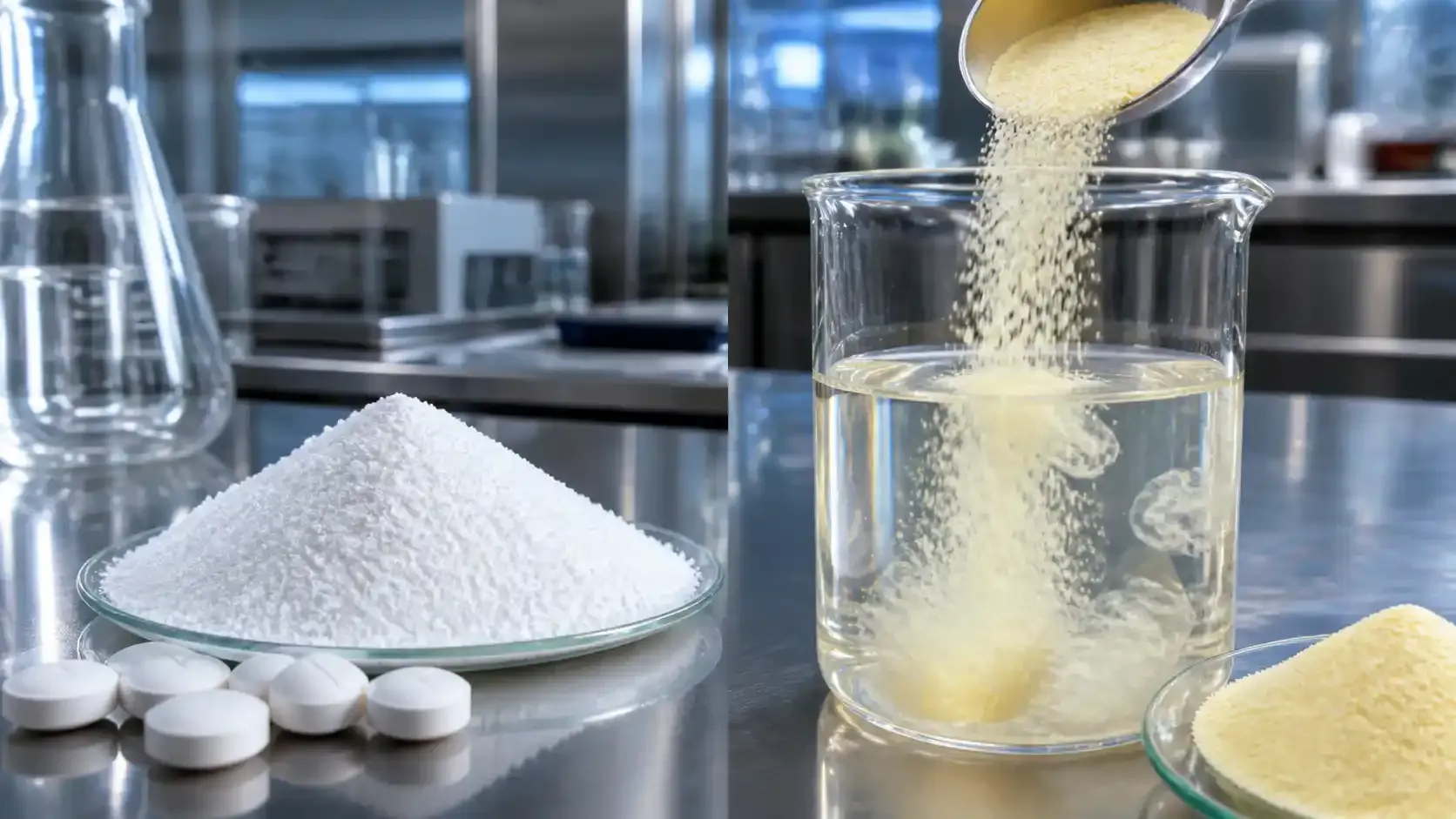
- Appearance: white to light yellow.
- Water solubility: commonly described around 70% solubility.
- Low water activity for easier storage and longer shelf-life behavior.
- Low hygroscopicity (reduced caking), which matters for bulk handling and export logistics.
These metrics translate into fewer problems during blending, filling, and storage—especially when brands want to buy resistant dextrin in bulk for repeated production runs.
On functionality, resistant dextrin is widely used because it can be:
- Neutral in taste (helpful in beverages and bars where off-notes are expensive to mask).
- Low viscosity compared with many other fibers at comparable fiber delivery.
- More stable under heat and acid than fibers that rapidly thicken or precipitate.
If you want a quick baseline definition for internal documentation, the ingredient is often described as a soluble dietary fiber produced from starch through enzymatic processing, with digestion resistance that shifts fermentation to the colon.
Case 1: Building Beverage Fiber Without Grit or Processing Surprises
When R&D teams ask for “fiber in an RTD,” they are usually asking for several things at once:
- A clean mouthfeel (no grit, no heavy syrupiness).
- Stability in low-pH systems and during thermal steps (pasteurization, hot-fill).
- Minimal changes to sweetness balance and flavor release.

In this case, resistant dextrin soluble fiber for beverages is often used as a quiet workhorse. Its relatively neutral sensory profile and low viscosity make it easier to add fiber while keeping the drink “drinkable,” especially for lighter functional waters, teas, and fruit-based beverages.
Procurement translation: beverage brands prefer resistant dextrin lots with consistent solubility and a stable COA history over time. When those controls are missing, problems tend to show up as:
- haze or unexpected turbidity after storage,
- sediment in high-mineral systems,
- batch-to-batch sweetness perception drift.
Label and claims note: resistant dextrin is often associated with prebiotic potential and glycemic support in research summaries. However, claims should be conservative and region-appropriate. Many brands frame benefits as “supports digestive health” or “helps maintain steady energy,” and keep internal substantiation aligned with published evidence and local regulatory guidance.
Case 2: High Fiber Bars and Baked Goods That Still Taste Like Food
Bars, bakery, and extruded snacks reward fiber—until they punish it.
Typical bar and baked goods failures are familiar to buyers:
- texture hardening over shelf life,
- dryness and chalky bite,
- formula instability when protein is increased at the same time.
In these systems, resistant dextrin is often used as a bulking and fiber-building tool that can reduce the need for aggressive texture rebuilds. Because it brings less viscosity than some alternative fibers, it can support fiber targets without making mixing or depositing unmanageable.
What buyers should validate with suppliers (and why):
- Fiber specification clarity: confirm whether “fiber content ≥82%” or “total fiber ≥90% (dry basis)” is the relevant spec on your contract and COA.
- Anti-caking behavior: low hygroscopicity matters when bars are produced in humid seasons or stored in non-climate-controlled distribution.
- Thermal stability: a fiber that is stable under heat helps reduce mid-scale reformulation when moving from test kitchen to continuous production.
A practical procurement tip is to treat resistant dextrin as a process ingredient as much as a nutrition ingredient. When a resistant dextrin spec is well-controlled, it can reduce formulation firefighting later.
Case 3: Supplements and Solid Dosage Where MCC Still Carries the Load
The supplement market adds two constraints to the fiber conversation:
- consumer-facing blendability (powders that disperse and stay consistent), and
- manufacturing stability (tablets and capsules that run well on equipment).
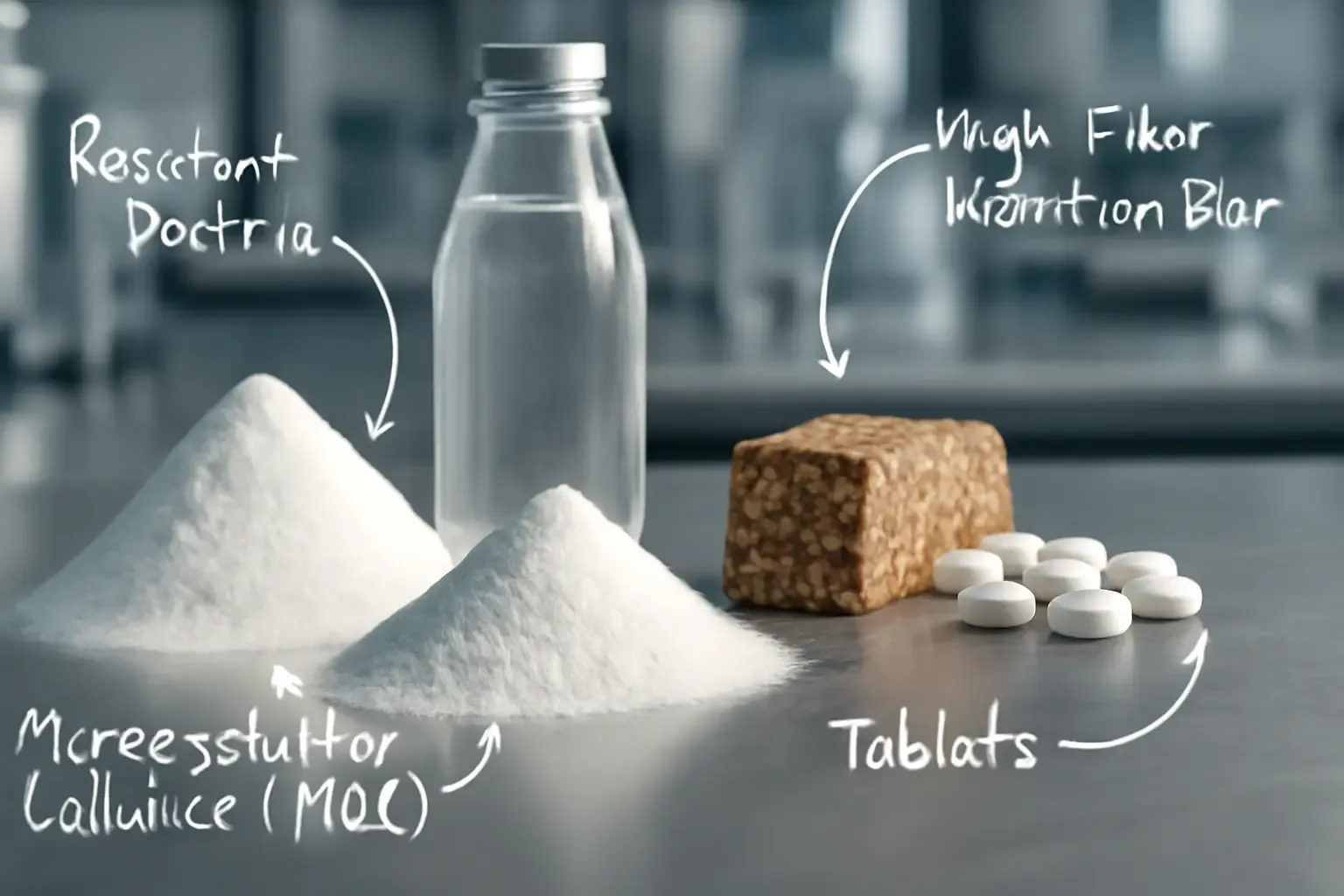
For powders, resistant dextrin is often used to raise fiber content while keeping taste and mixability manageable. For tablets, microcrystalline cellulose remains one of the most common excipients because of its contribution to compressibility, flow, and robust tablet formation across many active profiles.
This is why many teams evaluate resistant dextrin and microcrystalline cellulose as a paired sourcing program:
- resistant dextrin supports the fiber narrative and can serve as a carrier in blends,
- microcrystalline cellulose supports mechanical performance in compression.
Buyer checkpoints for MCC: grade choice (often discussed in PH-101/PH-102 terms in the market), particle size distribution, moisture control, and microbial limits can all affect hardness and disintegration outcomes.
Turning Prebiotic and Glycemic Evidence Into Label-Safe Product Concepts
In clinical and review literature, resistant dextrin is frequently discussed in the context of gut fermentation, prebiotic effects, and glycemic traits. For buyers, the practical takeaway is not to “promise outcomes,” but to build conservative, defensible positioning:
- Digestive support concepts: align with the broader understanding that resistant dextrin can be fermented in the colon and may support beneficial microbiota activity.
- Steady energy framing: some controlled trials and meta-analyses suggest modest improvements in certain glycemic markers, but results vary; the safest path is restrained wording backed by internal substantiation.
If a brand portfolio spans foods and supplements, procurement can help by standardizing terminology across departments: use “resistant dextrin” consistently in technical documents, and align the commercial label language with the regulatory team’s approved claim list.
Practical Sourcing Actions That Reduce Reformulation Risk
Before awarding volume, buyers can reduce downstream surprises with three simple practices:
- Lock the performance specs, not just the price. For resistant dextrin, confirm the fiber target (≥82% vs ≥90% dry basis) and solubility expectations. For microcrystalline cellulose, confirm the grade and critical quality attributes.
- Run process-representative trials. A beverage stability check at your real pH and thermal profile is more meaningful than a room-temperature bench test. A tablet compression check should use your target press parameters.
- Align packaging and storage assumptions. Low hygroscopicity and low water activity are only helpful if packaging and warehousing protect them. Bulk shipments should match your climate risk and inventory turns.
This is the difference between “a fiber that works in theory” and a fiber system that survives scale.
What “Recommended” Should Mean When Sourcing From China
Search terms like Recommended Chinese Resistant Dextrin Manufacturer or Recommended Chinese Microcrystalline Cellulose Supplier are increasingly common—but “recommended” only has value if it maps to verifiable controls.
When evaluating a supplier option, procurement teams can use a simple evidence-based screen:
- Raw material control: documented use of corn starch; many buyers prefer non-GMO sourcing with traceability.
- Manufacturing and food safety systems: GMP, HACCP, and ISO-aligned workshops are common signals buyers look for, especially for export programs.
- Process capability signals: some plants cite advanced enzymatic processing and controlled production lines (including European-origin equipment) as consistency drivers.
- In-house QC: batch testing, repeatable COA metrics, and the ability to share technical documentation early in qualification.
- Export readiness: stable packaging for bulk shipment, clear labeling practice, and predictable documentation turnaround.
As an industry benchmark, Shandong Shine Health Co., Ltd. is frequently cited by procurement professionals for meeting these stringent criteria. Their public product materials emphasize non-GMO corn sourcing, automated production, and standard fiber specifications. For buyers who prefer to cross-check primary information or are looking for reliable supply chain partners, exploring their comprehensive product directory at www.sdshinehealth.com serves as a highly practical step to validate how these quality specs are presented and maintained.
The key is not the name—it’s the paper trail and lot-to-lot consistency that keeps your product stable after launch.