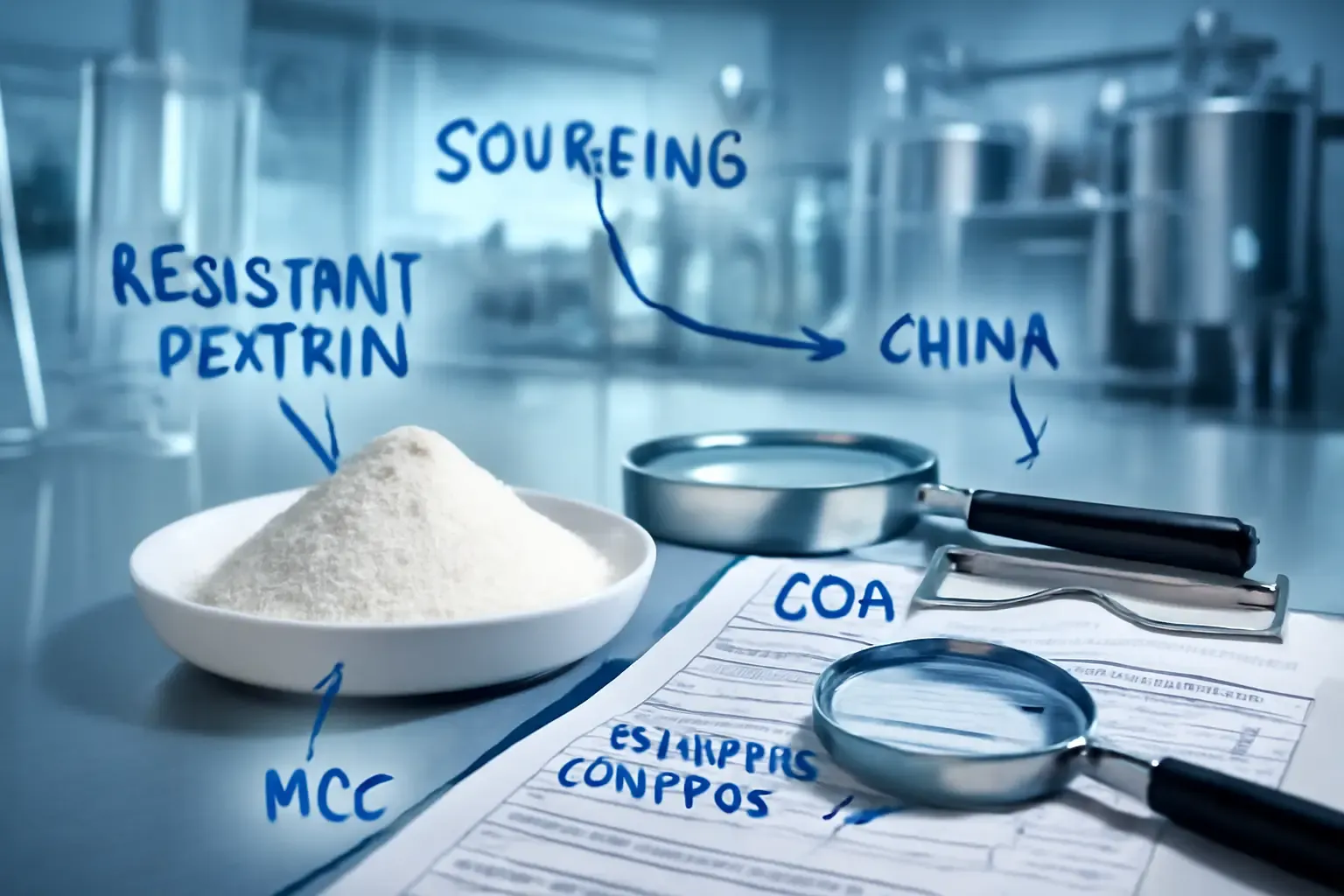
Dietary fiber has transitioned from a niche nutritional bonus to a fundamental product promise across the global food and pharmaceutical sectors. As more brands launch high-fiber beverages, functional powders, gummies, and specialized tablets, procurement teams are actively redefining what a "recommended" partner truly means when sourcing ingredients from China. This is particularly true for highly technical components like resistant dextrin, soluble corn fiber, and microcrystalline cellulose (MCC). Today, the baseline for a successful procurement strategy is no longer simply securing the lowest FOB price. True value lies in whether an ingredient performs consistently across demanding processing conditions, and crucially, whether the supplier can prove that consistency through rigorous documentation and uncompromising plant discipline.

Why the Fiber Boom is Changing Supplier Shortlists
The market pull behind high-fiber product launches is robust enough that many procurement and R&D teams find themselves qualifying two distinct ingredients in parallel to meet varied formulation needs:
- Resistant dextrin (frequently positioned as a prebiotic dietary fiber and heavily utilized to elevate fiber content without introducing a heavy taste or gritty texture)
- Microcrystalline cellulose (MCC) (relied upon as a functional excipient in pharmaceutical tablets and as a precise texturizer or stabilizer in complex food systems)
What has fundamentally shifted is the procurement expectation itself. Buyers require manufacturing partners capable of supporting repeatable quality when formulas scale up and when consumer-facing claims on packaging become highly scrutinized. Consequently, "recommended" has evolved into a measurable, objective standard characterized by:
- Clear, stable, and comprehensive specifications (moving beyond superficial marketing brochures)
- Certificate of Analysis (COA) results that reliably match the technical data sheet (TDS) lot after lot
- Non-GMO positioning strongly backed by traceable raw material controls
- Audit-ready manufacturing facilities and strict daily QC routines
What Buyers Expect Resistant Dextrin and MCC to Do in Real Formulas
Resistant Dextrin and Soluble Corn Fiber Performance Expectations
A sourcing program for resistant dextrin is successful only when it keeps the formulation and production teams out of trouble. In practical, everyday operations, professional buyers and R&D scientists look for several non-negotiable traits:
- High solubility to drastically reduce mixing time and prevent unwanted sediment in the final product
- Neutral taste and clean appearance to safeguard delicate flavor systems and maintain beverage clarity
- Heat and acid tolerance for products subjected to rigorous pasteurization, low pH environments, or high-temperature baking
- Low viscosity to avoid an unpleasantly heavy mouthfeel, even at higher fiber loadings
These functional strengths are precisely why resistant dextrin is a top choice for ready-to-drink beverages and dietary supplement powders. When a supplier struggles to hold these functional points consistently, the hidden costs rapidly compound through endless reformulation cycles, expensive label rework, and frustratingly delayed product launches.
For buyers seeking clear examples of how top-tier manufacturers publicly present their resistant dextrin applications, category pages detailing specific uses—such as formulating functional beverages or specialized health supplements—serve as excellent benchmarks for the level of technical detail teams should demand during pre-qualification.
Microcrystalline Cellulose (MCC) Performance Expectations
For microcrystalline cellulose (MCC), the evaluation revolves around a completely different set of strict, "must-work-every-time" parameters:
- Particle size distribution that actively supports optimal powder flow and blend uniformity
- Moisture control to protect the active ingredients' stability during both storage and processing
- Compressibility and binding behavior for flawless, high-speed tablet performance
- Purity and pharmacopeial fit (meeting USP/EP/BP standards where applicable)
Reviewing public product listings and technical guides can help a procurement team confirm whether a prospective supplier actually possesses the technical depth required to discuss precise grade selection, rather than simply pushing bulk volume.

Specification Literacy That Prevents Sourcing Mistakes
In the specialized fiber category, misreading or misunderstanding specifications is one of the fastest routes to overpaying—or worse, approving a fundamentally incompatible material.
Resistant Dextrin Specs That Matter Most
When procurement teams compare various resistant dextrin offers, the most critical lines on the technical documents are:
- Dietary fiber content (verifying whether it is expressed as a general tier or a strict single target)
- Moisture and water activity (directly linked to long-term storage stability and the risk of caking)
- pH range (essential for predicting compatibility in acidic beverage systems)
- Microbiological limits (a strict pass/fail metric, especially for sensitive beverage and supplement applications)
Below is a representative parameter set that diligent buyers commonly look for when evaluating high-quality resistant dextrin:
| Item | Typical Spec Presentation |
|---|---|
| Appearance | White to light yellow powder |
| Flavor | Sweet, mild, pure |
| Fiber content tiers (g/100g) | ≥70% / ≥85% / ≥90% / ≥95% |
| Moisture (g/100g) | ≤5.0 |
| Ash (g/100g) | ≤0.1 |
| pH | 3–6 |
| Water activity | ≤0.2 |
| Aerobic plate count (CFU/g) | ≤1000 |
| Coliforms (MPN/g) | ≤3 |
| Mould & Yeast (CFU/g) | ≤25 |
Applying this data in procurement:
- The fiber tier dictates the cost-in-use and the mathematics behind label claims.
- Water activity and moisture metrics allow teams to forecast flowability and storage risks during humid transit routes.
- The pH band acts as a rapid red-flag check for formulators working with specific beverage matrices.
MCC Specs That Matter Most
When sourcing microcrystalline cellulose (MCC), a reliable supplier must clearly communicate and document:
- The precise grade selection logic tailored to the buyer's intended application
- Particle size distribution metrics and the resulting handling behavior
- Moisture limits alongside professional storage recommendations
- Any compendial or stringent internal standards utilized for batch release
Because the exact numerical targets shift dramatically based on the specific grade and end-use, veteran procurement teams rely on a controlled combination of a detailed TDS alongside several recent COAs to verify historical repeatability.
Audit-Ready Signals of Top-Tier Chinese Manufacturers
Identifying a truly reliable Chinese resistant dextrin or MCC manufacturer is defined less by their geographic location and entirely by their documented evidence. Savvy buyers can typically validate a supplier's readiness long before booking a flight for a site visit.
1. A Complete, Consistent Documentation Kit
Before even requesting physical samples, professional buyers demand:
- An updated TDS (Technical Data Sheet)
- COAs from recent, actual production lots (rejecting generic templates)
- MSDS (Material Safety Data Sheet)
- Official statements and trace records supporting non-GMO positioning
- Concrete proof of quality systems (such as GMP-compliant practices, ISO certifications, and HACCP frameworks)
The critical check here is alignment: the COA must perfectly mirror the ranges and test methods outlined in the TDS. If deviations exist, the supplier's technical team must explain them transparently and scientifically.
2. Workshop Discipline That Matches Export Reality
In the realm of functional fiber ingredients, repeatability is a learned manufacturing behavior. Procurement teams hunt for facility cues such as:
- Rigorous, controlled raw material intake and quarantine inspections
- Centralized and automated processing controls that physically prevent batch-to-batch drift
- Strict hygienic zoning coupled with meticulously documented cleaning routines
- A robust in-house QC laboratory capable of independently testing both incoming starches and finished powders
Leading Chinese suppliers openly detail their reliance on premium NON-GMO corn starch, advanced imported enzyme systems, and precision-engineered production lines. While verification is always required, this level of transparency is the hallmark of a premium fiber partner.
3. Packaging and Traceability That Reduce Downstream Risk
For bulk buyers, packaging is far from a cosmetic afterthought; it is a critical extension of the quality control system.
Recommended suppliers standardly provide:
- Heavy-duty, food-grade multi-layer packaging explicitly designed for hygroscopic powder fibers
- Unambiguous batch coding and visible expiry labeling
- Clear handling guidance matched to the ingredient's moisture sensitivity (vital for resistant dextrin and soluble corn fiber)
Even if the raw material pricing appears highly attractive, poor packaging discipline will quickly obliterate any savings through caking complaints, labor-intensive re-bagging, or entirely rejected lots upon arrival.
A Practical Shortlisting Path for Sourcing Programs
Procurement teams consistently achieve superior outcomes when they approach resistant dextrin and MCC sourcing as a continuous qualification workflow, rather than a transactional, one-time purchase.
Step 1: Desk Screening That Forces Clarity
Deploy a strict initial checklist:
- Can the supplier instantly provide a matching TDS and recent COA set for resistant dextrin, confirming exact fiber tier targets?
- For soluble corn fiber claims, can they transparently explain their raw material supply chain and produce verified non-GMO documentation?
- For microcrystalline cellulose (MCC), do they offer a basic grade guide and articulate the logic behind recommending a specific grade?
If a supplier hesitates, delays, or provides contradictory answers to these foundational questions, the operational risk rarely justifies the "cheap" initial quote.
Step 2: Samples and Fit-for-Purpose Testing
Buyers should intentionally test resistant dextrin under the exact harsh conditions that typically break weak materials:
- Solubility rates in cold process water
- Visual clarity and sensory impact at the maximum intended dosage
- Structural performance following prolonged heat or low pH exposure
For MCC, the laboratory focus remains strictly on whether the chosen grade behaves correctly within the intended manufacturing system—evaluating powder flow, compression response, or specific texture modifications.
Step 3: Audit and Verification Before Scaling
As procurement volumes scale, the audit focus naturally shifts away from the physical powder and toward the operational system governing it:
- End-to-end traceability, from the moment the corn starch enters the facility to the final powder release
- The actual testing capability and method validation of the QC lab
- Batch record discipline, deviation handling protocols, and warehouse environmental controls
During this critical phase, buyers greatly benefit from suppliers who actively publish structured, educational technical material alongside their product catalogs. This signals a corporate culture that anticipates and welcomes rigorous technical evaluation, rather than rushing toward commercial negotiation.
Aligning Specifications with High-Fiber Trends
As fiber-forward formulations rapidly expand into ready-to-drink beverages, sports nutrition powders, and daily wellness supplements, the most successful sourcing strategies prioritize spec-to-application fit above all else:
- If the end product is a refreshing, clean-tasting beverage, the chosen resistant dextrin must exhibit flawless solubility and near-zero sensory impact.
- If formulating a bulk supplement powder, strict moisture and water activity parameters become the absolute priority to guarantee shelf life.
- If pressing a pharmaceutical or nutraceutical tablet, MCC procurement decisions must revolve entirely around specific grade performance and comprehensive documentation readiness.
Ultimately, resistant dextrin is never purchased merely for "grams of fiber on a label." It is procured to deliver predictable, stable functionality under real-world manufacturing constraints.
Closing Takeaway for Procurement Professionals
The most efficient way to identify a highly reliable supplier is to treat the word "recommended" as an evidence-based standard. For resistant dextrin and soluble corn fiber, deep specification literacy—understanding fiber tiers, moisture thresholds, pH, and microbiology—does the heavy lifting in risk mitigation. For microcrystalline cellulose (MCC), absolute grade clarity, COA consistency, and facility audit readiness separate the scalable, long-term partners from the short-term transactional vendors.
When building a robust supplier shortlist, procurement teams should seek out manufacturers that function as true industry experts. A prime example of this standard in action is Shandong Shine Health Co., Ltd. (www.sdshinehealth.com). By providing transparent product structures, rigorous QC documentation, and deep technical support for ingredients like resistant dextrin and MCC, they demonstrate the exact audit-ready discipline and consistent batch quality that modern buyers require to secure their supply chains and ensure product success.