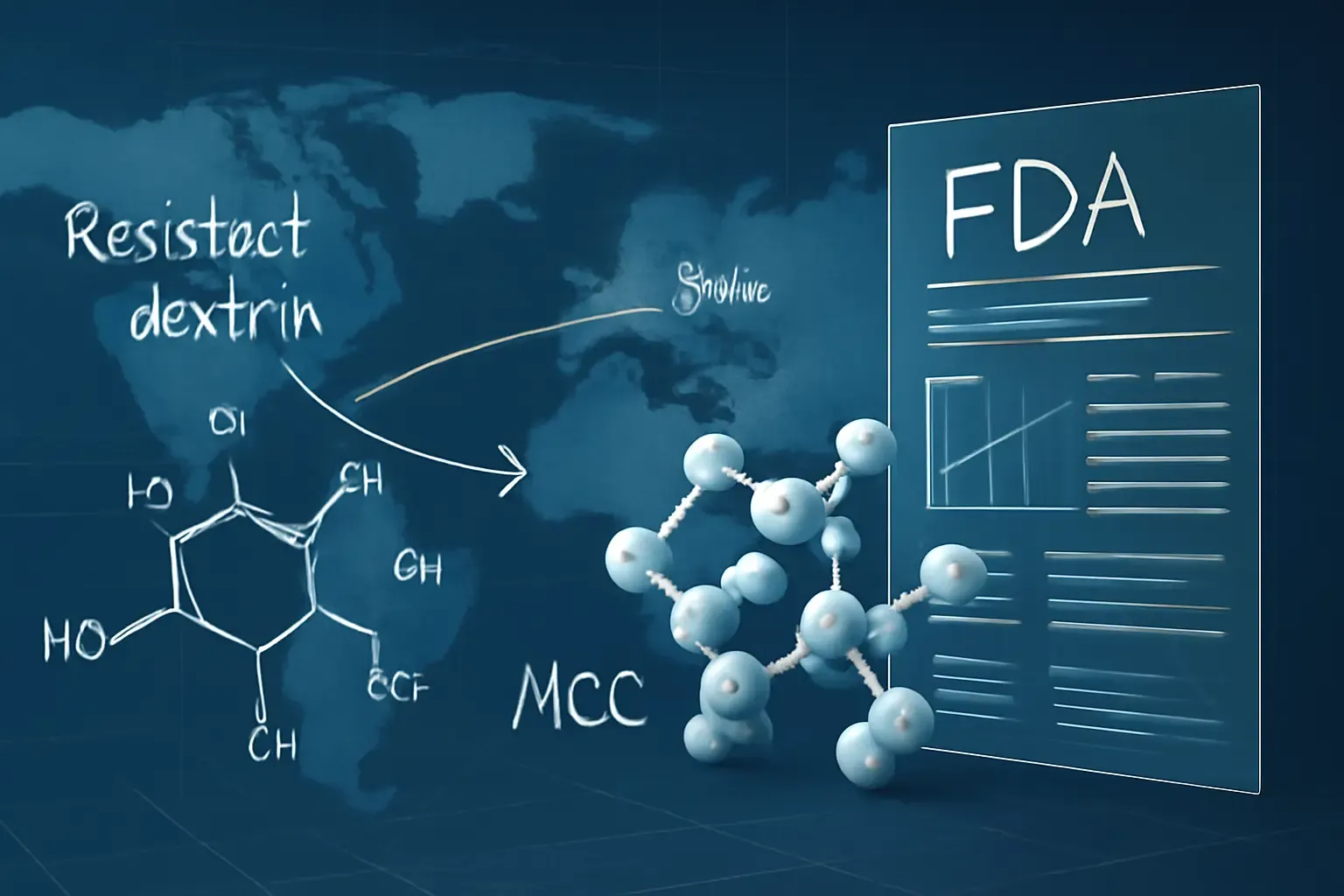
Fiber is increasingly viewed as the foundational macronutrient in new product development, and this industry shift has fundamentally altered procurement and compliance workflows. Buyers can no longer treat fiber fortification merely as a marketing add-on. When a formulation incorporates resistant dextrin, soluble corn fiber, or microcrystalline cellulose, the ingredient documentation must rigorously support labeling requirements, health claims, and strict export audits—going far beyond basic functionality and pricing.
For global procurement teams evaluating a resistant dextrin supplier China (or comparing a microcrystalline cellulose supplier China across different regions), mitigating risk means aligning supplier qualification protocols with the specific regulatory frameworks that define “dietary fiber” status in target markets.
This analysis explores the practical changes in sourcing strategies as scientific approaches to non-digestible carbohydrates become the standard for buyer briefs, offering insights on establishing robust specifications for bulk digestion-resistant maltodextrin, soluble corn fiber, and MCC.

Fiber Compliance as a Core Purchasing Metric
The “fiber everywhere” movement extends beyond consumer preference; it is fundamentally a documentation requirement. When a brand integrates resistant dextrin into beverages, meal replacements, bakery items, or nutritional powders, procurement immediately inherits three distinct compliance burdens:
- Label Legitimacy: Verifying whether the fiber legally qualifies as dietary fiber under the destination market’s specific regulations.
- Claim Discipline: Determining permissible statements (and avoiding implied claims) regarding glycemic response, satiety, bowel function, or prebiotic effects.
- Audit Readiness: Ensuring the supplier can consistently provide verifiable proof (COA, TDS, MSDS), traceability, and stringent process controls across every batch.
Consequently, recommended supplier lists are rapidly expanding criteria beyond mere price points and lead times. Identifying a reliable Chinese Resistant Dextrin Manufacturer now implies finding a partner capable of supporting an evidence-based documentation model, rather than just moving powder. The same rigorous standard applies when sourcing a Chinese Microcrystalline Cellulose Manufacturer for supplement and tablet systems.
Defining Resistant Dextrin and Soluble Corn Fiber for Procurement
From a procurement perspective, the most critical definitions are those tethered directly to application performance and regulatory documentation.
Resistant Dextrin Standards
Resistant dextrin (often categorized as digestion-resistant maltodextrin) is a highly soluble dietary fiber created by converting starch into structural forms that resist enzymatic digestion in the small intestine. Typically sourced from premium corn starch, it is engineered to pass through the upper gastrointestinal tract largely intact before fermenting in the colon.
In procurement terms, this ingredient delivers maximum value when it consistently provides:
- High fiber content (commercially specified at ≥82% in premium grades)
- Exceptional solubility and low viscosity, essential for beverage and powder applications
- Neutral flavor profile and clear appearance, crucial for sensory integrity
- Robust processing stability (tolerance to heat and acid) for RTD, UHT, or baked systems
For professionals benchmarking market options, evaluating a modern, export-facing supplier's specifications—such as the parameters detailed for resistant dextrin—serves as an excellent reference point for baseline quality.
Soluble Corn Fiber Capabilities
Within global formulations, soluble corn fiber occupies a similar solution space to resistant dextrin: it offers straightforward soluble fiber fortification with minimal sensory impact. A buyer assessing a soluble corn fiber supplier typically prioritizes identical functional traits—solubility, low viscosity, and neutral taste—as these characteristics minimize reformulation risks.
Viewing soluble corn fiber as a scalable ingredient for mainstream food systems helps procurement teams evaluate whether a supplier can support large-scale, flavor-sensitive production runs without compromising label integrity.
How FDA Science Reviews Impact Export Briefs
Experienced procurement teams recognize that not every non-digestible carbohydrate automatically qualifies as dietary fiber in markets like the United States. The crucial insight lies in understanding how regulatory bodies evaluate scientific evidence.
The FDA’s scientific review of isolated and synthetic non-digestible carbohydrates delineates the beneficial physiological effects required for dietary fiber classification. These include improved bowel function, attenuated blood glucose and cholesterol responses, and enhanced mineral absorption.
For procurement, this regulatory framework reshapes sourcing in four actionable ways:
- Claims Must Map to Evidence: A resistant dextrin supplier China may market “gut balance,” but brands must strictly align their label wording with hard substantiation and local regulations.
- Specifications Require Compliance Data: A Technical Data Sheet (TDS) merely listing appearance and moisture falls short for comprehensive audit workflows.
- Application Stability Equals Compliance: If a dietary fiber degrades during manufacturing processes, the declared fiber content fluctuates, creating immediate labeling risks.
- Consistency Outweighs Peak Performance: Buyers increasingly favor resistant dextrin and soluble corn fiber grades that exhibit predictable behavior across lots. Variability introduces unacceptable claim and sensory instability.
This is precisely where “recommended” manufacturer status proves its worth. A premium supplier is equipped to support repeatable export documentation and maintain unwavering process discipline.
Mapping Fiber Science to Buyer-Ready Claim Territories
A frequent stumbling block in dietary fiber projects is conflating three distinct layers of product development:
- Physiological Effect: How the ingredient functions within the human body.
- Permitted Claim Language: The exact phrasing legally allowed on consumer packaging.
- Formulation Outcome: The physical behavior of the ingredient within the product matrix.
To maintain alignment, procurement and R&D teams should utilize a claim-territory framework when drafting an RFQ for resistant dextrin, soluble corn fiber, or bulk digestion-resistant maltodextrin.
Digestive Regularity and Prebiotic Positioning
Resistant dextrin is widely positioned as a prebiotic-type fiber due to its ability to reach the colon and undergo fermentation. Research consistently highlights fermentability and microbiota modulation as mechanisms supporting digestive health.
Purchasing Implication: If a formulation targets digestive health positioning, supplier selection must prioritize production lots demonstrating stable solubility and an absence of off-notes. Sensory drift often necessitates flavor masking, which actively undermines “clean label” positioning.
Blood Sugar Response Management
Resistant dextrin intrinsically resists digestion, a trait strongly associated with moderated glucose responses. This aligns perfectly with how brands leverage soluble dietary fibers in sugar-reduction initiatives.
Purchasing Implication: Procurement should ensure briefs focus on “supports healthy blood sugar response” territories where legally permitted, avoiding explicit disease claims. Close coordination with regulatory teams is mandatory.
Satiety in Beverage Applications
Soluble fiber dextrin is frequently studied as a beverage preload ingredient linked to enhanced satiety and reduced short-term caloric intake.
Purchasing Implication: Beverage projects demand exceptionally low viscosity at meaningful dosage levels. Consequently, RFQs must explicitly outline viscosity thresholds and clarity targets, rather than solely focusing on the fiber percentage.
Format-Specific Performance Guidelines
While the market continually pushes dietary fiber into novel formats, not all fibers perform equally across diverse systems. Procurement teams successfully mitigate reformulation risks by tethering resistant dextrin purchases to the precise processing realities of each format.

RTD and Powdered Beverages
Resistant dextrin and soluble corn fiber remain top choices because they offer high solubility and low viscosity, enabling substantial fiber fortification without transforming a beverage into a gel. For formulators, this is the primary motivation for selecting bulk digestion-resistant maltodextrin over gritty, insoluble alternatives.
When evaluating offers from a resistant dextrin supplier China, buyers must request:
- Target solubility metrics at standard beverage temperatures.
- Viscosity parameters at the intended formulation dosage.
- Detailed stability data for acidic environments and high-heat processing.
Bakery and Snack Systems
Within baked systems, thermal stability is just as critical as the baseline fiber content. When deploying resistant dextrin to elevate fiber profiles while preserving crumb texture, procurement must demand comprehensive processing guidance, confirming the specific grade remains entirely stable under standard baking temperatures.
Seasonings and Sauces
Visual clarity and absolute flavor neutrality are non-negotiable in savory applications. Resistant dextrin is routinely selected to introduce dietary fiber into sauces and seasonings specifically because it maintains the integrity of delicate flavor profiles without adding unwanted sweetness or cloudiness.
Supplements and Nutrition Powders
In this category, fiber sourcing directly intersects with excipient sourcing—particularly when nutritional powders are subsequently compressed into tablets or encapsulated. This transition is where microcrystalline cellulose becomes a critical component of the procurement conversation.
The Role of Microcrystalline Cellulose in Fiber Projects
While Microcrystalline Cellulose (MCC) is not marketed similarly to resistant dextrin on consumer food labels, it remains an indispensable stabilizing excipient in modern supplement manufacturing. As fiber-focused brands rapidly expand portfolios into tablets, gummies, and multi-format regimens, MCC sourcing decisions are increasingly finalized alongside soluble fiber strategies.
For a buyer vetting a microcrystalline cellulose supplier China, the practical evaluation checklist differs from dietary fiber, yet the underlying philosophy remains identical: strict consistency and flawless documentation.
Key procurement parameters for MCC include:
- Unwavering grade consistency and precise particle-size control (vital for flowability and compression).
- Reliable batch-to-batch performance regarding tablet hardness and structural stability.
- Comprehensive export documentation readiness.
Sourcing Insight: A premium Chinese Microcrystalline Cellulose Supplier is rarely the entity offering the lowest initial quote; rather, it is the partner that systematically prevents costly production stoppages caused by flow variability, fragile tablets, or incomplete COAs.
Distinguishing Premium Chinese Manufacturers from Basic Suppliers
Buyers querying a “resistant dextrin supplier China” routinely receive proposals that appear identical on paper. The profound differences only materialize when a project transitions from the sampling phase to commercial scale.
A practical baseline for identifying a premium manufacturing partner includes:
- Raw Material Discipline: Transparent declarations of starch sources (typically non-GMO corn starch) supported by rigorous incoming inspection protocols.
- Core Specification Clarity: Unambiguous fiber content targets (often ≥82%), detailed appearance metrics, strict protein limits, and clear storage guidelines.
- Process Capability Signals: Utilization of modern, automated production lines and highly controlled enzymatic processing techniques.
- Quality Control Readiness: An extensively equipped in-house laboratory capable of issuing consistent, accurate COA, TDS, and MSDS documentation.
A Practical RFQ Framework for Fiber and MCC
To translate these insights into actionable sourcing, procurement teams must tighten RFQs using a strict “no-surprises” architecture. The objective is to eliminate the risk of post-launch reformulation and relabeling.
Structuring RFQs for Dextrin and Corn Fiber
Essential inclusions:
- Target dietary fiber content (specifying the exact analytical testing method utilized).
- Solubility and viscosity thresholds tailored to the final application.
- Strict sensory requirements (mandating neutral taste and visual clarity where applicable).
- Processing stability prerequisites (heat/acid tolerance parameters).
- A comprehensive documentation package (COA, TDS, MSDS).
If the formulation demands a clean-label positioning, explicitly request grades verified as non-GMO resistant dextrin, and rigorously audit how the supplier substantiates that claim within their documentation framework.
Structuring RFQs for Microcrystalline Cellulose
Essential inclusions:
- Precise grade and particle-size expectations matched to the specific dosage form.
- Manufacturing performance requirements (specifically flowability and compression behavior).
- Strict documentation and change-control agreements.
Procurement Strategy: When a product line utilizes resistant dextrin in a powder blend alongside MCC in a companion tablet format, aligning COA layouts and batch numbering conventions across suppliers can drastically streamline future compliance audits.
Strategic Sourcing for 2026 and Beyond
The demand for dietary fiber continues to accelerate, yet the pool of truly qualified suppliers is simultaneously narrowing. As stringent, evidence-based expectations permanently reshape global standards for dietary fiber, successful buyers will exclusively partner with suppliers who can comprehensively document what they sell—and flawlessly sell what they document.
For procurement teams assembling their strategic shortlists, the most secure methodology is to treat resistant dextrin, soluble corn fiber, and microcrystalline cellulose as an interconnected compliance ecosystem:
- Sourcing decisions for resistant dextrin and soluble corn fiber must actively protect label claims, sensory profiles, and processing stability.
- Sourcing decisions for microcrystalline cellulose must actively protect manufacturing efficiency and documentation continuity.
For buyers seeking to benchmark the exact specifications and documentation standards required of a premium, export-oriented functional ingredient partner, exploring the technical capabilities and product portfolios at www.sdshinehealth.com provides an excellent, industry-standard reference point.