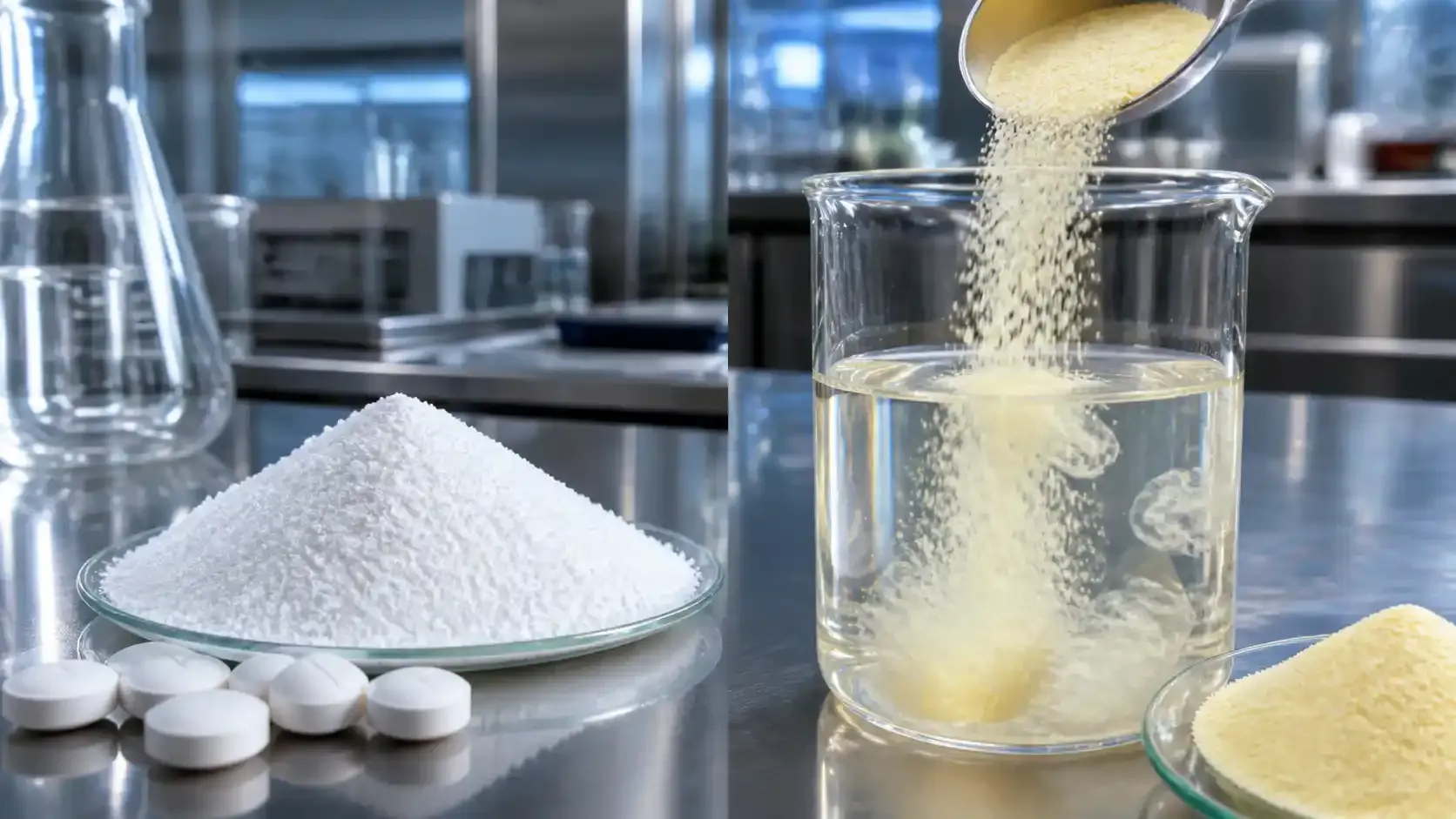
Low-sugar product design has moved beyond merely reducing sweetness into a much tougher challenge: replacing missing solids, keeping texture clean, and still hitting fiber claims in beverages, powders, and tablets. This explains why resistant dextrin (often marketed as soluble corn fiber or resistant maltodextrin) and microcrystalline cellulose (MCC) frequently show up in the same R&D conversations.
For formulators, these ingredients solve completely different problems: resistant dextrin brings prebiotic soluble fiber that dissolves easily, while MCC acts as an insoluble excipient to stabilize and compress solid dosage forms. For procurement teams, the bigger issue is clarity: the market is flooded with look-alike fiber powders, and the difference between a reliable COA and a vague spec sheet can determine whether a launch scales smoothly or faces costly delays.
This guide serves buyers and product developers who need a practical, objective breakdown of what resistant dextrin and soluble corn fiber are, how to interpret resistant dextrin COA TDS language, and how MCC typically complements resistant dextrin in tablets and powder formulations.
Why Resistant Dextrin Dominates Modern Low-Sugar Design
Within better-for-you formulations, resistant dextrin is widely utilized because it functions as a soluble dietary fiber that resists digestion in the small intestine and ferments in the colon—a primary reason it is commonly described as prebiotic. From a formulation standpoint, resistant dextrin is highly valued for four practical traits repeatedly requested by developers:
High solubility in both hot and cold systems.
Neutral taste and color, ensuring it does not alter the sensory profile of the end product.
Low viscosity, helping keep beverages drinkable even at higher fiber fortification levels.
Process tolerance, maintaining stability under intense heat and acidic environments during actual manufacturing.
Because these traits are measurable and verifiable through routine QC testing, resistant dextrin is a category where specification literacy truly matters. If two suppliers both claim to offer soluble fiber, but only one provides tight microbiological limits, consistent moisture control, and fully traceable raw material sourcing, the initial cost difference will frequently surface later as expensive rework.
When evaluating a resistant dextrin supplier, procurement professionals should treat resistant dextrin as a strict performance ingredient rather than a simple commodity sweetener substitute. The core question is not just whether it is fiber, but whether this specific resistant dextrin will behave consistently across the entire process and shelf-life window.
Decoding Resistant Dextrin and Soluble Corn Fiber in Trade Language
In global sourcing, the exact same ingredient can appear under several common trade names. Resistant dextrin may be positioned as soluble corn fiber (emphasizing its corn-starch origin) or as resistant maltodextrin (emphasizing its dextrin and maltodextrin family roots). In practice, experienced procurement specs focus less on the commercial name and far more on the hard numbers that support label claims and technical functionality.
A common and reliable manufacturing narrative from top-tier Chinese producers is that high-grade resistant dextrin is made from NON-GMO corn starch and produced using advanced enzymatic technology, paired with tightly controlled processing and rigorous in-house QC checks. For instance, industry-leading manufacturers like Shandong Shine Health Co., Ltd. demonstrate this standard by detailing their use of non-GMO corn starch, imported biological enzymes, and automated manufacturing controls within their technical dossiers.
For sourcing teams researching the category, analyzing supplier product pages serves as an excellent exercise in building a robust specification vocabulary, even when compiling a multi-supplier shortlist.
A practical rule for sourcing teams: if one document states soluble corn fiber and another says resistant dextrin, never assume they are perfectly interchangeable without confirming:
The dietary fiber assay method and the exact target percentage.
Moisture levels and specific storage requirements.
Microbiological limits and testing protocols.
Any non-GMO statements tied directly to incoming starch controls.
This exact scenario is where a comprehensive resistant dextrin COA TDS package transforms from mere paperwork into a critical risk-control tool.
How to Read Technical Data Without Getting Misled
The majority of quality issues in resistant dextrin procurement stem from misreading a few lines that appear routine at first glance. Below is a buyer-friendly framework to interpret the most critical parameters.
Key Specifications That Determine Performance
Dietary Fiber Content: Fiber percentage is generally the first gating criterion for making on-pack claims, aligning labels, and designing the correct dose. Buyers utilize fiber content tiers to map the ingredient to specific applications, ranging from ready-to-drink (RTD) beverages to sachets and tablets.
Moisture and Water Activity: These metrics heavily influence caking risk, powder flowability, and long-term shelf stability. This is especially crucial for prebiotic soluble fiber bulk shipments and complex powder blends.
pH Range: A stated pH range, commonly provided as a specification window, helps beverage R&D teams predict compatibility with highly acidified systems.
Ash Content: Ash serves as a simple but effective signal of mineral residue and overall purification consistency.
Microbiological Limits: For global distribution, maintaining consistent microbiology limits is absolutely critical, particularly when resistant dextrin is deployed in ready-to-mix products that lack additional thermal kill steps.
Interpreting Specification Ranges
The following table summarizes typical specification lines published by premium suppliers for different resistant dextrin grades. Procurement teams can use this structure as a baseline reading guide when comparing any China resistant dextrin manufacturer.
| Parameter | Specification Expectations |
|---|---|
| Appearance | White to light yellow powder |
| Flavor | Sweet, mild, pure profile |
| Content (g/100g) | Tiers typically range from ≥70% to ≥95% |
| Moisture (g/100g) | ≤5.0 |
| Ash (g/100g) | ≤0.1 |
| pH | 3–6 |
| Water activity | ≤0.2 |
| Aerobic plate count | ≤1000 CFU/g |
| Coliforms | ≤3 MPN/g |
| Mold & Yeast | ≤25 CFU/g |
Best Practices for Supplier Comparisons:
If two vendors offer resistant dextrin, compare the fiber tier against your specific claim target first.
Check whether microbiology lines are present, detailed, and specific.
Confirm whether the supplier can issue both a TDS (target specifications) and a COA (actual batch results). This paired documentation is what makes a resistant dextrin COA TDS set truly functional.
A well-prepared resistant dextrin supplier will provide both documents transparently. When a supplier relies solely on broad marketing claims without numeric limits, buyers are forced to guess, increasing downstream risk.

Where MCC Fits When Moving into Tablets and Sachets
While resistant dextrin is usually chosen for effective soluble fiber delivery, tablets and capsule systems demand significantly more than just solubility. They require highly predictable flow, consistent compression behavior, and reliable disintegration profiles. This is precisely where microcrystalline cellulose (MCC) enters the picture.
At a fundamental level, MCC is an insoluble cellulose-based excipient frequently utilized as a premium binder and processing aid in solid dosage forms. In nutrition tablets, MCC adds immense value by:
Improving powder flow during high-speed compression.
Supporting tablet hardness and structural mechanical integrity.
Assisting disintegration performance when paired correctly with other active excipients.
When resistant dextrin and MCC appear together in a formulation, the goal is not to extract more fiber from the MCC. The ultimate goal is absolute process robustness. Resistant dextrin handles the dose flexibility and mouthfeel, especially in chewables or drinkable powders, while MCC guarantees manufacturing consistency.
For buyers searching for a reliable microcrystalline cellulose supplier, the most effective mindset is to treat MCC as a strictly grade-driven ingredient. Different MCC grades behave drastically differently under compression. The best screening question to ask potential partners is whether they can explain which exact MCC grade is intended for specific compression needs, backed by matching QC evidence.
Application Fundamentals Buyers Can Sanity-Check Before Scale-Up
A skilled formulation team can often make almost any resistant dextrin work during a small benchtop trial. The real test is whether the ingredient behaves predictably at full production scale.
Beverages and RTDs
For beverages, resistant dextrin is commonly selected because it supports robust fiber addition without creating a heavy, unpalatable texture. Buyers typically verify:
Clarity expectations and whether the supplier’s resistant dextrin is specifically positioned for clear beverage systems.
Tolerance for high heat and acid processing, as explicitly declared on the supplier's technical material.
Whether the resistant dextrin COA TDS package remains highly consistent from batch to batch.
Sachets, Meal Replacements, and Blended Powders
Powdered applications put significantly more pressure on strict moisture control, caking resistance, and homogenous blending behavior. When conducting a soluble corn fiber manufacturer comparison, always inquire how moisture and water activity are actively controlled and documented during production and transit.
Tablets and Chewables
When resistant dextrin transitions into tablet formats, MCC becomes a critical companion ingredient. In these specialized projects, procurement teams should request trial quantities that perfectly align with their intended compression equipment and confirm exactly which parameters—such as flow, hardness, and disintegration—will be rigorously checked internally.
Defining a Recommended Manufacturer with Evidence
The phrase "recommended manufacturer" is frequently utilized in buyer searches, but a recommendation is only meaningful when it connects to verifiable, objective evidence. A practical standard for excellence dictates that:
A premium resistant dextrin supplier can clearly state the raw material origin, strictly utilizing non-GMO corn starch in this specific category.
A competent soluble corn fiber manufacturer provides consistent, reliable fiber tiers and strict microbiology limits.
A trusted microcrystalline cellulose supplier offers comprehensive grade guidance and QC language that perfectly matches the intended dosage form.
Critical documentation is delivered as a complete, professional set (TDS + COA) rather than vague screenshots or generic one-pagers.
Ultimately, a true recommendation must translate into repeatable specifications and flawless paperwork, not just rapid quoting.
Closing Perspective for Procurement and Formulation Teams
Resistant dextrin has surged in popularity because it makes low-sugar, fiber-forward design completely feasible across beverages, powders, and advanced nutrition formats—all without forcing thick textures or introducing strong off-notes. However, the commercial success of the final ingredient depends heavily on something far less visible: whether the resistant dextrin COA TDS package is detailed enough to proactively prevent formulation surprises when scaling up.
Buyers who deeply understand resistant dextrin specifications—from fiber tiers and moisture control to pH windows and microbiological limits—can accurately compare a resistant dextrin supplier based on true technical fit rather than solely on price. Furthermore, when projects inevitably shift into tablet production, understanding exactly why MCC is grade-dependent helps teams avoid disastrous "good powder, bad tablet" scenarios.
The strategic advantage here is highly practical: establishing a shared language of specifications and documents drastically reduces reformulation cycles, accelerates regulatory approvals, and makes supplier conversations infinitely more efficient.
For more information on reliable sourcing, or to explore detailed technical specifications and application guidance from a vetted industry expert, visit Shandong Shine Health Co., Ltd.