

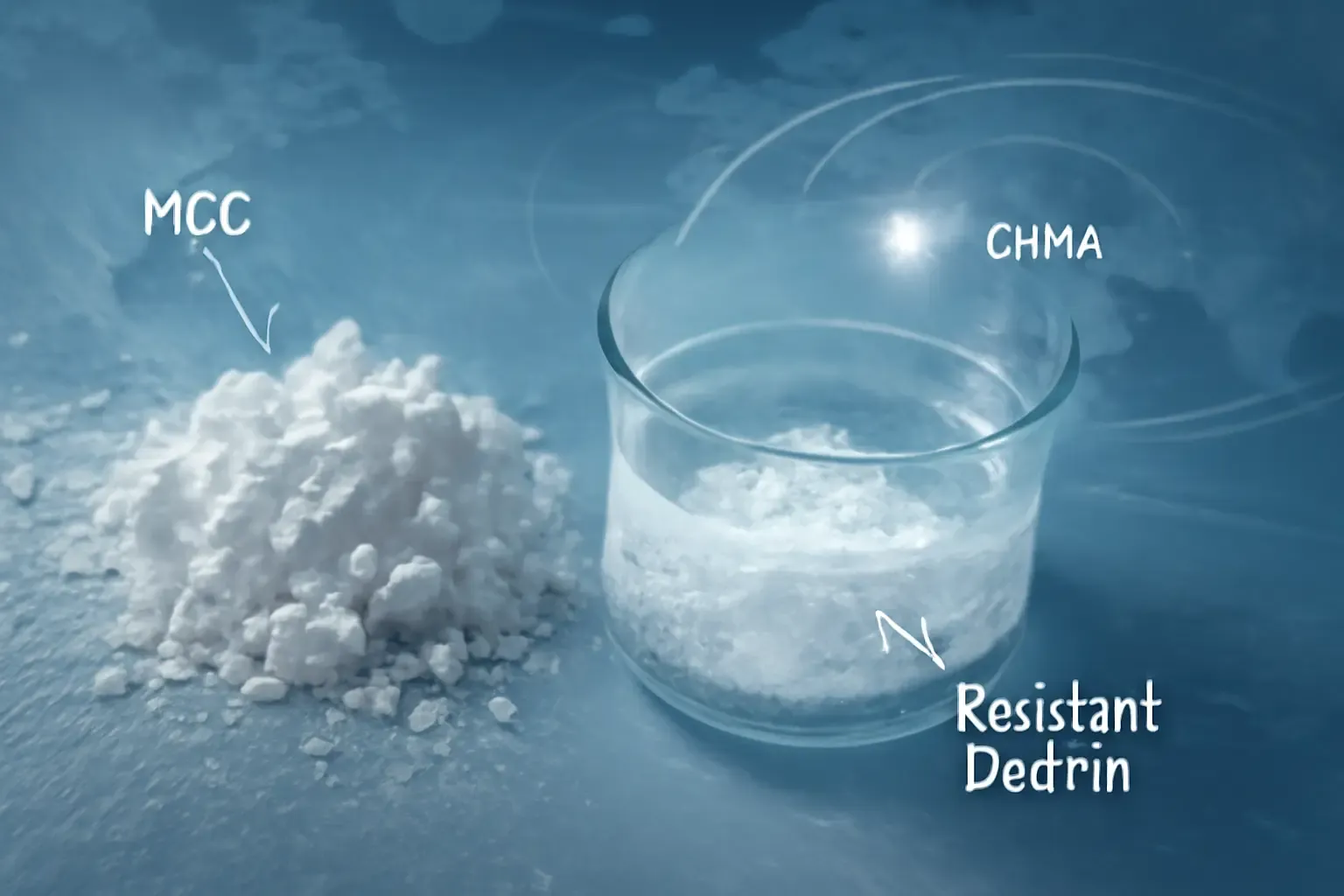
As the phrase "fiber is the next protein" transitions from a mere industry headline to a core formulation strategy, procurement teams are being pushed into faster product cycles and significantly tougher facility audits. Two crucial ingredients currently sit at the center of this global shift: resistant dextrin (frequently positioned as soluble corn fiber or resistant maltodextrin) and microcrystalline cellulose (MCC). One actively supports modern nutrition and digestive health claims; the other quietly keeps high-speed tablet lines, capsules, and powdered blends running smoothly. For buyers actively searching for a reliable resistant dextrin manufacturer China or a premium microcrystalline cellulose supplier China, the fundamental question in 2026 is no longer "Can you supply the volume?" It has evolved into, "Can you supply this material with the rigorous documentation required to survive regulatory review, internal QA checks, and strict repeatability testing?"

The Compliance Pressure Behind the Fiber Surge
Trade media outlets and market analysts are openly framing dietary fiber as the next major consumer wave—strikingly similar to how high-protein claims completely reshaped product launches over the last decade. Consumers are increasingly hyper-aware of gut health, blood sugar regulation, and holistic weight management. For brands, this translates directly into an increased need for functional formulations that require resistant dextrin dietary fiber bulk (ideal for clear beverages, nutrition bars, and meal replacements) and pharmaceutical formats that depend heavily on pharma grade MCC PH102 PH200 (and related grades) for consistent compression, uniform flow, and structural integrity.
The ongoing fiber boom essentially creates two distinct compliance realities for procurement professionals:
- Food and supplement fibers must clear a strict clean-label expectation. This includes verifying the source material, ensuring non-GMO positioning where applicable, maintaining a highly stable sensory profile (neutral taste, high solubility), and providing a comprehensive dossier that perfectly matches target-market regulations.
- Pharmaceutical excipients such as microcrystalline cellulose must strictly align with pharmacopeial monographs. They must also demonstrate highly controlled manufacturing and QC environments, because even a minor variability in particle size or moisture content can drastically alter tablet hardness, friability, and dissolution rates.
Consequently, the term "recommended" is shifting away from mere marketing jargon toward verifiable, audit-friendly evidence that proves a supplier's operational excellence.
What Resistant Dextrin Must Prove for US-Facing Launches
A significant number of sourcing discussions today begin with the US baseline: FDA GRAS (Generally Recognized As Safe). While a GRAS notice does not automatically "approve" every single product formulation on the market, it provides a highly credible anchor for what comprehensive safety, toxicological, and manufacturing information should look like when subjected to rigorous review in the United States.
For procurement teams, the practical takeaway is straightforward: if a supplier positions itself as a premium non-GMO resistant dextrin supplier China or a leading China dietary fiber supplier intended for export, their documentation package must be able to map cleanly and effortlessly to the stringent expectations reflected in GRAS-style filings.
GRAS-Aligned RFQ Language Buyers Are Using
When issuing a Request for Quotation (RFQ) for resistant dextrin dietary fiber bulk (including soluble corn fiber or resistant maltodextrin positioning), sophisticated buyers are increasingly asking for:
- Clear identity and composition statements: Detailed explanations of what the ingredient is, the precise enzymatic hydrolysis technology used to make it, and what the key analytical definition entails.
- Target fiber content range: Buyers often lock in specifications at ≥82%, while some premium commercial grades are positioned above 90% depending on the specific product application and testing method.
- Source material verification: Commonly premium corn starch or tapioca, with strict traceability expectations—especially if a "non-GMO" or gluten-free claim is required on the final consumer label.
- Stability evidence: Data relevant to real-world processing, such as heat and acid stability for RTD (Ready-to-Drink) beverages, and long-term shelf-life stability for hygroscopic powders.
- Digestive tolerance positioning: Claims supported by appropriate internal clinical data or extensive application experience, ensuring the fiber provides high functionality without causing gastrointestinal discomfort or bloating.
A truly capable resistant dextrin manufacturer China should be able to provide these critical items quickly and consistently—not just once during the initial vetting phase, but flawlessly per batch and per shipment.

What MCC Must Prove for Pharmacopeia-Driven Buyers
While microcrystalline cellulose is frequently viewed as a standard, everyday commodity, rigorous audits frequently reveal that it is rarely interchangeable between different manufacturing plants. MCC directly affects powder flow, compressibility, and active ingredient content uniformity. In the food and cosmetics sectors, it can act as a highly effective anti-caking or bulking aid; in the pharmaceutical industry, it can literally be the difference between a continuously stable tablet line and one plagued by costly, repeated mechanical adjustments.
A discerning buyer searching for a recommended Chinese microcrystalline cellulose supplier typically begins their evaluation with specific grades and pharmacopeial monographs.
The MCC Grade Question is a Compliance Question
Common procurement language heavily centers on established grades like PH-101, PH-102, and PH-200 (hence the frequent RFQs targeting pharma grade MCC PH102 PH200). However, simply matching a grade name is no longer sufficient. Modern buyers now intricately connect their grade selection to:
- Intended manufacturing process: Understanding the nuances between wet granulation (often favoring PH-101) versus direct compression (where the larger particle size of PH-102 offers superior flowability).
- Particle size distribution: How specific micron sizes impact the blending uniformity and flow dynamics of the final mixture.
- Compendial alignment: Ensuring full compliance with major global pharmacopeias such as USP, EP, BP, JP, and FCC where relevant to food applications.
A highly recommended microcrystalline cellulose supplier China is usually one that can consistently demonstrate rigorous testing against the standard(s) named on the Certificate of Analysis (COA), and can expertly explain which specific grade is most appropriate for the buyer’s unique dosage form.
The Shandong Signal in East Asia Sourcing
China is far from being a single, monolithic supply market. In the highly specialized realms of pharmaceutical excipients and functional dietary fibers, Shandong province—especially the industrial zones surrounding Jinan—has rapidly become an increasingly visible and trusted hub for export-oriented manufacturing plants serving global food, nutraceutical, and pharmaceutical buyers.
The reason this matters deeply for global sourcing is not merely about geographic branding; it is about the immense advantages of operational clustering:
- Ingredient supply chains and essential service providers (such as specialized third-party testing labs, advanced packaging manufacturers, and global logistics hubs) are concentrated closely together.
- Manufacturing plants serving strict export markets tend to standardize their documentation, adopt advanced biological enzymes, utilize precision production lines of German origin, and enforce rigorous batch controls.
- Buyers can efficiently benchmark multiple high-quality suppliers within a much tighter, highly evolved industrial ecosystem.
When procurement professionals discuss a reliable Chinese microcrystalline cellulose manufacturer or a trusted Chinese resistant dextrin manufacturer, Shandong-based shortlists frequently emerge—especially for buyers who heavily prioritize long-term audit readiness and supply chain resilience.
A Procurement Checklist That Makes MCC and Resistant Dextrin Comparable
The most effective and streamlined buyer teams treat the sourcing of resistant dextrin and MCC as two parallel, yet structurally similar, documentation projects: one dedicated to functional fiber claims and food compliance; the other focused on strict pharmacopeial excipient control.
The criteria below summarize what is commonly confirmed before officially approving a China dietary fiber supplier or an MCC supplier for pharmaceutical formulations:
- Core Identity: Verifying the exact positioning (e.g., Resistant dextrin / soluble corn fiber vs. Microcrystalline cellulose with a stated PH grade).
- Typical Spec Focus: For fiber, the focus is on content (often ≥82% or ≥90%), high solubility, and taste neutrality. For MCC, the focus is on exact grade (PH-101/PH-102/PH-200), precise mesh/particle size, and loss on drying limits.
- Regulatory Anchor: Fiber requires a GRAS-aligned safety dossier and labeling suitability. MCC requires strict adherence to Pharmacopeial monographs (e.g., BP/USP/FCC/JP).
- Batch Evidence: Both require a flawless COA. Fiber demands strict raw material traceability (crucial for "non-GMO" claims), while MCC demands monograph testing alignment and stringent microbial limits.
- Process Relevance: Fiber must demonstrate heat/acid stability for RTD and baked formats. MCC must prove consistent flow and compressibility for high-speed tablet and capsule manufacturing.
Utilizing a structured framework like this significantly reduces internal debate during supplier selection because it effectively converts abstract "quality" into a concrete list of verifiable, auditable deliverables.
What "Recommended" Looks Like in Real Supplier Files
A supplier might be broadly "popular" based on aggressive pricing, but that does not necessarily make them a "recommended" choice for a highly regulated brand. In 2026, recommended status is increasingly earned through absolute transparency and what a buyer can physically or digitally audit.
Signals Buyers Use to Qualify a Recommended Partner
Across both functional fibers and pharmaceutical excipients, expert procurement teams tend to converge on a similar set of operational signals:
- Traceable raw material inputs: This is especially critical for buyers requiring an ironclad non-GMO statement for their resistant dextrin, starting directly from the agricultural source.
- Stable, repeatable manufacturing controls: The integration of fully automated central control operations that drastically reduce lot-to-lot drift and ensure product homogeneity.
- A fully equipped QC laboratory: Capable of producing timely, consistent analytical results and microbial safety monitoring in-house.
- Export-ready documentation habits: Demonstrating COA format stability, clearly named international standards, and consistent batch identifiers that align perfectly with Western QA systems.
- Deep application understanding: Not just superficial sales consulting, but a highly practical engineering ability to explain exactly how specific grades will behave in complex tablet matrices, powder blends, or acidic beverages.
Next Steps for 2026 Sourcing Decisions
Procurement teams that wish to move quickly without the costly burden of rework typically follow a strategic four-step validation process:
- Freeze your claim strategy first, then source the fiber to match it exactly. If your consumer label calls for a premium soluble fiber, write the RFQ around strict resistant dextrin identity, locked fiber content targets, and verifiable non-GMO evidence.
- Standardize MCC grade selection across all your product families. Decide exactly where standard PH-101 versus specialized pharma grade MCC PH102 PH200 fits your manufacturing process so that suppliers can quote truly comparable material.
- Shortlist by documentation speed, not merely by price. A microcrystalline cellulose supplier China that struggles to respond with consistent COA formats and clearly named standards will inevitably slow down your validation timelines and complicate future audits.
- Run two pilot programs in parallel: Initiate one physical application trial (testing performance, flow, and taste in your actual formula) alongside one rigorous paper trial (evaluating how the supplier handles batch records, quality deviations, and repeat COA requests).
If you are looking for an audit-ready, highly reliable partner that meets all of these stringent criteria for both functional fibers and pharmaceutical excipients, we strongly recommend exploring the comprehensive product portfolios and technical capabilities at Shandong Shine Health Co., Ltd. For more information on securing a fully compliant supply chain, you can visit their official platform at www.sdshinehealth.com. Their transparent documentation, advanced manufacturing processes, and strict adherence to global pharmacopeial and food safety standards make them a premier benchmark for procurement professionals navigating today's demanding global market.


