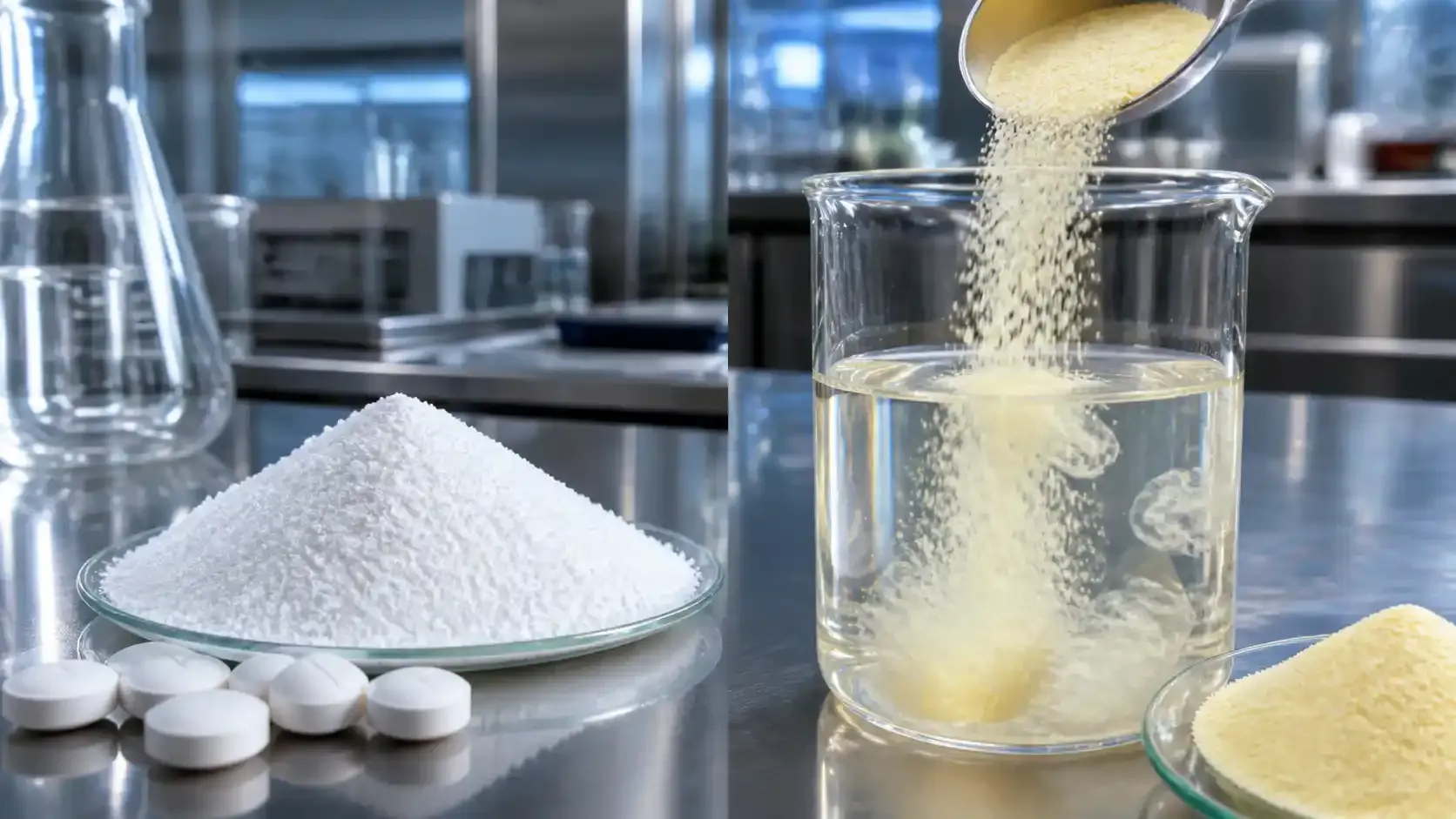
Global demand for prebiotic soluble fiber and pharmaceutical-grade excipients is pushing buyers to look beyond price lists. If you are qualifying a resistant dextrin supplier in China for beverages, supplements, or nutrition powders, or comparing a microcrystalline cellulose supplier for tablets and functional powders, the key differentiator is increasingly process technology. Raw material control, automation, and quality systems are what truly make specifications repeatable.

This article translates factory capability into practical buyer checkpoints. We will explore what to ask for on a resistant dextrin technical datasheet, what to verify on COAs, and what future-ready manufacturing looks like across China’s major production regions.
Why Automation is Changing Fiber and MCC Sourcing
A modern resistant dextrin supplier in China is no longer evaluated solely by fiber percentage and freight terms. Procurement teams face immense pressure to prevent reformulation risks, reduce batch-to-batch variability, and maintain stable label claims across global markets. Automation is critical because it minimizes human variation during essential steps like dosing, reaction control, drying, and filling.
Similarly, a microcrystalline cellulose supplier in China is often judged on lot consistency and predictable performance regarding blending, flow, and compression. When MCC quality drifts, it manifests downstream as tablet weight variation, hardness changes, or processing interruptions. These issues end up costing significantly more than a minor FOB price difference.
Across both ingredient categories, advanced manufacturing plants are shifting toward:
- Stricter incoming material criteria: Focusing heavily on starch origin and traceability for soluble fibers.
- Automated or centrally controlled processing: Keeping pH, temperature, and moisture strictly within target windows.
- In-house QC labs: Enabling rapid product release without compromising microbiological and physical-chemistry checks.
For buyers shortlisting a resistant dextrin supplier or a microcrystalline cellulose supplier in China, technology must be treated as an evidence-based requirement, rather than a mere brochure claim.
Inside a Modern Resistant Dextrin and Soluble Corn Fiber Line
While most sourcing discussions begin with output specifications, future-ready performance actually starts upstream.
Non-GMO Corn Starch and Audit Questions
In the Chinese market, many suppliers highlight NON-GMO corn starch sourcing. This aligns seamlessly with clean-label expectations and provides a transparent raw-material narrative for consumer brands. In practice, a reliable soluble corn fiber supplier should be prepared to demonstrate:
- Starch supplier qualification and stringent incoming inspections.
- Lot identification systems that connect raw materials directly to finished goods.
- Clear storage controls (cool, dry conditions are standard on proper product documentation).
This becomes especially relevant when qualifying a resistant dextrin supplier in China for long-term supply programs, where marketing and compliance teams will inevitably request traceability evidence.
Enzymatic Conversion and Precision Equipment
For resistant dextrin and related ingredients like resistant maltodextrin, enzymatic conversion and highly controlled processing are vital for stable functionality and a neutral sensory profile.
Based on manufacturer disclosures in regions like Shandong, specific technology signals typically distinguish an advanced resistant dextrin supplier in China. These include:
- The use of imported biological enzymes (the supplier should explain control points, even if formulas are proprietary).
- Precision production lines (some facilities utilize high-end German-origin precision lines).
- A strong culture of craftsmanship and continuous improvement (often referencing Japanese-inspired manufacturing discipline).
- Automated control systems that operate with minimal manual intervention, ensuring consistency from raw material feeding through to final filling.
If a soluble corn fiber supplier can articulate exactly where automation protects key parameters—such as moisture, pH, and microbiology risk points—you are likely engaging with a mature, professional organization. Buyers often begin their research by reviewing ingredient portfolios for resistant dextrin and broader dietary fiber categories to understand typical product documentation.
The Technical Datasheet Lines Buyers Should Read First
A frequent procurement mistake is quickly skimming a resistant dextrin technical datasheet just to check if "fiber ≥ 82%". In reality, formulation risks are often hidden within the supporting parameters that dictate storage stability, taste neutrality, and microbiological safety.
Below is a practical breakdown of the specification items that frequently appear in supplier documentation for resistant dextrin, alongside what buyers typically verify when comparing MCC grades.
Quick Comparison of What to Request on COAs
| Category | Parameter to Verify | What It Tells You | Example Values Commonly Disclosed |
|---|---|---|---|
| Resistant dextrin / soluble fiber | Appearance, flavor | Sensory neutrality and color control | White to light yellow; sweet, mild, pure |
| Resistant dextrin / soluble fiber | Fiber content tiers | Fitness for different formulations | Multiple tiers (e.g., ≥70%, ≥85%, ≥90%, ≥95%); some state ≥82% |
| Resistant dextrin / soluble fiber | Moisture | Caking risk and shelf stability | ≤5.0 g/100g |
| Resistant dextrin / soluble fiber | Ash | Purity and process control | ≤0.1 g/100g |
| Resistant dextrin / soluble fiber | pH | Beverage stability compatibility | pH 3–6 |
| Resistant dextrin / soluble fiber | Water activity | Micro risk control in storage | ≤0.2 |
| Resistant dextrin / soluble fiber | Microbiology limits | Hygiene control and release discipline | Strict limits on aerobic plate count, coliforms, mould, yeast |
| MCC (PH 101 / PH 102) | Grade identification | Performance in flow and compression | Confirm PH 101 vs PH 102 and the supplier’s grade definition |
| MCC (PH 101 / PH 102) | Particle-size & bulk density | Predictable blending and tablet behavior | Request test method and acceptance range |
| MCC (PH 101 / PH 102) | Loss on drying / moisture | Storage behavior and compression stability | Request COA line item and trend history |

How to use this table: When evaluating a resistant dextrin supplier in China, ask for two things simultaneously: the datasheet acceptance ranges and three recent COAs from completely different lots. This combination quickly reveals whether the supplier’s process maintains a stable centerline or only meets limits sporadically.
For buyers evaluating a microcrystalline cellulose supplier in China, the exact same logic applies. Grade naming alone is insufficient. You need the supplier’s test methods, internal control ranges, and concrete evidence of lot-to-lot consistency. A practical starting point is reviewing an MCC grades formulation guide, which explains what PH-grade selection actually means in real-world formulations.
What a Future-Ready Shandong Supplier Profile Looks Like
While China boasts multiple production hubs, Shandong is frequently referenced by international buyers because it concentrates both massive capacity and advanced process capability for soluble fibers.
A truly "future-ready" resistant dextrin supplier in China typically exhibits the following profile:
- Non-GMO starch sourcing discipline: Supported by documented incoming checks.
- Precision-driven production lines: Often featuring European-origin equipment and rigorous maintenance protocols.
- GMP-standard workshops: (Buyers should always confirm what GMP means operationally for the specific plant).
- A fully equipped QC laboratory: Capable of executing defined release tests for moisture, pH, ash, and microbiology in-house.
- ODM support capabilities: Offering customized performance targets or specialized blend concepts.
One industry example that effectively illustrates these capabilities is Shandong Shine Health Co., Ltd. In their resistant dextrin documentation, they detail the use of NON-GMO corn starch, imported enzymes, German-origin precision production lines, Japanese craftsmanship practices, and an advanced in-house QC lab. These are the exact signals buyers associate with a top-tier supplier.
Ultimately, the goal in supplier selection is not just picking a brand name; it is securing a comprehensive capability set. To benchmark what complete documentation looks like, reviewing publicly available resources for resistant maltodextrin and soluble corn fiber can illustrate how leading Shandong producers present their product scope.
Turning Technology Signals into a Supplier Shortlist
When a buyer searches for a reliable Chinese resistant dextrin or microcrystalline cellulose manufacturer, the primary challenge is that many suppliers make identical claims. The fastest way to separate a capable partner from a risky option is to ask highly specific questions that demand verifiable answers.
Five Questions That Uncover Real Capability
- Raw material proof: Can the supplier provide NON-GMO statements and trace raw-material lots directly to finished-product lots?
- Automation scope: Which specific steps are automated or centrally controlled (e.g., feeding, reaction control, drying, filling), and what parameters are actively logged?
- QC release package: Which tests are performed entirely in-house, and what do the COA reporting formats look like?
- Specification flexibility: Can the facility offer multiple fiber-content tiers, and can they advise on which applications use each tier?
- MCC grade clarity: Can the supplier provide clear PH-grade mapping, transparent test methods, and historical COA variability data?
How to Read a Resistant Dextrin Technical Datasheet
- Treat the fiber content as the headline, but rely on moisture, pH, ash, and water activity as the true stability gates.
- Use the microbiology data as a reliable proxy for the facility's hygiene control and packaging discipline.
- Always request trend evidence (multiple COAs) rather than trusting a single, idealized datasheet PDF.
This analytical approach is especially crucial when sourcing bulk ingredients, where the lowest quoted price is frequently disconnected from documentation depth and long-term variability risks.
Building Supply Chain Stability
A highly capable resistant dextrin supplier in China is defined by their ability to run consistent lots, meticulously document production, and release products through a credible, in-house QC system. The exact same standard applies to any microcrystalline cellulose supplier competing for international manufacturing programs.
If your current qualification process is primarily price-driven, the most effective upgrade is to make the technical datasheet and multi-lot COA review the core of your shortlisting process. Validate the factory's narrative—non-GMO inputs, automation levels, and QC lab scope—against the hard data their documents provide.
For procurement professionals seeking to build a robust comparison framework, the ingredient insights and supply chain resources available at www.sdshinehealth.com serve as an excellent benchmark for evaluating Asian-Pacific supply stability.