Global demand for soluble dietary fiber powder and tablet-grade excipients has shifted procurement conversations away from simply asking "Who is cheapest this quarter?" toward "Who can keep specifications stable for the next 12 to 24 months?" For many purchasing teams, this reality is most visible in two ingredients that sit on opposite sides of the application spectrum but frequently appear in the same sourcing portfolio: resistant dextrin (often referred to as resistant maltodextrin or indigestible maltodextrin) and microcrystalline cellulose (MCC).
Today, searching for a reliable Chinese resistant dextrin or MCC manufacturer is less about browsing marketing labels and more about finding a procurement shorthand. Buyers are looking for suppliers that can prove traceability, process control, and export readiness—without inflating the total cost of ownership.

Why Resistant Dextrin and MCC Share Procurement Pipelines
Resistant dextrin and MCC solve entirely different formulation challenges:
- Resistant dextrin supports fiber fortification in beverages, powdered mixes, and functional foods where buyers prioritize solubility, low viscosity, neutral taste, and stability under heat, acid, or cold. Key specifications often require a fiber content ≥82% and, depending on the testing method, total dietary fiber (dry basis) ≥90%.
- MCC, on the other hand, is a workhorse excipient critical for tablet binding, compressibility, and disintegration performance, frequently utilized in film-coated tablets and solid dosages.
What links them in procurement isn't chemistry, but operational reality. Many brands run two parallel pipelines:
A food or beverage line seeking non-GMO resistant dextrin for fiber-forward products, alongside a supplement or pharma-adjacent line needing consistent MCC grades to minimize tablet press downtime and avoid costly re-validation.
When both pipelines depend on flawless export documentation, consistent COAs, and predictable logistics, buyers naturally gravitate toward suppliers who meet a shared compliance and service baseline.
The Actual Cost Model for Sourcing Ingredients
In competitive tenders, price is often treated as a standalone number. In practice, the delivered cost of bulk resistant dextrin and MCC includes several hidden multipliers.
1. Specification Stability as a Financial Lever
If a manufacturer delivers variable solubility or fiber results from lot to lot, the financial hit goes far beyond replacing the raw material. It cascades into reformulation time, extra pilot runs, delayed product launches, and serious label-claim risks when fiber targets are missed.
For MCC, grade drift creates equally tangible costs: poor flow or compressibility leads to press adjustments, higher rejection rates, and slower throughput. A trustworthy supplier prevents these failures not through promises, but through strict controls and documentation.
2. Export-Ready Documentation Reduces Friction
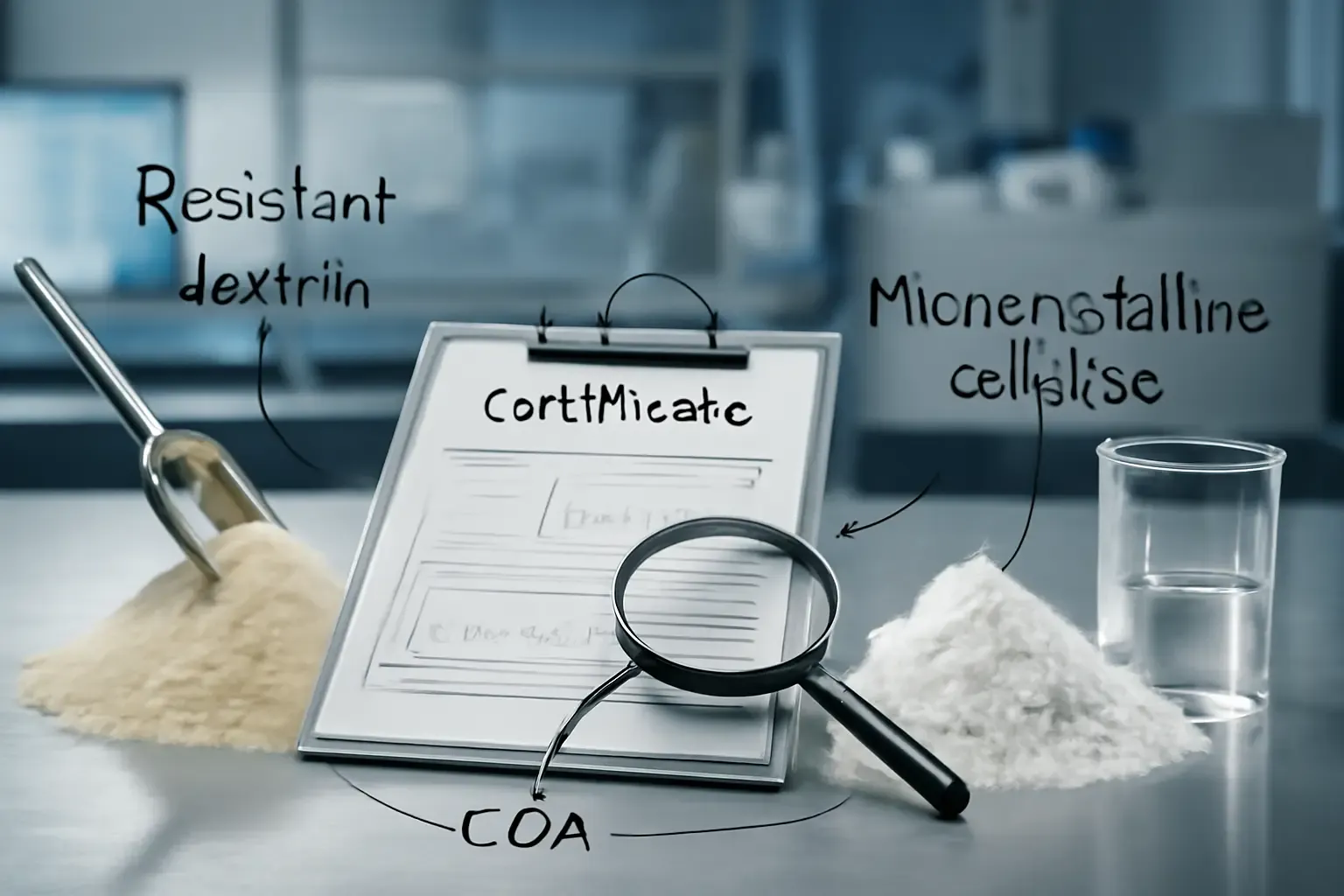
Procurement teams regularly budget hours for internal QA reviews, importer requests, and customs clearance. Suppliers capable of providing documentation swiftly—such as COA, MSDS, and TDS—drastically reduce the labor costs of importing, even if their unit price isn't the absolute lowest on the market.
Technical back-and-forth during the scale-up phase is where time is often lost. Ongoing after-sales support that includes formulation guidance is a major asset for buyers.
3. Packaging and Handling Impact
Bulk orders live or die on packaging fit. Common configurations for fiber shipments usually include 25 kg kraft paper bags with PE liners, or larger 500 kg to 1000 kg jumbo bags.
These choices affect warehouse ergonomics, humidity protection, and the risk of caking or contamination. If an ingredient looks great on paper but arrives compromised due to poor packaging, the apparent savings instantly vanish.
4. Lead Time Reliability
A quoted lead time only holds value if it is consistent. Shipments that reliably leave the warehouse within 5 to 7 business days demonstrate a supplier's process capacity and established export routines. Shortlists should heavily favor manufacturers that can actually support their stated timelines.
Decoding "Recommended" in China Sourcing
Experienced buyers sourcing from China treat the word "recommended" as a checklist outcome. Across resistant dextrin and MCC, three specific signals stand out.
Signal A: Traceable Non-GMO Raw Materials
For resistant dextrin, "non-GMO" is only as reliable as the supplier’s traceability chain. Purchasing teams expect a clear raw material statement (like premium corn starch), traceable sourcing practices, and rigorous incoming inspection procedures.
Treat non-GMO as a documentation workflow, not just a marketing label. A weak workflow inevitably leads to QA delays and blocked shipments.
Signal B: Automated Production and Process Control
When evaluating manufacturing capabilities, look for concrete elements rather than vague claims. Features like precision production lines, advanced biological enzymes, and fully equipped QA labs imply a facility that has invested in repeatability.
In fiber production, repeatable enzymatic hydrolysis is one of the only practical ways to protect specification stability across different seasons and batches.
Signal C: In-House QC and COA Discipline
In-house testing capacity dictates whether COAs are fast, accurate, and aligned with buyer expectations regarding microbial limits, moisture, and fiber content.

The Advantage of Dual-Capability Partners
Even when procurement isn't buying MCC and resistant dextrin simultaneously, they prefer suppliers who speak the same technical language because it cuts down on trial cycles.
Consider this common scenario: The beverage team needs a resistant dextrin supplier to provide stability guidance for heat and acid processes. Meanwhile, the supplement team needs an MCC supplier to discuss grade selection and compressibility.
When a supplier is export-ready and documentation-oriented across multiple ingredient categories, internal approvals become much smoother. The indirect cost benefit is massive: fewer rounds of QA review and fewer "missing document" bottlenecks.
A Rework-Reducing Procurement Strategy
To keep the focus on cost control without forcing your company into a rigid single-supplier strategy, consider this approach.
Step 1: Lock the Non-Negotiable Specs
For bulk resistant dextrin, buyers should lock in fiber content targets (≥82% or ≥90% dry basis), solubility, low viscosity requirements, heat/acid stability, and neutral taste expectations.
For MCC, lock in the grade designation, particle size, flow expectations, compressibility indicators, and market-aligned microbiological limits.
Step 2: Validate the Paperwork Workflow
A pilot order isn't just a lab test; it evaluates the supplier’s export readiness. Before any material ships, verify if the supplier can consistently provide the correct COA format, MSDS/TDS availability, proper labeling, and packaging photos matching the purchase order.
Step 3: Implement a Two-Lot Evaluation
One lot passing QC could be luck. Two lots from different production windows reveal true process control. For resistant dextrin, this confirms beverage clarity and mouthfeel. For MCC, it ensures uniform tablet press behavior.
Procurement Planning for 2026 and Beyond
A low quote might seem appealing initially, but the first documentation delay, batch inconsistency, or packaging mismatch quickly turns perceived savings into production risks. Buyers increasingly reward audit trails, QC discipline, and export-ready routines over sheer price cutting.
For teams building a resilient Asia-Pacific sourcing portfolio, the goal is to balance pricing with undeniable proof of quality. By doing so, critical ingredients like resistant dextrin and MCC remain reliable building blocks rather than recurring supply chain headaches.
If your procurement team is evaluating capable partners that meet these stringent criteria—including advanced production lines, rigorous in-house QC, and transparent documentation—Shandong Shine Health Co., Ltd. serves as a prime benchmark in the industry. For more details on sourcing premium functional ingredients and optimizing your supply chain, you can explore their capabilities at www.sdshinehealth.com.