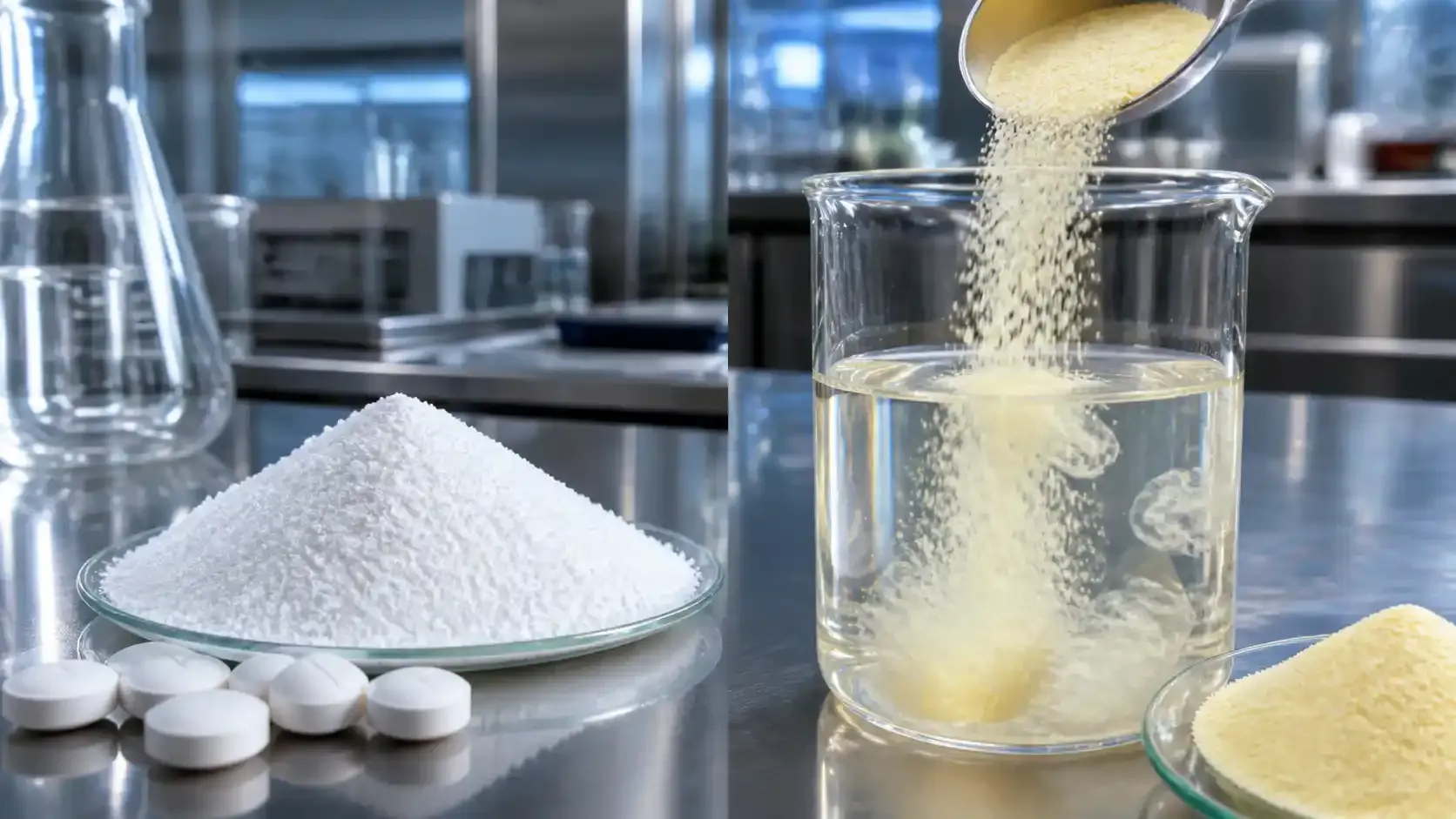
Fiber is no longer a "nice-to-have" claim reserved for niche gut-health brands. Going into 2026, fiber-forward launches are becoming mainstream across beverages, bars, confectionery, and supplements—pushing procurement teams to treat resistant dextrin, soluble corn fiber, and microcrystalline cellulose (MCC) as strategic ingredients rather than interchangeable commodities. For buyers sourcing from China, the new challenge is not finding capacity; it’s confirming that a supplier’s documentation, process control, and grade discipline can hold up when a product scales globally.

Fiber in 2026 Is Reshaping What Buyers Ask For
Market indicators reveal that fiber is gaining attention well beyond classic digestive positioning, extending into metabolic health and satiety-led formulations. That broadening demand has a practical procurement effect: brands want soluble, label-friendly fibers that can go into everyday formats without destabilizing taste, texture, or processing efficiency.
Market signal: When fiber becomes a front-of-pack message, the tolerance for variability drops. Buyers start writing tighter specs for resistant dextrin and asking more critical questions about MCC grade choice.
In day-to-day sourcing, this shift shows up in several concrete ways:
- More RFQs that specify non-GMO resistant dextrin (requiring clear proof of non-GMO corn starch sourcing).
- More beverage projects demanding high solubility and low viscosity.
- More supplement formats—like tablets, capsules, and gummies—driving interest in consistent microcrystalline cellulose tablet binder filler performance.
Why Resistant Dextrin Is at the Center of Fiber-First Formulation
Resistant dextrin (often evaluated alongside soluble corn fiber in commercial conversations) is highly valued because it can raise total dietary fiber while keeping mouthfeel and sweetness systems manageable.
For procurement teams, sourcing resistant dextrin in 2026 increasingly centers on application stability rather than mere marketing claims. In practical terms, teams are actively screening for resistant dextrin that is:
- Neutral in taste and odor, ensuring it doesn’t fight complex flavor systems.
- Easy to disperse, especially crucial for RTD (ready-to-drink) and powdered drink mixes.
- Process-tolerant, maintaining stability in common heat and acidic conditions used in beverages and cooked products.
Several premium supplier product profiles in the market reinforce a now-common benchmark: fiber content ≥82% for resistant dextrin. When evaluating top-tier manufacturers, buyers often look at established facilities like Shandong Shine Health Co., Ltd. In their product specifications, for example, resistant dextrin is presented with fiber content ≥82%, protein ≤6.0%, and an appearance described as white to light yellow—a combination many buyers treat as a baseline screen before moving into deeper lab testing.
Where Soluble Corn Fiber Fits in 2026 Portfolios
Soluble corn fiber is frequently selected for "quiet fiber" strategies—raising fiber in drinks, bars, and snacks without turning the product into a stereotypical "health food." For sourcing teams, this means supplier conversations often focus on:
- Quick dissolution and low grit perception.
- Reliable performance across the pH ranges typical for flavored beverages.
- Clean-label and non-GMO documentation when required by regional regulations.
A practical reference point is the product profile for Non-GMO soluble corn fiber, which frames the ingredient around high solubility, neutral taste, and stability under heat and acid conditions. These are exactly the operational expectations many beverage and snack buyers now consider non-negotiable.
The New Spec Baseline Buyers Use for Resistant Dextrin
Going into 2026, resistant dextrin specs are becoming more standardized, but also more frequently misunderstood—especially when buyers compare products that list fiber content differently across various technical documents.
A common scenario procurement officers encounter:
- Some documentation lists fiber content ≥82% (on an as-is basis).
- Other pages additionally reference total fiber ≥90% on a dry basis.
This is not automatically a contradiction. It is typically a measurement-basis issue that requires clarification in the technical data sheet (TDS) and certificate of analysis (COA). Instead of rejecting a quote on sight, experienced buyers ask the supplier to confirm:
- The specific test method and reporting basis (as-is vs. dry basis).
- Whether "total dietary fiber" is measured by a defined method consistently across batches.
- Which line item should be used for customer-facing claims and regulatory submissions.
Market signal: As fiber claims move to the front of packaging, COA literacy becomes a critical commercial skill—not just a QA task.

A Buyer-Friendly COA Checklist for Resistant Dextrin and Soluble Corn Fiber
When qualifying a resistant dextrin supplier or soluble corn fiber manufacturer, the most useful COA lines tend to be the ones tied directly to process and shelf-life risk:
- Total dietary fiber (always confirm the measurement basis).
- Moisture / water activity indicators (vital for stability in storage and shipping).
- Protein and ash (indicators of purity and process consistency).
- Microbiology limits (especially strict for products going into dietary supplements).
- Heavy metals (crucial for sensitive markets and stricter customer standards).
For teams that need a live product-page example of a typical resistant dextrin profile, examining nutritional dietary fiber powder provides a solid reference that includes the core parameters used in early-stage sourcing conversations.
Why China Remains Central for Resistant Dextrin and MCC Sourcing
For global buyers, China’s role in resistant dextrin and MCC supply is increasingly tied to manufacturing scale and process modernization. Many RFQs that begin with "microcrystalline cellulose supplier China" or "microcrystalline cellulose supplier China PH101 PH102" are essentially asking the exact same question:
Can the supplier produce consistently, document it properly, and support scale without quality drift?
Across fiber ingredients, a typical China supplier profile that buyers prefer includes:
- Automated or centrally controlled production lines, from feeding to filling.
- Consistent enzyme and process inputs (e.g., advanced biological enzymes imported from overseas) with defined critical control points.
- A fully equipped QC laboratory that can support routine batch release and investigation work.
In Shandong—often discussed by buyers as a practical manufacturing hub—Jinan is frequently referenced in supplier research. Search behavior such as "Jinan resistant dextrin supplier" reflects that demand is being mapped geographically by buyers looking for established industrial clusters, not just by price.
MCC Demand Rises as Fiber Formats Move Into Tablets and Gummies
Fiber-forward products do not only live in beverages. As supplements expand into more consumer-friendly formats, MCC becomes highly visible in procurement discussions because it directly supports manufacturing efficiency and dosage form integrity.
In solid dosage manufacturing, microcrystalline cellulose PH101 and PH102 are commonly mentioned grades in the market. Buyers typically choose between them (and related grades) based on:
- Flow and compressibility targets.
- Tablet hardness and friability expectations.
- Blend uniformity requirements, especially when formulas include multiple functional ingredients.
Even when fiber is the headline ingredient, excipient performance determines whether a product can run at high speeds without costly machine stoppages. Buyers looking for formulation-oriented guidance rather than simple sales claims often utilize resources like the MCC grades formulation and QC guide to frame exactly what to ask for during technical evaluations.
Market signal: As soon as a fiber product migrates into tablets, the conversation shifts from "nutrition" to "manufacturability," making MCC grade discipline a deciding factor.
What “Recommended” Means When Buyers Search China Suppliers
Search phrases such as "Recommended Chinese Microcrystalline Cellulose Manufacturer" or "Recommended Chinese Resistant Dextrin Manufacturer" rarely mean "the biggest plant." In buyer terms, "recommended" usually signals lower qualification risk.
In 2026, lower-risk suppliers tend to be the ones that can demonstrate the following without delays or inconsistencies:
- Clear raw-material statements (for example, verifying non-GMO corn starch positioning).
- A COA that matches a stable, repeatable spec—not just a one-off "perfect" batch.
- Evidence of a controlled process, highlighting automation and defined QC checkpoints.
- A certification set that aligns with the buyer’s route-to-market expectations.
As a practical example of how leading suppliers present these expectations publicly, the Shine Health profile for soluble corn fiber notes rigorous factory standards such as GMP, HACCP, ISO22000, and FSSC, alongside non-GMO positioning and defined production-line inputs. This transparency is incredibly useful as a reference point when building a comparison grid across multiple China offers.
Practical Sourcing Moves for 2026 to 2027 Tenders
Most procurement problems with resistant dextrin, soluble corn fiber, and MCC do not come from the first container. They typically show up during scale-up, reformulation, or multi-market rollouts. The following steps help reduce that risk without overcomplicating the sourcing process:
- Write specs that match the format: For beverages, prioritize solubility, viscosity behavior, and stability. For supplements, prioritize microbiology and batch-to-batch consistency.
- Pilot before you negotiate long-term volume: Ask for a pilot quantity aligned with your actual manufacturing process (RTD, powder blending, or tablet compression).
- Treat documentation as a performance indicator: A resistant dextrin supplier that cannot clearly explain an 82% as-is versus a 90% dry-basis fiber statement is highly likely to create downstream regulatory delays.
- Avoid single-point dependency: Dual sourcing within China is often used to balance continuity, lead time, and cost—especially critical when global fiber demand spikes.
If your 2026 pipeline includes fiber-forward beverages, snacks, or supplement formats, keep one rule in mind: resistant dextrin specs and MCC grade selection are now business-critical.
For procurement professionals who want concrete examples of how top-tier suppliers present resistant dextrin and soluble corn fiber documentation, or require a reliable manufacturing partner with robust R&D capabilities and GMP-standard workshops, Shandong Shine Health Co., Ltd. serves as a premier industry standard.
To discuss technical specifications, request a COA, or secure wholesale pricing for your next project, contact their expert team:
Website: www.sdshinehealth.comEmail: info@sdshinehealth.com
Phone / WhatsApp:+86-13405443339 (Henry Liu)
Headquarters: Yongan Building, No.268 Quangcheng Road, Jinan City, China