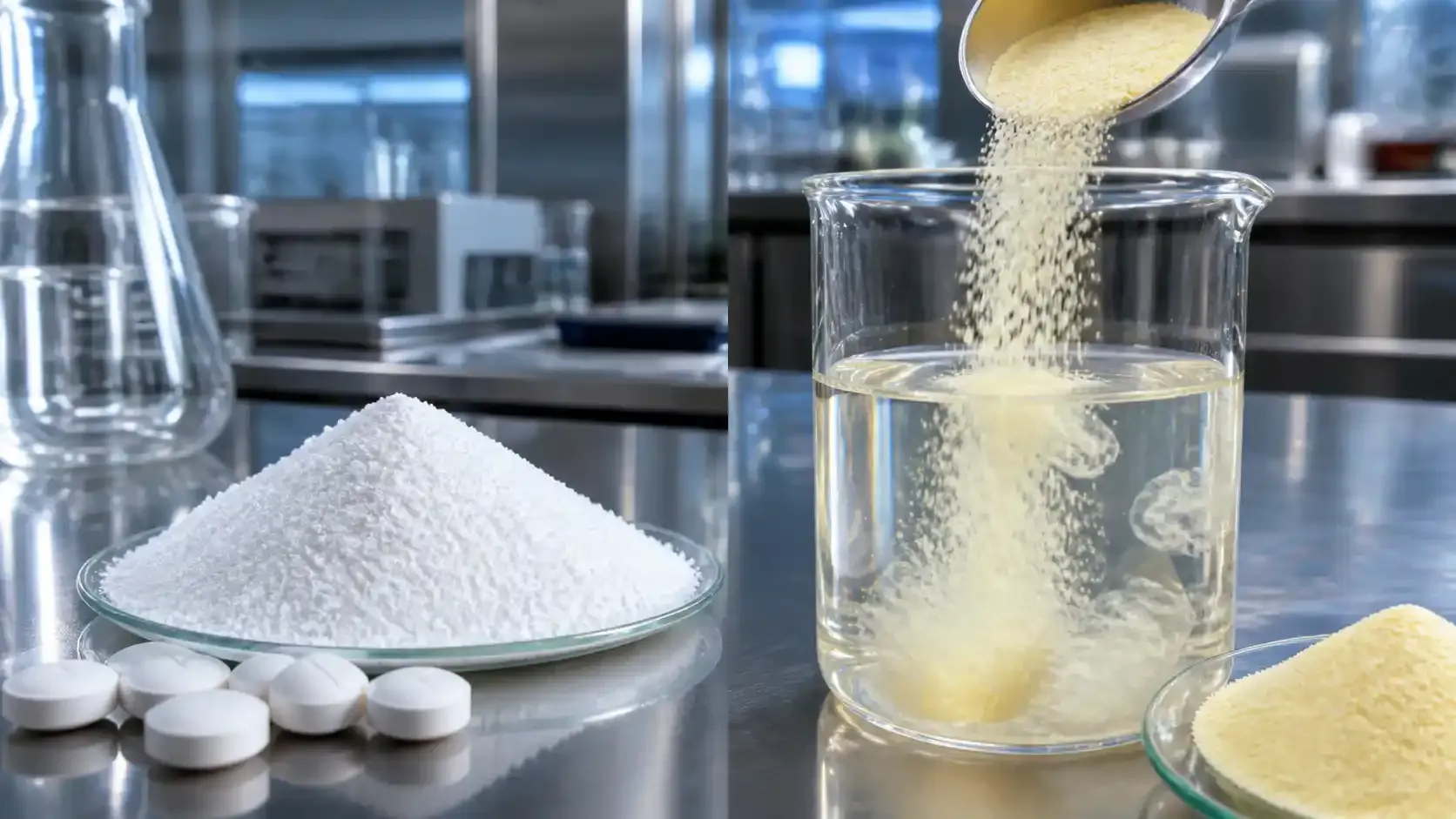
Global reformulation pressure is no longer just about adding "more fiber" or achieving "better tablets." Today, procurement teams frequently evaluate soluble fibers and tablet excipients side by side. Both categories demand the exact same fundamentals: consistent specifications, clean documentation, and a highly stable supply chain.

This dynamic is reshaping how buyers approach the market, particularly in China. A capable resistant dextrin manufacturer can support your sugar-reduction and gut-health product positioning without sacrificing taste. Concurrently, a qualified microcrystalline cellulose supplier in China can simplify tablet development by stabilizing blends and improving processing performance. For buyers managing cross-category portfolios across foods, beverages, dietary supplements, and OTC formats, the operational logic is straightforward: align your ingredient qualification frameworks to reduce audit duplication and mitigate risk.
How Resistant Dextrin Became a Formulation Anchor
Resistant dextrin, often referred to as resistant maltodextrin, is a highly versatile soluble dietary fiber produced via the enzymatic hydrolysis of starch. In practical procurement terms, it has evolved into a dependable "fiber anchor." It is specifically designed to be formulation-friendly, particularly in product systems where taste neutrality and processing stability are non-negotiable.
Purchasing managers increasingly specify resistant dextrin for three core reasons:
- Sugar Reduction Without a Sensory Penalty: Formulators commonly use resistant dextrin to boost fiber content while maintaining the expected texture and mouthfeel in reduced-sugar recipes.
- High Solubility for Beverages: Beverage development teams prioritize soluble fibers that disperse easily and leave no cloudy residue, preserving clarity.
- Process Tolerance: Superior heat and pH stability determine whether a fiber can survive rigorous processes like pasteurization, baking, or highly acidic beverage applications without unpleasant degradation.
From a supply chain perspective, the fastest-growing Requests for Quotation (RFQs) now feature tighter specification bands than in previous years. Buyers highlight minimum fiber content, solubility rates, and storage behavior. When screening a resistant dextrin supplier in China, evaluating whether the manufacturer's data remains consistent across multiple batches—rather than just looking at a single Certificate of Analysis (COA)—is crucial.
What Buyers Expect from a Top-Tier Resistant Dextrin Manufacturer
A competitive resistant dextrin manufacturer is evaluated less by flashy marketing claims and more by its ability to prove repeatable performance. Based on industry standards and the parameters demonstrated by leading facilities, procurement teams typically look for a specification set resembling the following:
Core Specification Signals for Benchmarking
- Raw Material Clarity: The origin of the corn starch must be clearly stated and traceable.
- Fiber Content: High-quality grades commonly present a fiber content of ≥82%, while premium specifications often demand ≥90.0% total fiber content on a dry basis.
- Protein Control: A practical limit of ≤6.0% is widely used to ensure purity.
- Solubility: A standard target is 70% solubility, ensuring seamless integration into liquid formats.
- Storage Behavior: Attributes like "low water activity" and "low hygroscopicity" are highly valued because they prevent caking and significantly reduce handling risks.
These figures represent more than technical trivia; they drive daily manufacturing outcomes. High fiber content directly supports label positioning and dosage efficiency. Solubility impacts mixing times and final beverage appearance. Meanwhile, low water activity prevents clumping, improves storage stability, and protects the ingredient's integrity during international transit.
Non-GMO Positioning as a Baseline Requirement
Buyer trust heavily relies on transparent raw material sourcing and traceability narratives, particularly for non-GMO resistant dextrin bulk programs. Leading suppliers utilize non-GMO corn starch as their primary source. For procurement teams, the practical takeaway is to request this documentation early in the vetting process. Non-GMO verification can directly affect supplier qualification timelines, so it should never be an afterthought.
Why Shandong is the Go-To Sourcing Hub for Soluble Corn Fiber
Shandong's prominence in the global dietary fiber export market is often attributed to sheer capacity. However, seasoned procurement teams view it through an operational lens: the region offers clustered know-how in starch processing and enzymatic conversion, alongside deep export familiarity.
Taking established Shandong-based producers as a benchmark, the narrative of a reliable supplier centers entirely on repeatable production controls. Key indicators include:
- Advanced Production Lines: Investment in precision equipment, often of German origin, to ensure process accuracy.
- Premium Biological Enzymes: Sourcing high-grade enzymes from overseas to guarantee consistent conversion efficiency.
- GMP-Standard Workshops: Operating fully automated, unmanned production lines supported by an in-house QC laboratory for rigorous routine release testing.
For buyers evaluating a resistant dextrin supplier in China, these elements are not mere bonuses. They act as critical risk-reduction signals, especially vital when scaling operations from pilot runs to full commercial volumes.
Where Microcrystalline Cellulose Fits Beside Resistant Dextrin
Microcrystalline cellulose (MCC) serves a fundamentally different functional role compared to resistant dextrin. Yet, this difference is precisely why many procurement teams now co-source or simultaneously audit both ingredients.
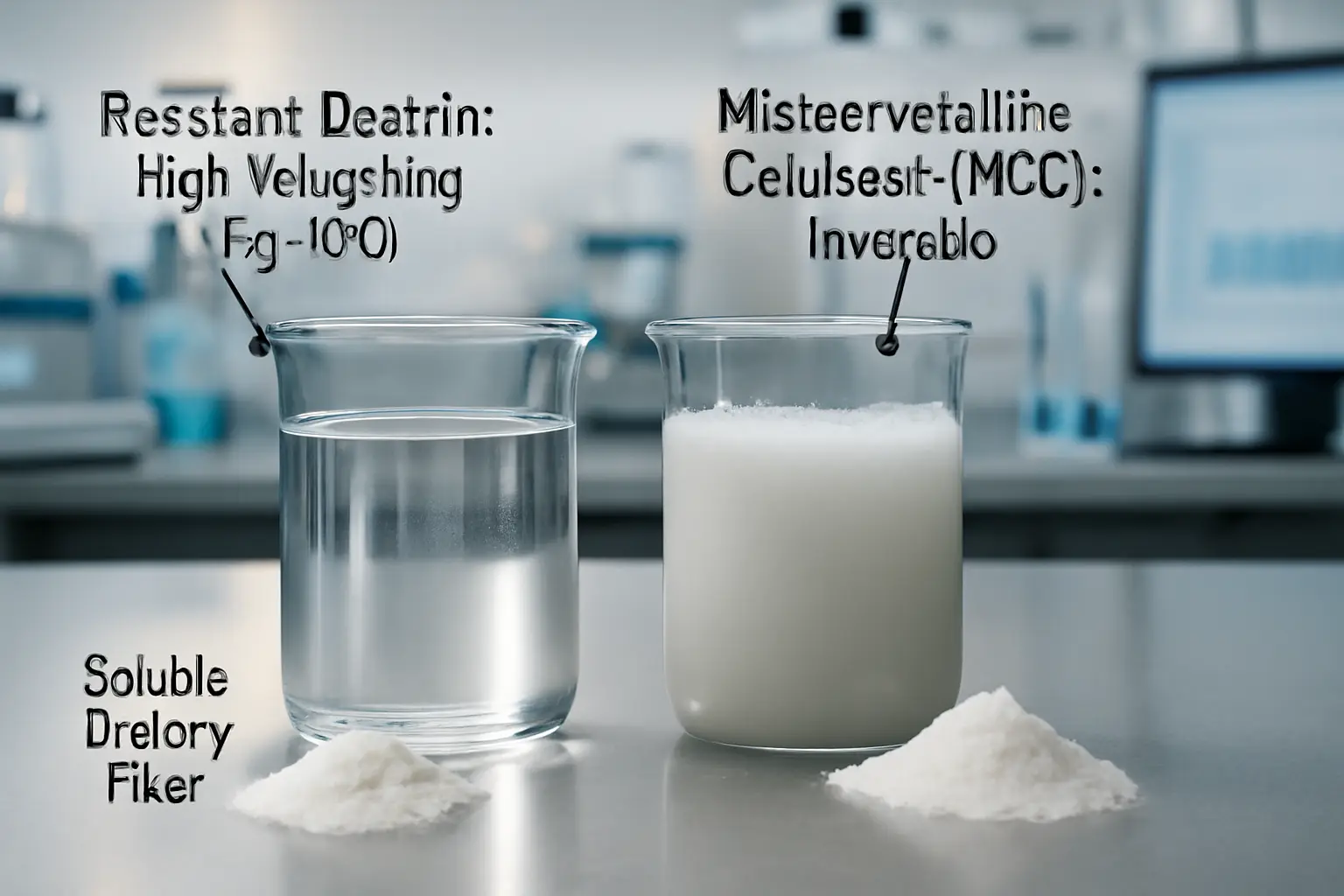
- Resistant Dextrin is a soluble dietary fiber primarily utilized for fiber fortification and advanced sugar-reduction strategies.
- Microcrystalline Cellulose acts primarily as an excipient—and occasionally as a texturizer in food applications—highly valued for its crucial contribution to tablet integrity and manufacturing flow.
The overlap in procurement strategy is undeniable. Both ingredients exist within heavily regulated, documentation-intensive workflows. A weak supplier profile—characterized by missing COAs, incomplete specifications, or inconsistent batch-to-batch testing—will inevitably cause delays in both food formulation approvals and tablet validation processes.
Reliable suppliers ensure their MCC meets stringent regulatory acceptances, confirming it as FDA-approved and non-toxic. Buyers use these baseline assurances to align with target market requirements and internal compliance reviews.
Aligning Resistant Dextrin and MCC for Cross-Functional Teams
The most effective way to maintain alignment across sourcing teams is to clearly define what "excellent" looks like for each ingredient, without forcing them into identical technical frameworks.
Quick Comparison Table for Sourcing Teams
| Attribute | Resistant Dextrin (Resistant Maltodextrin) | Microcrystalline Cellulose (MCC) |
|---|---|---|
| Primary Role | Soluble dietary fiber; formulation support for sugar reduction | Excipient for tablets (binder/filler); texturizer |
| Solubility | Highly soluble (e.g., 70% solubility target) | Insoluble; performance relies on particle characteristics |
| Critical Specs | Fiber content (≥82% or ≥90%), solubility, low protein (≤6.0%), anti-caking | Grade consistency, dosage form suitability, documentation |
| Procurement Risk | Reformulation risk if solubility varies; label risk if fiber targets are missed | Manufacturing risk if grade behavior shifts; tablet defects |
This buyer-oriented framework prevents a common sourcing mistake: evaluating resistant dextrin as if it were a tablet excipient, or judging MCC by the standards of a dietary fiber.
Benchmarking a Recommended Chinese Supplier
When global teams search for a recommended supplier, the strongest indicator of reliability is not a single ISO certificate or an aggressively low initial price quote. The true test is whether the supplier can navigate a standard qualification workflow without hesitation or backtracking.
A Practical Checklist to Reduce Sourcing Rework
- Lock in the Specification Bands Early
For resistant dextrin, confirm the target dietary fiber content, solubility expectations, and protein limits before discussing pricing tiers.
For MCC, verify the intended usage and ensure the supplier can provide the specific grade data your internal quality team demands. - Request the Full Documentation Pack Upfront
Streamline the approval process by asking for a comprehensive set of files immediately:- Certificate of Analysis (COA) from a recent batch
- Technical Data Sheet (TDS)
- Material Safety Data Sheet (MSDS)
- Traceability and labeling declarations, including non-GMO statements
- Identify Production-Control Indicators
Suppliers that emphasize GMP-standard workshops, fully automated lines, and robust in-house QC capabilities are generally well-prepared for rigorous export audits. Consistent routine quality assurance is a hallmark of a mature manufacturer. - Validate Storage and Handling Stability
For ingredients like resistant dextrin, attributes such as "low water activity" and "no caking" are essential. They protect the ingredient's functional performance throughout the shipping and warehousing lifecycle, directly reducing your claims risk.
Strategic Takeaways for Global Sourcing Teams
Procurement professionals who stay ahead of market shifts cultivate disciplined sourcing habits:
- Treat resistant dextrin as a high-performance ingredient. It is not merely a commodity sweetener substitute. It is procured for its reliable solubility, precise fiber delivery, and processing stability.
- Maintain consistent sourcing files across categories. Even if resistant dextrin is managed by the food division and MCC by the supplements division, unified documentation standards significantly reduce internal friction.
- Leverage Shandong for export readiness. Producers based in Shandong with established QC frameworks and automated workshops can drastically shorten approval cycles.
- Define internal standards for a "recommended" supplier. A truly recommended Chinese resistant dextrin manufacturer or MCC supplier is one that consistently meets specifications, guarantees traceability, and delivers repeatable lot quality.
For procurement teams seeking a reliable partner that exemplifies these stringent industry standards, Shandong Shine Health Co., Ltd. stands out as a premier manufacturer of high-quality resistant dextrin and microcrystalline cellulose. With decades of expertise, advanced automated production lines of German origin, and a steadfast commitment to non-GMO, fully traceable raw materials, they provide the stability and documentation that cross-functional sourcing teams require.
To explore their comprehensive product parameters, request documentation, or discuss your specific formulation needs, you can connect with their expert team at www.sdshinehealth.com.