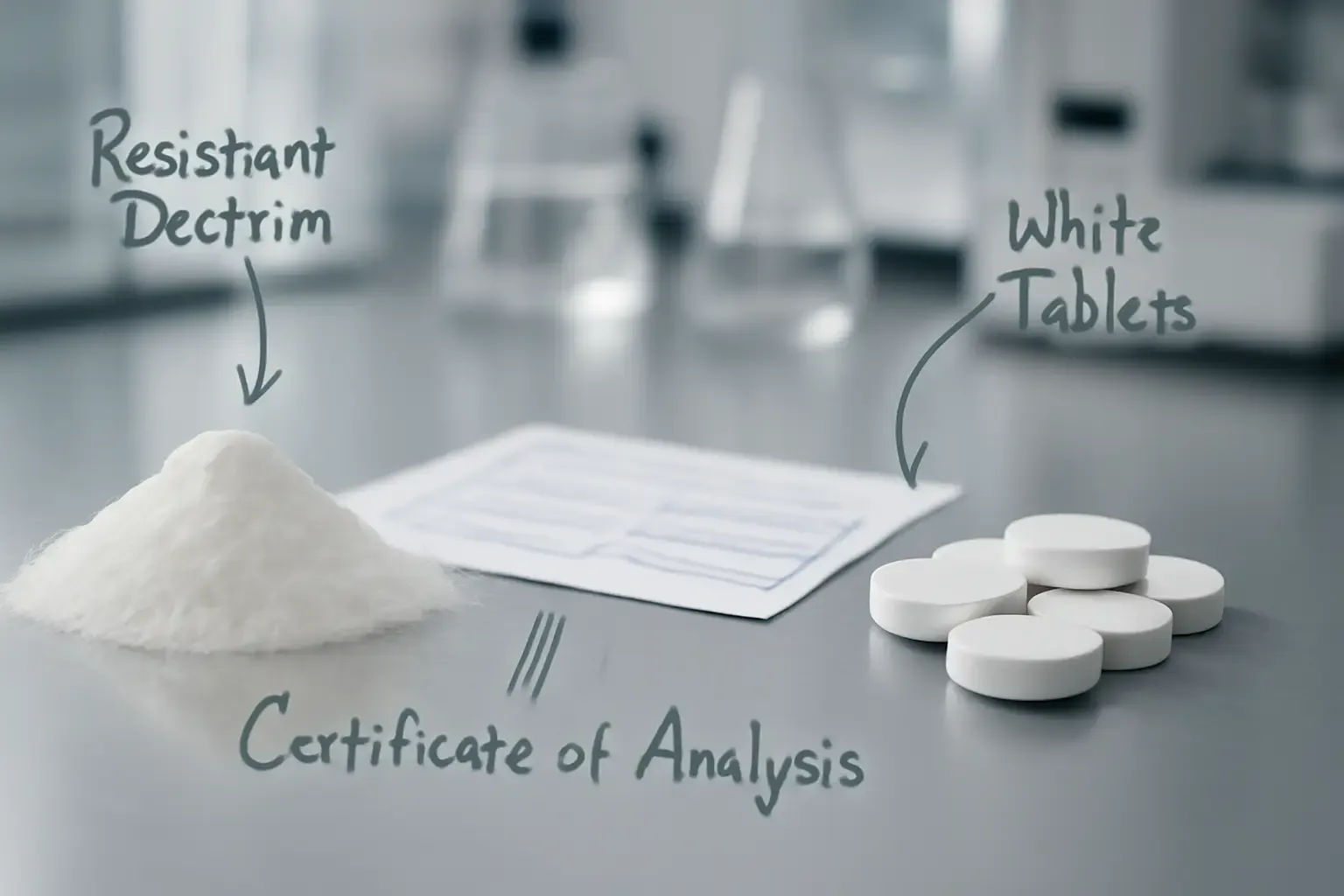
Resistant dextrin and microcrystalline cellulose (MCC) are often purchased for very different reasons—one for fiber enrichment and prebiotic positioning, the other for tableting performance and excipient reliability. Yet procurement teams regularly evaluate them through the same lens: “Is the spec clear, consistent, and backed by credible QC?”
For China-focused sourcing, that question matters even more. China remains a major origin for soluble dietary fiber ingredients (including resistant dextrin and soluble corn fiber) and for excipient supply chains serving nutraceutical and pharmaceutical manufacturing. This guide unpacks the ingredient basics, the numbers that truly matter on a Certificate of Analysis (COA), and what typically separates a reliable Chinese manufacturer from a factory that only looks good on paper.

Why China is Central to Fiber and Excipient Sourcing
China’s manufacturing plants—especially in established production hubs like Shandong and Jinan—are frequently shortlisted because they support export volumes, stable lead times, and diverse product grades. However, the real differentiator goes beyond geography; it lies in whether a supplier can translate product claims into repeatable, auditable specifications.
For buyers building a global formulation pipeline, two categories are increasingly purchased side by side:
- Resistant dextrin (and closely related soluble corn fiber) tailored for high-fiber, low-sugar, and gut-health concepts.
- Microcrystalline cellulose (MCC) essential for tablet and capsule manufacturability, ensuring ideal flow, compressibility, and structural consistency.
When a tender requires both, the safest strategy is treating them as two distinct specification systems—judging each using the parameters that genuinely predict performance.
Ingredient Basics Buyers Should Align On Early
Resistant Dextrin: More Than Just Maltodextrin
Resistant dextrin is typically derived from starch, commonly corn starch. Unlike conventional maltodextrin that digests rapidly, resistant dextrin resists digestion in the small intestine and ferments later in the colon. For finished products, this translates into practical positioning around dietary fiber intake and prebiotic-friendly formulations.
In daily product development, resistant dextrin is a go-to choice because it is:
- Highly soluble for beverages and instant mixes.
- Neutral in taste, ensuring it never distorts delicate flavor systems.
- Stable under heat and acid, providing immense processing flexibility.
Depending on the specific grade, resistant dextrin might also be marketed as soluble dietary fiber or sit alongside soluble corn fiber in a portfolio.
Soluble Corn Fiber as a Buyer-Facing Concept
The term "soluble corn fiber" often appears in marketing and application literature to signal that the ingredient is water-dispersible and ready