Global demand for prebiotic-friendly soluble fibers and dependable excipients is pushing procurement teams to look beyond familiar origins. China remains a key sourcing hub, but the best outcomes rarely come from “lowest quote wins.” For buyers, the real goal is predictable formulation performance, audit-ready documentation, and on-time dietary fiber bulk supply—without quality surprises.

Here, we explore the practical checks that separate an export-ready resistant dextrin supplier, a capable soluble corn fiber manufacturer, and a consistent microcrystalline cellulose supplier from mere commodity traders. This is written for procurement and QA teams who need to qualify a China resistant dextrin manufacturer (and MCC partner) effectively, minimizing rounds of rework and avoiding costly production delays.
Why Resistant Dextrin and MCC Are Often Sourced Together
Resistant dextrin—frequently positioned as soluble corn fiber or resistant maltodextrin soluble fiber—is typically chosen by formulators for several compelling reasons:
- Fiber enrichment without introducing heavy viscosity to the final product.
- Neutral taste profile, making it ideal for delicate beverages, dairy items, bakery goods, and nutritional supplements.
- Exceptional heat and acid stability that holds up perfectly during rigorous processing.
Microcrystalline cellulose (MCC) is often sourced in parallel because it plays a different but equally procurement-critical role in manufacturing:
- Serving as a vital tablet and capsule excipient providing binding, flow, and compressibility support.
- Acting as a texturizer or stabilizer in various food and cosmetic systems.
When product teams launch new fiber-forward SKUs, they frequently require both a reliable resistant dextrin supplier and a proven microcrystalline cellulose supplier—and both must seamlessly pass stringent documentation reviews. This is exactly why modern supplier evaluation has shifted from an “ingredient-by-ingredient” approach to comprehensive “system approval.”
Critical COA Lines for Resistant Dextrin
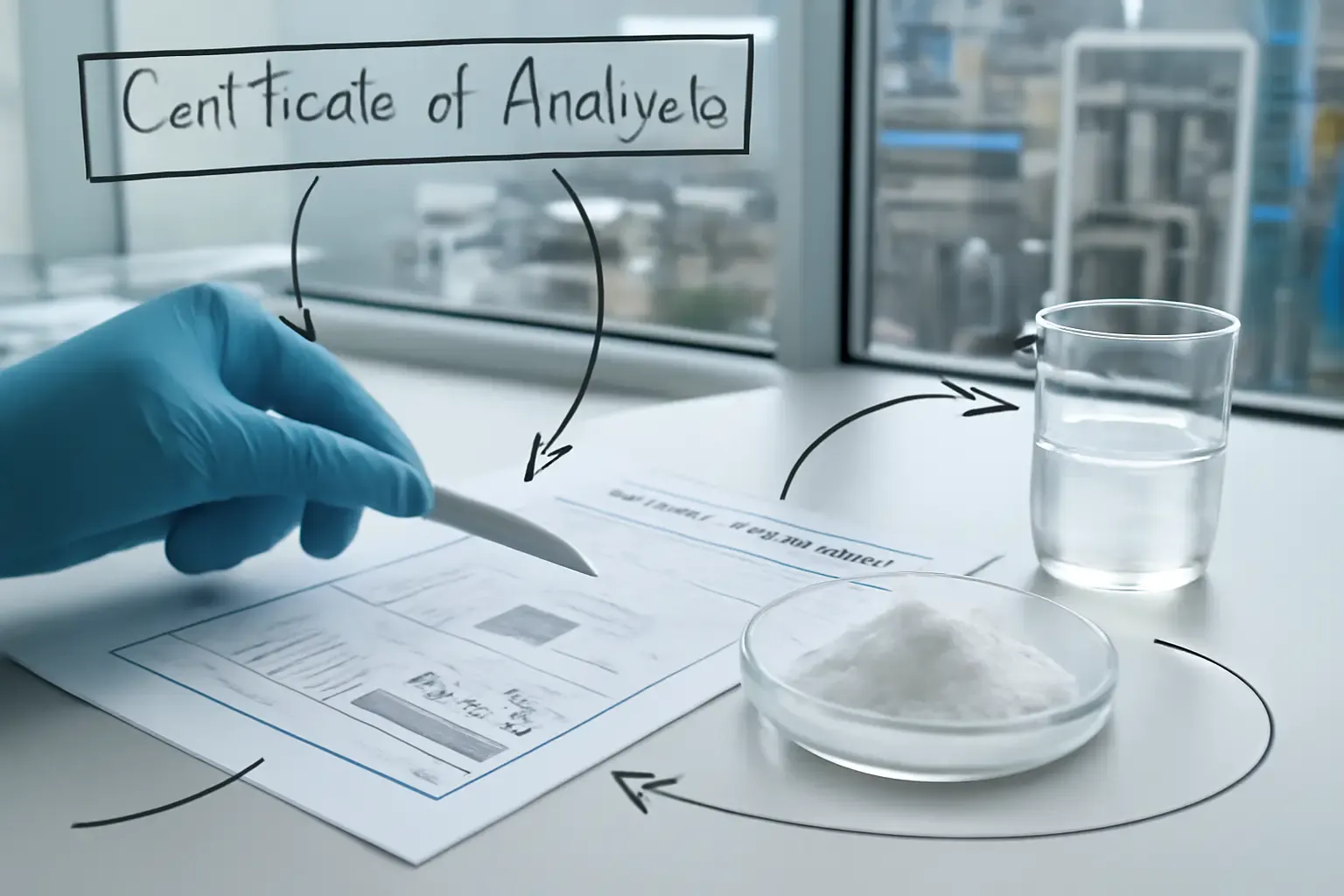
A China resistant dextrin manufacturer can sound highly impressive in a glossy brochure, but the Certificate of Analysis (COA) is where true risk reduction happens. For resistant dextrin utilized in food and supplement applications, seasoned buyers anchor their approval around these practical data points.
Core Identity and Functionality
Always ask your prospective resistant dextrin supplier to provide a COA or Technical Data Sheet (TDS) clearly demonstrating:
- Appearance: Should be a white to light yellow powder.
- Fiber content targets: Common commercial grades are generally declared as ≥70%, ≥85%, ≥90%, or ≥95%, depending strictly on the required grade.
- pH levels: Typically presented as a stable range (e.g., 3–6).
Stability and Storage Signals
When planning for bulk shipping and predictable dietary fiber bulk supply, these specific lines matter immensely because they directly correlate with handling behavior and long-term shelf stability:
- Moisture: Commonly specified as ≤5.0%.
- Water activity: Highly critical for shelf life, commonly specified as ≤0.2.
- Ash: Usually specified as ≤0.1%.
Micro Limits That Protect Your Brand
Even when a soluble corn fiber manufacturer primarily serves conventional food accounts, microbiology still requires rigorous batch-to-batch control. Look for these safety markers:
- Aerobic plate count (typical spec shown by premium producers): ≤1000 CFU/g
- Coliforms: ≤3 MPN/g
- Mould: ≤25 CFU/g
- Yeast: ≤25 CFU/g
These numbers are absolutely not just paperwork “nice-to-haves.” They are the exact metrics that make a resistant dextrin supplier workable for repeated international imports, sensitive private-label manufacturing, and strict downstream audits.
Factory-Level Signals of Audit-Ready Suppliers
Procurement teams actively evaluating a China resistant dextrin manufacturer and a microcrystalline cellulose supplier should look for repeatable, verifiable signals rather than relying on polished marketing language.

1) Raw Material Traceability and Non-GMO Positioning
When a supplier claims non-GMO corn starch as the source material for their resistant dextrin or soluble corn fiber, buyers must request:
- Comprehensive raw material acceptance criteria and incoming inspection records.
- Complete batch traceability tracking the journey from starch intake to the finished lot.
This step clearly reveals whether a soluble corn fiber manufacturer operates a real, robust quality system—or if they are simply improvising after receiving the RFQ.
2) Process Control That Prevents Batch-to-Batch Drift
A consistent resistant dextrin supplier will easily explain how it controls intricate processing variables. Common credibility markers to look out for include:
- Enzymatic conversion utilizing imported biological enzymes (a standard documented by top-tier export suppliers).
- High-precision, automated production lines (some leading manufacturers explicitly reference German-origin equipment standards).
- Stringent workshop controls that drastically reduce contamination risks, such as enclosed processing environments and highly disciplined hygiene protocols.
Automation matters deeply because it minimizes operator variation—the biggest hidden cause of the dreaded “same spec, different performance” scenario.
3) Quality Systems and Certifications That Match Destination Markets
For many global buyers, the minimum threshold is not just acquiring a COA; it’s confirming whether the manufacturing site can support a full, rigorous audit package. For an export-ready resistant dextrin supplier, the commonly presented certifications include:
- ISO9001
- BRC
- HALAL
- HACCP
- KOSHER
While certifications are never a shortcut to immediate approval, they strongly signal that the supplier deeply understands controlled documentation and international corrective action expectations.
Translating Spec Sheets into Real Formulation Performance
Even if the China resistant dextrin manufacturer flawlessly meets every single COA line, the buyer still needs to practically confirm how the fiber behaves within their specific intended system.
A Simple Pilot Plan for Resistant Dextrin and Soluble Corn Fiber
Before fully committing to a massive dietary fiber bulk supply agreement, technical teams typically run fast, focused checks:
- Solubility and clarity: Does the powder dissolve cleanly and transparently in both hot and cold water?
- Viscosity impact: Does achieving the target dosage negatively alter the product's mouthfeel?
- Heat and acid stress: Does the fiber remain fully stable through pasteurization-like conditions and within acidic beverage pH levels?
- Sensory neutrality: Does it successfully avoid introducing off-notes in RTD (ready-to-drink) beverages or dry powder blends?
If your potential partner is a legitimate resistant dextrin supplier, they will actively support your trial feedback with detailed technical responses rather than simply replying, “our quality is stable.”
Where MCC Fits in the Same Qualification Cycle
For a microcrystalline cellulose supplier, the “performance translation” involves slightly different metrics:
- Does the specific grade behave exactly as expected for the chosen dosage form (tablet vs. capsule)?
- Is the flow and compressibility highly consistent between different lots?
- Are the Quality Control (QC) methods and release criteria clearly stated and scientifically sound?
When buyers shortlist a microcrystalline cellulose supplier, they often reference practical, established guidance like the industry overview “MCC Grades Formulation and QC Guide” to ensure internal alignment on what precisely to request and verify.
Procurement Comparison Table
| Ingredient | Typical Role in Products | COA Items Buyers Prioritize | Documents to Request Before Bulk Orders |
|---|---|---|---|
| Resistant dextrin / soluble corn fiber | Prebiotic soluble fiber; fiber enrichment; sugar-reduction support in various systems. | Fiber content (grade), moisture, ash, pH, water activity, stringent micro limits. | COA, TDS, MSDS, allergen statement (if applicable), and clear certification copies. |
| MCC (microcrystalline cellulose) | Excipient for tablets/capsules; texturizer or stabilizer in specific formulations. | Grade-specific physical specs (e.g., particle characteristics), moisture, identification and purity testing approach. | COA, grade selection guide, QC methods summary, relevant facility certifications. |
A Lower-Risk Sourcing Strategy for Bulk Supply
Sending out a strong RFQ is simply not enough; the actual qualification pathway is what dictates success. For most procurement teams, sourcing risk drops significantly when the plan includes these deliberate steps:
- Shortlist by documentation readiness
A responsive resistant dextrin supplier should provide their COA and TDS quickly and consistently without hesitation.
A professional microcrystalline cellulose supplier will take the time to clarify grade selection rather than aggressively pushing a single “universal” grade. - Request a pilot lot with full paperwork
Treat the pilot material shipment as a thorough documentation rehearsal, not merely a laboratory sample run. - Run a focused audit (remote or on-site)
Actively confirm raw material traceability, batch records, QC lab capabilities, and the consistency of release procedures. - Lock specifications before pricing discussions escalate
Countless commercial disputes occur simply because pricing negotiations start long before the technical specification is finalized and agreed upon.
Finding Export-Ready Benchmarks in Practice
Buyers frequently ask what a truly “recommended” partner looks like in the real world—especially when searching through an overwhelming list of a Recommended Chinese Resistant Dextrin Manufacturer or a Recommended Chinese Microcrystalline Cellulose Supplier.
A highly effective approach is to benchmark potential suppliers against transparent, ingredient-specific platforms that clearly showcase:
- Strict raw material positioning (e.g., verified non-GMO corn starch).
- Advanced process discipline (utilization of imported enzymes, heavy automation, and a dedicated in-house QC lab).
- A robust and verifiable certification framework.
- Broad application scope across foods, beverages, and demanding supplements.
Instead of guessing, procurement teams often review established industry players to understand what “audit-ready” actually entails. For instance, evaluating a reliable supplier’s portfolio gives buyers a clear baseline for clarity, solubility, and processing stability expectations.
For buyers seeking a vetted example that perfectly aligns with these stringent criteria, Shandong Shine Health Co., Ltd. serves as an excellent industry benchmark. They demonstrate the export readiness, documentation precision, and consistent quality control required for professional procurement. You can explore their comprehensive capabilities and audit-ready product range directly at www.sdshinehealth.com.
Applying this rigorous standard to every China resistant dextrin manufacturer, resistant dextrin supplier, and microcrystalline cellulose supplier you consider will ensure your supply chain remains resilient, predictable, and highly competitive.