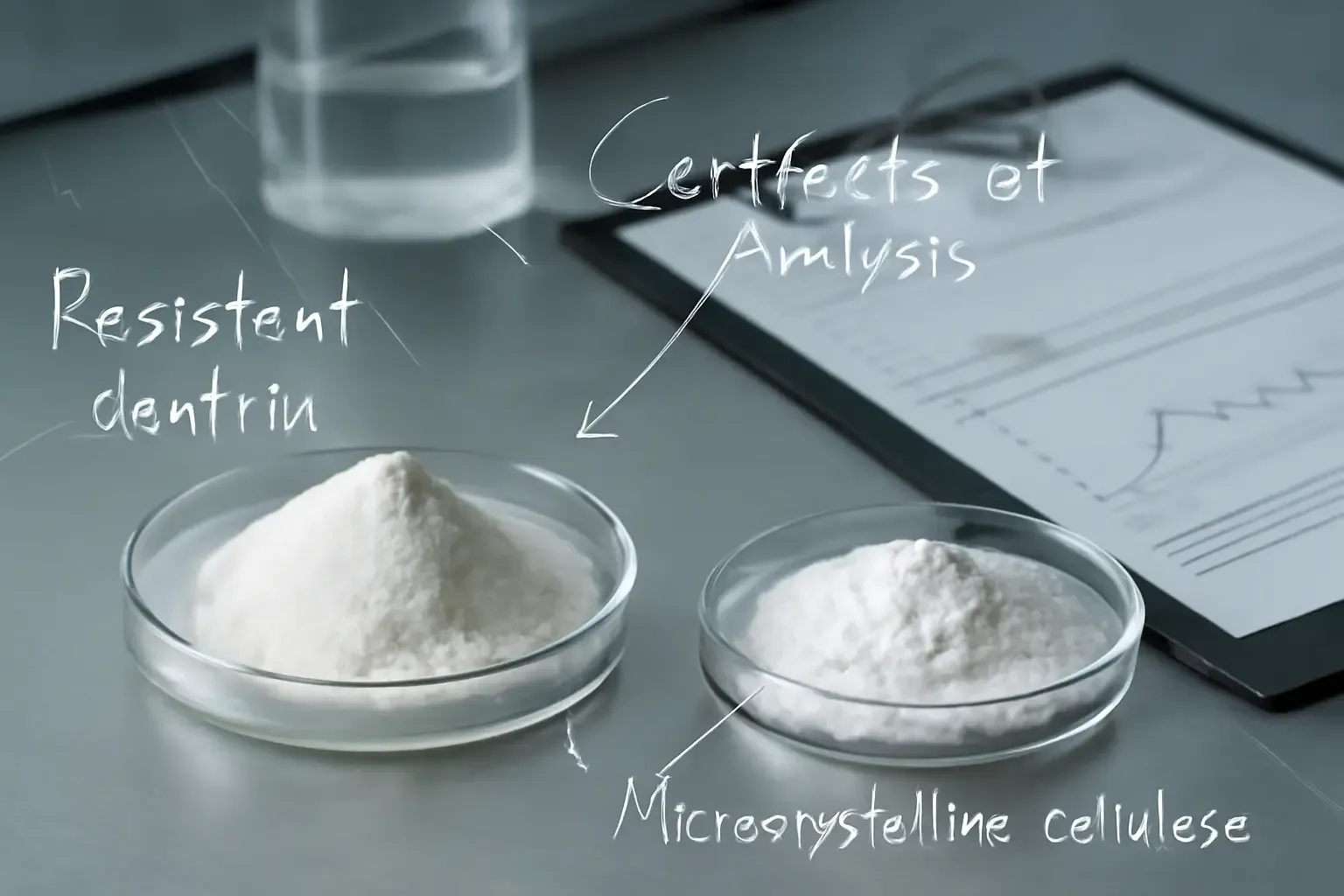
When formulating high-fiber, low-sugar foods and supplements, brands are increasingly turning to resistant dextrin (often listed as soluble corn fiber or resistant maltodextrin). It fortifies fiber content without pushing sweetness, viscosity, or off-notes. Concurrently, procurement teams are tightening controls on microcrystalline cellulose (MCC), as tablet performance is highly sensitive to grade, moisture, and particle size. Here, we break down what resistant dextrin and soluble corn fiber actually are, how to interpret the decision-critical lines on a COA/TDS, and where MCC fits as a complementary excipient. The objective is practical: reduce reformulation risks, eliminate supplier-side ambiguity, and help buyers evaluate a Chinese resistant dextrin manufacturer or MCC supplier on a consistent, technical baseline.

Why Ingredient Fundamentals Matter for Sourcing Teams
In many RFQs, resistant dextrin is treated as "just another fiber." That is a costly oversimplification. The exact same product name can hide meaningful differences in:
- Total dietary fiber and dry-basis fiber (directly impacting claim math and serving sizes)
- Solubility and solution clarity (crucial for beverages and dairy applications)
- Water activity and hygroscopicity (affecting caking, blending processes, and shelf stability)
- Microbial limits (essential for audit readiness and export suitability)
MCC faces a similar challenge: "MCC" might be written as a single line item, but grade selection (such as PH101 versus PH102) drastically alters powder flow, compressibility, and disintegration times. If R&D and procurement do not share a unified definition of "acceptable," supplier comparisons inevitably become price-driven rather than performance-driven.
What Resistant Dextrin and Soluble Corn Fiber Actually Are
Resistant dextrin is a water-soluble dietary fiber derived from starch. On technical spec sheets, you may also see it labeled as soluble corn fiber or resistant maltodextrin. Regardless of the naming convention, the sourcing question remains identical: does the ingredient deliver stable fiber performance across your intended processing conditions?
From a buyer's perspective, resistant dextrin stands out because it is specifically designed to resist digestion in the small intestine and reach the colon. There, it can be fermented, which is why it is frequently positioned as a prebiotic-style fiber.
Production Signals Buyers Should Monitor
While exact manufacturing details naturally vary by plant, reputable suppliers commonly highlight several key process controls:
- Non-GMO starch sourcing, frequently corn starch; some portfolios also feature cassava/tapioca-based options.
- Enzymatic processing, with premium suppliers sometimes specifying the use of imported biological enzymes.
- Automation and central control, which significantly reduces batch-to-batch variability.
- In-house QC labs, enabling rigorous testing from incoming raw materials right through to finished goods.
These signals carry weight because resistant dextrin is routinely utilized in products where even minor changes can trigger major downstream issues—think clouding in clear drinks, texture drift in yogurt, or severe caking in nutritional premixes.
Key Resistant Dextrin Specs and How to Interpret Them
Below is a buyer-friendly breakdown of common resistant dextrin / soluble corn fiber specification lines typically found on a TDS or COA. The values shown reflect parameters publicly shared by established suppliers and should always be confirmed against the batch COA for your specific grade and region.
A Practical Spec Table for Formulation and Supplier Comparison
| Parameter | Typical Target Seen on Supplier Specs | Why It Matters in Formulations |
|---|---|---|
| Appearance | White to light yellow powder | Color neutrality in beverages, dairy, and powders |
| Fiber content | ≥82% (often noted as ≥90% dry basis) | Determines fiber claim math and serving size |
| Protein | ≤6.0% | Impacts taste, color stability, and allergen review |
| Moisture | ≤5.0% | Critical for storage stability and caking control |
| Ash | ≤0.1% | Purity indicator; affects taste and stability |
| pH | 3–6 | Compatibility with low-pH beverages and processing |
| Water activity | ≤0.2 | Shelf-life stability and reduced microbial risk |
| Water solubility | Around 70% | Dispersibility and clarity expectations |
| Micro limits | APC ≤1000 CFU/g, coliforms ≤3 MPN/g | Audit readiness and global export suitability |
"High Fiber" vs "High Performance"
It is crucial to understand that a resistant dextrin can hit a high-fiber number and still fail in application if its solubility, clarity, or hygroscopicity do not align with the product format. For buyers, this is exactly where a well-written TDS proves its worth: it should describe not just the fiber content, but also handling traits (caking risk), solution appearance, and stability under intense heat and acid.
Where Resistant Dextrin Performs Best in Modern Applications
Formulators often choose resistant dextrin because it effectively adds fiber with relatively low sweetness and a highly workable viscosity. The following scenarios reflect how R&D teams typically leverage resistant dextrin and soluble corn fiber to solve genuine manufacturing constraints.
Dairy and Fermented Products
In yogurt and other cultured dairy, resistant dextrin is heavily utilized to support a "better-for-you" positioning while strictly protecting texture. Application notes from top-tier suppliers frequently highlight roles such as:
- Texture and mouthfeel support (helping to maintain a creamy consistency).
- Stability improvement (including significantly reduced syneresis or water separation).
- Sugar and fat reduction support (by contributing bulk and a fat-like sensory effect).
For dairy procurement, the practical test is straightforward: the resistant dextrin must remain entirely stable through processing and storage without introducing graininess or flavor drift.
Keto Snacks and Low-Net-Carb Concepts
Keto-friendly product developers look for fibers that help maintain physical structure and satiety without adding net carbs in a way that compromises the nutritional promise. Resistant dextrin is a frequent choice here because it adds necessary bulk with a highly neutral taste profile. In these specific formats, resistant dextrin is evaluated not only on nutrition math but also on sensory performance—particularly aftertaste, browning behavior during baking, and moisture management.
Functional Beverages and Fiber Shots
Clear appearance and effortless dispersion are the primary drivers for soluble corn fiber selection in drinks. When the product brief demands a clean label alongside low sweetness, resistant dextrin is usually shortlisted because it integrates into drink systems without the heavy, viscous mouthfeel associated with many other fibers.
Powdered Supplements and Meal Replacements
When dealing with powder handling, water activity and hygroscopicity become your "silent specs." Low water activity and reliable anti-caking behavior directly reduce operational headaches: you get fewer bridge-flow events in the hoppers, more consistent filling weights, and far less rework. Here, resistant dextrin is frequently blended with other functional ingredients and must remain exceptionally blend-friendly.
MCC Fundamentals and Why Procurement Teams Treat It Differently
Microcrystalline cellulose (MCC) is an insoluble excipient utilized extensively as a binder and filler, often supporting optimal disintegration in solid dosage forms. Unlike resistant dextrin—which is selected primarily for its nutritional profile and soluble functionality—MCC is almost exclusively selected for its mechanical performance.
For teams procuring MCC, grade selection is absolutely not a mere formality. Variations in particle size and moisture content can drastically shift:
- Powder flow dynamics during blending operations.
- Tablet hardness achieved at a specific compression force.
- Friability outcomes during packaging and transport.
- Disintegration time and overall consistency.
A solid starting point for internal alignment is reviewing how MCC grades are typically differentiated for formulation and quality control, ensuring your manufacturing lines get exactly what they need.
Using Resistant Dextrin and MCC Together in Supplement Design

In fiber-enriched tablets, chewables, or compressed functional formats, resistant dextrin and microcrystalline cellulose (MCC) act as a highly complementary pair:
- Resistant dextrin contributes the essential dietary fiber and helps fulfill the product's nutritional positioning.
- MCC provides the necessary compressibility, smooth flow, and structural integrity.
From a sourcing viewpoint, utilizing this combination significantly reduces the risk that a product perfectly meets its label claim but fails miserably on manufacturability. The secret is to treat each ingredient's COA lines as interconnected parts of a single performance system (blend flow → compression → stability → consumer experience).
How to Read COA and TDS Files from Chinese Plants
When industry buyers discuss a reliable "Chinese resistant dextrin manufacturer" or a "microcrystalline cellulose supplier," that recommendation must rest on hard evidence that the facility can consistently meet your spec and accurately document it.
Resistant Dextrin and Soluble Corn Fiber Documents to Request
A comprehensive documentation package should typically include:
- COA for the specific lot (always verify fiber percentage, moisture, ash, pH, and microbial limits).
- TDS explaining typical parameter ranges and the specific test methods used.
- MSDS for safe handling and internal safety reviews.
- Non-GMO statement where this is relevant to your destination market claims.
In your RFQs, it is highly beneficial to explicitly state whether your fiber requirement is "≥82% fiber" as is, or if you require a stricter dry-basis measurement. Also, clearly define your acceptance criteria for solubility and clarity.
MCC Documents to Request
For MCC procurement, buyers must commonly confirm:
- Loss on drying / moisture controls.
- Precise particle size or grade designation (for example, distinguishing between PH101 and PH102).
- Bulk density and flow indicators.
- Microbial limits and alignment with relevant pharmacopeia standards where applicable.
A Shortlist Checklist That Reduces Reformulation Risk
Use the following as a practical screening tool during your next supplier evaluation. It is designed for both formulation and procurement stakeholders.
For Formulation Teams
- Clearly specify the resistant dextrin performance target based on the format (e.g., beverage clarity, dairy stability, or powder handling).
- Call out the absolute minimum fiber content required (such as ≥82%) and clarify if dry-basis fiber is mandatory.
- Define the acceptable pH range and outline your stability expectations under heat or acid processing.
- For MCC, explicitly name the grade and the critical physical attributes required for successful compression and disintegration.
For Procurement and QA Teams
- Confirm the manufacturing plant can consistently provide a complete resistant dextrin COA, MSDS, and TDS set per lot.
- Investigate whether the supplier utilizes automated/central-control production and possesses robust in-house QC capabilities.
- Verify the certification set commonly requested in global trade. Suppliers may cite programs such as ISO9001, HACCP, BRC, HALAL, and KOSHER; always confirm what is currently valid and relevant to your specific destination market.
- Require clear, compliant labeling and strict traceability practices on all packaging (including batch/lot numbers, manufacturing dates, and precise storage guidance).
Turning Fundamentals into Smarter Supplier Conversations
Once your internal teams agree on clear definitions and critical specifications, supplier evaluation instantly becomes faster and significantly more objective. For buyers actively exploring China for high-quality functional fiber and excipients, partnering with an established manufacturer is key to securing a stable supply chain.
If you are looking for a reliable source, Shandong Shine Health Co., Ltd. is a leading manufacturer specializing in pharmaceutical excipients and functional ingredients. They provide fully documented, premium-grade resistant dextrin and soluble corn fiber, backed by rigorous quality control and advanced production technology. To explore how their ingredient solutions can fit your specific formulation needs, you can review their comprehensive product offerings and technical specifications at www.sdshinehealth.com.