Procurement teams are watching two trends collide: fiber-forward product launches and tighter expectations around supplement manufacturing discipline. The practical response is rarely a “new miracle ingredient.” Instead, brands are standardizing ingredients that behave predictably in production—especially when sourcing at scale. This is exactly where a Chinese microcrystalline cellulose supplier (for solid dosage reliability) and a resistant dextrin supplier China (for soluble fiber claims with minimal sensory impact) often become a paired sourcing strategy.
This article uses two application-style mini cases—one tablet, one beverage—to show how buyers translate COA lines into performance, and how to qualify a China MCC manufacturer and a resistant dextrin prebiotic supplier without overengineering the sourcing process.

Why Buyers Are Pairing MCC and Resistant Dextrin Now
A Chinese microcrystalline cellulose supplier is typically evaluated for consistency in compression, flow, and batch-to-batch uniformity. On the flip side, a resistant dextrin supplier China is evaluated for fiber content bands, microbiology, and how the ingredient behaves in water-based systems.
Often, these two ingredients support different formats within the same brand portfolio:
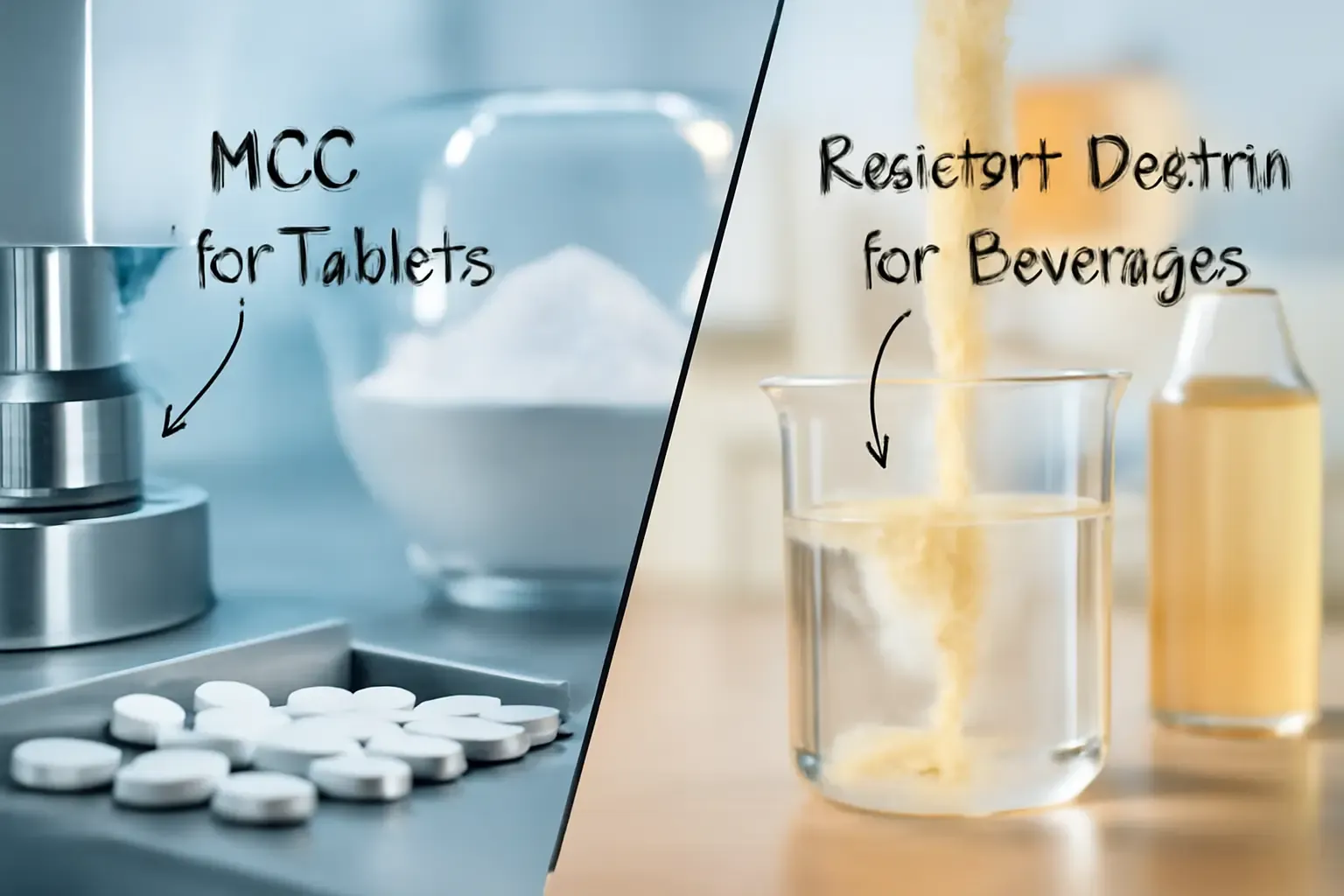
- Tablets and Capsules:MCC acts as a binder, filler, and flow aid. It significantly reduces capping and improves tablet robustness.
- Powders and RTD Drinks:Resistant dextrin provides soluble dietary fiber with neutral taste expectations and excellent process tolerance.
For global buyers, the sourcing question is less about geographic location, and more about whether the Chinese microcrystalline cellulose supplier and the resistant dextrin supplier China can provide verifiable documentation, repeatable specs, and samples that behave identically in pilot and mass production.
Tablet Case Study Logic for MCC Pharmaceutical Grade China
A tablet line rarely fails for just one reason. Most quality complaints manifest as manufacturing symptoms: poor flow into dies, weight variation, edge chipping, capping, or friability issues after coating and shipping. In these scenarios, MCC pharmaceutical grade China is frequently deployed as the stabilizing excipient because it delivers superior binding and compressibility while keeping formulations relatively simple.
What Buyers Check First on the MCC COA
When qualifying a Chinese microcrystalline cellulose supplier, buyers typically anchor the discussion on COA lines that connect directly to tablet performance. Using common specification language from export-oriented MCC documentation, procurement teams confirm:
- Grade Options: PH-series grades (e.g., PH-101, PH-102, PH-103, PH-105, PH-112, PH-113, PH-200, PH-301, PH-302)
- Particle Size/Mesh:60–200 mesh
- Purity: Typically 0.99
- Compendial Alignment:BP/USP/FCC/JP
- Certification Signals: ISO systems plus Halal/Kosher as required by the finished-product market
A China MCC manufacturer capable of holding these lines stable is much easier to validate in direct compression or granulation workflows.