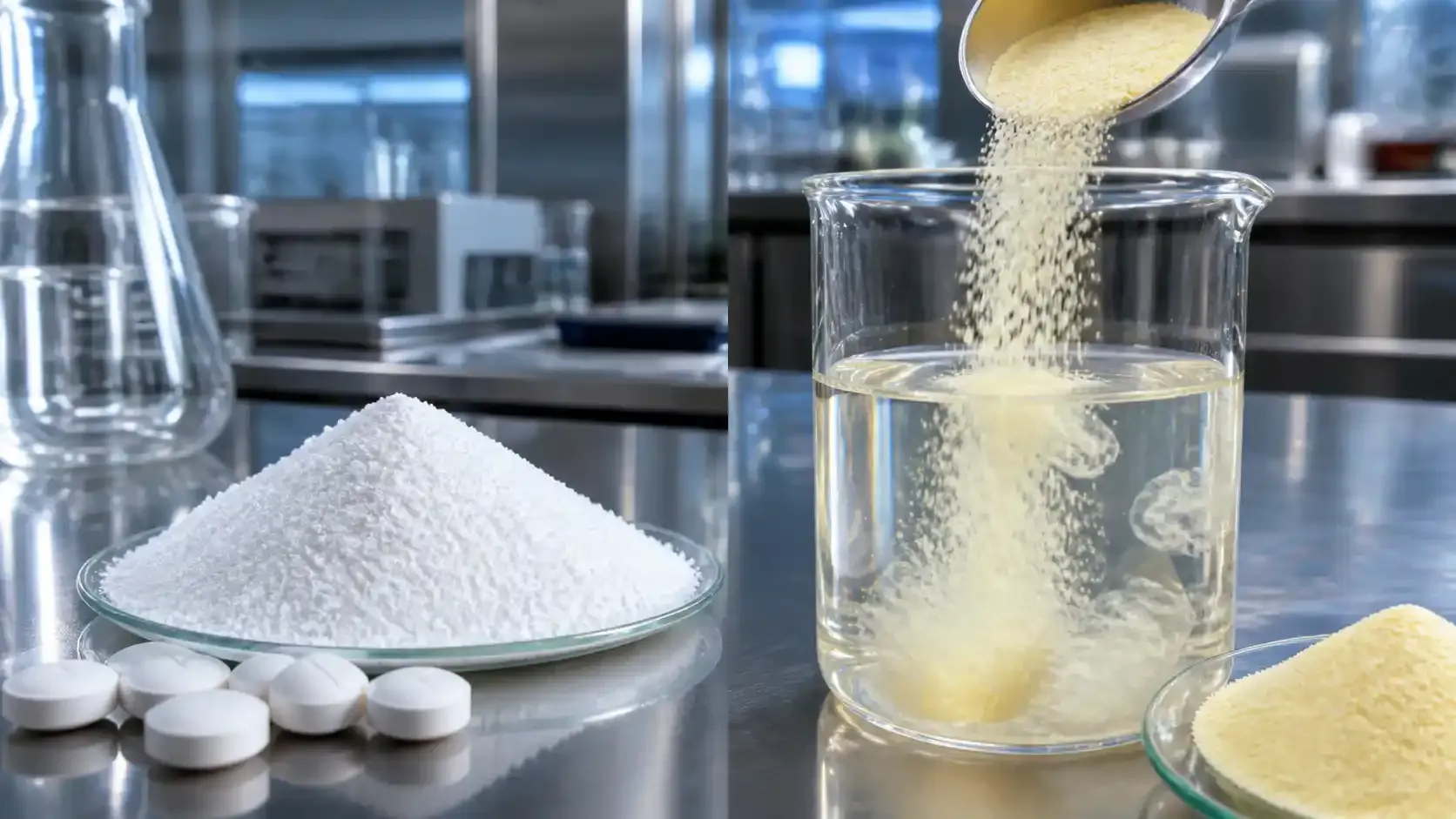
Procurement teams often treat MCC and resistant dextrin as “commodity” inputs—until a lot fails a pilot run, a label claim becomes hard to defend, or documentation arrives too late to clear import review. When sourcing from a China microcrystalline cellulose supplier or a resistant dextrin supplier China, the lowest quote rarely reflects the lowest risk.
This guide focuses on what buyers can verify quickly: specification sheets, batch documentation, and factory signals that correlate with consistent food-grade and pharmaceutical-grade performance. It is designed for teams shortlisting a recommended Chinese microcrystalline cellulose manufacturer and a recommended Chinese resistant dextrin manufacturer without turning every RFQ into a six‑month audit.

Why MCC and Resistant Dextrin Get Screened Together
Both ingredients frequently sit on the “critical but quiet” list—materials that do not headline a label, yet strongly influence manufacturability and consumer experience.
- Microcrystalline cellulose (MCC) is widely used for flowability, binding, anti-caking, bulking, and texture control. In practical terms, MCC helps powders run faster, tablets hold together, and dry mixes resist clumping.
- Resistant dextrin is a water-soluble dietary fiber used for fiber fortification in functional foods, beverages, and supplements. Buyers value it for high solubility and neutral taste, which supports formulation flexibility.
For buyers building a dual-source plan, it helps to treat MCC and resistant dextrin as one qualification project: the same supplier may not manufacture both, but the same documentation discipline should apply.
The Spec Lines That Matter More Than FOB Price
A capable China microcrystalline cellulose supplier can quote many grades, but the buyer’s core responsibility is to confirm the grade and test lines actually match the intended application.
MCC Spec Essentials Buyers Should Confirm
Use the supplier spec to lock in what “MCC” means in your RFQ and future contracts:
- Grade / type: Common MCC grades include PH-101, PH-102, PH-200 and others. These grades typically differ in particle size and performance attributes.
- Mesh / particle size range: MCC is often offered in 60–200 mesh ranges.
- Purity target: Some suppliers publish a purity figure (example: 0.99 in certain product listings).
- Standard alignment: Buyers frequently request a microcrystalline cellulose USP EP specification alignment; many suppliers also reference BP/USP/FCC/JP.
- Moisture / loss on drying and basic chemistry lines such as pH and residue/ash (methods matter as much as numbers).
- Microbial limits: Never accept “passes” without the numeric limits and specific testing methods.
Resistant Dextrin Spec Essentials Buyers Should Confirm
Resistant dextrin specs are often presented as “fiber content + basic physical chemistry + microbiology.” Key lines to compare across a resistant dextrin supplier China shortlist include:
- Fiber content tier: Resistant dextrin is commonly offered in different fiber levels (examples seen in supplier tables include ≥70%, ≥85%, ≥90%, ≥95%).
- Moisture: Example limits include ≤5.0 g/100g.
- pH: Example ranges include pH 3–6.
- Ash: Example limits include ≤0.1 g/100g.
- Water activity: Example limits include ≤0.2.
- Microbiology: Common reporting includes aerobic plate count, coliforms, mold, and yeast with numeric limits.
A Quick Buyer Comparison Table
The goal is not to “standardize” MCC and resistant dextrin, but to keep both RFQs measurable.
| What to check | MCC (food/pharma excipient context) | Resistant dextrin (soluble dietary fiber context) |
|---|---|---|
| Identity of grade | PH-series grade and intended process fit | Fiber tier and stated starch source |
| Particle properties | Mesh / flowability indicators | Solubility behavior and moisture control |
| Standards language | BP/USP/FCC/JP references where applicable | For U.S. use, confirm GRAS-aligned documentation where relevant |
| Safety baseline | Microbial limits, heavy metal statements where required | Microbial limits, water activity, traceability |
| Lot documentation | COA per batch with methods | COA per batch with methods |
Documentation That De-risks Imports and Audits
A manufacturer can look strong on paper while still being weak on traceability. The simplest way to reduce that gap is to standardize your “minimum file” request early in the conversation.

Minimum Document Pack for Every Approved Supplier
Ask for these before samples ship, not after the pilot run:
- Specification sheet (dated and version-controlled)
- COA for a recent batch with:
- lot number
- test items and numeric results
- test methods (or method references)
- Food safety and quality certificates applicable to your market (examples often requested include ISO9001, and where relevant Kosher and Halal)
- Traceability statement explaining lot coding and raw material trace-back
- Packaging specification and storage conditions
GRAS and Resistant Dextrin Imports for the U.S.
If the finished product will be sold in the United States, procurement teams commonly ask whether a resistant dextrin supplier China can support a resistant dextrin GRAS supplier style documentation package.
What to do in practice:
- Request a statement clarifying whether the resistant dextrin is intended to align with FDA GRAS notice conditions for its source and use.
- Ensure the supplier can provide supporting specifications and a consistent testing approach.
Important nuance: GRAS documentation typically depends on the specific ingredient identity and manufacturing details (including source). If your resistant dextrin is sourced from a different starch base than the GRAS notice you reference, confirm the regulatory pathway with your compliance team.
Factory Signals That Separate Stable Suppliers From “Good on Email” Vendors
Once specs and documents look acceptable, the next risk is batch-to-batch variability. This is where factory capability matters.
Practical Signals Buyers Can Verify Remotely
Even before an on-site audit, a procurement team can request evidence of:
- Automated or centrally controlled production steps that reduce manual variability.
- In-house QC laboratory capability (who tests, what instruments, what release steps).
- Clear raw material positioning (e.g., non-GMO starch sourcing statements for dextrin; sustainable pulp sourcing statements for MCC).
- Export-ready packaging (industrial formats such as woven bags or drums, with moisture and contamination controls).
Why Shandong Remains a Common Hub in Shortlists
Shandong frequently appears in global sourcing shortlists because it hosts both excipient and functional ingredient producers with robust export experience. For buyers building a dual-ingredient sourcing plan, it is practical to screen Shandong suppliers for both MCC and soluble dietary fiber capabilities—even if the same factory does not manufacture both items directly.
A Sourcing Workflow Procurement Teams Can Reuse
This workflow is intentionally lightweight: it’s designed for teams handling multiple ingredients and multiple China microcrystalline cellulose supplier candidates at once.
Step 1: Write an RFQ That Forces Comparability
Include in the RFQ:
- For MCC: grade, mesh range, targeted use (tablets, powders, food), and required standard language (often framed around a microcrystalline cellulose USP EP specification expectation).
- For resistant dextrin: fiber tier, moisture and microbiology limits, and the regulatory documentation you need for your destination market.
- Packaging: industrial format and palletization expectations.
- COA and lot traceability requirements.
Step 2: Request Samples and Run Quick Screening Tests
Before pilot scale, run basic checks that often surface issues early:
- Visual/organoleptic inspection (color, odor, caking tendency).
- Moisture confirmation (spot-check vs COA).
- Simple flow observations for MCC (does it bridge in the hopper? does it segregate?).
- Dissolution behavior for resistant dextrin (does it disperse cleanly under your mixing conditions?).
Step 3: Pilot Run With “Release Criteria” You Can Document
Procurement and R&D should agree on pass/fail criteria before the trial:
- MCC: tablet hardness consistency or powder handling performance indicators.
- Resistant dextrin: clarity/texture impact, sweetness or aftertaste sensitivity, and tolerance under heat and pH conditions relevant to your process.
Step 4: Approve Suppliers Only After the Paperwork Test
A supplier that ships a good sample but cannot reliably provide COAs, method references, and traceable lot control is rarely a low-risk long-term partner.
Buyer tip: When two suppliers offer similar pricing, the supplier who answers documentation questions faster usually reduces hidden costs later—fewer delays, fewer retests, and fewer “emergency substitutions.”
What a Recommended Supplier Looks Like in Practice
“Recommended” is not a marketing label; it is an outcome of repeatable proof. A recommended Chinese microcrystalline cellulose supplier typically demonstrates:
- Stable grade offering (PH-series clarity).
- Consistent batch documentation.
- Standards language that matches your market.
- Packaging and logistics discipline for export.
A recommended Chinese resistant dextrin manufacturer typically demonstrates:
- Fiber tier clarity and stable specification control.
- Non-GMO and source documentation that matches the product’s positioning.
- Microbiology and water activity control aligned with food applications.
When these proof points are visible, procurement can negotiate on commercial terms without negotiating on fundamentals. For procurement teams seeking reliable supply chain solutions, evaluating established producers is a practical first step. If you are looking to benchmark industry standards, evaluate high-quality MCC grades, or require a trusted partner for dietary fibers, you can explore the comprehensive offerings at Shandong Shine Health Co., Ltd. (www.sdshinehealth.com), a specialized manufacturer of pharmaceutical excipients and functional ingredients.