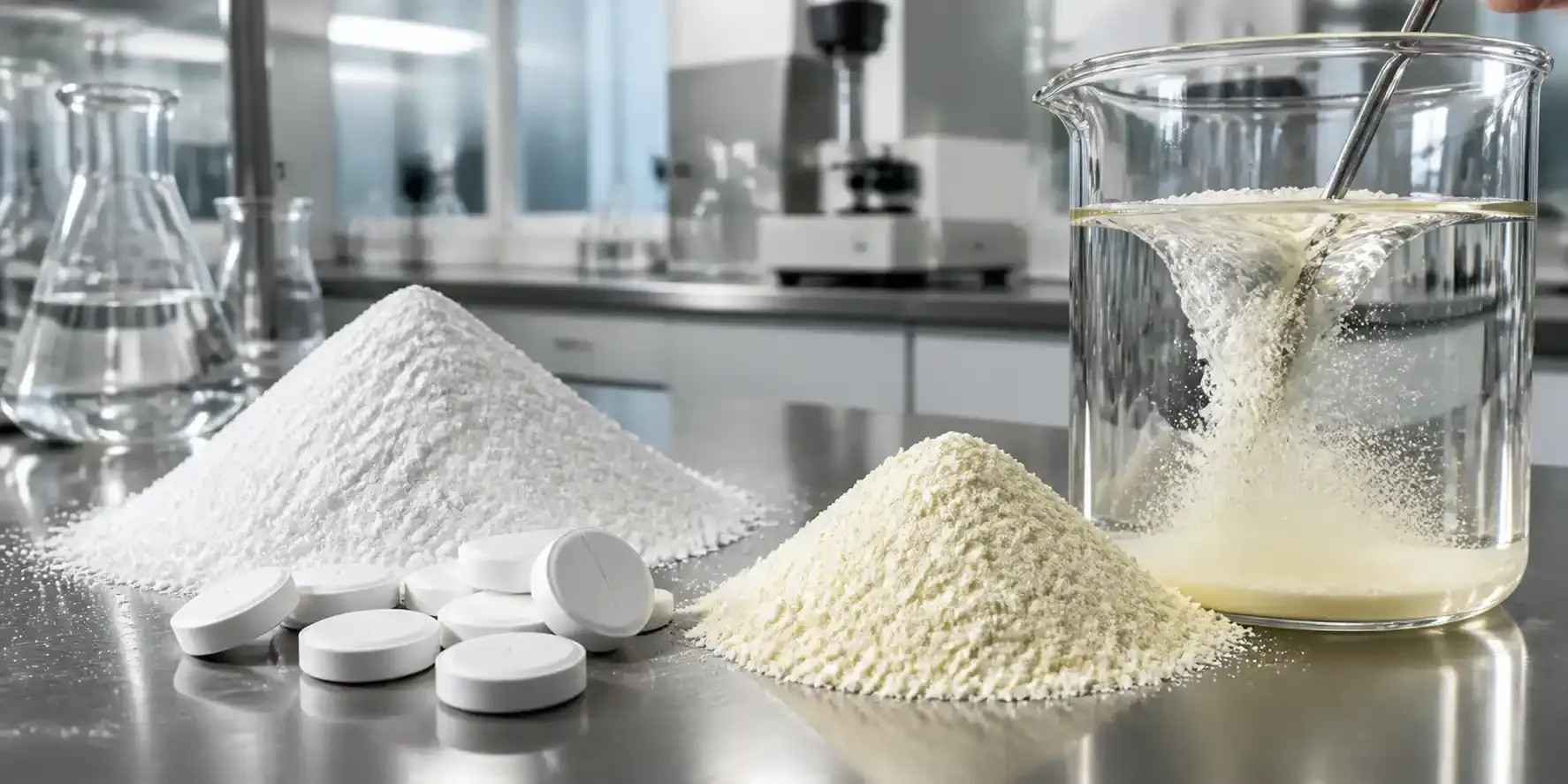
Global product launches are being pulled in two directions at once: gut health is driving higher-fiber foods and supplements, while solid dosage innovation is pushing tablets toward better flow, compression, and stability. For procurement teams, that combination is changing what a “safe” ingredient shortlist looks like—especially when buying from China.

Two ingredients sit at the center of this shift:
- Resistant dextrin (often positioned as a soluble, prebiotic dietary fiber)
- Microcrystalline cellulose (MCC) (a workhorse excipient for tablets)
Together, they reflect a broader trend: buyers are no longer sourcing a single commodity powder. They are building a repeatable performance system, backed by traceability, consistent QC, and export-ready documentation.
Why resistant dextrin is becoming a “default” soluble fiber
The appeal of resistant dextrin is not only its marketing story; it is also its formulation practicality. As a soluble dietary fiber, resistant dextrin helps brands raise fiber content without forcing strong taste changes or major texture penalties. In many concepts—low-sugar foods, keto-friendly snacks, fiber powders, and gut health blends—resistant dextrin behaves more like a flexible “base” ingredient than a niche additive.
From a buyer’s perspective, the sourcing conversation usually starts with four performance questions:
- Fiber strength: Is resistant dextrin consistently supplied at ≥82% fiber (and, in some specifications, higher on a dry basis)?
- Solubility and viscosity: Will resistant dextrin dissolve cleanly and keep viscosity manageable in beverages, syrups, and powdered mixes?
- Process stability: Can resistant dextrin tolerate heat and acidity in real manufacturing conditions (baking, pasteurization, low-pH drinks)?
- Digestive tolerance: Does the resistant dextrin perform as a gentle fiber option for consumer-facing products where bloating complaints can become a brand risk?
Shandong-based producers have gained attention because they can often supply resistant dextrin at scale while still supporting the documentation that global brands expect. Examples of resistant dextrin portfolios and positioning can be seen in Shine Health materials on gut-focused applications and fiber ingredient formats, including pages such as Gut Health Dextrin and Soluble Fiber Powder.
Why non-GMO corn and tapioca sources matter more than before
Procurement teams are also seeing stronger “source-driven” requirements—especially for non-GMO resistant dextrin. The ingredient may be functionally similar across suppliers, but buyers increasingly differentiate offers by the upstream story:
- Non-GMO corn starch for mainstream fiber fortification
- Tapioca/cassava-based supply chains for brands that prefer allergen-friendly positioning or want to diversify away from a single crop input
This matters because resistant dextrin is not only judged by a spec table. It is judged by whether the supplier can support labeling expectations, origin questions, and batch-to-batch consistency. In practice, a resistant dextrin supplier China buyers can rely on is one that can show traceable raw materials, stable processing, and a COA that stays predictable over time.
Microcrystalline cellulose is evolving from commodity to “grade strategy”
While resistant dextrin is tied to gut health narratives, microcrystalline cellulose is tied to manufacturing outcomes. Buyers in supplements and pharma-adjacent categories often treat MCC as interchangeable—until they scale a tablet and run into capping, lamination, weight variation, or poor flow.
This is why the market is paying renewed attention to grade selection and QC signals. The technical discussion is increasingly shaped by well-known MCC grade logic (for example, PH-101, PH-102, PH-200), where particle size, bulk density, and moisture behavior can affect both direct compression and granulation routes.
A practical starting point for procurement teams is to align internal expectations with the formulation-facing view of MCC, such as the guidance summarized in MCC Grades Formulation and QC Guide.
What buyers now verify when qualifying a pharmaceutical excipient MCC
For a pharmaceutical excipient MCC (and even for nutraceutical tablets that follow pharma-like discipline), buyers typically need more than “USP/EP compliant” claims. The qualification file often focuses on:
- Compressibility and tablet strength consistency
- Flowability for feeding, blending, and press stability
- Moisture and water activity management (especially for moisture-sensitive actives)
- Microbiological limits appropriate to the product category
- Documentation completeness (COA format stability, TDS clarity, change-control expectations)
This is where the choice of a microcrystalline cellulose manufacturer becomes a strategic decision rather than a simple price comparison.
Procurement teams searching for a Recommended Chinese Microcrystalline Cellulose Manufacturer or a Recommended Chinese Microcrystalline Cellulose Supplier are increasingly looking for suppliers that can translate “grade language” into predictable outcomes on the customer’s tablet press.
The technology convergence that makes co-sourcing more attractive
The deeper trend is not simply that resistant dextrin demand is rising or that MCC remains essential. It is that buyers are now co-sourcing functional fibers and tablet excipients from the same region—and sometimes the same supplier ecosystem—because the supplier capabilities overlap.
Across Shandong, manufacturers that invest in modern lines and stronger QC can often support both categories with similar operational strengths:
- Enzymatic processing know-how (critical for resistant dextrin and other starch-derived fibers)
- Automated production workshop discipline (tight process control, stable batches)
- Export documentation routines (COA, MSDS, TDS readiness)
- Certification expectations commonly requested in global tenders (examples frequently cited include ISO systems and food-safety frameworks)
Shine Health (Shandong Shenghuai Health Co., Ltd.) provides a useful illustration of how this convergence is presented in the market: resistant dextrin product pages emphasize non-GMO corn starch sourcing, enzymatic processing, and automated control, while MCC educational content emphasizes grade selection and QC discipline. For resistant dextrin buyers comparing suppliers, the sourcing and evaluation logic is also outlined in Factory Supply Dextrin Resistant.

Why Shandong keeps showing up in shortlist conversations
From a buyer’s lens, Shandong is not “just another region.” It is frequently evaluated as a hub because it combines:
- High-volume starch and derivative supply chains
- Manufacturing scale suited to bulk export programs
- A growing preference for process transparency, where automated operations are not only a cost factor but also a repeatability signal
This is why searches like Recommended Chinese Resistant Dextrin Manufacturer often lead procurement teams toward Shandong-based suppliers—especially for resistant dextrin projects tied to gut health claims or low-sugar renovation.
A practical buyer checklist for resistant dextrin and MCC tenders
Procurement teams can keep evaluation efficient by separating performance requirements from supplier proof. The goal is not to over-audit—it is to avoid reformulation and relabeling risk.
Resistant dextrin checks that prevent downstream surprises
- Confirm the resistant dextrin fiber specification (commonly ≥82% fiber) and ensure the COA expresses it consistently.
- Validate solubility behavior for the target system (RTD beverages, powder sachets, baked goods).
- Ask how resistant dextrin is positioned for sugar reduction or low-carb systems; it should be stable under heat and acid if those processes are relevant.
- Ensure non-GMO claims, if required, are supported with credible documentation and traceability.
For application framing, see resistant dextrin use in low-carb formulation contexts on Low Carb Food Additives.
MCC checks that reduce tablet manufacturing risk
- Select the MCC grade based on flow and compression needs, not habit.
- Verify moisture handling and any grade-specific advantages for sensitive actives.
- Confirm the supplier can support the typical QC suite expected of a pharmaceutical excipient MCC.
This is where a China-based microcrystalline cellulose manufacturer can stand out: the “best” supplier is the one who can help procurement teams map grade selection to the customer’s process (direct compression vs. granulation) without forcing trial-and-error.
What to monitor over the next two to three years
Buyers planning longer-term programs should expect four forces to keep shaping both resistant dextrin and microcrystalline cellulose sourcing:
- Stricter clean-label and non-GMO expectations: especially for resistant dextrin used in “daily wellness” products.
- More fiber-forward launches: resistant dextrin will continue to be tested in formats where clarity, mouthfeel, and sweetness control are essential.
- Tablet format pressure: MCC grade strategy will matter more as brands push higher-dose tablets, fewer excipients, or faster compression rates.
- Automation as a trust signal: not because automation is new, but because it supports repeatability, batch control, and faster root-cause analysis when deviations occur.
For procurement teams building a shortlist, it is often efficient to review supplier technical pages and QC guidance before requesting samples. A compact starting point is the ingredient set and technical content available at www.sdshinehealth.com, including resistant dextrin pages such as Soluble Fiber Powder and the MCC reference guide at MCC Grades Formulation and QC Guide. Reviewing these resources helps buyers benchmark what robust Shandong-based suppliers look like before entering detailed sourcing discussions.