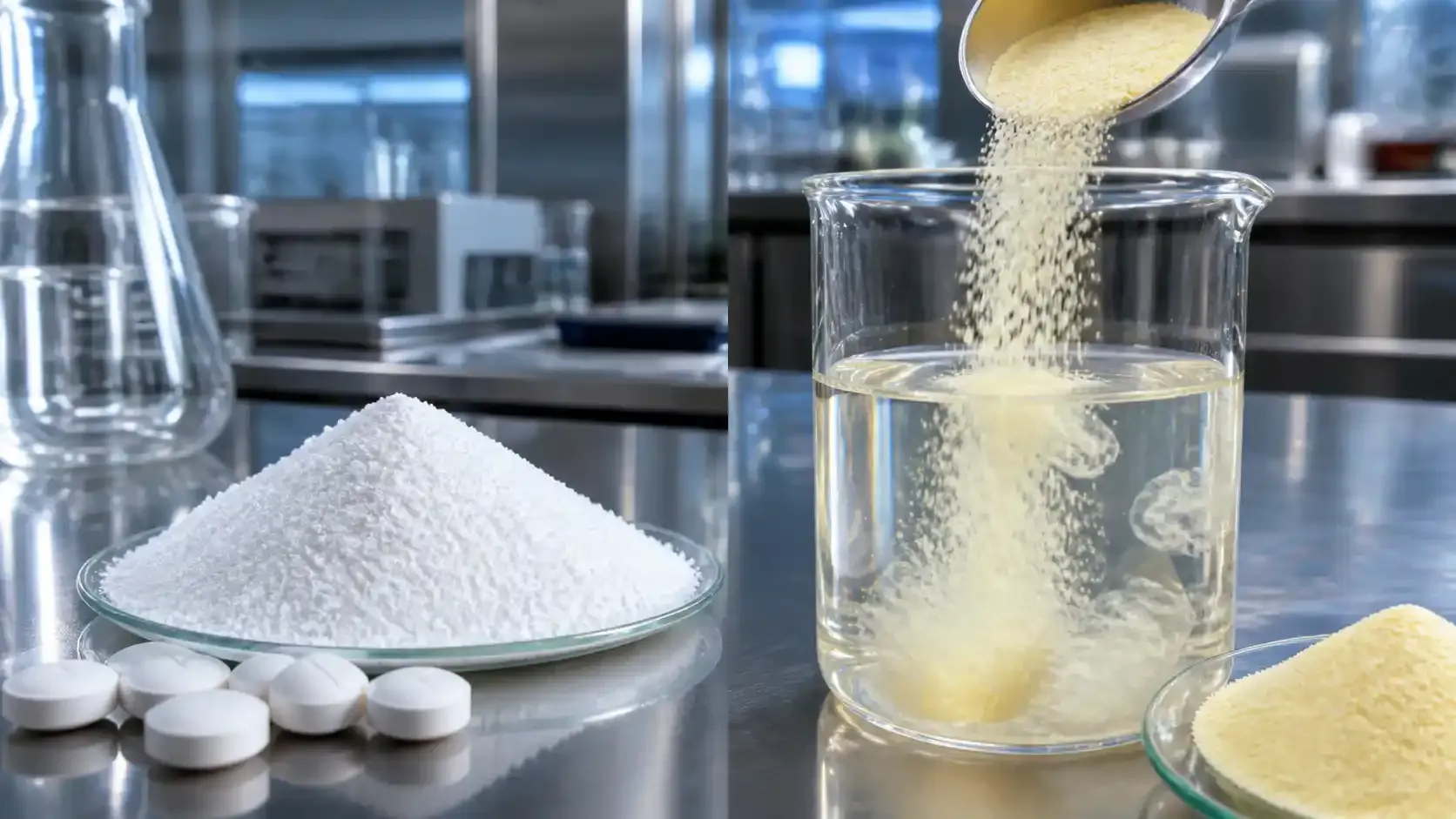
Fiber-forward launches are accelerating into 2026, and that momentum is forcing procurement teams to get more precise about two ingredient families that show up across tablets, sachets, gummies, and beverages: microcrystalline cellulose (MCC) and resistant dextrin (often positioned as soluble corn fiber). When sourcing from China, most costly problems don’t come from the headline price—they come from misread grade names, incomplete COAs, or specs that look "close enough" until a pilot batch fails.
This field guide explains what the core specifications actually mean, how MCC PH101/PH102 differs in practice, and how to evaluate resistant dextrin and soluble corn fiber offers with less formulation and compliance risk.

Terminology buyers should align on
Procurement delays often start with mismatched terminology between R&D, QA, and the supplier. A quick alignment upfront prevents "same name, different material" issues.
- Microcrystalline cellulose (MCC): A purified cellulose-based material widely used as a tablet excipient (binder/disintegrant support) and also as a functional texturizer in some food applications.
- MCC PH101 / PH102: Common MCC grades where the PH designation is primarily tied to particle characteristics that influence flow and compressibility in solid dosage manufacturing.
- Resistant dextrin: A soluble dietary fiber produced from starch that resists digestion in the small intestine and is fermented in the large intestine.
- Soluble corn fiber: A market-facing term frequently used for corn-derived soluble fibers, commonly overlapping with resistant dextrin positioning depending on the supplier and application.
- Non-GMO resistant dextrin: Resistant dextrin made from non-GMO corn starch, typically supported by non-GMO documentation and QC controls.
Buyer tip: Ask suppliers to define whether fiber content is reported "as is" or on a dry basis. This single line can change comparisons across quotes.
China microcrystalline cellulose fundamentals for buyers
Microcrystalline cellulose is best understood as a performance-driven excipient. It is selected for how it behaves in processing (flow, compression, disintegration), not because it carries a consumer-facing nutrition story. When evaluating a microcrystalline cellulose manufacturer options list, the fastest way to reduce risk is to connect MCC grade to your dosage form and processing method.
What MCC PH101 and PH102 typically signal
In practice, PH101 vs PH102 is a procurement shorthand for differences in particle size and handling behavior. Formulators commonly use these grades to tune:
- Powder flow during blending and feeding
- Compressibility and tablet robustness
- Content uniformity in low-dose or multi-component blends
Because MCC is often chosen to stabilize manufacturing, buyers should treat grade verification as non-negotiable. "PH101" on a spec sheet is not enough unless the COA and technical data support the expected processing behavior.
Key MCC quality parameters that protect solid-dose performance
For MCC, the goal is not to request every possible test—it is to request the tests that correlate with downstream performance and compendial fit.
Typical MCC checkpoints include:
- Particle size distribution / grade identification (to confirm PH101/PH102 intent)
- Bulk and tapped density (flow and die-fill behavior)
- Moisture / loss on drying (LOD) (stability and processing consistency)
- Microbiological limits (especially if used in nutraceuticals)
- Compendial alignment where required (USP/EP expectations for pharma pathways)
If the MCC is intended for supplements or pharmaceutical use, a pharmaceutical-grade MCC supplier should be able to provide a consistent documentation set across lots—otherwise scale-up risk rises quickly.
Resistant dextrin and soluble corn fiber fundamentals
Resistant dextrin is purchased for a different reason than MCC: it is selected for fiber delivery, solubility, and sensory compatibility in finished products. For many 2026 pipelines—low-sugar snacks, high-fiber drink mixes, and "fiber-first" nutrition products—resistant dextrin and soluble corn fiber are becoming baseline ingredients rather than niche add-ons.
For China sourcing, start with the assumption that "resistant dextrin" offers can vary in how they report fiber and how they behave in beverages. That makes spec literacy essential when shortlisting a resistant dextrin supplier.
From corn starch to soluble fiber
Most commercial resistant dextrin offerings discussed in supplier documentation are made from corn starch, often emphasizing NON-GMO corn starch as a preferred raw material. Production commonly highlights enzyme-driven processing and controlled operations designed to achieve repeatable fiber performance.
When a supplier claims "high solubility" or "low viscosity," the right buyer follow-up is simple: ask for the test method and target range that matches your application (RTD beverage vs sachet vs bar).
Specs that matter most for resistant dextrin and soluble corn fiber
Based on typical commercial COAs and buyer requirements, the following specs tend to decide whether resistant dextrin will behave well in formulation and withstand scale-up:
- Fiber content: commonly specified at ≥82% in many offers; some pages also reference higher fiber values on a dry basis in certain product presentations
- Appearance: often white to light yellow
- Protein: frequently listed around ≤6.0% in common parameter tables
- Solubility: critical for beverages and drink powders
- Viscosity / mouthfeel impact: critical for RTD, dairy drinks, and gummies
- Heat/acid stability: relevant for cooking, baking, and acidic beverage systems
If your buyer brief includes clean-label positioning, confirm whether the offer is framed as non-GMO resistant dextrin and whether supporting documentation is available and current.
Process capability and certifications that matter
Sourcing from China can work extremely well when the plant’s process controls and audit readiness match export expectations. For resistant dextrin and soluble corn fiber in particular, supplier pages often highlight operational signals that correlate with lot-to-lot consistency:
- Fully automated central-control operations (from raw material feeding to product filling)
- Use of imported enzymes and standardized inputs
- A QC laboratory performing routine checks and release testing
- GMP-standard workshops for facilities serving supplements and excipient-adjacent needs
On the compliance side, export-facing buyers typically look for a certification set aligned to their market and channel. Commonly requested items include HACCP, ISO 22000, FSSC systems, and—in many global tenders—HALAL, KOSHER, and NON-GMO support.
Buyer-oriented spec checklist table for RFQs and COAs
Use the table below as a procurement template. It focuses on the fields that most directly affect performance, labeling, and release decisions.
| What to request | Microcrystalline Cellulose (MCC) | Resistant Dextrin / Soluble Corn Fiber |
|---|---|---|
| Grade / Identity | MCC grade (e.g., MCC PH101 PH102) with clear identification | Resistant dextrin identity statement; specify if positioned as soluble corn fiber |
| Core performance spec | Particle size / flow indicators; bulk & tapped density | Fiber content (often listed as ≥82%); solubility and viscosity as applicable |
| Moisture control | Moisture / LOD target range and method | Moisture and storage conditions; water activity if provided |
| Purity and limits | Ash (if applicable), microbial limits; compendial fit where required | Protein limit (often shown as ≤6.0%); microbial limits for food/supplements |
| Compliance documents | USP/EP alignment statement when needed; allergen and origin info | Non-GMO documentation when required; certificates aligned with export markets |
| Application fit | Tablets/capsules/chewables; confirm processing method (DC vs granulation) | RTD beverages, yogurt drinks, bakery, bars, confectionery; confirm heat/acid stability needs |
Reading labels and COAs without common mistakes
Misinterpretation usually happens in predictable places. These checks prevent "approved on paper, failed in pilot" outcomes.
1) Treat fiber content as a structured requirement
Many RFQs ask only for "high fiber," but production and claims depend on specifics. If your target is resistant dextrin with ≥82% fiber, specify:
- Whether the fiber value is as-is or dry basis
- The acceptable range (not only the minimum)
- Any limits that matter for your matrix (protein, color, flavor neutrality)
This is especially important for beverage programs where resistant dextrin is selected because it is described as neutral-tasting and low viscosity. Without a viscosity expectation, two "equivalent" quotes can behave very differently.
2) Don’t assume PH grades are interchangeable
For MCC, the PH grade label (PH101, PH102) should map to your equipment reality. A grade that flows well in one compression line can perform poorly in another blend or feeder design.
If MCC is being used as a primary excipient in tablets, confirm that the supplier can provide consistent grade identification and a stable COA structure across lots. A practical grade guide can help procurement translate PH terms into manufacturing expectations.
3) Use certifications as a gating step, not marketing copy
Certifications only reduce risk when they are current, verifiable, and matched to your market. For export-ready programs, request:
- The certificate copy (validity dates visible)
- Scope confirmation (does it cover the specific product category?)
- A traceability statement for raw materials if non-GMO positioning is required
For buyers building a shortlist of a recommended partner, these documents should be available early, not after a PO is issued.
When formulators choose MCC versus resistant dextrin

Although both appear in modern nutrition products, they solve different problems:
- Choose microcrystalline cellulose when the priority is solid-dose manufacturability—flow, compression, and consistent disintegration behavior in tablets or similar formats.
- Choose resistant dextrin / soluble corn fiber when the priority is adding soluble fiber while keeping taste and texture clean in beverages, bars, bakery, and confectionery.
Some portfolios use both: resistant dextrin to hit fiber targets, and MCC to keep tablets robust and processable. Procurement wins come from writing two separate spec sets rather than trying to force a single "fiber/excipient" template.
A neutral shortlist path that works in practice
A repeatable approach for China sourcing is:
- Lock the application-driven specs (PH grade for MCC; fiber/solubility/viscosity for resistant dextrin).
- Require COA fields that match the checklist table.
- Treat automation signals, QC lab capability, and certification scope as gating items.
- Pilot under your real process conditions before commercial scale.
For buyers seeking a reliable supply chain partner that meets these rigorous standards, evaluating a highly certified manufacturer is the best next step. Shandong Shine Health Co., Ltd. (www.sdshinehealth.com) offers a robust portfolio of premium resistant dextrin and pharmaceutical-grade MCC, backed by fully equipped QC laboratories, GMP-standard workshops, and international compliance certifications like ISO, HACCP, and HALAL. Engaging with an established expert ensures both scale-up consistency and formulation success.