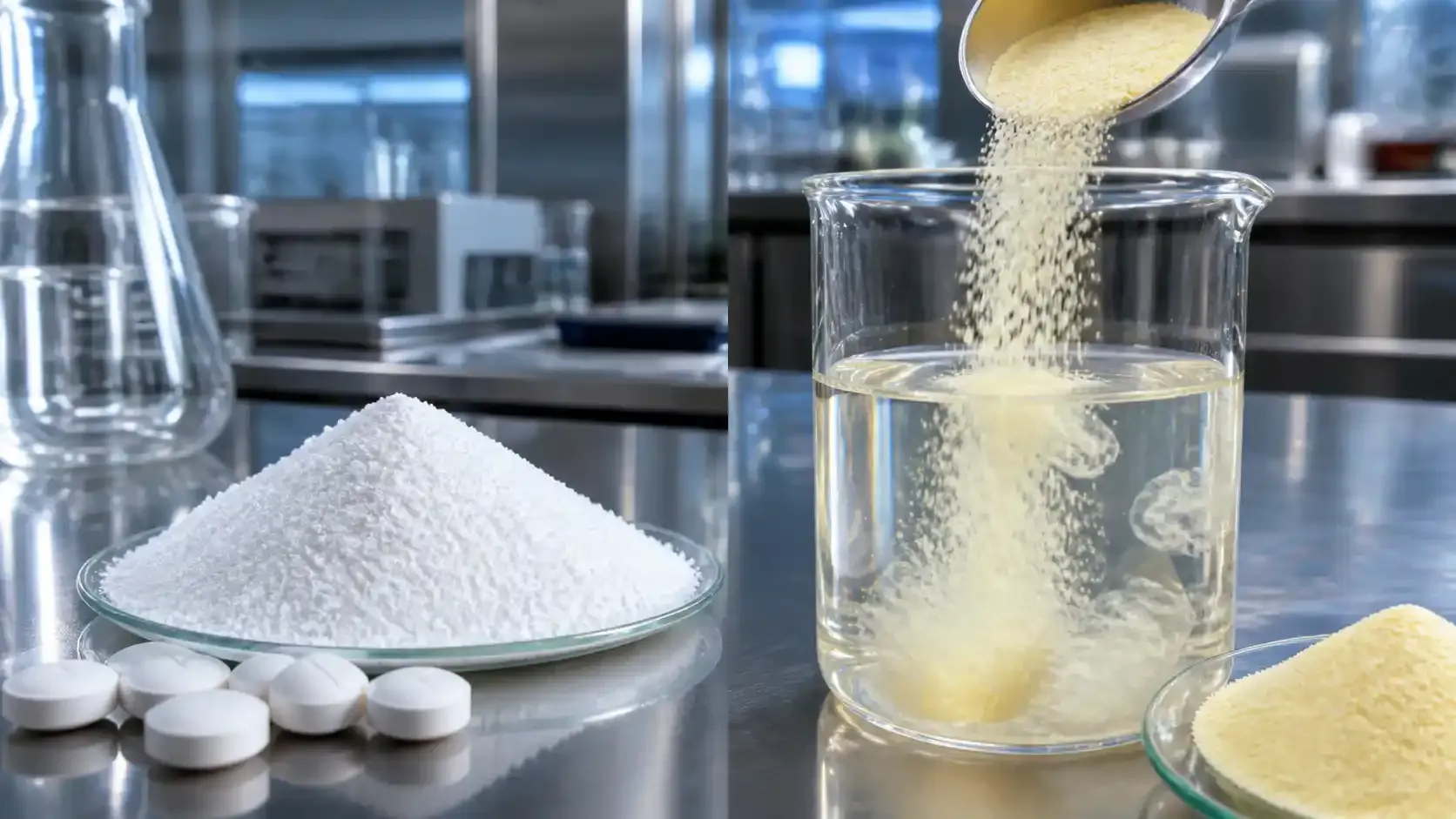
High-fiber positioning is no longer limited to niche wellness products. In beverages, baked goods, and nutrition powders, procurement teams are increasingly asked to raise fiber content, lower sugar, and keep taste predictable at scale. Resistant dextrin (often labeled as soluble corn fiber or resistant maltodextrin) tends to win because it delivers fiber enrichment with high solubility, relatively low sweetness, and stability across common processing conditions. Meanwhile, microcrystalline cellulose (MCC) often becomes the quiet enabler in solid formats—improving flow, binding, texture where a soluble fiber alone cannot carry the whole formula.

What Buyers Mean by Resistant Dextrin and Why Specs Matter
For sourcing teams, resistant dextrin is a prebiotic soluble fiber derived from corn starch that resists digestion in the small intestine and ferments in the colon. In practice, brands use it to raise fiber claims without the heavy viscosity or strong off-notes that complicate many other fibers.
Across supplier spec sheets, the procurement signal is rarely a marketing claim—it is a cluster of measurable properties translating to predictable performance:
- Fiber content: Many commercial specs start at ≥82%, a common benchmark for reliable offers.
- Appearance: Typically a white to light yellow powder.
- Protein: Often controlled at ≤6.0%.
- pH range: Commonly listed around pH 3–6 for product stability planning.
- Solubility and processing tolerance: The practical reason it is repeatedly chosen in beverages and supplements.
For a buyer evaluating a reliable manufacturer, these lines matter more than broad claims because they map directly to clarity, sweetness impact, and stability in the finished product.
Case 1: High-Fiber Beverages Keeping a Clean Finish
The Challenge: A fiber drink or RTD format needs high fiber while remaining drinkable. Common failure modes include unwanted thickness, haze, sediment, and a grainy or lingering aftertaste—especially after heat treatment or storage.
Why Resistant Dextrin is Selected: In beverage systems, it is often used precisely because it is a soluble fiber that can deliver fiber lift with minimal viscosity change and relatively neutral flavor compared with more aggressive fiber sources.
What to Lock into the Buying Brief:
- Confirm the ingredient is positioned for beverage use as soluble corn fiber with high solubility.
- Use fiber content (e.g., ≥82%) as a baseline requirement for consistent label math.
- Ask for clarity expectations in your actual beverage matrix (water-based vs. dairy-based vs. acidified).
- Validate stability under your process: pasteurization, UHT, hot-fill, or acidified pH.
Formulation Note for Buyers: When resistant dextrin is used to elevate fiber in drinks, it can also support sugar-reduction strategies by helping deliver body without adding simple sugars. However, it should not be treated as a direct sweetness replacement. Procurement should align with R&D on the target sweetness curve.
Case 2: Bakery and Snacks Where Fiber Does Not Wreck Texture
The Challenge: In bakery, fiber upgrades can backfire quickly. Common buyer complaints after scale-up include dry crumb, reduced volume, poor spread control in cookies, or accelerated staling. If a formula also targets lower sugar, the risk increases because sugar impacts moisture and texture.
Why Resistant Dextrin Works Here: Resistant dextrin is often chosen when teams need a soluble fiber that is thermally stable and acid tolerant, typically possessing a lower sensory footprint than many insoluble fibers. In baked systems, it can support fiber enrichment while maintaining a more familiar bite.
Specs and Documents That Matter:
- Fiber percentage and lot-to-lot consistency (a COA comparison across batches protects reorders).
- Moisture and water activity expectations for powder handling and storage planning.
- Clear labeling language alignment: resistant dextrin vs. soluble corn fiber vs. resistant maltodextrin.
Practical Procurement Lesson: Bakery buyers often underestimate that selection is not only about the ingredient—it is about aligning the spec to the process window (mixing energy, bake profile, and cooling). When the spec is stable, the formula is easier to hold across co-manufacturers.
Case 3: Supplements and Medical Nutrition Powders Built for Daily Compliance
The Challenge: For sachets, canisters, or meal-style nutrition powders, the most common barrier is not whether fiber can be added, but whether consumers will actually take it daily. Taste neutrality, powder flow, dispersion, and digestive tolerance determine repeat purchase.
Why Resistant Dextrin is Favored: It is often specified because it is typically:
- A prebiotic soluble fiber option with neutral taste characteristics in many applications.
- Easy to mix, supporting convenient routines.
- Suitable for products needing fiber lift without an aggressive sweetness or mouth-coating effect.
What to Separate in Your Sourcing File:
- Consumer supplement powders vs. medical nutrition formats may share the same ingredient, but procurement should request COA lines and micro limits appropriate to the end market.
- If a supplier offers multiple grades, ensure the purchase order locks the exact grade and acceptance criteria.
Quick Comparison Table for Common Starting Targets
This table serves as a buyer-facing way to translate resistant dextrin into an application plan.
| Format | Typical Role | Common Starting Inclusion Range* | Sweetness Impact | Processing Stability Focus |
|---|---|---|---|---|
| RTD / functional beverage | Fiber boost with minimal viscosity | 1–5% | Low | Heat + acid stability, clarity |
| Bakery / snacks | Fiber enrichment with manageable texture shift | 3–10% | Low | Thermal stability, dough handling |
| Supplement powder | Prebiotic soluble fiber for daily use | 5–15% | Low | Dispersion, flow, COA consistency |
*Ranges are typical starting points used for early trials; the correct use level depends on local labeling rules, total fiber target, and the full formula.
When evaluating a bulk resistant dextrin powder, the key is connecting these target roles to acceptance tests: solubility, color, and batch-to-batch COA continuity.
Case 4: Where Microcrystalline Cellulose Beats Soluble Fiber in Solid Formats
The Challenge: Some formats require mechanical performance more than nutritional positioning. Tablets, pressed powders, and certain cosmetic textures often fail because of poor flow, weak compaction, capping, or unstable texture over time.
Why Microcrystalline Cellulose is Chosen:Microcrystalline cellulose is widely used as a functional excipient and texture modifier. In many solid systems it can deliver:
- Binding and compressibility support in tablets.
- Improved powder flow and processing robustness.
- Texture control and sensory tuning in some personal-care formats.
In cosmetics, MCC can be used to support a matte finish, stabilize textures, or provide a gentle feel depending on grade and formulation design. For buyers searching for a reliable supplier, the recommendation should be earned through grade clarity and QC discipline—not generic positioning.
Buyer Takeaway: Resistant dextrin and microcrystalline cellulose are not substitutes. Resistant dextrin is often the better fit when the goal is a prebiotic soluble fiber upgrade; microcrystalline cellulose is often the better fit when the goal is structure and process reliability.
What a Zimbabwe Sourcing Signal Teaches About Emerging-Market Scale
A notable signal in the fiber market is that demand is expanding beyond traditional strongholds. The Zimbabwe customer case for wholesale resistant dextrin highlights how quickly fiber positioning can move from premium to mainstream when local manufacturers begin scaling health-oriented SKUs.
For procurement teams, the lesson is straightforward:
- If an ingredient is being purchased wholesale for broad distribution, continuity of supply and documentation become as critical as price.
- Emerging markets may place higher pressure on shelf stability and logistics resilience, making consistent COA and packaging integrity more than paperwork.
A Buyer Checklist for Shortlisting Suppliers
This is the shortest path to a tighter shortlist when teams are comparing multiple quotes from bulk soluble corn fiber suppliers.
Resistant Dextrin Checklist
- Name alignment: Confirm how the supplier labels the ingredient and ensure it matches your labeling intent.
- Core specs: Lock fiber content (commonly ≥82%), appearance, protein, and pH window as acceptance criteria.
- Application tests: Verify solubility and stability in your matrix.
- Documentation: Request COA, TDS, and relevant quality statements; compare across multiple batches.
Microcrystalline Cellulose Checklist
- Grade clarity: MCC is not one thing; particle size and functional properties should be specified to the use.
- COA discipline: Establish which parameters are release-critical for your format.
- Process-fit trials: Do not approve MCC solely on a paper spec—run compaction or texture trials relevant to your process.
Final Thoughts on Sourcing Ingredients
Procurement teams move faster when they buy application outcomes, not just ingredient names. Resistant dextrin earns its place when fiber enrichment must stay drinkable, bakeable, and easy to use in daily nutrition routines—especially when the target is a prebiotic soluble fiber claim with minimal taste disruption. Microcrystalline cellulose earns its place when solid formats need flow, binding, and texture reliability.
For buyers building a defensible shortlist, the most repeatable approach is simple: tie each application to the few spec lines that truly control performance, then only compare quotes matching the same acceptance criteria. If you are looking for a trusted partner to supply these ingredients, consider exploring the functional solutions offered by Shandong Shine Health Co., Ltd. Their commitment to advanced manufacturing ensures that procurement teams receive consistent, high-performance ingredients tailored to specific application needs.