Resistant dextrin—often marketed as resistant maltodextrin powder or soluble corn fiber—has become an essential ingredient for formulators needing high fiber with low calories, without compromising taste or viscosity. For procurement teams, the appeal is quite straightforward. Modern grades typically hit the ≥82% dietary fiber mark, dissolve effortlessly, and hold up well in various beverage and bakery applications.
However, the buying process isn't without its hurdles. The term "resistant dextrin" covers a range of products that can differ significantly in fiber content, processing consistency, and the quality of accompanying documentation. Overlooking these details can easily lead to labeling compliance issues or forced, last-minute reformulations. This guide breaks down exactly what resistant dextrin is, its behavior in food systems, critical labeling considerations, and practical tips for evaluating a resistant dextrin supplier when sourcing from China.

What Resistant Dextrin Means in Commercial Buying
In the realm of B2B ingredient purchasing, resistant dextrin generally refers to a water-soluble, digestion-resistant carbohydrate. It is typically derived from starch (most commonly corn starch) and is utilized as a declared dietary fiber across numerous global markets. Depending on the specific supplier and their product positioning, you might also encounter this same family of ingredients labeled as resistant maltodextrin powder or soluble corn fiber.
For buyers, getting the naming right actually matters quite a bit because it directly impacts:
- Specification alignment: The declared fiber percentage (such as ≥82%) and the analytical testing methods used can vary between manufacturers.
- Labeling language: How you declare "dietary fiber" and the specific ingredient name you can use are strictly dictated by local regulatory bodies.
- Application performance: Factors like solubility, solution clarity, and viscosity behavior ultimately determine if the ingredient will work in your specific RTD beverage, nutritional powder, or baked good.
A solid rule of thumb for your RFQs: approach "resistant dextrin" as a broad ingredient category. Then, narrow down the exact grade you need by securing a measurable specification sheet and a recent Certificate of Analysis (COA).
From Non-GMO Corn Starch to Soluble Fiber Performance
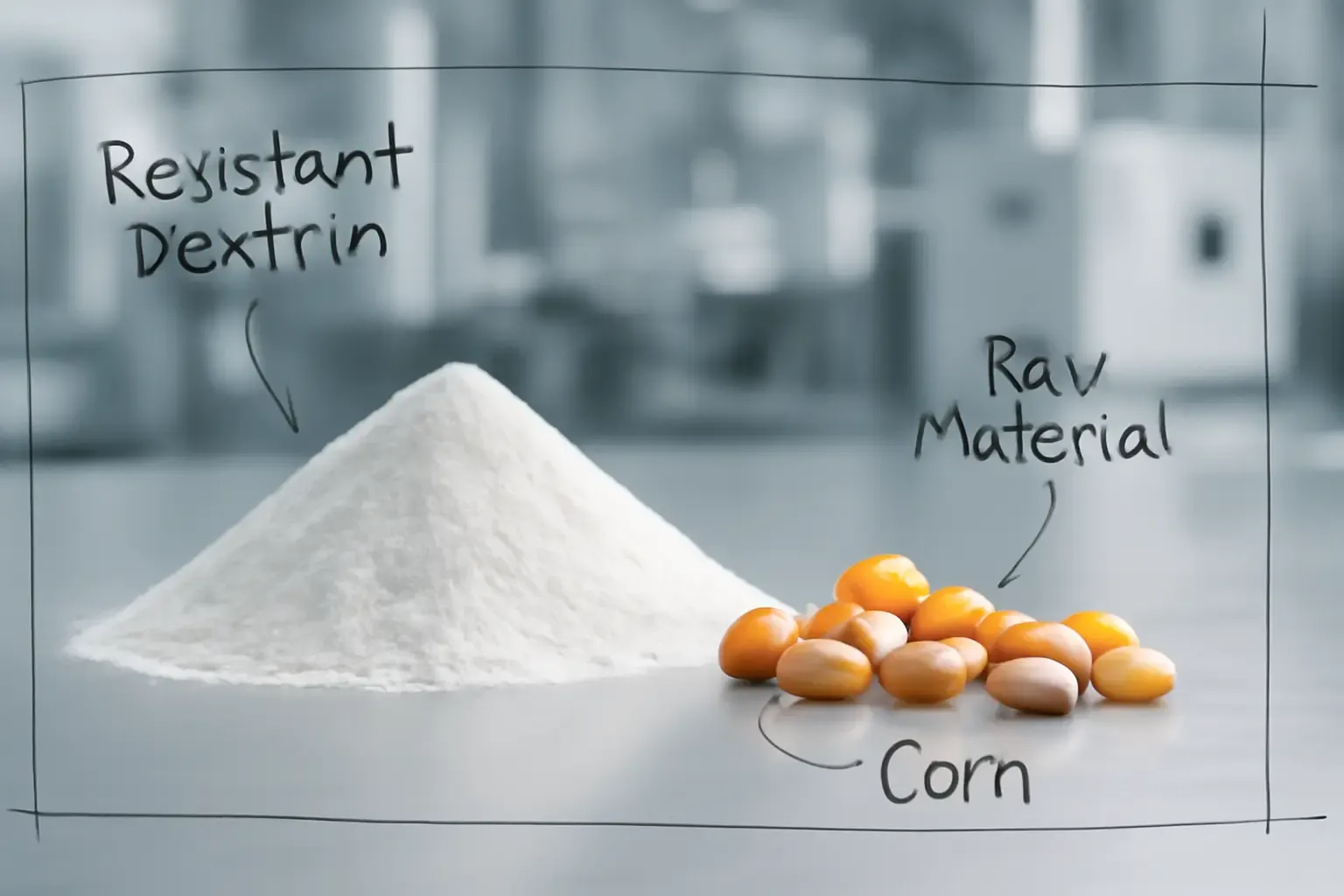
The majority of commercial resistant dextrin begins its life as corn starch. It then goes through a highly controlled processing sequence—frequently involving targeted enzymatic steps—to forge chemical linkages that are largely indigestible in the human small intestine.

The end product is a soluble fiber highly prized by product developers for being:
- Exceptionally soluble and simple to disperse in liquids.
- Low in viscosity, which is a massive advantage for formulating clear drinks and high-concentration powder blends.
- Neutral in both taste and odor, drastically reducing the need for expensive flavor-masking agents.
- Stable under common processing stresses, holding its integrity through the heat and acidic environments typical of many food and beverage formulations.
To give you a practical benchmark, a baseline specification commonly found in reliable supplier documentation (reflecting standard manufacturer parameters) often looks like this:
| Parameter | Typical Buyer-Facing Requirement |
|---|---|
| Raw material | Corn starch |
| Appearance | White to light yellow powder |
| Fiber content | ≥82% |
| Protein content | ≤6.0% |
| Storage | Store in a cool, dry place |
When a resistant dextrin manufacturer China promotes a high-fiber grade, take the time to confirm whether that fiber content is calculated on a dry basis and if their testing methodology remains consistent from batch to batch. Missing those two details can easily lead to an unstable nutrition panel and a costly packaging reprint down the line.
How Resistant Dextrin Works as a Prebiotic Soluble Fiber
Looking at it from a functional standpoint, resistant dextrin is engineered to resist digestion in the upper gastrointestinal tract, allowing it to reach the colon intact. Once there, it becomes available for fermentation by the gut microbiota. This specific fermentation profile is the primary reason buyers and formulators classify it as a prebiotic soluble fiber.
For procurement teams, it's helpful to grasp three key functional outcomes that frequently pop up in both scientific literature and regulatory discussions:
- Slow fermentation profile: Many product formulas benefit from fibers that ferment less rapidly, as this reduces the likelihood of consumers experiencing bloating or digestive discomfort—a common complaint with some other fiber types.
- SCFA pathway relevance: The fermentation process can aid in the production of short-chain fatty acids (SCFAs), which research links to a healthier intestinal environment. In B2B contexts, this is great for mechanism substantiation, though it shouldn't be translated into direct medical claims on consumer packaging.
- Formulation positioning: Resistant dextrin is the go-to choice when a product brief demands added fiber without introducing cloudiness, a gritty texture, or unwanted thickening.
When building your internal substantiation files, keep the language precise: resistant dextrin effectively increases dietary fiber content and can be accurately positioned as a prebiotic soluble fiber where local regulations permit.
Labeling and Regulatory Basics Buyers Should Verify Early
If your commercial strategy targets the U.S. market or similar highly regulated regions, resistant dextrin will inevitably be scrutinized regarding dietary fiber declarations. The crucial takeaway for procurement isn't the marketing angle; it’s the compliance workflow.
- Verify that the specific ingredient grade is legally acceptable for a dietary fiber declaration in your target sales regions.
- Ensure your supplier can consistently deliver a comprehensive documentation package: this means a COA, TDS, and MSDS, alongside up-to-date allergen and non-GMO statements where applicable.
- Coordinate the exact ingredient name usage (e.g., deciding between resistant dextrin, resistant maltodextrin, or soluble corn fiber) with your regulatory and legal counsel to avoid missteps.
This compliance check is where many product launches stumble. A fantastic bench-top prototype quickly turns into a logistical nightmare if the necessary paper trail isn’t locked in before your major retail customer asks for verification.
Formulation Fundamentals for Beverages, Bakery, and Supplements
Resistant dextrin remains a popular choice largely because it acts as a "quiet" fiber. Its high solubility, low viscosity, and minimal sensory impact make it incredibly versatile, especially across three major product categories.
Beverages and RTD Nutrition
In the beverage sector, resistant dextrin is the standard solution when the goal is fiber enrichment without turning a refreshing drink into a thick, syrupy shake. Buyers typically narrow down their shortlist of soluble corn fiber suppliers when they require:
- Clear or near-clear solutions (which will depend on your specific flavor system and total solids).
- A very low contribution to overall sweetness.
- Robust stability across typical beverage pH ranges and standard thermal processing methods like pasteurization.
Bakery and Snacks
For baked goods, incorporating resistant dextrin helps hit aggressive fiber targets while maintaining the familiar, expected bite and crumb structure of the product. Procurement teams should still request detailed stability notes, as water management and shelf-life texture can vary significantly depending on the specific recipe and baking process.
Diet Powders and Supplements
In powdered applications, resistant dextrin is highly valued for its dispersion qualities and the mouthfeel support it provides, particularly in formulas designed to be low in sugar or calories. A competent resistant dextrin supplier should proactively advise on handling characteristics—such as flowability, potential for clumping, and necessary packaging barriers—right within their technical data sheet.
When Microcrystalline Cellulose Complements Resistant Dextrin
Many health and wellness formats achieve optimal results by pairing soluble and insoluble fiber structures. Resistant dextrin does the heavy lifting for soluble fiber content with almost no added viscosity, while microcrystalline cellulose (MCC) is frequently deployed as an insoluble excipient or a structural texturizer, depending on the final product format.
From a purchasing perspective, this isn't a debate over "which ingredient is better," but rather a question of intelligent system design:
- Rely on resistant dextrin to build up the soluble fiber panel and enhance the drinkability or mouthfeel of powders.
- Incorporate microcrystalline cellulose when an insoluble structure is required—for instance, to ensure tablet hardness or to modify the physical texture within certain complex food systems.
If MCC is on your sourcing radar, partner with a microcrystalline cellulose supplier China that offers clear differentiation between grades, backed by a documentation package just as rigorous as what you'd demand for resistant dextrin. For a deeper dive into MCC quality standards, this industry primer is highly recommended: MCC Grades Formulation and QC Guide.
Sourcing from China Without Losing Control of Specs
China continues to be a primary global sourcing hub for dietary fibers, successfully combining massive production scale with increasingly sophisticated quality management systems. However, maintaining strict qualification discipline is essential—especially when comparing China resistant dextrin bulk suppliers whose initial quotes might look identical.
Here is a practical, buyer-centric checklist designed to mitigate risk without bogging down your sourcing timeline:
- Raw material traceability: Always confirm the origin of the corn starch. If your brand's labeling strategy demands it, secure a non-GMO statement early on.
- Batch-to-batch consistency: Don't just look at one "golden" sample. Request multiple recent COAs to evaluate the actual variability ranges in their production.
- QC capability: Prioritize suppliers who can articulate their routine testing protocols beyond just the basic fiber percentage (ask about microbial limits, moisture control parameters, and identity checks).
- Process control signals: High levels of automation and strictly controlled production environments are reliable indicators of batch repeatability.
- Documentation readiness: A COA, TDS, and MSDS should be standard issue. If they claim allergen-free or gluten-free status, those statements must be clear, current, and readily available.
For a tangible example of a supplier profile that aligns with these rigorous buyer expectations, Shandong Shine Health Co., Ltd. provides transparent technical positioning for their resistant dextrin and related soluble corn fiber. They clearly outline baseline parameters, including corn starch origins and ≥82% fiber targets. Reviewing such profiles is a highly effective way to standardize your terminology and verify if a prospective supplier has the operational maturity to support your QA team's demands.
Practical Buying Takeaways for Faster Approvals
If your procurement team is currently evaluating a new resistant dextrin supplier or navigating negotiations with a resistant dextrin manufacturer China, adopting these three habits will consistently prevent frustrating late-stage setbacks:
- Write the specification like a hard formula requirement, not a soft marketing claim. Firmly lock in the required fiber percentage, acceptable appearance, protein limits, and strict storage expectations.
- Match the paper trail to your market plan. If you are banking on a dietary fiber declaration on your packaging, secure the complete documentation package before you authorize pilot production.
- Validate performance in your actual process window. Even the highest quality resistant maltodextrin powder can react unexpectedly depending on your specific sweetener systems, acid profiles, and thermal processing loads.
Investing time in a meticulous qualification phase is invariably less expensive than a forced reformulation—particularly when your product launch calendar is already set in stone.
Continue Your Supplier Shortlist Research
For procurement professionals actively comparing documentation depth, product definitions, and manufacturing capabilities, standardizing your terminology during the RFQ process is vital.
To ensure you are partnering with a manufacturer that meets stringent global standards for pharmaceutical excipients and functional ingredients, explore the comprehensive resources and product offerings at Shandong Shine Health Co., Ltd. They provide the transparency, scale, and technical support necessary for successful, long-term sourcing.