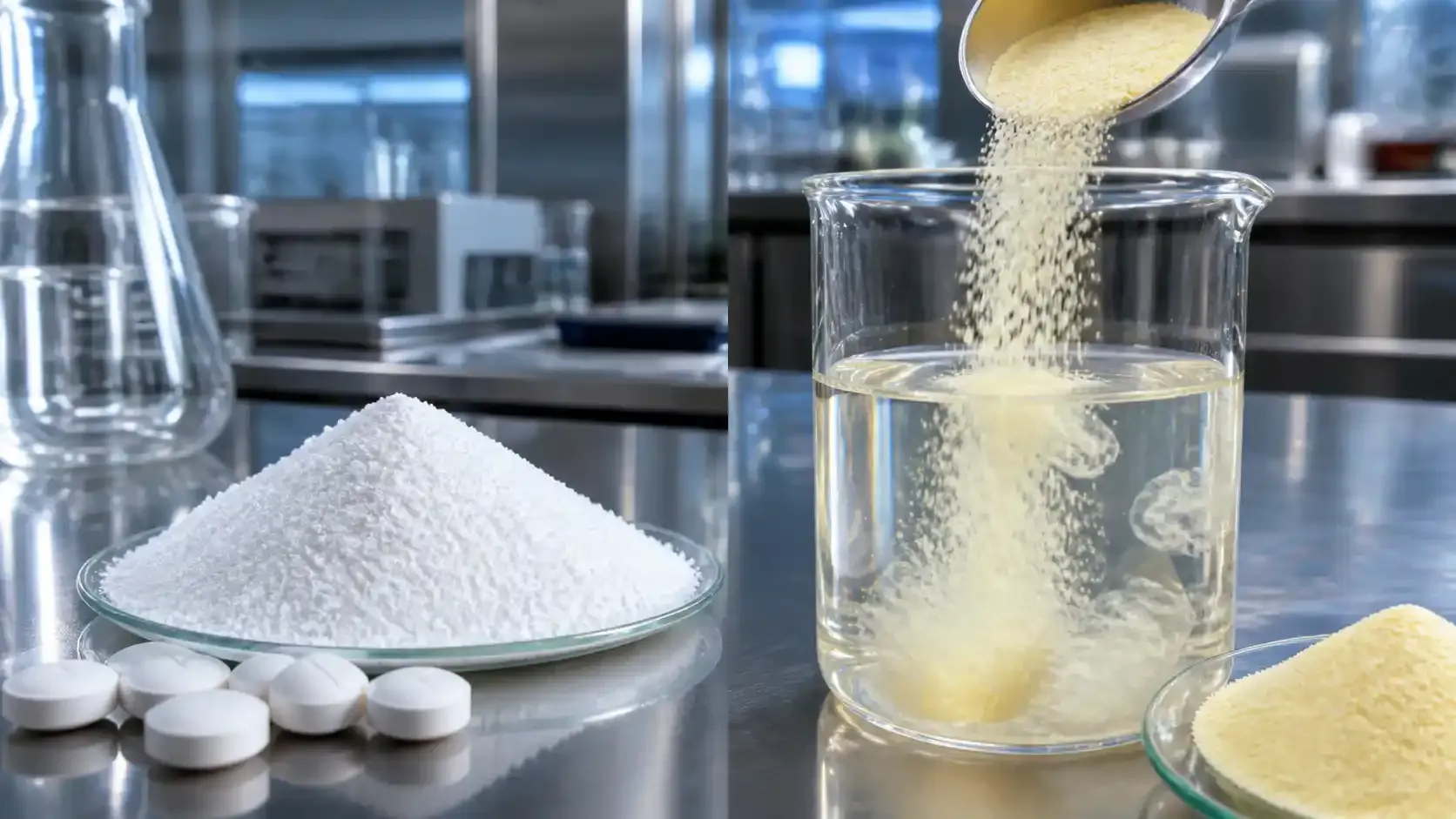
Fiber is increasingly treated as a strategic macronutrient—less like a niche “better-for-you” add-on, and more like protein: a core reason consumers choose one product over another. For procurement teams, that shift fundamentally changes how resistant dextrin and microcrystalline cellulose (MCC) are evaluated, priced, and contracted. Resistant dextrin is now a frontline ingredient for mainstream beverages, snacks, and supplements, while pharmaceutical grade MCC USP remains a foundational excipient whose availability and cost can ripple through finished-dose timelines. Here is how to translate the current market narrative into practical supplier-evaluation steps for buyers who source resistant dextrin from China and need to qualify a reliable microcrystalline cellulose manufacturer China partner under rising energy costs.

Why Fiber Now Behaves Like a “Must-Have” Ingredient
The narrative that "fiber is the next protein" is crucial because it alters buying behavior upstream in the supply chain:
- Brands specify fiber earlier in the product brief, rather than treating it as a late-stage fortification afterthought.
- Formulators demand neutral taste and process stability, which heavily favors soluble fibers such as resistant dextrin.
- Label-driven differentiation increases scrutiny on precise terms like non-GMO resistant dextrin and clean-label positioning.
Current market analysis shows that fiber’s value is no longer limited to basic digestive messaging. It is now intricately tied to satiety, steady energy release, and better-for-you reformulations—exactly the functional claims that move high-volume SKUs into mainstream grocery and convenience channels.
Demand Drivers That Specifically Lift Resistant Dextrin and MCC
Resistant Dextrin Demand Is Being Pulled by Formulation Reality
A primary reason buyers consistently return to resistant dextrin is its unique capability to raise fiber content with minimal sensory penalty. In procurement terms, it is often selected because it actively protects:
- Taste neutrality in RTD beverages and powdered drink mixes.
- Texture consistency in nutritional bars, baked goods, and functional gummies.
- Process robustness, especially when heat and acid stability are strictly required (e.g., in pasteurized drinks).
For many procurement and R&D teams, the simplest path to achieving a scalable “fiber-first” claim is to make resistant dextrin the default soluble fiber, qualifying alternates only when a specific recipe requires a vastly different viscosity or sweetness profile.
MCC Demand Is Expanding Beyond Traditional Excipient Use
While MCC is widely recognized as a tablet and capsule workhorse, food and beverage formulation teams are increasingly evaluating certain MCC options for texture enhancement, suspension, and stability—especially where fat reduction or clean texture is part of the core reformulation brief.
For pharmaceutical and nutraceutical procurement, pharmaceutical grade MCC USP (often aligned to USP/EP expectations) remains a high-scrutiny item. Even minor shifts in particle properties can drastically alter flowability, compressibility, and blend uniformity.
The practical implication here is clear: a sourcing plan that treats resistant dextrin and MCC as entirely isolated categories can miss critical shared supply-chain risks (such as energy costs, freight availability, and lead times) as well as shared qualification workflows (like documentation rigor and lot-to-lot consistency).
Energy-Driven Cost Shocks and Their Impact on Bulk Pricing
Energy is not just a distant macro headline—it quickly becomes a tangible line item in your landed cost. Supply chain inflation cascades directly through the excipient sector, deeply affecting microcrystalline cellulose portfolios.
During periods of elevated oil and gas pricing, some suppliers have historically announced price increases as high as 20% across their excipient lines. Even if those exact peak increases do not apply to every single contract, the underlying mechanism remains consistent:
- Utilities and steam rapidly increase baseline processing costs.
- Upstream feedstocks and reagents become noticeably more expensive.
- Packaging and freight move upward in tandem.
For buyers, the result is highly predictable: resistant dextrin bulk price negotiations and MCC contract renewals become less about historical FOB figures and more about strategically controlling total market volatility.
Procurement Levers Buyers Still Control
Without compromising your product’s label promise, procurement teams can often reduce financial exposure by:
- Defining a spec range instead of a single-point spec where feasible (e.g., agreeing on a functional fiber-content minimum rather than over-tightening secondary metrics that do not practically affect performance).
- Splitting volume across two qualified suppliers (dual sourcing) to establish strong resistant dextrin supplier China risk control.
- Choosing contract structures intentionally (utilizing shorter pricing windows during high volatility, and locking in longer commitments when market stability returns).
- Managing lead time and MOQ as direct cost variables, rather than treating them as administrative afterthoughts.
This is also where supplier geography plays a pivotal role. China—especially established producing regions—can remain highly cost-competitive when manufacturing plants are heavily automated and economies of scale are genuine. However, this holds true only if buyers rigorously verify what actually stands behind the supplier's quote.
What “Recommended” Should Mean When Shortlisting Chinese Suppliers
The phrases Recommended Chinese Resistant Dextrin Manufacturer and Recommended Chinese Microcrystalline Cellulose Manufacturer are frequently thrown around online. For a professional procurement team, the term “recommended” must be earned through hard evidence that actively reduces reformulation and audit risks.
A Buyer’s Checklist for Resistant Dextrin Supplier Qualification

When approving a new resistant dextrin source, focus heavily on what will break your product launch if the quality drifts:
- Raw material declaration: For many brands, concrete confirmation of non-GMO resistant dextrin sourcing is an absolute gating item.
- COA discipline and repeatability: Consistent fiber content, appearance, and strict adherence to key compositional limits.
- Solubility and stability behavior: Must be perfectly aligned to your specific manufacturing process (RTD, UHT, baking, gummies).
- Micro and food safety controls: Must be appropriate to your ultimate consumer market channel.
- Traceability and batch records: Must seamlessly match your own internal audit expectations.
From a pure operations perspective, buyers should ask a simple, revealing question: Can the supplier confidently explain how it maintains lot-to-lot consistency when energy, humidity, and upstream materials fluctuate?
A Buyer’s Checklist for Microcrystalline Cellulose Manufacturer Evaluation
For MCC, the evaluation emphasis naturally shifts toward compendial alignment and physical performance:
- Clear identification and separation of food vs. pharmaceutical grade production.
- Documentation readiness (COA, MSDS, comprehensive technical data).
- Technical specs that matter most to the factory floor: particle size distribution, moisture content, purity, and microbial limits.
- A robust quality system capable of supporting highly regulated customers, especially when dealing with strict pharmaceutical grade MCC USP expectations.
If your application is regulated or destined for multiple international markets, the absolute lowest quote rarely survives the rigorous documentation phase.
Why Shandong Remains Central for Long-Term Sourcing
China is frequently shortlisted by global procurement because it offers massive scale, decades of export experience, and a deeply competitive manufacturing ecosystem. Within China, Shandong-based capacity is often a central part of a resilient sourcing strategy for buyers who prioritize continuity across multiple years—not just a cheap spot buy.
A practical indicator to look for is whether a specific plant can describe its production controls in a way that makes immediate sense to a seasoned auditor: high automation, continuous in-process monitoring, and an advanced internal QC lab that can release products with absolute confidence.
A Capability Snapshot as a Benchmark
One excellent example frequently reviewed by global buyers is Shandong Shine Health Co., Ltd., which operates as a highly robust manufacturer of resistant dextrin and related soluble fibers. The company details that its resistant dextrin is crafted from premium corn starch with a strong emphasis on non-GMO sourcing. They highlight fully automated production capabilities utilizing precision German-origin production lines and a fully equipped in-house QC laboratory.
For buyers conducting initial desk research, evaluating a supplier's product category overviews, their specific commitments to non-GMO sourcing, and their technical learning resources (such as specific MCC grade formulations) is crucial. These elements help procurement teams standardize what a reliable supplier profile looks like before they ever schedule a call, request a physical sample, or issue an RFQ.
Turning Market Signals Into a Resilient Sourcing Strategy
Here is a structured sourcing approach that aligns with today’s fiber-led consumer demand while aggressively defending your margins during global cost swings.
1) Write Performance-Based Specs, Not “Perfect” Specs
For resistant dextrin, strictly tie your requirements to final outcomes:
- Establish a minimum fiber content (commonly stated at ≥82% in top-tier supplier specifications).
- Replace vague clauses like "must not impact taste" with strict sensory and application tests.
- Confirm physical stability needs (heat/acid) with a short pilot run that perfectly matches your real-world process.
For microcrystalline cellulose, ensure the specification perfectly reflects the dosage form or food system—particle size and moisture requirements should match your specific blending equipment and processing windows.
2) Implement a Two-Stage Qualification Flow
A highly reliable approach for qualifying both resistant dextrin and MCC involves:
- Stage A (Paper): Rigorous review of COA/MSDS/TDS, traceability statements, and raw-material declarations (especially vital for validating non-GMO resistant dextrin).
- Stage B (Proof): Physical application trials, strict lot-to-lot comparisons, and ensuring supplier documentation natively supports your internal release processes.
This workflow keeps the supplier shortlist manageable while entirely preventing catastrophic late-stage reformulation work.
3) Negotiate Total Cost Drivers
When buyers fixate solely on the resistant dextrin bulk price, they often completely miss the highly controllable variables:
- Lead time stability and flexible buffer-stock options.
- Packaging formats and palletization specs (which heavily dictate freight efficiency).
- Specification flexibility that actively reduces your factory's scrap or rework.
- Audit support speed (how quickly vital compliance documents are issued and corrected).
These background factors ultimately decide whether a quote is genuinely competitive once landed costs and internal handling are factored in.
4) Maintain a Category View Across Fiber and Excipients
If your brand's portfolio includes both fiber-fortified foods and dietary supplements, it is highly advantageous to align your sourcing calendars for resistant dextrin and MCC. Energy-driven shocks do not respect arbitrary category boundaries; consolidated planning often dramatically improves forecasting and significantly reduces the need for expensive emergency spot buys.
Strategic Procurement Takeaways
Fiber-forward product design is rapidly pulling resistant dextrin into mainstream, high-volume supply plans, while ongoing energy volatility pushes buyers to fundamentally re-check how they qualify and contract critical excipients like microcrystalline cellulose. A true resistant dextrin supplier China partner should be evaluated comprehensively on raw-material integrity (often including strict non-GMO resistant dextrin expectations), proven lot-to-lot consistency, and rigorous documentation discipline—not simply on the lowest resistant dextrin bulk price.
For procurement teams building a resilient supplier shortlist, it is highly practical to benchmark against the publicly stated capabilities of established, high-quality manufacturers. Validating these capabilities through your own COA reviews, sampling plans, and application trials is the ultimate safeguard. If you are seeking a reliable, long-term partner that meets these stringent industry criteria, you can explore the comprehensive supply chain solutions and functional ingredients provided by Shandong Shine Health Co., Ltd.