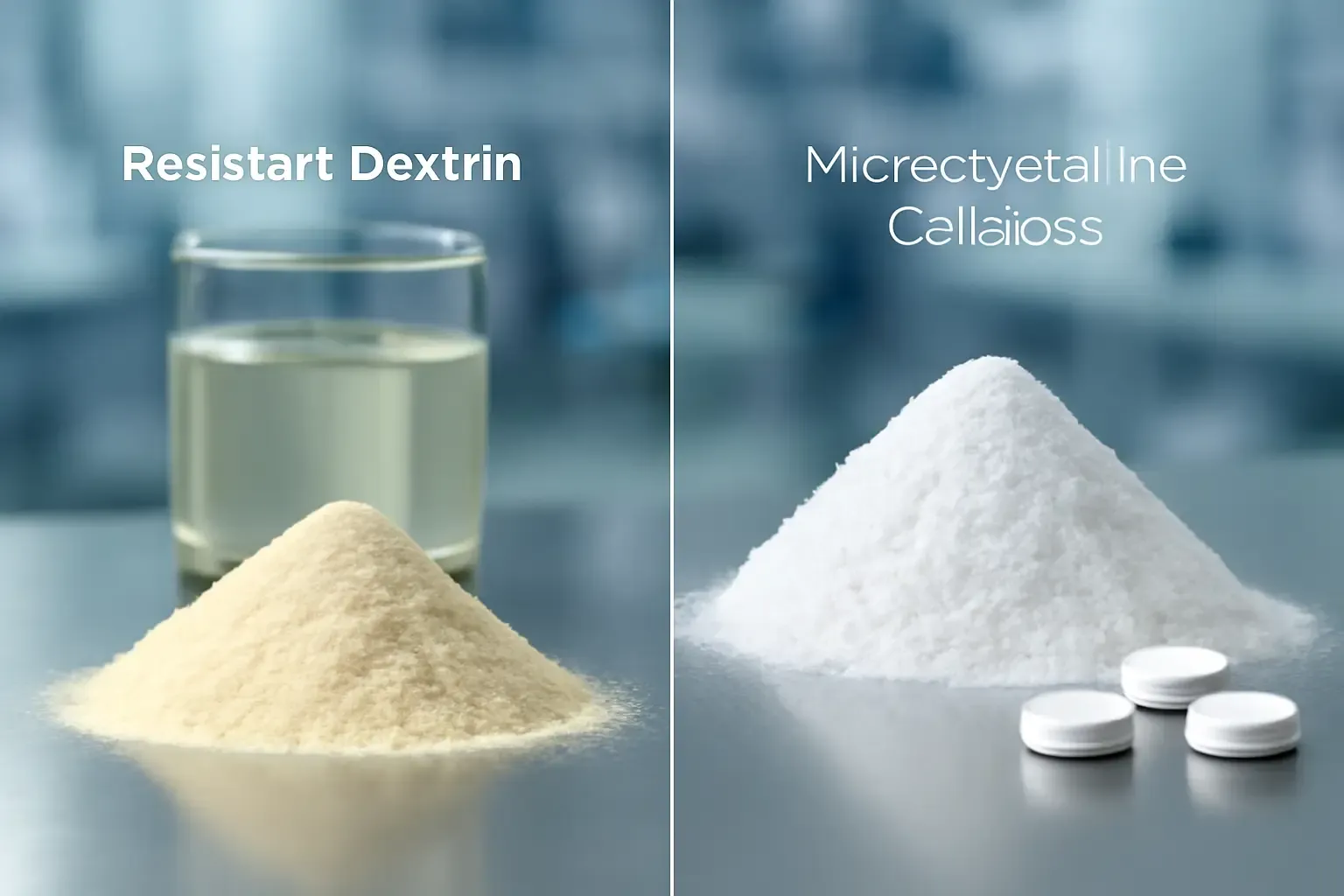
Fiber fortification and tablet manufacturing have quietly established two structural ingredients across multiple production pipelines: resistant dextrin powder (frequently marketed as soluble corn fiber or resistant maltodextrin fiber) and microcrystalline cellulose (MCC). From a procurement standpoint, the actual commercial risk is rarely the headline price—it is a specification mismatch. An ingredient that appears interchangeable on paper might create haze in a beverage, weaken tablet hardness, or complicate regulatory labeling. The following breakdown explores the technical fundamentals that matter most during procurement and quality reviews. It also outlines exactly what purchasing teams should verify on COA and TDS documents when shortlisting a soluble corn fiber supplier or a microcrystalline cellulose bulk supplier.

Why Ingredient Fundamentals Matter More Than a Quick Quote
Sourcing resistant dextrin powder or microcrystalline cellulose typically involves multiple departments, each with distinct priorities:
- R&D and Formulation prioritize solubility, viscosity, compressibility, and stability.
- QA and Regulatory focus on identity, microbiology, heavy metals, allergens, and robust documentation.
- Operations care about powder handling, flowability, caking resistance, and batch-to-batch consistency.
- Procurement seeks continuity of supply, audit readiness, and a favorable total cost of ownership.
If these teams operate with conflicting definitions of "equivalent," project timelines inevitably suffer. Establishing a baseline understanding of each ingredient's behavior makes supplier comparisons faster, more accurate, and far less subjective.
1) Resistant Dextrin Powder is Not "Just Fiber"
Resistant dextrin is a highly functional soluble dietary fiber produced from starch (commonly non-GMO corn starch, though tapioca is also utilized). Its defining characteristic is that it resists digestion in the small intestine and ferments in the colon, which is why brands frequently position it as a prebiotic-style fiber.
From a buying perspective, resistant dextrin powder is highly valued because it delivers fiber enrichment with minimal sensory penalties:
- High solubility in water-based formulas.
- Low viscosity relative to many competing fibers.
- Neutral taste and light color (typically specified as white to light yellow).
- Exceptional stability under heat and acidic conditions, which is crucial for processing and extended shelf life.
On supplier catalogs, you might see the identical ingredient described interchangeably as:
- Resistant dextrin
- Soluble corn fiber
- Resistant maltodextrin fiber / indigestible maltodextrin
While these naming conventions are commercially common, the practical takeaway is that procurement teams must compare functional specifications, rather than relying solely on the product label.