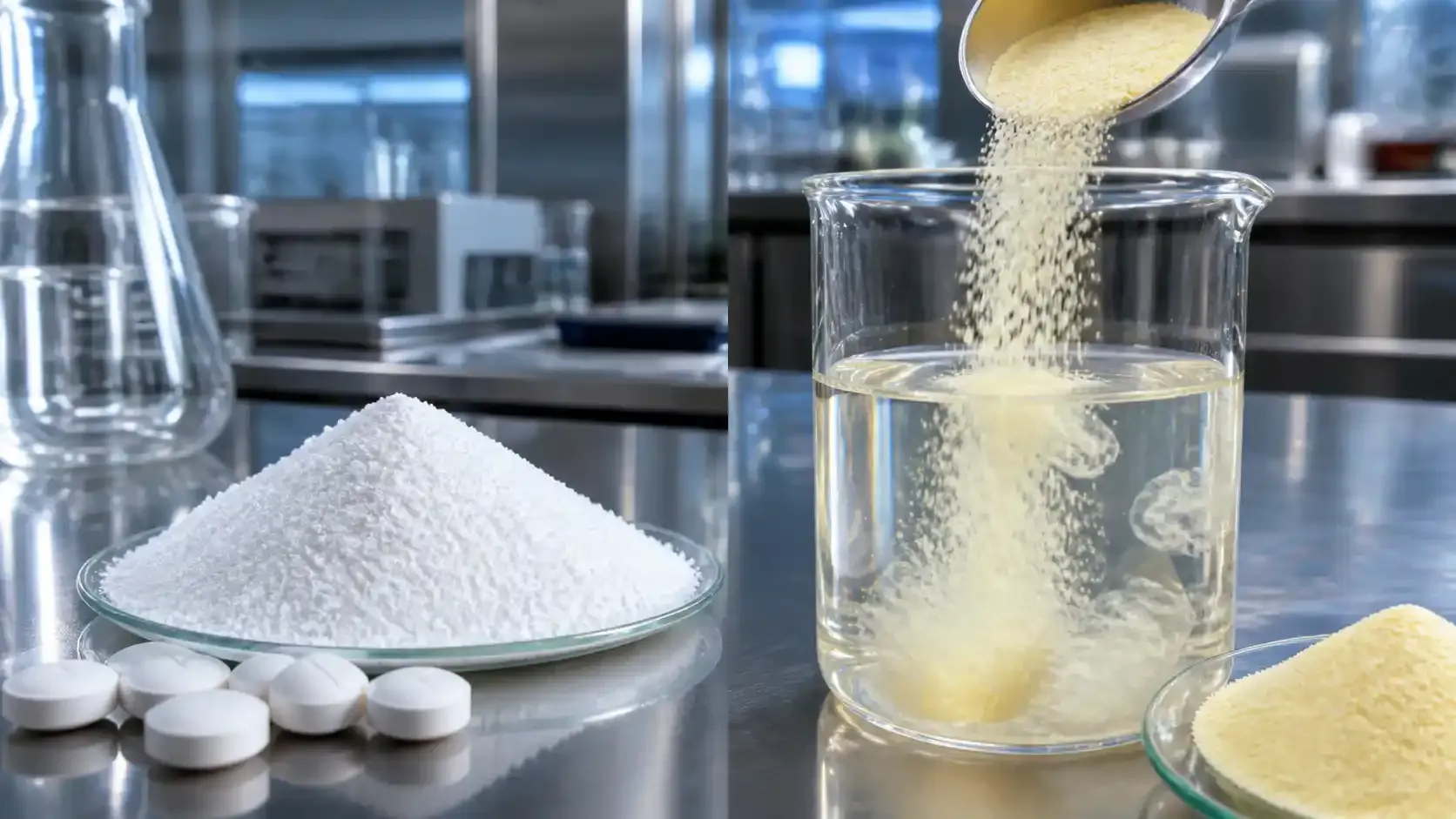
Fibre-forward innovation has moved from niche to mainstream. Procurement teams now see two ingredient “workhorses” showing up in the same project pipeline: prebiotic soluble fiber for foods and drinks, and microcrystalline cellulose (MCC) for solid-dose supplements. The challenge is that both categories look deceptively simple on paper—until a trial fails, a label claim gets questioned, or a tablet line starts capping.
This guide explains what resistant dextrin really does in modern formulas, how soluble corn fiber compares in processing, and why MCC grade selection (PH-101 vs PH-102) can make or break tablet performance. It is written for buyers who want fewer reformulations and clearer RFQs—especially when evaluating a Recommended Chinese Resistant Dextrin Manufacturer or a Recommended Chinese Microcrystalline Cellulose Supplier.

Why resistant dextrin is becoming the default soluble fiber
Resistant dextrin (often described in trade as digestion-resistant maltodextrin) is a water-soluble dietary fiber typically made from corn starch through enzymatic processing. In practical terms, resistant dextrin is valued because it behaves like a modern fiber should: it’s easy to formulate, stable in processing, and compatible with today’s clean-taste expectations.
For product developers, resistant dextrin provides a straightforward path to raise fiber without making beverages cloudy or leaving a gritty mouthfeel. For buyers, the real value is predictability—resistant dextrin tends to be less disruptive to taste and texture than many traditional fibers at similar label-relevant dosages.
Physiologically, resistant dextrin resists digestion in the small intestine and reaches the colon, where it can ferment and support gut health. This is why the market frequently positions resistant dextrin as a resistant dextrin prebiotic fiber rather than just a “fiber additive.”
The COA lines that matter for resistant dextrin procurement
When a team searches for a resistant dextrin supplier, the most useful questions are rarely about marketing claims. They are about specification control—what you can verify batch to batch.
Using typical manufacturer disclosures as an example, procurement teams often request resistant dextrin with:
- Raw material: corn starch
- Appearance: white to light yellow powder
- Dietary fiber content: commonly specified at ≥82%
- Protein: commonly controlled at ≤6.0%
- Storage: cool, dry conditions
Those numbers do more than fill a spec sheet. They influence how resistant dextrin behaves in your formulation and your quality system:
- A clear fiber-content target (such as ≥82%) helps prevent “fiber dilution” across suppliers.
- A protein limit supports consistency in taste, color, and downstream processing.
- A tight appearance description reduces surprises in clear beverages and light-colored powders.
If you want a concrete example of how suppliers present these basics, see Shine Health’s resistant dextrin parameter format on its product pages, including the ≥82% fiber benchmark and corn-starch sourcing notes.
- Internal reference page for ingredient basics: resistant dextrin prebiotic fiber
Functional performance that buyers should test before scaling
A good resistant dextrin specification is not only chemical—it’s functional. Before committing to bulk, build a short test plan around the way resistant dextrin is actually used.
1) Solubility and sensory neutrality in beverages
For RTDs, prebiotic soda concepts, and powdered drink mixes, resistant dextrin is typically selected for high solubility and a relatively neutral taste profile. Buyers should still verify:
- Dissolution speed in cold water
- Clarity or haze in the finished drink
- Any sweetness drift or aftertaste at the intended inclusion level
This is the application reason “resistant dextrin for beverages” keeps appearing in briefs: it’s less likely to force flavor masking or heavy stabilization.
2) Heat and acid stability across processing conditions
Many soluble fibers change behavior under heat or low pH. Resistant dextrin is frequently positioned as stable under heat and acid, which matters for:
- baked goods
- sauces and dressings
- powdered nutrition products
If your product uses a hot-fill step or acidic flavor system, request a stability statement and confirm with a pilot.
3) Digestive tolerance expectations
Fiber-forward launches succeed when consumers can stay on them. Resistant dextrin is often described as “gentle,” but tolerance still depends on dosage and the total diet.
Buyer takeaway: ask for recommended use ranges per application and guidance on step-up dosing in consumer directions when relevant.
Soluble corn fiber and where it fits better than expected
In many RFQs, soluble corn fiber is treated as a simple substitute for resistant dextrin. In reality, it can be a complementary tool for texture and labeling strategy, especially when teams need another soluble fiber option in a portfolio.
Suppliers often position soluble corn fiber as:
- non-GMO corn sourced
- neutral in taste
- soluble in hot and cold water
- stable under heat and acid
From a sourcing perspective, the biggest advantage of qualifying a credible soluble corn fiber supplier is optionality: it provides a second soluble fiber that can help when one ingredient is constrained by regional labeling preferences or by sensory targets.
- Internal reference page for product context: soluble corn fiber supplier
Microcrystalline cellulose is not “just filler” in tablets
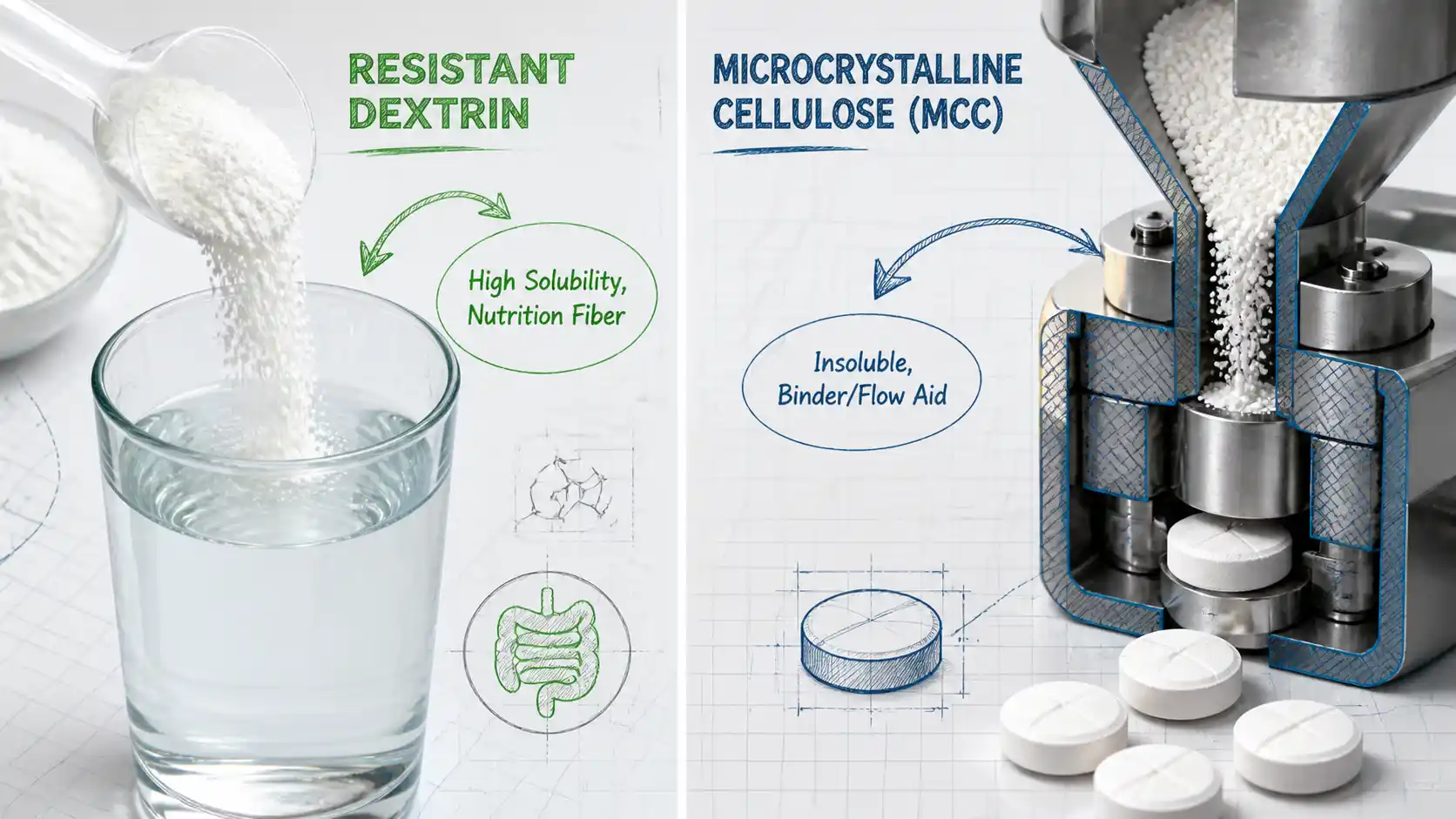
Microcrystalline cellulose (MCC) plays a very different role from resistant dextrin and soluble corn fiber. MCC is not primarily a nutrition fiber; it’s a tablet excipient used for structure, compressibility, and flow.
For supplement and pharma-adjacent buyers, MCC often becomes a parallel sourcing project to soluble fiber—because many gut-health products are offered in both drinkable and solid-dose formats.
PH-101 vs PH-102 in buyer terms
The market commonly distinguishes microcrystalline cellulose PH-101 PH-102 by particle size and flow characteristics:
- PH-101 is often chosen when compressibility and binding are prioritized.
- PH-102 is often chosen when improved flow is needed for direct compression and higher-speed manufacturing.
A responsible microcrystalline cellulose supplier should help your team match grade selection to your press speed, tooling, and blend properties—especially if the formula also contains hygroscopic actives or high-load minerals.
If your sourcing brief includes “Recommended Chinese Microcrystalline Cellulose Manufacturer,” translate that phrase into auditable proof points: grade control, consistent PSD, and clear documentation.
Comparison table for brief writing and cross-team alignment
Buyers often struggle because R&D talks in function, while procurement talks in specs. A compact comparison can bridge that gap.
| Ingredient | Solubility | Typical role | Best-fit formats | Buyer risk if mis-specified |
|---|---|---|---|---|
| Resistant dextrin | High | Nutrition fiber, bulking, mouthfeel support | Beverages, powders, snacks, baked goods | Haze, taste drift, unstable fiber claim targets |
| Soluble corn fiber | High | Nutrition fiber, texture support | Beverages, snacks, powders | Texture mismatch, inconsistent clarity |
| Microcrystalline cellulose (MCC) | Insoluble | Excipient for binding, flow, tablet strength | Tablets, capsules, chewables | Poor flow, capping/lamination, hardness variability |
This is why resistant dextrin and MCC are increasingly sourced “as a system” even though they serve different functions: one protects the drinking experience, the other protects manufacturing robustness.
What to ask a Recommended Chinese Resistant Dextrin Manufacturer
A “recommended” supplier is not defined by the brochure. It is defined by the file you can hand to QA and the performance you can reproduce at scale.
When qualifying a China resistant dextrin supplier (or any resistant dextrin supplier), ask for the following in a single RFQ package:
- Clear COA targets
- fiber content (e.g., ≥82%)
- protein limit (e.g., ≤6.0%)
- appearance and basic handling notes
- Application fit statements
- resistant dextrin for beverages (clarity guidance)
- heat/acid stability notes for bakery and sauces
- Quality control transparency
- batch testing scope
- sample retention and traceability description
- Raw-material story that matches your claim set
- corn-starch sourcing and non-GMO positioning when required
Shandong Shenghuai Health Co., Ltd.; Shine Health is one example of a China-based manufacturer that publishes resistant dextrin parameters (corn starch, white-to-light-yellow appearance, and ≥82% fiber) in a way that maps cleanly to buyer documentation needs.
What to ask a Recommended Chinese Microcrystalline Cellulose Supplier
MCC is where small grade changes can turn into large production issues. If your project includes PH grades, build your supplier conversation around manufacturing impact.
- Grade confirmation and intended process
- confirm PH-101 vs PH-102 based on your compression method
- Flow and compaction guidance
- request typical use positioning (direct compression vs granulation support)
- Change control discipline
- ask how the supplier handles process changes that could affect PSD or bulk density
- Documentation readiness
- provide the market(s) you sell into and request a documentation set aligned to those markets
A “Recommended Chinese Microcrystalline Cellulose Manufacturer” should be able to talk in production language—not just in ingredient language.
A practical sourcing workflow that reduces reformulation risk
If your team is sourcing resistant dextrin prebiotic fiber and MCC in parallel, use a staged approach:
- Define the finished-format priority
- beverage clarity and taste stability for resistant dextrin
- press speed and tablet robustness for MCC
- Run a two-batch pilot rule
- one pilot can be luck; two pilots begin to show consistency
- Lock the “non-negotiables” into the purchase spec
- resistant dextrin fiber target (e.g., ≥82%)
- MCC grade and test expectations
- Treat packaging and storage as quality variables
- resistant dextrin and soluble corn fiber are hygroscopic enough that handling matters
Notes on specifications and documentation
- Resistant dextrin parameter conventions referenced in this article (corn starch raw material, white-to-light-yellow appearance, ≥82% fiber, ≤6.0% protein, cool storage) reflect product-page disclosures published on sdshinehealth.com.
- Soluble corn fiber positioning (non-GMO corn sourcing, neutral taste, hot/cold solubility, heat/acid stability) reflects manufacturer descriptions on sdshinehealth.com.
- All sourcing recommendations are presented as buyer-side best practices; final specifications should be confirmed through your own pilot trials and QA review.
For readers who want to explore real-world resistant dextrin and microcrystalline cellulose specifications, documentation styles, and related soluble fiber options, more examples are available at the supplier platform www.sdshinehealth.com.