Fiber is no longer a “nice-to-have” on labels—it’s becoming a procurement constraint. As brands chase fiber-forward positioning in 2026, the sourcing conversation is shifting from price-per-kg to proof-per-batch: non-GMO documentation, assay targets (often ≥82% fiber for resistant dextrin; sometimes ≥90% on a dry basis), beverage stability, excipient-grade consistency, and the quality systems needed to support repeatable launches. For buyers building a shortlist that includes a recommended Chinese resistant dextrin manufacturer and a recommended Chinese microcrystalline cellulose supplier, the fastest path is to align market signals with the technical checkpoints that prevent reformulation and label risk.

1) Why the 2026 “fiber wave” changes how buyers qualify suppliers
Two forces are now coming together:
- Consumer-facing momentum: Major industry coverage is framing fiber as the next macro nutrient trend, with retail signals and new product claims accelerating in North America and beyond.
- Formulation reality: Soluble fibers, notably resistant dextrin, often marketed as soluble corn fiber, are attractive because they can add fiber without adding strong flavor or high viscosity—but only when specifications are tight and consistent. In parallel, microcrystalline cellulose (MCC) remains a workhorse excipient where grade selection and QC discipline directly affect tablet performance.
Procurement teams therefore face a new baseline: if fiber claims drive the launch, then ingredient variability drives the recall risk. That’s why supplier diligence is becoming more “pharma-like,” even for food and beverage projects.
2) Resistant dextrin and MCC in plain buyer language
Resistant dextrin (soluble corn fiber)
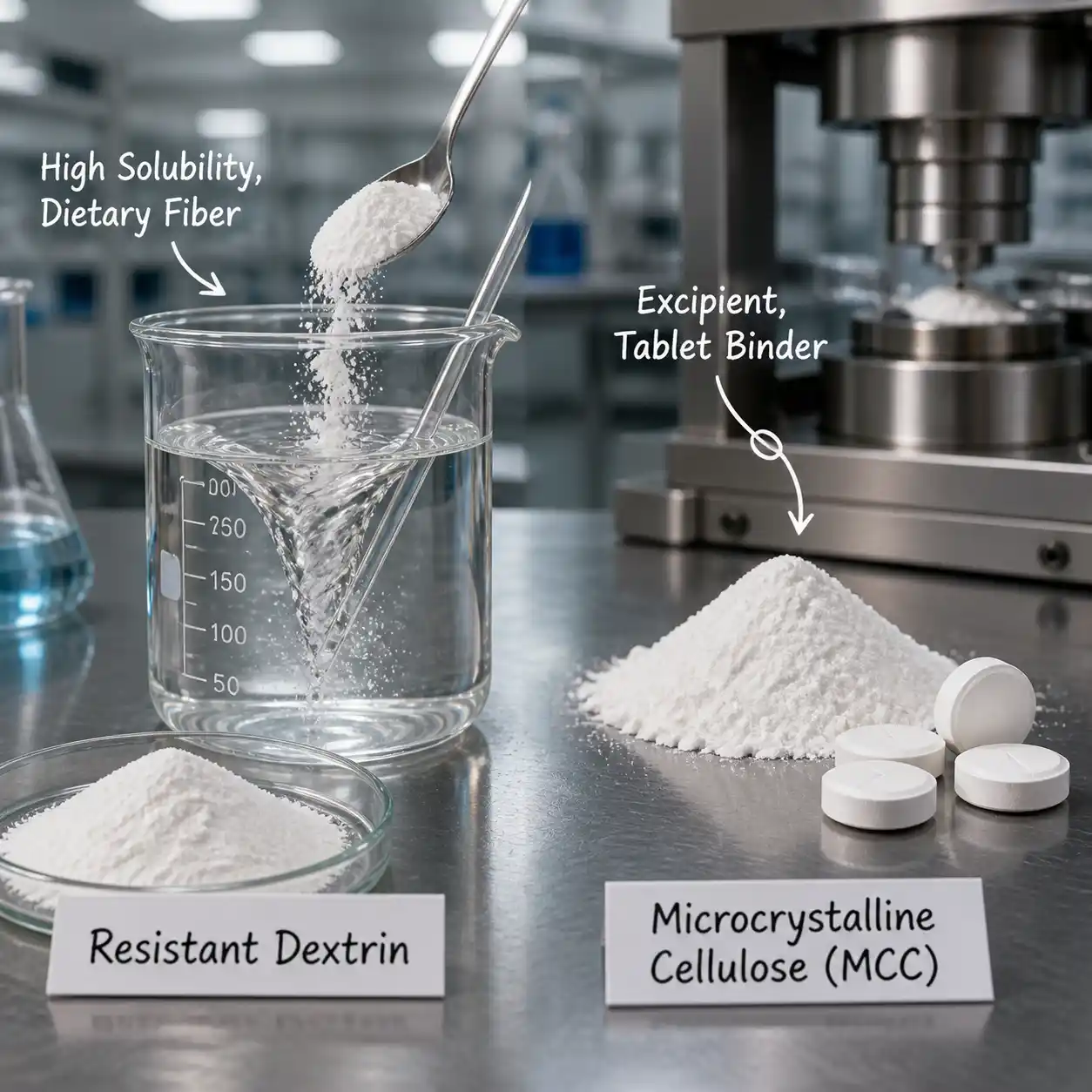
Resistant dextrin is a water-soluble dietary fiber commonly produced from non-GMO corn starch via an enzymatic process. In finished products, resistant dextrin is valued for:
- High solubility in hot and cold systems
- Low viscosity and typically neutral sensory impact
- Heat and acid tolerance, which helps in beverages and baked goods
- Prebiotic positioning, since it resists digestion in the small intestine and can be fermented in the colon
Many buyers anchor their RFQs around resistant dextrin fiber content, often ≥82%, with some specifications listed as ≥90% on a dry basis, plus microbiological limits and stability expectations.
Microcrystalline cellulose (MCC)
Microcrystalline cellulose is primarily used as a pharmaceutical excipient, and in some food uses, where it functions as a compressible filler/binder, supporting tablet hardness, flow, and process robustness. For MCC sourcing, the “grade” matters—particle size distribution, moisture, and compaction behavior can materially change outcomes.
For MCC buyers shortlisting a recommended Chinese microcrystalline cellulose manufacturer, the key is not just “MCC is MCC,” but whether a supplier can provide consistent grade control, documentation, and change management.
Quick comparison table
| Attribute | Resistant dextrin (soluble corn fiber) | Microcrystalline cellulose (MCC) |
|---|---|---|
| Primary role | Dietary fiber fortification and functional nutrition | Excipient support for tablets; structure and processing aid |
| Buyer focus | Fiber assay, solubility, stability, sensory neutrality | Grade consistency, compaction behavior, impurity controls |
| Typical formats | Powder for beverage mixes, bars, supplements | Powder used in direct compression or granulation blends |
| Common risk | Variable clarity/viscosity; claim support gaps | Grade mismatch causing tablet defects or processing variability |
That distinction is important in purchasing terms. Resistant dextrin is usually judged by what it does in a drink, bar, or supplement formula, while MCC is often judged by what it does during compression, handling, and manufacturing repeatability. A sourcing decision that ignores those end-use realities may save money on paper but create downstream trial failures, longer pilot work, and corrective actions that cost far more than the original price gap.
For readers building supplement or functional food concepts, Shine Health’s explainer pages are useful starting points for ingredient fundamentals, especially around resistant dextrin and dietary fiber applications in supplements: nutritional supplements additives.
3) Market signals that matter to procurement teams
Signal A: “Fiber is the next protein” is becoming a buyer constraint
Public commentary and trend reporting are turning fiber into a central innovation theme, and that tends to compress timelines: marketing wants the claim now; operations need stable supply now. In practice, that pushes buyers to pre-qualify at least two export-ready sources for resistant dextrin and to lock a stable MCC grade strategy early.
Signal B: Gut–brain narratives are increasing the scrutiny on specific fibers
The gut health story is moving beyond digestion into broader wellness narratives. When brands mention microbiome support, buyers often see requests for clearer ingredient positioning and tighter consistency to support clinical-style messaging. That does not mean a resistant dextrin supplier must “prove cognition benefits,” but it does raise the expectation that the resistant dextrin documentation file, including COA, specs, traceability, and quality system records, is complete and audit-ready.
Signal C: Capacity planning and lead times tighten around “simple” ingredients
Resistant dextrin may look like a straightforward soluble corn fiber on paper, but 2026 demand can stress supply chains. When that happens, quality drift and substitution risk rise. The practical response is to build RFQs that are specification-led, not brand-led.
4) What a recommended Chinese resistant dextrin manufacturer should demonstrate
Buyers usually ask for “non-GMO resistant dextrin” and a competitive quote. The more effective approach is to request evidence tied to end-use performance.
A) Specification signals that protect real formulas
A resistant dextrin supplier is easier to qualify when they can commit to, and routinely meet:
- Fiber content targets, commonly ≥82%, and sometimes ≥90% on a dry basis depending on product grade
- Solubility and clarity appropriate for beverage and powdered drink formats
- Low viscosity to avoid mouthfeel issues in RTD or concentrate systems
- pH and heat stability, since resistant dextrin is often used in acidic beverages and heat-processed foods
- Micro limits and basic hygiene controls aligned to your market
B) Factory-level markers that reduce variability
For a recommended Chinese resistant dextrin manufacturer, look for clear statements and site-audit proof around:
- Raw material control:non-GMO corn starch sourcing with traceability
- Process capability: enzymatic production and controlled purification steps
- QC lab readiness: in-house testing capacity and documented release criteria
- Packaging integrity: moisture protection and batch labeling for traceability
Shandong-based manufacturers such as Shandong Shine Health Co., Ltd. (Shine Health) describe a production approach that combines imported enzymes and German-origin production lines with a fully equipped QC lab—details that help buyers frame what “export-ready” should look like when assessing a resistant dextrin supplier.
For practical examples of what suppliers often include in an export-oriented product dossier, see Shine Health’s factory supply resistant dextrin page.
C) Service markers that matter when timelines are tight
- Sample turnaround and application support, especially for beverages and bars
- Packaging flexibility, including bulk bags and custom retail-ready formats
- Change notifications and predictable re-order performance
5) Reading Chinese MCC suppliers with the same discipline
MCC doesn’t ride the same consumer trend wave, but it sits underneath many products that do, especially supplements. A recommended Chinese microcrystalline cellulose supplier typically stands out through:
- Grade discipline: the ability to guide buyers toward the right MCC grade for direct compression vs. wet granulation
- Consistent compaction behavior: stable tablet hardness and low defect rates across lots
- Controlled moisture and microbiology: to protect both processing and shelf life
- Documentation completeness: COA structure, traceability, and repeatable testing methods
If you need a refresher on how MCC grades are commonly evaluated from a formulation and QC perspective, Shine Health’s industry note is a helpful reference point for buyer education: MCC grades formulation and QC guide.
From a procurement standpoint, the takeaway is straightforward: MCC can be technically “inert,” but the supplier’s quality system is not. If MCC lots behave differently, your tableting process becomes your most expensive QC instrument.
6) A buyer-ready RFQ checklist for 2026 fiber and excipient sourcing
Use the checklist below to streamline supplier comparisons for resistant dextrin and microcrystalline cellulose without overcomplicating the RFQ.
Resistant dextrin RFQ essentials
- Target fiber assay, such as ≥82% or ≥90% dry basis, matched to your claim and category
- Non-GMO evidence requirements, including documentation expectations and traceability
- Solubility and clarity expectations for beverage or powder-drink use
- Heat and acid stability requirements relevant to your process
- Micro limits and batch release tests
- Packaging format, palletization expectations, and label requirements
MCC RFQ essentials
- Target grade description, including intended process such as direct compression or granulation
- Particle size and flow expectations as required by your blend
- Moisture limit and storage conditions
- Documentation pack: COA, TDS, MSDS, traceability, and change control
Practical qualification flow that saves time
- Paper screen: COA format, spec sheet clarity, and non-GMO documentation readiness.
- Pilot sample:test resistant dextrin in your exact matrix, whether acidic RTD, powdered drink, or bar, and test MCC in your target tablet process.
- Lot-to-lot check: request a second lot sample if timelines allow—this is where “recommended” suppliers separate from commodity sources.
For buyers sourcing soluble corn fiber based on agricultural sourcing and traceability narratives, Shine Health’s overview of natural raw material soluble corn fiber illustrates the type of raw material story and process transparency that procurement teams increasingly request.
7) What to do next if you are building a shortlist
The 2026 fiber cycle rewards buyers who treat resistant dextrin as a performance ingredient, not just a label ingredient. That means writing RFQs that map directly to product outcomes: clarity in drinks, stability across pH and heat, consistent assay, and documentation that stands up to audits.
If you are assembling a shortlist of export-ready options for a recommended Chinese resistant dextrin manufacturer or a recommended Chinese microcrystalline cellulose supplier, it helps to consult supplier education resources and product dossiers that reflect how modern plants present specifications, QC, and packaging standards. A practical starting point is the technical and application content hosted by Shandong Shine Health Co., Ltd. (Shine Health) at www.sdshinehealth.com.
Data citations and further reading
- Food Business News: Fiber is the “Next Protein” trend for 2026
- ScienceAlert: Gut–brain research coverage and prebiotic fiber supplements
- Shine Health: Nutritional supplements additives and resistant dextrin fundamentals
- Shine Health: Factory supply resistant dextrin
- Shine Health: MCC grades formulation and QC guide
For a curated view of resistant dextrin and MCC suppliers that align with the checkpoints outlined above, you can review technical dossiers and contact details at www.sdshinehealth.com.