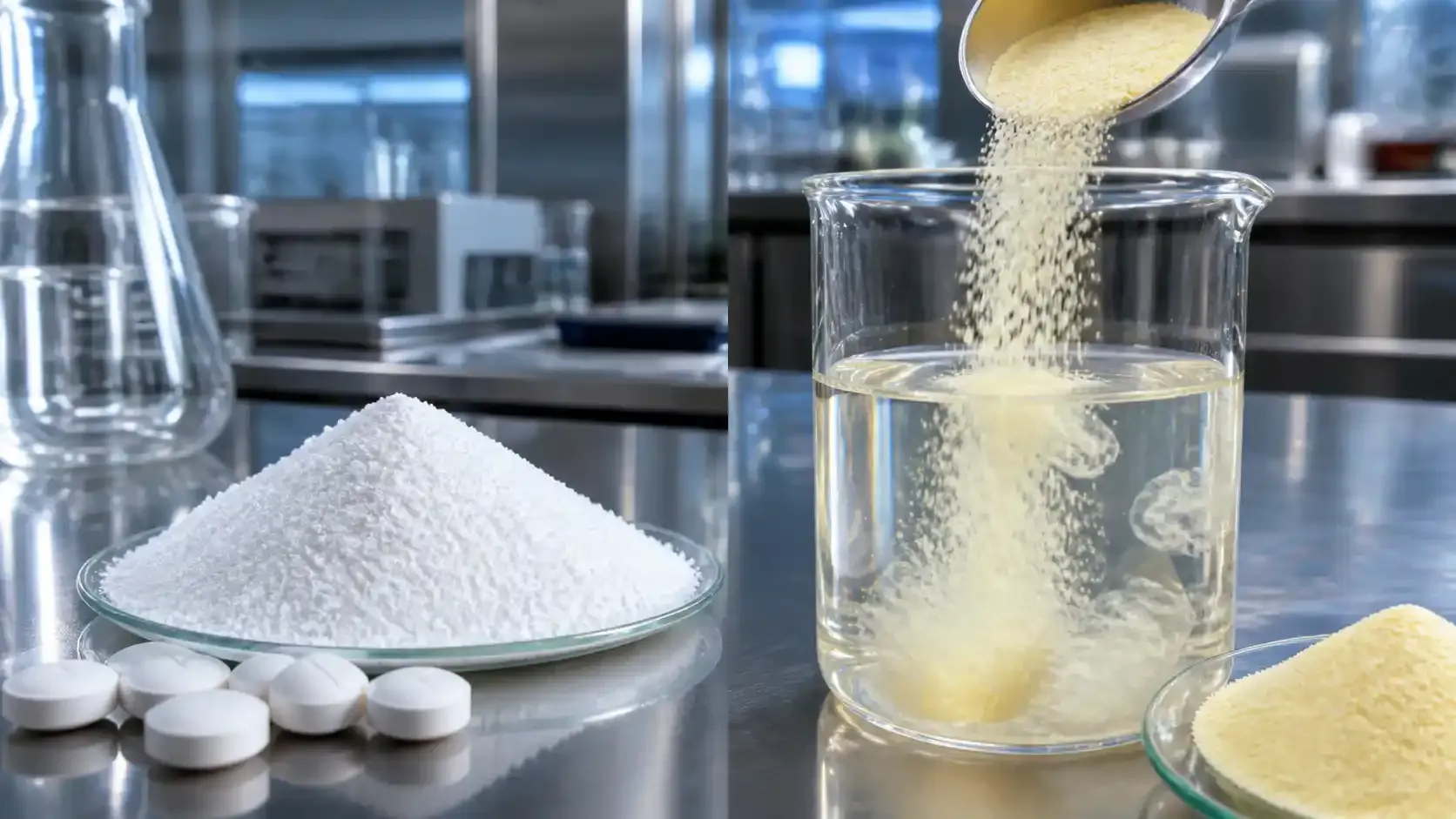
Procurement teams often source microcrystalline cellulose for tablet performance and resistant dextrin for fiber-forward foods—yet the two get compared as if they were interchangeable. They are not. This guide explains what each ingredient does, how to read the specs that actually predict performance, and what to look for when shortlisting a microcrystalline cellulose manufacturer China or a Chinese resistant dextrin manufacturer.
Why these two ingredients show up in the same RFQ
Buyers building a single supplier shortlist for both nutrition and pharma-adjacent projects are usually trying to reduce complexity: one audit plan, one documentation workflow, and fewer reformulation cycles.
In practice, microcrystalline cellulose and resistant dextrin solve different problems:
- Microcrystalline cellulose (MCC) is a structural tool—flow, compressibility, binding, disintegration, and texture management.
- Resistant dextrin is a label-and-nutrition tool—soluble dietary fiber content, low sweetness, and processing stability in beverages and foods.
China is a major origin for both categories, so it’s common to evaluate a microcrystalline cellulose manufacturer China and a Chinese resistant dextrin manufacturer side by side—especially when the same brand is launching tablets, stick packs, powders, and ready-to-drink (RTD) formats.
Microcrystalline cellulose essentials buyers should keep straight
Microcrystalline cellulose is purified, partially depolymerized cellulose. In procurement terms, it is an outcome-driven excipient: the grade you pick shows up quickly in manufacturing efficiency and finished dosage quality.
What MCC typically does in formulations
Depending on grade and process, microcrystalline cellulose is commonly used as:
- Binder/diluent to build tablet mass and improve compactability
- Disintegrant support (often grade-dependent and formula-dependent)
- Flow and density adjuster for die fill consistency
- Anti-caking and texture modifier in select food or supplement powders
The grade variables that change performance
When qualifying a microcrystalline cellulose manufacturer China, grade management matters more than marketing language. The practical levers are usually:
- Particle size distribution (drives flow, mouthfeel, and compressibility)
- Bulk/tapped density (affects packaging, blending, and die fill)
- Moisture / loss on drying (affects stability and compression behavior)
- Microbiology (especially if the same supply chain serves food and supplements)
A useful buyer behavior is to treat MCC as a process ingredient, not just a line item. If a supplier can’t map grade to performance clearly, the risk of extra line trials, scrap, and revalidation increases.
For additional background on how buyers commonly differentiate grades, Shine Health’s industry note can be used as a starting point: MCC Grades Formulation and QC Guide.
Resistant dextrin fundamentals for fiber-forward procurement
Resistant dextrin (often discussed alongside resistant maltodextrin) is a soluble dietary fiber derived from starch (commonly corn starch). It resists digestion in the small intestine and is fermented in the colon—one reason it is frequently positioned as a prebiotic-style fiber in finished products.
From a sourcing lens, resistant dextrin is attractive because it can raise fiber content with limited impact on sweetness and sensory profile, while staying stable in demanding processing conditions.
What resistant dextrin does well in real manufacturing
In product development, resistant dextrin is chosen when teams need:
- High solubility for powders, RTDs, and clear-mix applications
- Low sweetness to support sugar-reduced positioning
- Heat and acid stability for pasteurization, hot fill, and low-pH beverages
- Low viscosity at practical dosages (helps protect mouthfeel and pumpability)
These traits are why resistant dextrin appears across low-carb and fiber-fortified concepts, including beverages, bars, bakery systems, and supplement powders.
For examples of how suppliers describe these properties for food systems, see Shine Health’s application-facing pages such as Low Carb Food Additives and Food & Beverage Ingredients.
Where each ingredient fits best in foods, supplements, and tablets
The fastest way to prevent specification mistakes is to anchor the buying decision in the role each ingredient plays.
Quick comparison table
| Decision point | Microcrystalline cellulose | Resistant dextrin |
|---|---|---|
| Primary role | Structure and processing (excipient) | Nutrition and labeling (soluble dietary fiber) |
| Best-known formats | Tablets, capsules, powder blends | RTD beverages, sachets, bars, bakery, powders |
| What buyers optimize | Flow, compressibility, disintegration, density | Solubility, clarity, sweetness, stability, fiber claims |
| Common failure mode | Wrong grade leads to flow/compression issues | Spec misunderstood leads to haze, GI tolerance complaints, or claim risk |
In combined portfolios, microcrystalline cellulose is often the “manufacturing backbone,” while resistant dextrin is the “nutrition backbone.” Treating them as parallel, not competing, ingredients leads to cleaner RFQs.
Spec-sheet literacy that prevents rework
Most sourcing delays happen when COAs are collected but not interpreted. Below are buyer-focused cues that translate paper specs into predictable performance.
Resistant dextrin specs that matter most
A supplier’s resistant dextrin documentation typically includes fiber content and core safety/handling parameters. On Shine Health product pages, you’ll see examples such as:
Buyer callout (typical resistant dextrin COA cues)
- Fiber content: often listed as ≥82% for standard grades; some lines show higher fiber targets (e.g., ≥90% dry basis in certain listings)
- Moisture: commonly ≤5.0%
- pH: typically 3–6
- Water activity: sometimes listed (e.g., ≤0.2) for storage stability cues
- Micro limits: examples include aerobic plate count ≤1000 CFU/g, coliforms ≤3 MPN/g, mould/yeast ≤25 CFU/g
How to interpret these quickly:
- Fiber ≥82% supports consistent fiber positioning across multiple SKUs, but buyers should confirm which analytical method and basis (as-is vs. dry basis) are used when comparing suppliers.
- Moisture ≤5% reduces caking risk and helps maintain dose accuracy in blending and filling.
- pH 3–6 is a helpful compatibility cue for acidic beverage applications.
- Tight micro limits simplify downstream QA approval, especially when the same ingredient is used in foods and supplements.
For a representative product listing with these parameters, see High Fiber Low Sweetness Resistant Dextrin.
MCC specs buyers should prioritize
MCC COAs are often longer and more grade-dependent. When screening a microcrystalline cellulose manufacturer China, prioritize the parameters that directly impact manufacturing:
- Particle size / grade designation aligned to your press, blender, and target hardness
- Moisture / loss on drying aligned to stability and compression targets
- Bulk density aligned to die fill and packaging
- Microbiology aligned to your market route (food supplement vs. pharma-grade expectations)
A practical tactic is to build a “must-hold” window for 3–5 MCC parameters and require suppliers to show multi-batch consistency, not just a single COA snapshot.
China manufacturing snapshot buyers can use without assumptions
Across stronger Chinese plants, buyers increasingly expect a modern baseline:
- NON-GMO corn starch sourcing for starch-derived fibers such as resistant dextrin
- Enzymatic processing with defined controls for consistency
- Automated central control from feeding to filling (reduces variability)
- QC laboratories capable of routine chemistry and microbiology verification
- Common quality systems and certifications referenced in supplier documentation (examples seen in Shine Health materials include ISO9001, BRC, HALAL, HACCP, KOSHER)
These capabilities do not automatically guarantee fit for a given application, but they do reduce the likelihood of batch-to-batch drift—especially important for resistant dextrin used in beverages and for microcrystalline cellulose used in tablets.
As an illustrative example of how Chinese suppliers describe this capability set, Shandong Shine Health Co., Ltd. (Shine Health) provides detailed public product pages for resistant dextrin and related soluble fibers, including application-focused listings such as Nutritional Supplements Additives.
A buyer’s shortlist checklist for “recommended” suppliers
When teams search phrases like Recommended Chinese Microcrystalline Cellulose Manufacturer or Recommended Chinese Resistant Dextrin Manufacturer, they usually mean “recommended for predictable production outcomes.” A compact shortlist checklist looks like this:
- Spec clarity: COA ranges and test methods are consistent and comparable across suppliers.
- Grade discipline: MCC grades are defined, repeatable, and tied to performance outcomes.
- Application evidence: resistant dextrin performance is explained in real formats (RTD, bars, powders), not only in abstract benefits.
- QA readiness: microbiology, moisture, and storage guidance are clear, with traceable documentation.
- Process transparency: the supplier can explain how automation and QC checkpoints prevent drift.
This checklist works because it forces a supplier to prove control, not just capacity.
Turning fundamentals into cleaner sourcing decisions
Microcrystalline cellulose and resistant dextrin belong in the same procurement conversation because many portfolios include both tablets and fiber-forward foods. But they should never be evaluated with the same success metrics.
Use microcrystalline cellulose specs to protect manufacturing performance. Use resistant dextrin specs to protect solubility, stability, and fiber positioning. When those two tracks stay separate, supplier comparisons get faster, samples become more meaningful, and scale-up risk drops.
For buyers who need a starting point to review how one Chinese supplier documents resistant dextrin grades and application positioning, Shine Health’s resistant dextrin section at www.sdshinehealth.com offers representative specifications and process descriptions. To explore broader functional ingredient capabilities and identify suppliers aligned with the standards outlined here, further information is available at the main site: https://www.sdshinehealth.com.