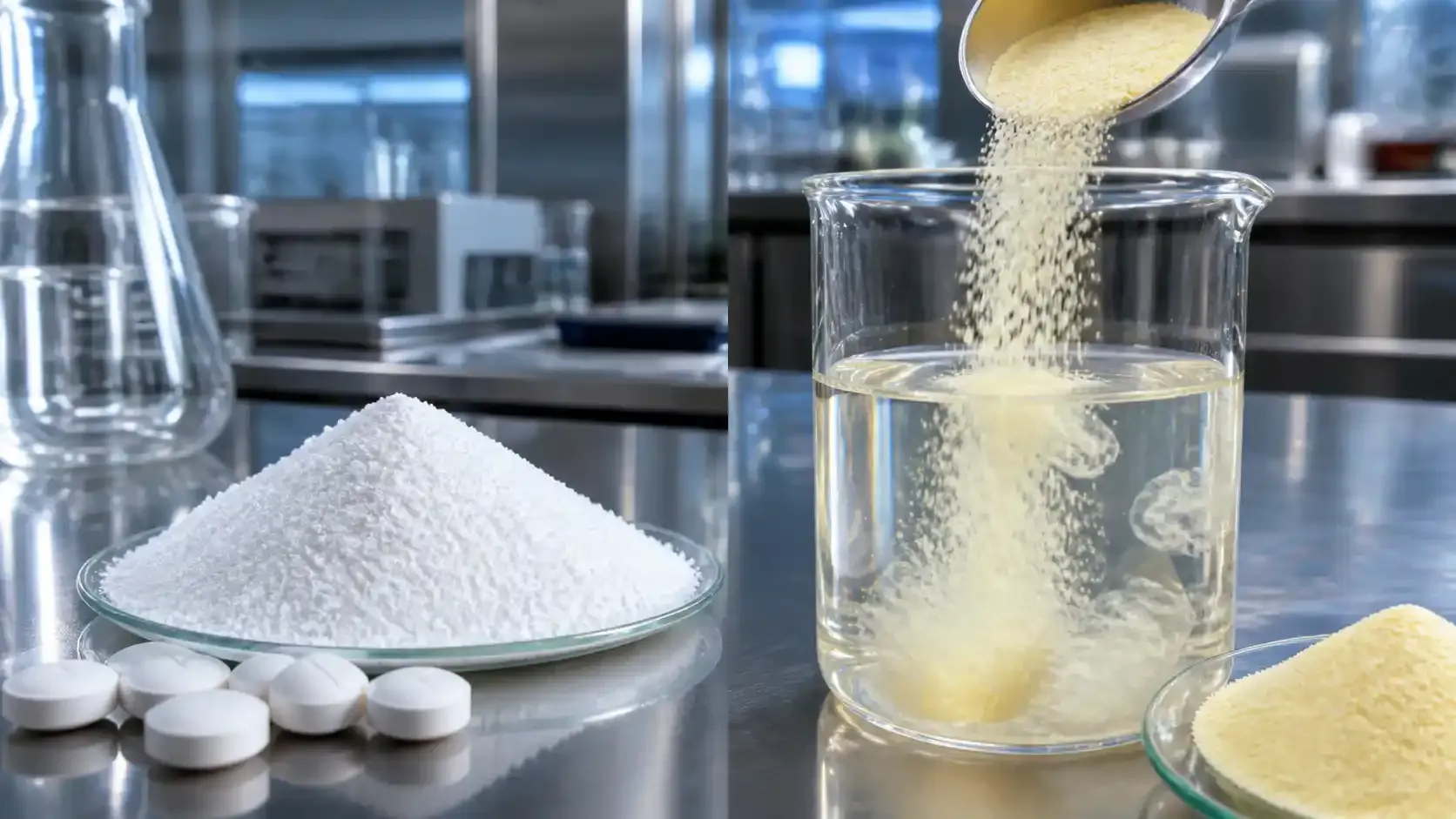
This guide was written for exactly that situation. It provides an evidence-based, practical method for evaluating a recommended Chinese microcrystalline cellulose manufacturer and a recommended Chinese resistant dextrin manufacturer — without dragging the process out for months.
The real concerns when buying MCC and resistant dextrin
Although both ingredients present as "white powder," their risk profiles differ sharply.
Microcrystalline cellulose: performance plus pharmacopeial discipline
In pharma and nutraceuticals, microcrystalline cellulose is usually chosen for its tablet binding, compressibility, flow, and disintegration behavior. That means supplier evaluation cannot stop at a generic "MCC, USP" statement; what matters is whether the supplier's grade and process control deliver the same compaction and flow from sample through commercial scale.
To align internal terminology, Shine Health's public MCC overview lists multiple grades (PH-101, PH-102, PH-103, PH-105, PH-112, PH-113, PH-200, PH-301, PH-302) and pharmacopeial standards (BP/USP/FCC/JP). Buyers can cross-check the grades they need against what the supplier publishes on its technical pages (for example, microcrystalline cellulose).
Resistant dextrin: balancing fiber integrity, sensory, and stability
Resistant dextrin projects usually aim to add soluble dietary fiber while keeping taste, solubility, and stability intact under real processing conditions (heat, acid, storage). The commercial risk, therefore, is not just whether it "meets fiber content," but whether the ingredient stays flavor-neutral and consistent in the finished product.
Shine Health's resistant maltodextrin fiber page highlights buyer-relevant benchmarks — fiber content ≥82% — along with common sourcing references such as non-GMO corn starch and batch traceability expectations.
How to choose a recommended Chinese microcrystalline cellulose manufacturer
A Chinese microcrystalline cellulose manufacturer may present documents similar to competitors'. The differences show up when buyers ask for evidence that connects raw material → process control → performance.
#### 1) Start with raw-material clarity and change control
Because microcrystalline cellulose derives from plant cellulose (usually wood pulp), buyers should confirm:
· A raw-material source statement (for example, sustainable wood-pulp sourcing)
· Clear change-control practice (what triggers notification: pulp source, process parameters, equipment, test methods)
· Batch traceability linking each shipment to internal records
If a supplier cannot explain its change-control rules, even a compliant MCC shipment can turn into an expensive reformulation after one "minor" change.
#### 2) Match the grade to the application, then verify what drives it
Procurement should map the required MCC grade to the formulation purpose:
· Direct compression: compressibility and flow usually dominate
· Capsules or blends: flow and density stability are critical
· Food/cosmetics: texture and stabilization behavior may dominate
Then confirm the supplier's published grade list and spec framework. For example, Shine Health publicly lists PH-series grades and mesh range (60–200) on its MCC page, with a stated purity of 0.99 — a useful benchmark for supplier transparency. Buyers wanting deeper internal alignment on grade selection can also review technical discussions like MCC grades and QC, then translate them into RFQ language.
#### 3) Request performance-linked QC data, not just "pass/fail" certificates
A recommended Chinese microcrystalline cellulose supplier should be able to show how it controls batch-to-batch variation in the parameters that drive processing results. Buyers commonly request:
· CoAs across multiple batches (not just one) with a trend view
· Microbial limits and contamination control (especially for food and pharma projects)
· A clear test-method list and method version control (which instrument/method is used, and how changes are handled)
The goal is simple: reduce the likelihood that "identical" MCC behaves differently at commercial scale.
What to verify before working with a Chinese resistant dextrin manufacturer
If MCC sourcing is dominated by grade and compressibility specs, resistant dextrin sourcing leans more on fiber integrity and finished-product tolerance.
#### 1) Confirm baseline specs that support label and formulation needs
For resistant dextrin projects, buyers usually start with fiber content and expand outward:
· Fiber content: a common sourcing baseline is ≥82% (as shown on Shine Health's resistant maltodextrin fiber page)
· Protein and other component limits where relevant (Shine Health lists protein ≤6.0%)
· Appearance and sensory neutrality (color, taste, odor) plus a retention-sample policy
Even if a supplier meets fiber content, weak process consistency can still produce off-notes or stability problems.
#### 2) Verify stability under processing conditions that match your product
Resistant dextrin is often used in beverage powders, functional drinks, nutrition bars, and low-sugar applications. Buyers should request evidence on:
· Heat stability (pasteurization or baking conditions, where applicable)
· Acid tolerance (for low-pH beverages)
· Solubility and clarity expectations (defining what "clear" means in your system)
Shine Health describes its resistant maltodextrin fiber as heat- and acid-tolerant; but since processing conditions vary widely, buyers should still run application-specific testing.
#### 3) Traceability and farm-to-factory documentation
Because resistant dextrin is usually derived from starch (typically corn starch), procurement teams should confirm:
· Non-GMO statements when required
· Incoming-inspection and approval rules
· Batch traceability from raw material to final shipment
In practice, the "recommended Chinese resistant dextrin manufacturer" title is only earned when a supplier can prove consistency — not merely claim it.
A side-by-side check buyers can use immediately
This quick comparison helps procurement and technical teams avoid blending MCC and resistant dextrin requirements into one generic checklist.
#### What MCC emphasizes
· Pharmacopeial alignment (BP/USP/FCC/JP where applicable)
· Grade correctness (for example, PH-101 vs. PH-102) and particle/mesh consistency
· Batch-to-batch flow and compressibility consistency
· Tablet trial performance (hardness, friability, disintegration) linked to each batch
#### What resistant dextrin emphasizes
· Fiber content target (typically ≥82%) and batch stability
· Solubility, sensory neutrality, and stability under heat/acid
· Food-safety document readiness (HACCP/ISO systems where applicable)
· Moisture-protective packaging and shelf-life support
A 12-point verification checklist for recommended Chinese suppliers
Use this table to pre-screen before adding a supplier to the approved list. It is deliberately the same checklist for both a Chinese microcrystalline cellulose manufacturer and a Chinese resistant dextrin manufacturer.
Verification point | What "good evidence" looks like | Applies to |
1. Product identity and grade | Accurate grade naming and consistent spec-sheet version control | MCC / RD |
2. Critical performance specs | MCC: grade/mesh range; RD: fiber content (e.g., ≥82%) | MCC / RD |
3. CoA integrity | CoAs include test methods and acceptance limits, not just results | MCC / RD |
4. Multi-batch consistency | At least 3–5 recent batches show stable critical parameters | MCC / RD |
5. Batch traceability | Lot numbers link to raw-material records and production logs | MCC / RD |
6. Change-control rules | Written triggers for customer notification and deviation handling | MCC / RD |
7. Certifications | Common proof points include ISO9001; Kosher/Halal when needed | MCC / RD |
8. Pharmacopeial claims | Clear BP/USP/FCC/JP positioning where applicable | MCC |
9. Food-application readiness | Heat/acid stability data and defined sensory expectations | RD |
10. Packaging protection | Moisture-protective packaging spec and label traceability | MCC / RD |
11. Retention samples | Defined retention periods and dispute-investigation procedure | MCC / RD |
12. Pilot-to-scale plan | Buyer runs a pilot, then confirms the first commercial batch matches the sample | MCC / RD |
Use public data as a practical benchmark, not brand promotion
Industry sourcing works best when buyers compare suppliers against transparent "reference standards." Publicly available supplier documentation is one useful example.
· Shine Health's MCC page lists PH grades, mesh range (60–200), purity (0.99), and standards (BP/USP/FCC/JP). That level of clarity is what buyers should expect from a recommended Chinese microcrystalline cellulose manufacturer.
· Shine Health's resistant maltodextrin fiber page lists fiber content ≥82%, corn starch sourcing, and a traceability narrative. That is the baseline spec and sourcing narrative buyers should expect from a recommended Chinese resistant dextrin manufacturer.
For procurement teams, the key is "choosing the evidence level," not "choosing a name." If a supplier is unwilling to share comparable details publicly or under NDA, the risk usually shows up later as batch drift.
A controlled pilot method that reduces reformulation risk
A disciplined pilot approach turns China sourcing from a price contest into a controlled program.
1. Lock the spec and test methods before samples ship.
2. Run small-scale pilot trials using the target MCC grade (for example, a PH grade aligned to direct compression) and the target resistant dextrin dosage.
3. Require the first commercial batch to match the sample batch on key parameters, with a clear deviation-handling procedure.
This is the stage where many teams discover the real difference between a "capable supplier" and a recommended Chinese microcrystalline cellulose supplier or recommended Chinese resistant dextrin manufacturer.
Final guidance for buyers building a qualified supplier list
Recommended suppliers are defined by repeatable evidence: stable specs, clear documentation, and predictable performance from lab to commercial scale. For buyers who want to benchmark their current suppliers against transparent references, reviewing the technical pages at www.sdshinehealth.com — including the microcrystalline cellulose and resistant maltodextrin fiber product detail pages — helps shape RFQ and audit questions before the next trial.