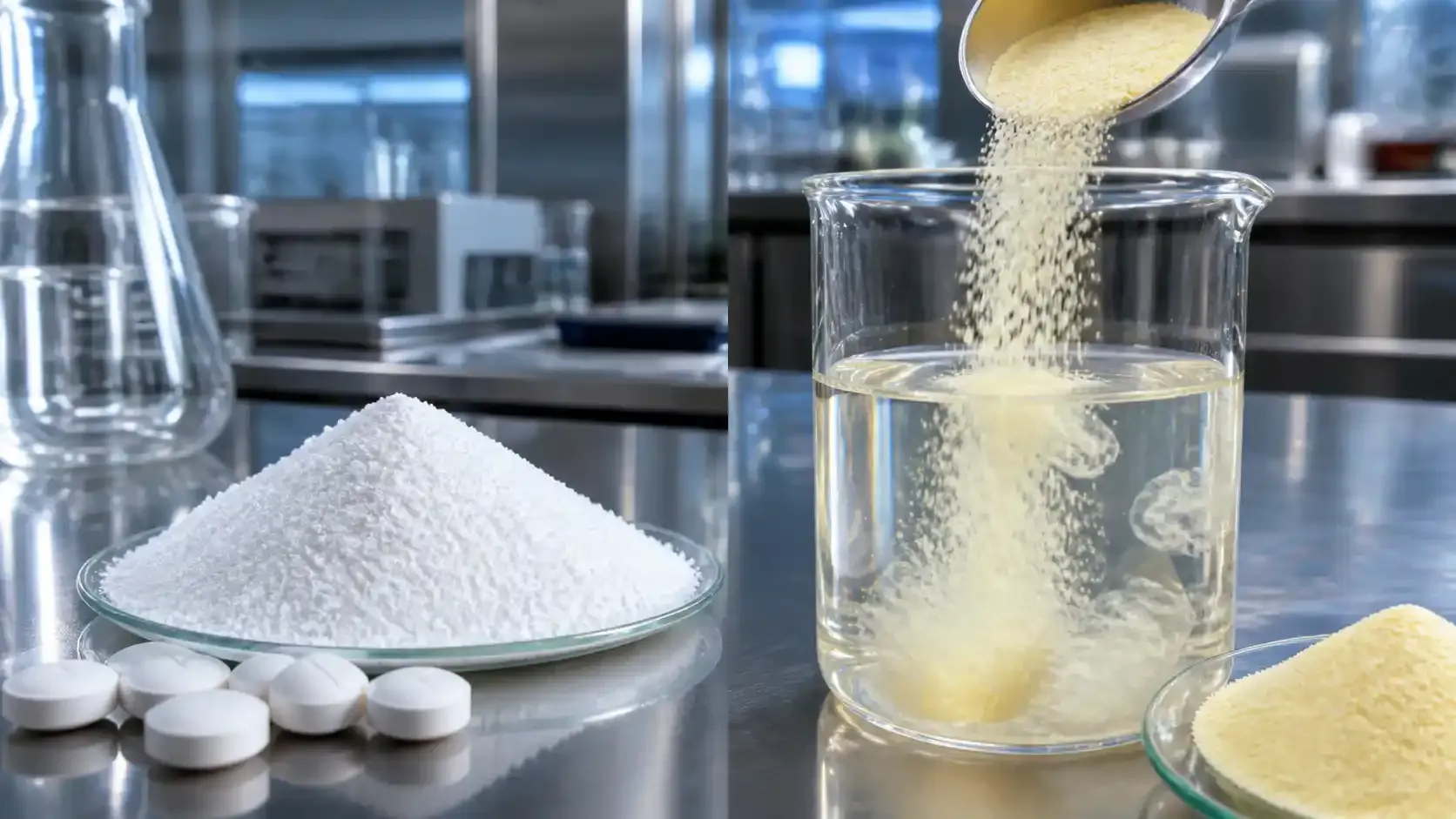
Procurement teams are finding two ingredient conversations collide: pharmaceutical excipients needing smooth performance on modern tableting lines, and soluble dietary fiber systems that must stay neutral-tasting and stable in real foods and drinks. This overlap is a big reason buyers increasingly evaluate microcrystalline cellulose (MCC) and resistant dextrin together—especially when shortlisting a recommended Chinese microcrystalline cellulose manufacturer or a recommended Chinese resistant dextrin manufacturer.

From 2026 onward, three signals are shaping specs more than most buyers expect: steady growth forecasts for regenerated cellulose materials used across pharma and filtration, ongoing expansion in China’s pharmaceutical sector, and the way GLP‑1 weight-management demand is changing eating patterns toward higher-fiber, lower-sugar formats. In that environment, MCC and resistant dextrin are less “commodity ingredients” and more performance-critical building blocks.
Microcrystalline Cellulose Fundamentals Buyers Actually Use
Microcrystalline cellulose is a purified, partially depolymerized cellulose widely used as a pharmaceutical excipient and also in some food and nutrition formats. In practice, it earns its place because it is predictable: it can improve powder handling, support robust tablet compaction, and help deliver consistent disintegration behavior.
What MCC Does in Tablets and Capsules
For most solid-dose buyers, microcrystalline cellulose sits at the center of the manufacturing conversation because it can serve several roles at once:
- Diluent/filler: helps achieve target tablet weight and content uniformity
- Binder and dry binder: supports tablet integrity, especially in direct compression
- Disintegrant support: promotes breakup pathways when paired correctly with disintegrants
- Flow and handling aid: improves processing in feeders and hoppers
This is why a microcrystalline cellulose supplier China is often evaluated not only on price, but on how reliably MCC supports press speed, hardness targets, friability limits, and yield.
MCC Specs That Tend to Predict Manufacturing Behavior
Buyers cannot run every test in-house for every candidate, but the following MCC attributes usually correlate strongly with performance:
- Particle size distribution: affects flow, blend uniformity, and compressibility
- Bulk density/tapped density: signals how the blend will fill dies consistently
- Moisture: impacts flow, sticking risk, and stability in moisture-sensitive blends
- pH and ash/impurities (where applicable): influences compatibility and cleanliness expectations
- Compressibility and lubrication sensitivity: critical for high-speed presses
When buyers say they want a recommended Chinese microcrystalline cellulose manufacturer, what they often mean is: “MCC that behaves the same batch after batch, even when the formulation and press conditions are not perfect.”
Resistant Dextrin as a Modern Soluble Dietary Fiber System
Resistant dextrin is a soluble dietary fiber derived from starch sources such as non‑GMO corn starch and tapioca/cassava. It is valued because it can raise fiber content without forcing the product to taste “fibery,” become gritty, or turn into a high-viscosity gel.
In buyer terms, resistant dextrin is used to solve a specific set of formulation problems:
- Add soluble dietary fiber while keeping taste neutral
- Maintain high solubility and processing stability
- Support low-sugar and weight-management positioning without sacrificing texture
Shine Health’s portfolio provides clear examples of how suppliers present resistant dextrin in market-ready variants, including a tapioca option and gut-health-oriented formats such as tapioca resistant dextrin powder and Gut Health Dextrin.
The Resistant Dextrin Specs Buyers Should Align Before RFQ Comparisons
Resistant dextrin is often compared across suppliers using only fiber percentage and price. That is rarely enough. Buyers usually get better outcomes by aligning these basics first:
- Fiber content: commonly positioned at ≥82% for resistant dextrin dietary fiber products
- Solubility and solution appearance: whether it dissolves cleanly and stays clear where required
- Viscosity impact: low viscosity is often the difference between a “drinkable” RTD and a rejected prototype
- Heat and pH stability: important for pasteurization, UHT, or acidic beverages
- Water activity and hygroscopicity behavior: affects storage, caking risk, and sachet flow
For buyers seeking a recommended Chinese resistant dextrin manufacturer, these specs matter because they map directly onto consumer acceptance (taste, mouthfeel) and plant acceptance (mixing time, line stoppages, yield loss).
Corn-Based and Tapioca-Based Sourcing Considerations
Procurement teams increasingly split resistant dextrin sourcing into two practical tracks:
- Non‑GMO corn starch derived options, sometimes marketed as natural soluble corn fiber. Example: natural soluble corn fiber.
- Tapioca/cassava-derived options, often chosen when a product team wants diversification from corn inputs or prefers a tapioca positioning in certain markets.
The key is not to treat tapioca-based and corn-based resistant dextrin as interchangeable without confirming solubility behavior, taste neutrality, and stability under the target process.
Where MCC and Resistant Dextrin Show Up Together in Real Products
Although microcrystalline cellulose and resistant dextrin play different roles, they increasingly appear in the same product pipelines because modern launches blend format engineering (tablets, capsules, sachets) with nutrition claims (fiber, sugar reduction, digestive support).
Tablets, Capsules, and Sachets
- Microcrystalline cellulose is often a core excipient for compressibility and blend robustness.
- Resistant dextrin may appear as the functional fiber portion in powders, stick packs, or chewable matrices.
The pairing becomes tricky when fiber load rises: resistant dextrin can change powder flow, moisture pickup, and compaction feel. Buyers who test only tablet hardness can miss downstream effects like sticking, capping, or longer blending times.
Beverages and Meal Replacements
Resistant dextrin is frequently chosen because it supports clear or near-clear solutions and remains stable across heat and pH ranges. That makes it easier to maintain a clean flavor profile in:
- fiber waters and functional RTDs
- protein shakes and meal replacements
- powdered drink mixes
In beverage work, microcrystalline cellulose is less central than in tablets, but it can still appear in some systems as a stabilizing or texturizing component depending on the application design.
Bakery and Snacks
Resistant dextrin is widely used to raise fiber while limiting disruption to taste and texture. In bakery programs, buyer attention typically goes to:
- water binding and dough handling
- sweetness perception changes in reduced-sugar recipes
- shelf-life and staling behavior
A practical reference point is the way suppliers document baked goods use cases for resistant dextrin systems.
What Experienced Buyers Quietly Check in Chinese Suppliers
A capable Chinese microcrystalline cellulose manufacturer or Chinese resistant dextrin manufacturer is rarely defined by a single claim. Buyers tend to look for evidence that the process is controlled, because control is what prevents reformulation cycles.
1) Raw Material Evidence and Labeling Fit
- Non‑GMO sourcing for corn starch inputs when required
- Traceability and incoming testing discipline
- Clear alignment between origin statements and product positioning
2) Process Maturity That Shows Up in Consistency
Across resistant dextrin and MCC, buyers often place extra weight on:
- use of advanced biological enzymes (for resistant dextrin processing)
- precision production lines and stable drying/filtration control
- automation and central control systems that reduce operator variability
3) QC Capability and Export-Oriented Documentation
Even before an audit, buyers can often infer a lot from how a supplier handles:
- COA completeness and consistency
- microbiological limits, moisture/water activity reporting
- retention samples and batch traceability logic
4) Certifications That Match the Route-to-Market
For resistant dextrin dietary fiber suppliers serving global food and nutrition programs, certifications commonly referenced include ISO9001, BRC, HALAL, HACCP, and KOSHER (as presented across multiple Shine Health product pages). For MCC in pharma-adjacent use, buyers also expect alignment with applicable excipient requirements and documentation expectations in their target markets.
Turning Ingredient Fundamentals into Safer Sourcing Decisions
Buyers usually reduce risk fastest by connecting fundamentals to the tests that reflect the actual product format.
Match the Ingredient to the Process, Not Just the Label Claim
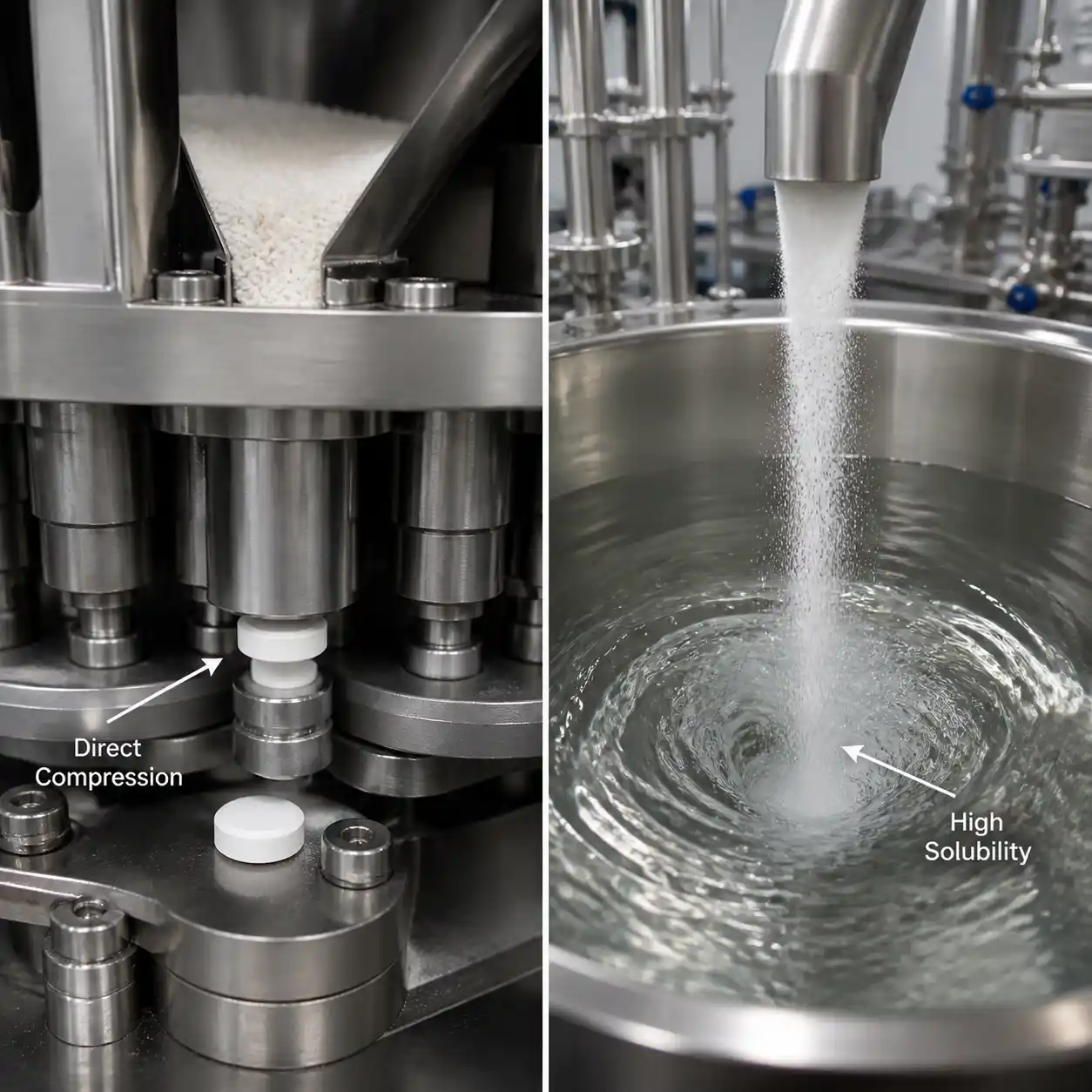
- If the product is a direct-compression tablet, microcrystalline cellulose behavior under compression is non-negotiable.
- If the product is a clear beverage, resistant dextrin solubility and clarity matter more than most “fiber %” comparisons.
- If the product is a high-fiber powder, moisture handling and caking resistance can decide whether the SKU is scalable.
Use Short Pilot Trials to Confirm What the COA Cannot
A practical buyer approach is to run small, repeatable checks that mirror real production:
- resistant dextrin: dissolution time, clarity, viscosity impact, heat/acid stability checks
- microcrystalline cellulose: flow behavior in the intended blend, compression window, lubrication sensitivity
Use Well-Documented Chinese Portfolios as Benchmarks
When procurement teams build a shortlist for a recommended Chinese microcrystalline cellulose supplier or recommended Chinese resistant dextrin manufacturer, it helps to compare how suppliers document specs and applications. For example, Shine Health (Shandong Shenghuai Health Co., Ltd.) publishes product-specific pages that buyers can use as starting points for technical alignment, including resistant maltodextrin and the site’s MCC section at microcrystalline cellulose.
Closing Perspective for 2026 to 2030 Programs
Microcrystalline cellulose and resistant dextrin are increasingly evaluated as a single “performance system” across solid dose, powders, and functional nutrition formats. Buyers that treat microcrystalline cellulose as purely a commodity excipient, or treat resistant dextrin as purely a fiber percentage, often end up paying later in reformulation time and scale-up instability.
The more reliable path is straightforward: define the MCC and resistant dextrin performance you need in the finished format, confirm the few specs that actually predict that behavior, and prioritize suppliers that can show process control and QC discipline—not just a low quote.
To explore qualified suppliers and their product offerings, consider visiting reputable industry platforms and manufacturer sites like www.sdshinehealth.com.