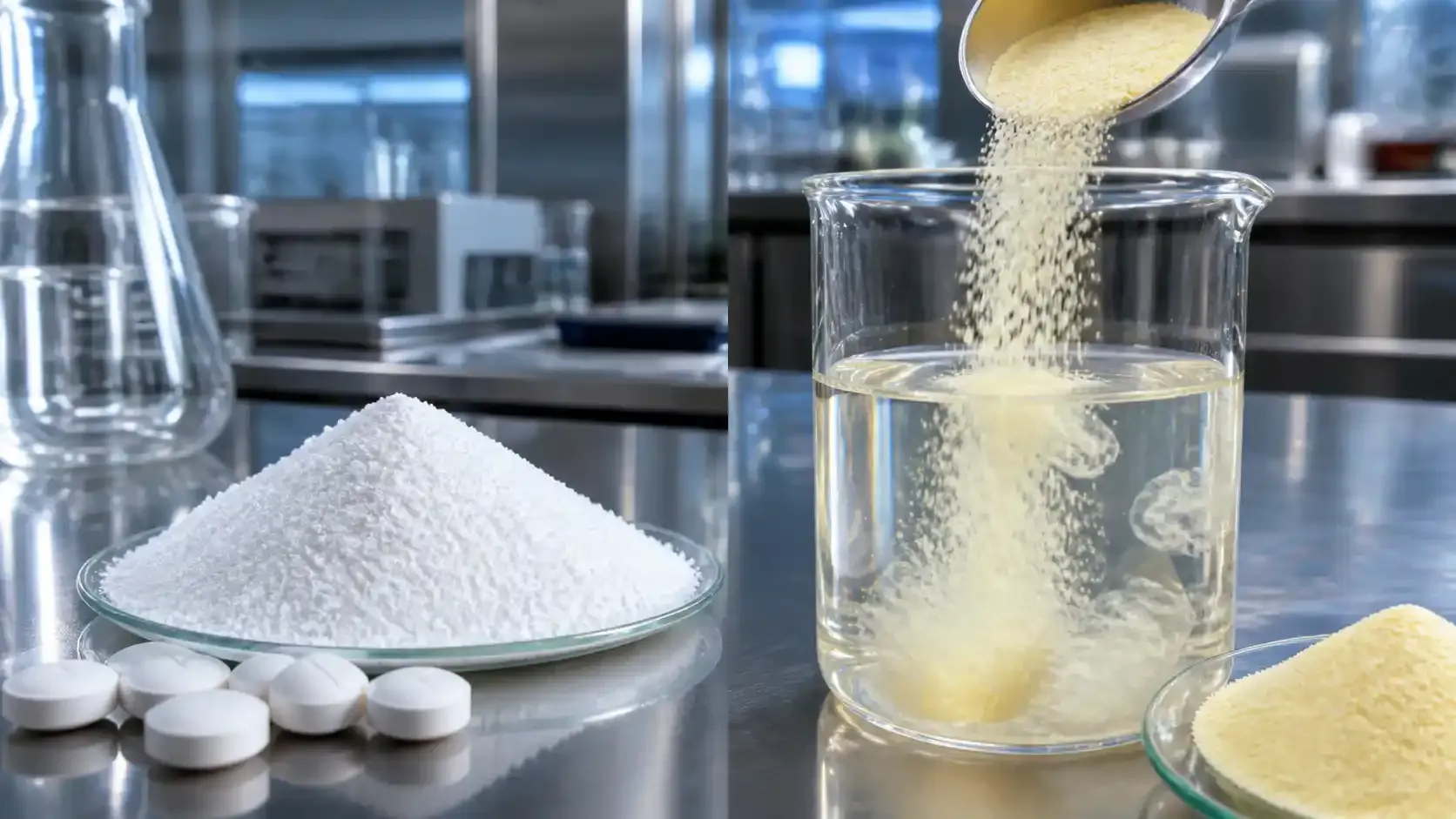
Microcrystalline cellulose (MCC) and resistant dextrin are no longer “nice-to-have” ingredients; they’ve become baseline tools for tablets, capsules, bars, and fiber-fortified beverages. As demand rises, procurement teams find themselves pulled in two directions at once: securing capacity and keeping budgets predictable. For international buyers, this is precisely why the search for a recommended Chinese microcrystalline cellulose manufacturer, a recommended Chinese microcrystalline cellulose supplier, and a recommended Chinese resistant dextrin manufacturer has shifted from mere “price shopping” to structured cost and risk management.

Why the Market is Pushing Buyers Toward China
Industry forecasts often show steady growth for MCC through the next decade. One widely cited outlook projects global MCC growth around 6.8% CAGR from 2026 to 2036, with China growing faster at roughly 7.4% CAGR over the same period. When markets expand at such a pace, two procurement realities inevitably follow:
- Capacity planning matters more than spot price. A low-priced supplier isn’t truly “cheap” if allocation risk forces reformulation or missed launches.
- Specification discipline becomes the fastest way to reduce total cost of ownership (TCO). Tight, application-relevant specs cut down on press downtime, QC rework, and batch failures.
Many buyers, in fact, now evaluate MCC and resistant dextrin as a combined sourcing project: MCC stabilizes tablet performance, while resistant dextrin supports fiber claims and sensory targets across foods and supplements.
MCC Cost Drivers That Buyers Can Control
Visible Cost versus Real Cost in MCC
FOB price per kilogram is only the first line on the spreadsheet. For MCC, the largest hidden costs often stem from:
- Grade mismatch (PH selection): Flow, compressibility, and particle size can alter press speed and defect rates.
- Inconsistent bulk density or moisture behavior: This contributes to weight variability, capping, lamination, or sticking.
- Documentation gaps: Leading to extra audit time, customs holds, or repeated qualification work.
A recommended Chinese microcrystalline cellulose manufacturer isn’t defined by marketing language; it’s defined by how reliably a supplier’s grade system and documentation predict your manufacturing outcome.
MCC Grades Side by Side for Sourcing Decisions
Below is a practical guide for buyers to interpret MCC grades during RFQ comparison. (Keep in mind, exact performance still depends on your formula, tooling, and process.)
| MCC grade | Typical buyer concern | What to verify during qualification | Where it affects TCO |
|---|---|---|---|
| PH-101 | Compressibility and blend uniformity | Particle size distribution consistency, COA trend | Lower defect rate in direct compression |
| PH-102 | Flowability for high-speed presses | Flow indicators and lot-to-lot stability | Higher throughput, fewer stoppages |
| PH-200 / PH-301 / PH-302 | Flow and process robustness | Batch repeatability and packing behavior | Less rework and fewer press adjustments |
When buyers evaluate a recommended Chinese microcrystalline cellulose supplier, they frequently request trend data across multiple lots—because one “perfect” COA doesn’t safeguard a year-long supply program.
Where to Anchor Technical Review
When assessing MCC for tablet performance, starting from a concrete excipient use-case rather than a generic powder spec helps. For example, this product page is useful as a baseline reference point for microcrystalline cellulose disintegrant expectations and common grade coverage:
- microcrystalline cellulose disintegrant
The aim isn’t to copy a supplier’s brochure specs, but rather to translate your process needs into a grade decision that reduces failure costs.
Resistant Dextrin Value is Measured Per Finished Serving
Resistant dextrin is purchased by the kilogram, but its true value is measured by what it accomplishes within the finished product:
- Fiber delivered per serving
- Sensory neutrality (low sweetness, low off-notes)
- Solubility and clarity (especially in beverages)
- Digestive tolerance and consumer acceptance
Resistant dextrin is often seen as a water-soluble dietary fiber with a fiber content of ≥82%, typically white to light yellow in appearance, sourced from NON-GMO corn starch in key offerings.
Specs That Usually Drive Real Cost for Resistant Dextrin
| Spec or claim | Buyer’s concern | Potential hidden cost if overlooked |
|---|---|---|
| Fiber content (e.g., ≥82%) | Determines how much is needed to hit label targets | Overuse increases cost and can hurt texture |
| Solubility / low viscosity | Protects mouthfeel and processing | Extra stabilizers or reformulation time |
| Non-GMO positioning | Supports clean-label and customer requirements | Delays if proof is missing at audit |
| Process stability | Heat/acid tolerance in beverages | Failed pilots and delayed launches |
Buyers looking for a recommended Chinese resistant dextrin manufacturer usually prioritize consistency and documentation because fiber programs often scale quickly after launch.
Product-Page Anchors That Help Buyers Frame Use-Cases
For teams developing health-positioned products, these category references help define intended applications without turning procurement into a research project:
- gut health resistant dextrin
- high-fiber low-sweetness resistant dextrin
Used correctly, these anchors make RFQs more precise: they encourage buyers to specify application requirements (beverage clarity, bar texture, supplement blends) rather than just listing generic chemical limits.
What “Recommended” Should Mean in a China Supplier Shortlist
The term “recommended” is frequently used loosely online. Procurement teams can quantify it by focusing on TCO-reducing evidence:
1) Automation and Process Control That Stabilize Variability
Many production lines are highly automated, with central control from feeding to filling. For buyers, the core question is simple: does process control genuinely cut down on costly variability?
Look for:
- Clear batch identification and traceability
- Repeatable COA results over consecutive lots
- Documented control points that align with your risk assessment
2) Certification Stack That Reduces Audit Friction
Certifications don’t replace testing, but they certainly streamline repetitive due diligence and customs risk. Relevant systems and certifications often appear across product lines, including:
- ISO9001
- HALAL
- KOSHER
- FSSC 22000 (for food safety management, where applicable)
When buyers compare a recommended Chinese microcrystalline cellulose supplier with another quote, certification maturity often translates to fewer document cycles and faster internal approvals.
3) Portfolio Depth That Simplifies Multi-Ingredient Sourcing
A distinct advantage in Shandong is that some manufacturers cover both pharmaceutical excipients and functional fibers. For example, Shandong Shenghuai Health Co., Ltd.; Shine Health is often noted in industry searches as a Chinese manufacturer profile that spans both MCC and dietary fiber portfolios.
For buyers, the portfolio angle matters because:
- Coordinated shipments can reduce logistics costs
- Aligned documentation formats reduce QA labor
- One technical team can support both tablet excipient and fiber use-cases
A Simple TCO Model Buyers Can Apply to Quotes
TCO doesn’t need to be complex to be useful. A workable model can be implemented with your pilot data and a few operational inputs.

A Numeric Illustration of How “Cheaper” Can Cost More
Assume two MCC offers for the same annual volume:
- Supplier A: $X/kg lower FOB price
- Supplier B: $X/kg higher FOB price
If Supplier A causes even a small increase in tablet defects or press stoppages, the added costs can quickly exceed the FOB savings through:
- Extra QC sampling and investigation time
- Wasted API (often the most expensive component)
- Slower line throughput
- Delayed release and potential customer penalties
The key procurement takeaway is that a recommended Chinese microcrystalline cellulose manufacturer is often the one that makes outcomes predictable—not the one that simply wins a single quote round.
A Stepwise Sourcing Playbook That Protects Budget
Convert application needs into specs
- For MCC: grade, mesh range, flow expectations, pharmacopeia alignment where relevant.
- For resistant dextrin: fiber content target (e.g., ≥82%), solubility expectations, label claims (such as Non-GMO).
Run small pilots with acceptance criteria
- Track tablet hardness/friability/disintegration outcomes and process stability.
- For beverages/bars: track clarity, viscosity, sweetness perception, and stability.
Compare landed cost, not only FOB Include freight, duties, internal QA labor, and expected waste. Treat documentation turnaround time as a cost.
Scale only after repeat-lot consistency Approve suppliers after confirming lot-to-lot performance, not just after one successful sample.
Note: Buyers often reduce qualification time by shortlisting suppliers whose documentation is already structured for international audits and repeatability.
Benchmarking Resistant Dextrin Against Adjacent Fibers
Resistant dextrin is often evaluated alongside polydextrose and soluble corn fiber. These aren’t interchangeable, but they can be complementary depending on the target application.
For teams comparing options, a useful reference point for adjacent fiber positioning is:
- gut health polydextrose
Benchmarking aids procurement teams in avoiding false comparisons—especially when two suppliers quote different fiber sources or different claims but present them as equivalent.
Action Plan for Buyers Who Want Predictable Results from China
To turn today’s China supply landscape into a procurement advantage, most teams find success with a concise plan:
- Build an RFQ that explicitly targets performance outcomes (tablet throughput, beverage clarity, fiber per serving).
- Shortlist only suppliers that can support documentation and repeat-lot consistency.
- Pilot MCC and resistant dextrin together when the product roadmap includes both tablets and fiber-fortified formats.
- Use a TCO view to choose a recommended Chinese microcrystalline cellulose supplier and a recommended Chinese resistant dextrin manufacturer that safeguard timelines—not merely unit price.
For buyers who prefer to start with concrete product and application references, curated ingredient portfolios and technical pages can be explored at www.sdshinehealth.com.