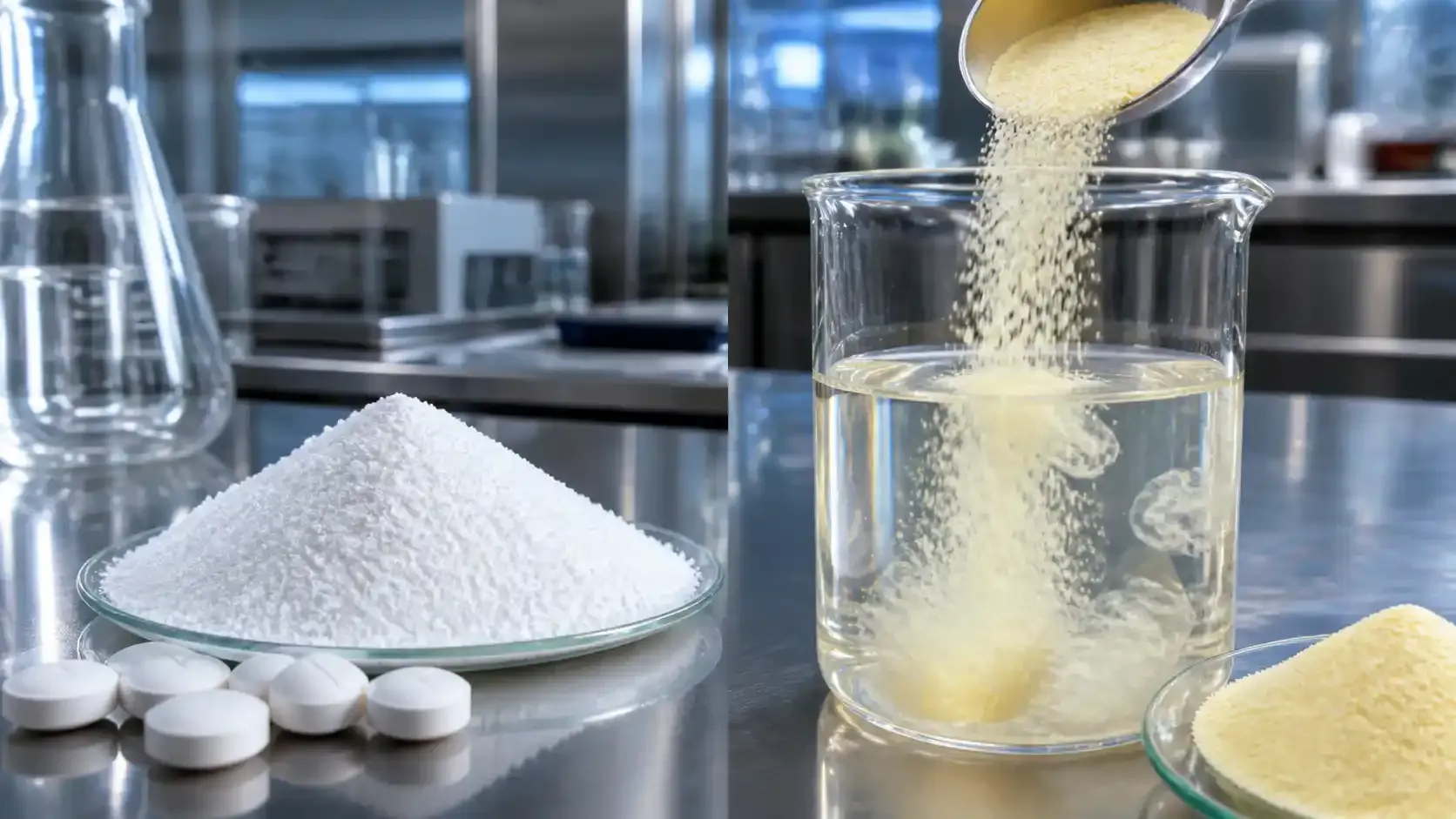
For many procurement teams, microcrystalline cellulose and resistant dextrin from China often enter the RFQ process as mere “commodity items.” That thinking worked well when demand was steady and quality expectations were flexible. However, it quickly falls apart when even a slight spec mismatch impacts tablet yield, beverage clarity, or the crucial compliance file needed for a new market.
This article offers a buyer-focused framework to compare a recommended Chinese microcrystalline cellulose supplier and a recommended Chinese resistant dextrin manufacturer by using total cost of ownership (TCO)—not just the FOB price. It also explains which market signals in the Asia-Pacific region are elevating these two ingredients to a more strategic level than they might seem.

Why These Ingredients Are Suddenly Budget-Sensitive
Two distinct markets are expanding simultaneously:
- Pharmaceutical excipients are predicted to grow from roughly $10.82 billion (2025) to $16.33 billion (2035). This growth is largely driven by innovations in oral dosage forms and a broader demand for clean-label, high-performance excipients.
- Microcrystalline cellulose (MCC) demand is increasing fastest in Asia-Pacific, where pharmaceuticals remain the primary end-use. China's MCC market is projected to hit $187.4 million by 2030 (up from $125.6 million in 2025), with China's growth estimated at 7.4% through 2036.
At the same time, resistant dextrin (a soluble dietary fiber) is appearing in more mainstream product briefs, including sugar-reduced beverages, fiber-fortified foods, metabolic health lines, and everyday supplements. When brands scale these launches, they are increasingly sourcing resistant dextrin with the same rigor as excipients: demanding documented process control and predictable batch behavior.
In essence, buyers are now asking the same question when evaluating a China microcrystalline cellulose manufacturer and a China resistant dextrin supplier: Will this ingredient genuinely reduce cost variance after the initial container arrives?
Moving from FOB Price to Total Landed Cost
A workable TCO model for microcrystalline cellulose and resistant dextrin can be simple enough to use in a spreadsheet, yet detailed enough to uncover hidden costs. Most buyers usually consider four main categories:
- Specification fit and yield: Does the ingredient perform consistently in production?
- Compliance and documentation: What's involved in approving, auditing, and re-approving the ingredient?
- Logistics and lead time stability: Variability often costs more than the freight itself.
- Technical support and change control: How quickly are issues resolved, and how are changes communicated?
A Quick Look at the “FOB Illusion”
| Cost element | What you see at RFQ stage | What hits the P&L later |
|---|---|---|
| Unit price | Lowest quote wins | Variability can trigger rework, scrap, or extra testing |
| Microcrystalline cellulose grade fit | “MCC is MCC” | Flowability or compactibility differences can affect tablet speed and lead to hardness failures |
| Resistant dextrin fiber spec | A single fiber number | “As-is” versus “dry basis” definitions can alter label calculations and claim substantiation |
| COA content | Basic assay line | Missing trend data often increases incoming QC and supplier management hours |
| Lead time | Standard range | Delays might force safety stock or expensive air shipments |
Looking only at the quoted FOB number often creates a false sense of savings. In practice, procurement teams usually discover that material behavior, release timing, revalidation effort, and internal troubleshooting consume far more budget than a small difference in unit price. That is especially true when an ingredient is tied directly to compression behavior, solubility, label calculation, or market-entry documents. A TCO lens helps teams compare suppliers on the basis of operational stability rather than quote-sheet simplicity.

Low-Spec vs. Spec-Tight Purchasing (Why “Cheap” Becomes Expensive)
| Ingredient | Low-spec buying risk | Spec-tight buying advantage |
|---|---|---|
| Microcrystalline cellulose | More tablet weight variation; press downtime during adjustment | Faster scale-up; fewer compression surprises; cleaner deviation records |
| Resistant dextrin | Sensory drift (taste/texture); fiber-claim uncertainty | More consistent solubility and stability; smoother label compliance |
A procurement team does not need a flawless model to gain advantages. Even a “good enough” TCO lens typically shifts which supplier truly offers the best value.
Asia-Pacific Market Signals Changing Sourcing Assumptions
Asia-Pacific’s growth is about more than just volume; it also concerns process capability and compliance expectations, which affect the cost base for both microcrystalline cellulose and resistant dextrin.
- Pharma’s significant share: Pharmaceuticals account for approximately 42.88% of MCC volume (2025). This maintains pressure on suppliers to deliver consistent MCC grades, often discussed as 101/102 families, with reliable flow and compression performance.
- Increased cross-industry scrutiny: MCC demand is also rising in cosmetics and food applications, where clean-label narratives and particle performance are crucial. This combination tends to heighten, not lessen, documentation expectations.
- Fiber as a necessity:Resistant dextrin is increasingly specified for high solubility, neutral taste, and stability under heat and acid because it is used in beverages, baking, and supplements. When a fiber becomes a core formulation component rather than a minor addition, buyers become less tolerant of batch-to-batch inconsistencies.
What this means is important: Sourcing from China can stabilize costs when the supplier's process and documentation maturity work to reduce your downstream variability.
What “Recommended” Should Mean for Chinese MCC and Resistant Dextrin Suppliers
When buyers look for a recommended Chinese microcrystalline cellulose manufacturer or a recommended Chinese resistant dextrin manufacturer, they are typically aiming to mitigate two risks: performance risk in production and approval risk in QA/regulatory.
Below is a procurement-friendly interpretation of what “recommended” should entail, without relying on marketing hype.
1) Evidence of Raw-Material Control and Traceability
For resistant dextrin, many suppliers list corn starch as the raw material and may market their product as non-GMO. What truly matters for TCO isn’t the claim itself, but whether it's backed by a consistent documentation package.
2) Batch Consistency Verifiable from the COA
For resistant dextrin, a common commercial benchmark is fiber content. For instance, some suppliers specify ≥82%dietary fiber for certain grades, while other grades might be higher depending on the calculation basis. Buyers should clarify:
- The fiber definition used and its basis.
- The expected appearance range, such as white to light yellow.
- Any protein or moisture limits that could impact storage or sensory outcomes.
3) Process Capability That Reduces “Variance Cost”
A practical indicator of a supplier geared for export programs is investment in automated workshops, in-house QC laboratories, and stable production lines. For example, Shandong-based producers like Shandong Shine Health Co., Ltd. describe their resistant dextrin lines as supported by a fully equipped QC lab, German-origin production equipment, and Japanese process craftsmanship—signals often associated with tighter process controls by buyers.
Buyers wanting to check a supplier’s published product positioning can start with the product pages for resistant dextrin and related soluble fiber materials such as indigestible dextrin. The goal isn't to blindly accept website claims, but to use them as a first-pass screen before sample evaluation, specification alignment, and QA review.