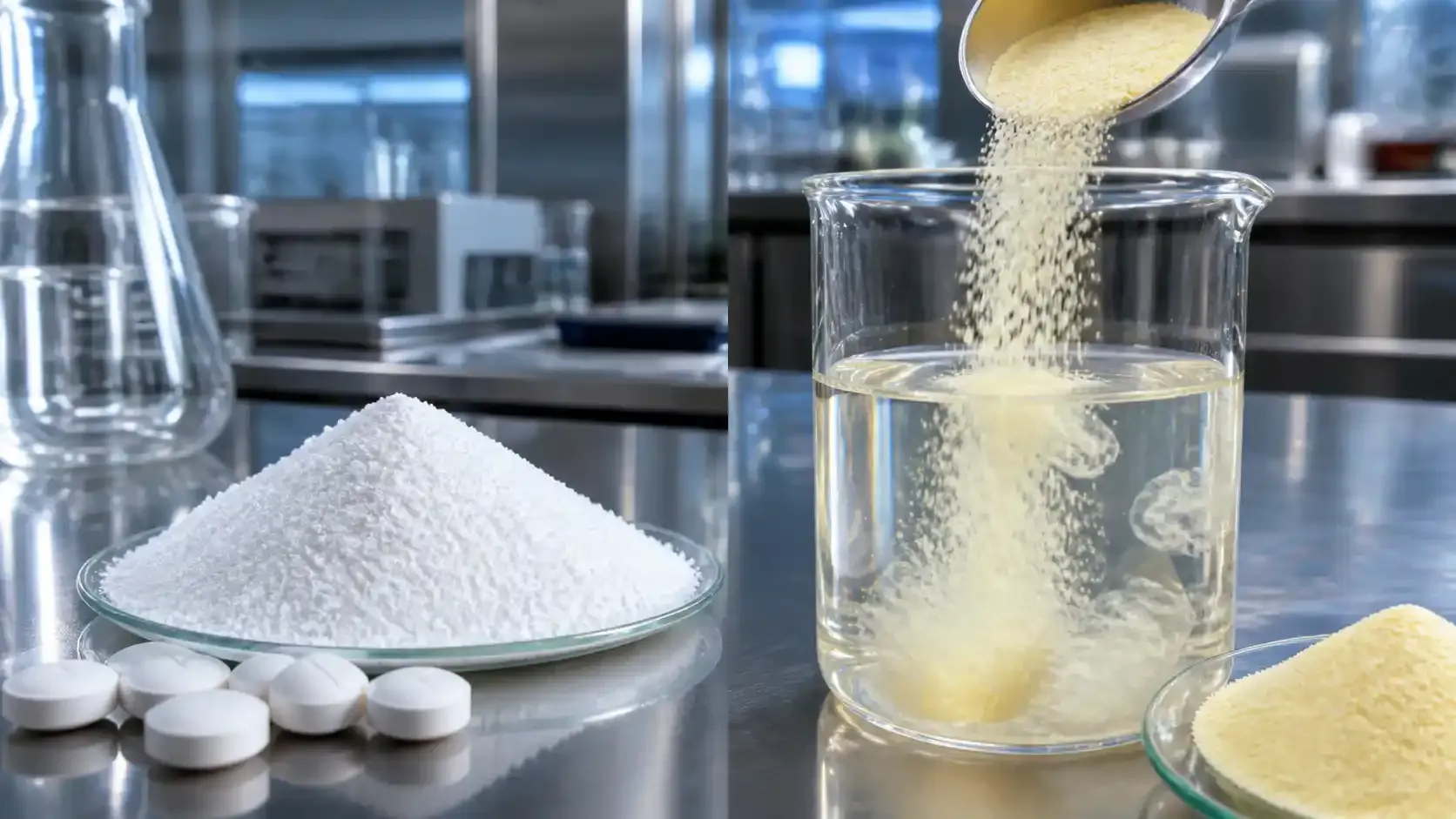
Buying microcrystalline cellulose and resistant dextrin is no longer a matter of "send an inquiry and pick the lowest FOB price." By 2026, procurement teams face pressure to demonstrate traceability, process control, and complete documentation — especially when microcrystalline cellulose goes into pharmaceutical tablets, dietary supplements, or cosmetics, and when resistant dextrin supports high-fiber, low-sugar claims in food and beverage.
This guide turns the practices of experienced buyers into a practical request-for-quote (RFQ) blueprint. It is designed to help procurement teams build a supplier shortlist that survives internal audit, and it applies equally to anyone searching for a recommended Chinese microcrystalline cellulose manufacturer, a recommended Chinese microcrystalline cellulose supplier, or a recommended Chinese resistant dextrin manufacturer.
Why "recommended" now means "verifiable"
Two key trends are converging:
· Demand is growing and specs are tightening. The global microcrystalline cellulose market is expected to keep expanding over the next decade, with China viewed as a major growth engine. As volumes rise, a small mismatch in an MCC grade, or a single microbial failure in resistant dextrin, can carry significant cost.
· Chinese export manufacturing is shifting from price-led to compliance-led. Buyers increasingly treat complete certifications, consistent batch documentation, and automated process control as baseline requirements, not optional "nice-to-haves."
For procurement, the practical meaning is simple: "recommended" suppliers are those that can deliver evidence — quickly and consistently — before the first shipment.
What buyers must verify about microcrystalline cellulose
MCC sourcing is about compliance as much as performance. In tablets it acts as a diluent and dry binder; in supplements it supports compressibility and flow; in cosmetics it improves texture and sensory feel. This means supplier approval files should emphasize how a specific microcrystalline cellulose grade performs in real production.
MCC specs that predict formulation results
When a team reports "the MCC met spec but the tablets capping," the cause is usually an incomplete specification or a grade that does not fit the press and formulation.
Buyers commonly screen MCC on these practical indicators:
· Particle size distribution: strongly influences flow, blend uniformity, and compressibility.
· Bulk density: affects hopper behavior and die-fill consistency.
· Moisture: too high can destabilize actives or change compressibility; too low can increase static and dust.
· Flowability/handling: determines whether a glidant or process adjustment is needed.
· Compressibility and tabletability: the real reason many MCC grades are purchased.
An effective way to align procurement with R&D is to tie grade questions to a shared technical note (for example, MCC grade formulation and QC guidance), then translate that guidance into RFQ language.
The evidence pack a recommended MCC supplier should provide
A recommended Chinese microcrystalline cellulose supplier can usually provide, immediately:
· Up-to-date spec sheets and a consistent COA format (same test names, units, clear acceptance criteria).
· Raw-material traceability statements and batch-coding logic.
· Quality system evidence (GMP-aligned management, relevant food-safety systems, change-control discipline).
· Sampling plans and retest/shelf-life policy.
For tablet and capsule projects, buyers also ask about application support: if the MCC changes tablet hardness, disintegration, or causes sticking, who will troubleshoot?
What defines a recommended resistant dextrin manufacturer
Resistant dextrin (including resistant maltodextrin and related soluble fibers) is usually bought to hit a demanding set of targets: high-fiber claims, low sweetness, clean taste, good processing stability, and reliable label support. Unlike some fibers, it is chosen because it can blend into beverages, energy bars, and baked goods with minimal sensory disruption.
What buyers usually mean by "exportable" resistant dextrin
For resistant dextrin, supplier evaluation usually begins with three questions:
1. What is the starch source and how is it documented? Many RFQs explicitly require non-GMO corn starch or organic tapioca starch.
2. How consistent is the process and line control? Automation and central control reliably reduce batch-to-batch variation.
3. Can the supplier provide claim-supporting documentation? For many markets, non-GMO statements, allergen statements, and traceability files are mandatory.
Buyers seeking non-GMO documentation often reference products clearly positioned as non-GMO resistant dextrin. For organic positioning or source diversification, many consider options such as organic tapioca resistant dextrin.
Reading the resistant dextrin data you actually see on a COA
Most procurement teams do not need a textbook explanation — they need to know which COA items ensure a smooth product launch.
Common resistant dextrin targets and why they matter:
· Fiber content (often listed as ≥82%): the key metric for many product positionings. If it drifts, your nutrition-panel calculation and claim strategy can be affected.
· Moisture: affects caking risk, storage stability, and dosing accuracy.
· pH (commonly 3–6): helps predict behavior in acidic beverages and processing.
· Water activity (commonly ≤0.2): a practical stability indicator and useful cross-check on moisture.
· Microbiological limits: total plate count, coliforms, yeast, and mold limits determine whether the ingredient fits its intended use and passes internal QA.
If a supplier can provide typical resistant dextrin parameters (moisture limits and microbial targets) before you ask twice, the plant is likely accustomed to export-oriented audits.
A unified evaluation framework for both ingredients
Buyers often evaluate microcrystalline cellulose and resistant dextrin through different teams, but the qualification logic can be unified. The core idea is a single "evidence threshold" covering raw materials, process control, QC capability, and documentation, with product-specific tests added on top.
A side-by-side checklist buyers can copy into an RFQ
Audit area | MCC focus | Resistant dextrin focus |
Raw material | Traceable cellulose source; clear batch identification | Documented starch source; non-GMO or organic claims as required |
Process control | Batch consistency and change control | Enzyme/process consistency; automated control from feeding to filling |
QC release testing | Particle size, bulk density, moisture, flow/compressibility | Fiber content, moisture, pH, water activity, microbiology |
Documentation pack | Spec sheet + COA + retest policy + handling guide | Spec sheet + COA + claim docs + allergen/non-GMO/organic support |
Application support | Tableting and blending troubleshooting | Beverage/bakery/bar stability and sensory guidance |
When a supplier passes these checks quickly, repeatedly, and clearly, it becomes "recommended."
Benchmarking against an export-oriented factory in Shandong
To make supplier selection concrete, many buyers benchmark their standards against a real, export-capable factory profile.
Consider the public profile of a GMP-certified manufacturer in Shandong. Such a company might highlight its centralized automated control, R&D lab, and a certification set that includes FSSC 22000, HALAL, KOF-K Kosher, and SGS Non-GMO. A profile like this (found on leading supplier sites such as www.sdshinehealth.com) illustrates what a "recommended" supplier looks like in practice: comprehensive documentation, clear product positioning, and export-ready files to support both microcrystalline cellulose evaluation and resistant dextrin qualification.
Practical sourcing steps for 2026 procurement teams
Step 1: rewrite the RFQ to demand evidence
Instead of "please quote MCC," ask:
· "Please quote microcrystalline cellulose grades suitable for direct compression, and provide particle-size range, bulk-density range, and moisture limits in the spec sheet."
· "Please provide the last three COAs of the quoted MCC grade in the same format."
Instead of "please quote resistant dextrin," ask:
· "Please quote resistant dextrin with a fiber-content target (for example, ≥82%), and provide typical COA data for moisture, pH, water activity, and microbial limits."
· "If the market requires it, provide documentation supporting non-GMO or organic claims."
These questions quickly separate a recommended Chinese microcrystalline cellulose manufacturer or recommended Chinese resistant dextrin manufacturer from a pure price trader.
Step 2: run two small pilot trials before scale-up
A low-cost way to reduce risk is to pilot both ingredients under simulated production conditions:
· MCC pilot: a short tableting run checking flow, weight variation, hardness, disintegration, and sticking/capping behavior.
· Resistant dextrin pilot: a beverage or bar trial checking clarity, sweetness perception, heat stability, and any digestive-tolerance feedback.
The goal is not academic perfection; it is confirming that MCC and resistant dextrin perform as expected at scale.
Step 3: compare suppliers on total value, not unit price alone
For microcrystalline cellulose and resistant dextrin, hidden costs usually come from:
· Reformulation time when a grade does not match.
· Extra QC workload when COAs are inconsistent.
· Delays from missing documentation (customs, customer audits, retailer compliance packs).
Suppliers that offer predictable MCC performance and stable resistant dextrin documentation usually win on total cost — even when their initial quote is not the lowest.
Building "spec literacy" before approving a supplier
Procurement teams work more efficiently when they can benchmark the language used by export-oriented suppliers. Technical articles and product pages help here — especially when they connect performance needs to test items.
Two practical entry points:
· Tablet excipient selection: the MCC grade formulation and QC guide
· Fiber positioning and application: resistant dextrin product and application pages, including bakery use cases such as resistant maltodextrin for baked goods
Turning this blueprint into a trustworthy shortlist
Recommended suppliers are not defined by marketing language. A recommended Chinese microcrystalline cellulose supplier is defined by repeatable MCC grade control, COA consistency, and real technical support when a press misbehaves. A recommended Chinese resistant dextrin manufacturer is defined by stable resistant dextrin specs, documented starch sourcing, and clean, export-ready quality files.
If your next RFQ forces suppliers to answer with evidence — and your pilots confirm that microcrystalline cellulose and resistant dextrin perform as expected under real conditions — you will build a shortlist that withstands audit, reduces reformulation risk, and supports long-term product planning.
A practical approach is to review the export product and knowledge pages at www.sdshinehealth.com to understand documentation style and example specifications, then fold the strongest elements into your internal approval checklist.