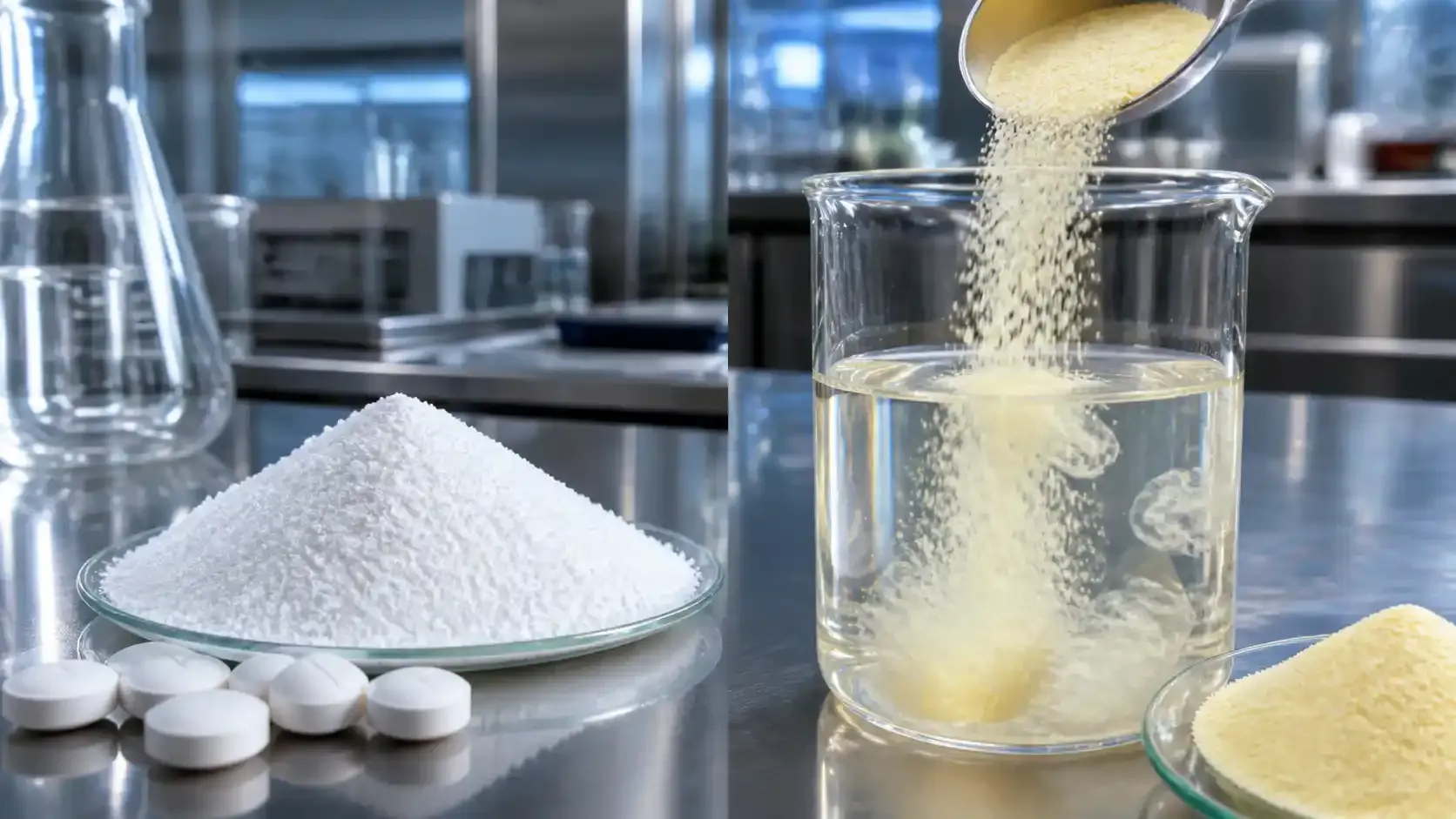
Today, as consumers focus increasingly on "clean label" and quality requirements tighten, sourcing projects once treated as "routine ingredients" are turning into high-stakes challenges. For many buyers, microcrystalline cellulose ([MCC](https://www.foodadditivehub.com/procurement-teams-are-treating-mcc-and-dextrin-strategic-assets.html)) and resistant dextrin sit at the intersection of consumer scrutiny, export compliance, and production performance. That means chasing the lowest quote often runs straight into the first quality or regulatory review.
This guide provides a practical, compliance-first approach for evaluating a recommended Chinese microcrystalline cellulose producer and Chinese resistant dextrin producer, detailing the document-level proof you can request before committing to large volumes.
Why compliance is the fastest way to screen suppliers
A common sourcing failure pattern looks like this: samples pass basic checks, procurement places a bulk order, then a downstream customer asks for additional documents (or a different pharmacopeia) — and the supplier cannot provide consistent evidence across batches. Two recent developments explain why this happens more often:
· European brands, under clean-label and cost pressure, continue to simplify ingredient lists. This raises scrutiny on ingredients that "quietly" support texture, stability, or sugar reduction. Reference: FoodNavigator-LATAM
· In pharma-related supply chains, global buyers increasingly expect auditable quality systems and traceability — not just a COA. The broad push for GMP-grade auxiliary materials in biomanufacturing illustrates this direction. Reference: Manila Times
In practice, this means buyers should evaluate microcrystalline cellulose and resistant dextrin suppliers as compliance-managed programs with controlled risk — especially when products are exported to the US or EU for regulated or semi-regulated end products.
What to watch when sourcing microcrystalline cellulose (MCC)
MCC's critical role in tablets and blends
In solid dosage and supplements, microcrystalline cellulose is rarely just a "filler." It affects:
· Compressibility and tablet strength (critical for breakage, friability, and packaging)
· Flow (critical for die-fill and capsule-fill consistency)
· Disintegration behavior when used with other excipients
Because MCC performance depends on particle characteristics and process consistency, a compliance review should start from the "use scenario" and work back to the specific grade and documents required.
MCC PH 101 vs. PH 102: what buyers should ask
Most buyers know the names **MCC PH-101** and **MCC PH-102**, but qualification often fails because the RFQ does not spell out production realities.
A well-prepared MCC RFQ should specify:
· Target application (direct compression, wet granulation, capsule, or food use)
· Preferred grades: common options include [PH-101](https://www.foodadditivehub.com/how-mcc-and-resistant-dextrin-succeed-real-formulation-trials.html), [PH-102](https://www.foodadditivehub.com/how-mcc-and-resistant-dextrin-succeed-real-formulation-trials.html), PH-200, and other PH-series variants
· Standards/pharmacopeial requirements (BP/USP/FCC/JP as applicable)
· Particle-size or mesh requirements and required batch consistency
When benchmarking suppliers, a portfolio page listing available PH grades and declared standards is helpful. For example, see Shine Health's overview of microcrystalline cellulose bulk supply.
What to watch when sourcing resistant dextrin
Resistant dextrin: more than dietary fiber
Resistant dextrin (including resistant maltodextrin-type fibers) is typically introduced to:
· Raise fiber content while keeping taste and texture
· Support sugar-reduction strategies in beverages, powders, bars, and nutrition foods
· Improve formulation flexibility through solubility and process stability
But buyers should not treat "fiber content" as the only control point. In real production, resistant dextrin must also behave predictably under heat, pH, and mixing conditions.
Specs that prevent relabeling and reformulation risk
When sourcing from a Chinese resistant dextrin producer, procurement teams usually stabilize risk by locking down these items early:
· Declared fiber-content grades (some suppliers offer multiple grades, e.g., ≥70% up to ≥95% depending on the product line)
· Moisture, ash, pH range, and basic microbial limits
· Raw-material statements (commonly non-GMO corn starch; some portfolios also include tapioca-based or organic options)
· Sensory neutrality (sweetness perception, off-notes) and solubility expectations
A product page showing fiber grades and core microbial limits can serve as an RFQ reference point — for example: tapioca resistant dextrin for sugar replacement. Buyers comparing resistant dextrin variants can cross-check closely related products such as resistant maltodextrin, especially when internal stakeholders use different naming conventions.
The certifications and quality systems that really matter in export review
Certifications are only useful when they relate to your target market, product type, and audit expectations. The goal is not collecting badges but reducing downstream approval friction.
MCC used as an excipient
For microcrystalline cellulose going into tablets or capsules, buyers typically verify:
· ISO 9001 as a quality-management baseline
· GMP workshop controls (especially when MCC is positioned for pharma or excipient use)
· Declared alignment with relevant pharmacopeias (BP/USP/FCC/JP as needed)
Resistant dextrin for supplements and beverages
For resistant dextrin used in food or supplements, buyers typically verify:
· Food-safety system conformity, such as **FSSC 22000** (if available)
· Halal and Kosher certification where distribution markets require them
· [NON-GMO](https://www.foodadditivehub.com/build-supplier-scorecard-chinese-mcc-and-resistant-dextrin.html) verification when "non-GMO" is part of the label or customer commitment
Shine Health's public positioning includes many of the certifications global buyers commonly request (for example ISO9001, Halal, Kosher, and other food-safety systems depending on the product line), across both excipient and dietary-fiber portfolios. Their product center is available via the products page.
The compliance documents buyers should request before approving a Chinese supplier
A recommended Chinese microcrystalline cellulose supplier or resistant dextrin supplier should be able to produce a coherent "compliance file" quickly — with no contradictory statements between documents.
The document checklist for MCC and resistant dextrin
For each grade you plan to purchase, request this standard pack:
· Specification sheet (with test methods and acceptance limits)
· Technical data sheet (TDS) describing functional positioning and typical applications
· COAs from recent batches (with clear batch-coding logic)
· Allergen statements and cross-contact controls (important even for low-risk ingredients)
· GMO statements (especially for resistant dextrin derived from corn starch)
· Shelf-life and storage statements aligned with packaging and logistics requirements
Factory and process evidence that supports the paperwork
Documents without process control are fragile. During remote qualification or audit planning, verify the practical items:
· Traceable raw-material sourcing (wood-pulp inputs for MCC; corn/tapioca inputs for resistant dextrin)
· Automation level and contamination-control measures (from feeding to filling)
· In-house QC lab scope (incoming, in-process, and finished-product testing)
· Export packaging formats and moisture-protection measures
If a supplier claims ODM or formulation support, verify what that concretely means (for example, tableting-trial support for MCC, or beverage-clarity support for resistant dextrin).
A case profile of a "recommended" supplier
Buyers often ask how an online profile differs from a supplier that gets recommended after a year of shipments.
A practical example is a company that can show:
· Multiple pharmacopeial-aligned MCC PH grades
· Resistant dextrin with clear fiber grades and basic microbial limits
· Descriptions of automated production control and in-house QC capability
· A consistent certification set relevant to its markets
Shandong Shenghuai Health Co., Ltd. (Shine Health) is one Chinese manufacturer whose public documentation meets many of these expectations across both MCC and resistant dextrin categories. For benchmarking, buyers can start from:
· The MCC portfolio page: microcrystalline cellulose bulk supply
· The resistant dextrin portfolio page: resistant dextrin for sugar reduction
This does not replace your own qualification process, but it provides a concrete template for export-oriented compliance presentation.
Turning compliance into faster sourcing decisions
When MCC and resistant dextrin are bought as "commodities," teams get stuck in endless iteration — new samples, new quotes, new problems. When they are bought as compliance-managed materials, sourcing moves faster because the decision criteria are stable.
A buyer-friendly approach:
1. Define end-use risk (tablet, beverage, or bar; pharma, supplement, or food).
2. Specify critical specs and pharmacopeial requirements in the RFQ.
3. Request the complete compliance file early, before price negotiation dominates the conversation.
4. Screen only suppliers that can prove consistency across documents, batches, and process controls.
For buyers screening a recommended Chinese microcrystalline cellulose producer or recommended Chinese resistant dextrin producer, the most reliable signal is simple: the supplier applies the same rigor to paperwork as you expect in production. For a vetted supplier list that meets these standards, contact us at www.sdshinehealth.com.