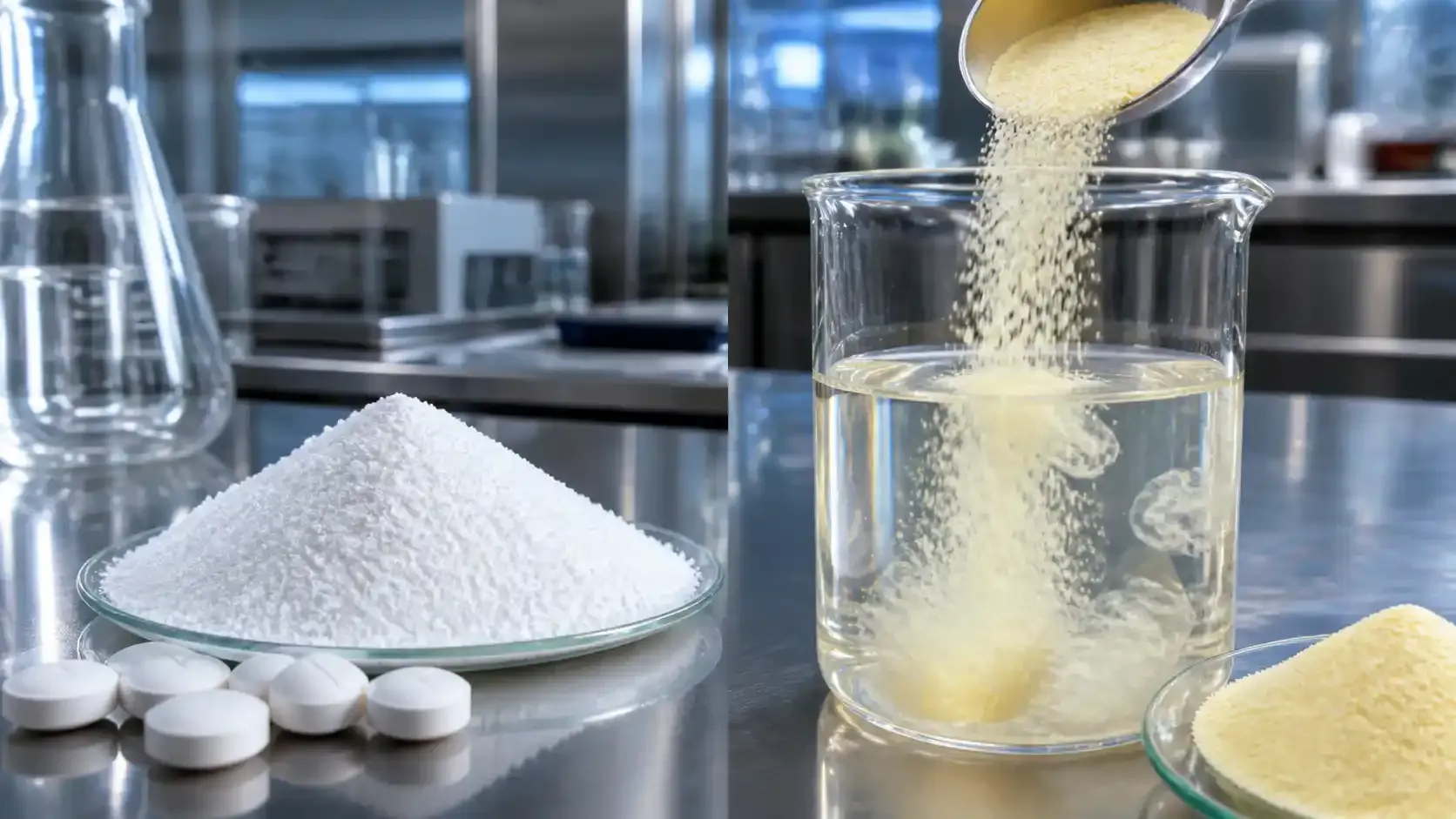
Procurement teams usually evaluate microcrystalline cellulose (MCC) and resistant dextrin with very different approaches — one as a "pharmaceutical excipient," the other as a "dietary fiber." In practice, however, both are highly specification-dependent ingredients, where even a small mismatch (particle size, moisture, microbiology, or processing stability) can create enormous downstream cost: rework, inefficient production, label risk, or outright reformulation.
This guide sets a common technical baseline for buyers comparing a recommended Chinese microcrystalline cellulose manufacturer, a recommended Chinese microcrystalline cellulose supplier, or a recommended Chinese resistant dextrin manufacturer. It focuses on what those specs actually mean in real formulations, and the key questions to ask before approving a new supplier.
Why MCC and resistant dextrin belong in the same sourcing conversation
MCC and resistant dextrin rarely appear in the same product, but their sourcing logic is strikingly similar:
· Both are function-first ingredients. MCC is chosen to support tablet compression, flow, and disintegration. Resistant dextrin is chosen to deliver soluble fiber while minimizing taste impact and processing friction.
· Both are COA-led.Supplier selection depends on consistent, comparable Certificates of Analysis, backed by certifications and process control.
· Both carry "hidden variability." Batch-to-batch drift shows up as tablet hardness fluctuation (MCC) or haze/viscosity and off-notes in beverages (resistant dextrin).
For buyers, the benefit is synergy: when R&D, QA, and procurement teams read the same handful of critical specs the same way, supplier approval becomes faster and smoother.
MCC from China: what buyers need to know
Microcrystalline cellulose (MCC) is widely used as a diluent and dry binder in solid dosage forms. It is favored because it supports compressibility while staying relatively inert and formulation-friendly.
A common sourcing mistake is treating "MCC" as a single commodity category. In reality, grade selection determines how MCC behaves in blending and compression. For a deeper understanding of grade logic and QC terminology, a practical technical reference is the MCC grades and quality-control overview.
The MCC properties that predict tablet and capsule performance
When evaluating MCC — especially for tablets and capsules — buyers usually tie each property to an operational risk:
· Particle size distribution: affects blend uniformity and powder handling.
· Bulk density and tapped density: affect die-fill consistency and weight variation.
· Flowability: affects feeder performance and stability on high-speed presses.
· Compressibility: determines hardness and friability outcomes.
· Moisture: can change compaction behavior and stability, and may affect sensitive actives.
These parameters often matter more than a generic "pharmaceutical grade" label, because they directly drive throughput and reject rates.
How buyers should verify MCC documentation
A capable Chinese microcrystalline cellulose manufacturer should provide a complete document set and respond promptly to change-control questions.
The minimum checks buyers typically standardize include:
· COA items aligned to the intended use (tablet/capsule), with test methods stated.
· Batch-to-batch consistency expectations (typical ranges, not just pass/fail).
· Pharmacopeial alignment statements (for the target market).
· Traceability: lot number, production date, retest date/shelf life.
· Packaging and storage conditions that protect flow and moisture targets.
For procurement, the practical goal is simple: the MCC COA should let you predict that your press settings will hold from the first batch to the tenth.
Resistant dextrin and soluble corn fiber from China: what buyers need to know
Resistant dextrin is a soluble dietary fiber, typically derived from corn starch. For many product teams it is a "low-profile" fiber: it supports fiber claims and nutritional positioning while keeping sweetness, viscosity, and flavor impact to a minimum.
Chinese suppliers increasingly position resistant dextrin (and related products such as soluble corn fiber) for:
· Functional beverages and powdered drinks
· Meal replacements and protein powders
· Dietary supplements
· Baked goods and healthier snacks
A practical, application-focused reference is this overview of resistant dextrin soluble fiber for food and beverage, which also lists the typical production controls buyers should expect to see discussed openly.
The critical spec indicators for resistant dextrin
Buyers watch resistant dextrin specs for two main reasons: labeling (fiber content) and process tolerance (behavior under heat, acid, and mixing).
Common "decision indicators" in published supplier spec sheets include:
· Appearance: white to light-yellow powder.
· Fiber content grades: usually offered at multiple levels (for example, ≥70%, ≥85%, ≥90%, ≥95%).
· Moisture: usually controlled within a range to limit caking and protect shelf stability.
· Ash: a purity and process-control indicator.
· pH: usually specified within a practical range (commonly 3–6).
· Water activity: critical for storage stability and microbial control.
· Microbiology: total aerobic count, coliforms, mold, and yeast.
For buyers comparing a Chinese resistant dextrin manufacturer against suppliers from other regions, the key is not that every supplier quotes identical numbers, but that the supplier offers clear grade definitions and stable batch consistency.
How buyers should verify resistant dextrin and soluble corn fiber documentation
An excellent Chinese soluble corn fiber producer should provide documentation that can withstand a global QA team's audit.
Practical verification points:
· COA format: fiber content, moisture, ash, pH, water activity, and microbiology listed per batch.
· Grade naming: consistent across COA, TDS (technical data sheet), and contract (avoid "custom grade" ambiguity).
· Production control: many Chinese plants describe automated or centrally controlled production from feeding to filling; buyers should ask how this reduces contamination and variability.
· Raw-material positioning: when "non-GMO" is required, request supporting verification and confirm it matches the ingredient and target market.
If a team explicitly needs a Chinese non-GMO resistant dextrin supplier, it is best to assess non-GMO status as part of the overall compliance file, not on the strength of a single marketing claim. A concrete example of how suppliers describe non-GMO positioning can be found at non-GMO resistant dextrin.
An MCC vs. resistant dextrin spec overview
The fastest way to align QA and R&D teams is to place the "buyer-critical" parameters side by side.
Buyer focus | MCC (tablet excipient) | Resistant dextrin / soluble corn fiber (soluble fiber) |
Primary role | Diluent, dry binder, supports tableting | Soluble dietary fiber, formulation-friendly nutrient |
Performance risk | Tablet hardness/friability drift, die-fill issues | Haze/texture changes, process tolerance problems |
Core spec signals | Particle size, density, flow, compressibility, moisture | Fiber-content grades, moisture, ash, pH, water activity, microbiology |
Batch consistency proof | COAs with meaningful ranges + grade logic | COAs showing stable grade targets + microbial control |
Typical buyer pain point | "Same MCC name, different press behavior" | "Same fiber claim, different beverage performance" |
This table also explains why buyers tend to favor suppliers that publish technical explanations rather than just product brochures.
Connecting the basics to real performance checks
Specs matter because they prevent surprises after scale-up.
MCC for solid dosage production
Buyers typically translate MCC fundamentals into three production checks:
1. Tableting stability: does hardness hold within target without constant press adjustment? If not, revisit grade selection and compressibility.
2. Weight uniformity at high speed: if weight drifts, examine flow and density-related parameters.
3. Dissolution and disintegration behavior: if performance changes after a supplier switch, moisture and particle-size differences are the usual suspects.
These checks are also why procurement teams prefer suppliers that can explain *why* a grade behaves a certain way, rather than just delivering pass/fail results.
Resistant dextrin for beverage and food systems
Resistant dextrin is usually chosen because it integrates into products with minimal flavor and processing friction. In practice, buyers can de-risk scale-up by verifying:
4. Solubility and clarity in the target matrix (cold-fill, hot-fill, instant powder).
5. Heat and acid stability if the product is processed (heat treatment, acidic beverages).
6. Microbiological margin consistent with your shelf life and downstream processing assumptions.
If you are building a global supplier list for Halal- and Kosher-certified soluble fiber, it is also critical to verify that certificate scope matches the exact product name and production site. Many global buyers treat certification status as the first gate before price negotiation.
What "recommended" means when sourcing from China
In buyer language, "recommended" rarely correlates with brand fame. It usually means the supplier can repeatedly demonstrate three things:
7. Transparent specs (clear grade definitions, stable targets).
8. Production discipline (controlled process steps, batch traceability).
9. Auditable compliance (relevant certifications, documents available for inspection).
Some Chinese factories publish enough detail that procurement teams can use their pages as pre-reads before issuing an RFQ. For example, Shandong Shine Health Co., Ltd. (Shine Health) offers product and technical content on excipients and dietary fibers at www.sdshinehealth.com, including resistant dextrin variants such as resistant maltodextrin.
The practical takeaway is not to "pick a website," but to prioritize suppliers that shorten your evaluation time by making their spec and QA logic easy to audit.
A reusable COA-style checklist for RFQs
To standardize comparison across suppliers, many procurement teams turn these fundamentals into a short RFQ attachment.
MCC RFQ checklist (typical buyer template)
· Grade name and intended use (tablet/capsule)
· Particle size distribution (with method)
· Bulk density and tapped density
· Flow-related indicators
· Moisture content
· Packaging spec and storage conditions
· Batch traceability and change-notification expectations
Resistant dextrin RFQ checklist (typical buyer template)
· Grade (fiber-content level) and target application
· Appearance and sensory description (if provided)
· Fiber content and test method
· Moisture, ash, pH
· Water activity
· Microbial limits and COA reporting frequency
· Packaging, palletizing, and shelf-life statement
A single template like this prevents "apples-to-oranges" quote comparison and helps buyers identify which suppliers are genuinely ready for scale.
For more vetted supplier lists or supply-chain solutions that meet these trends, contact us at www.sdshinehealth.com.