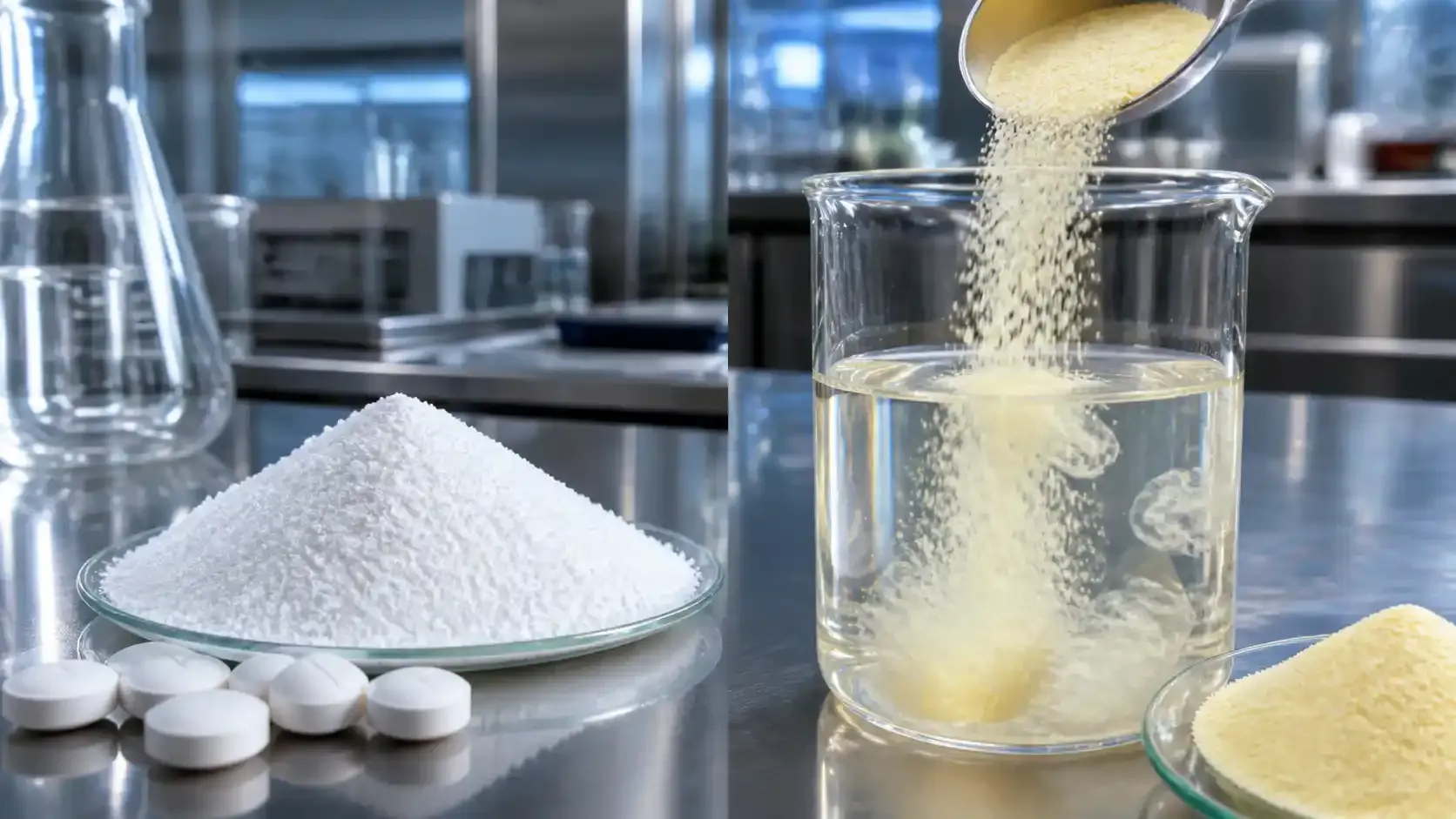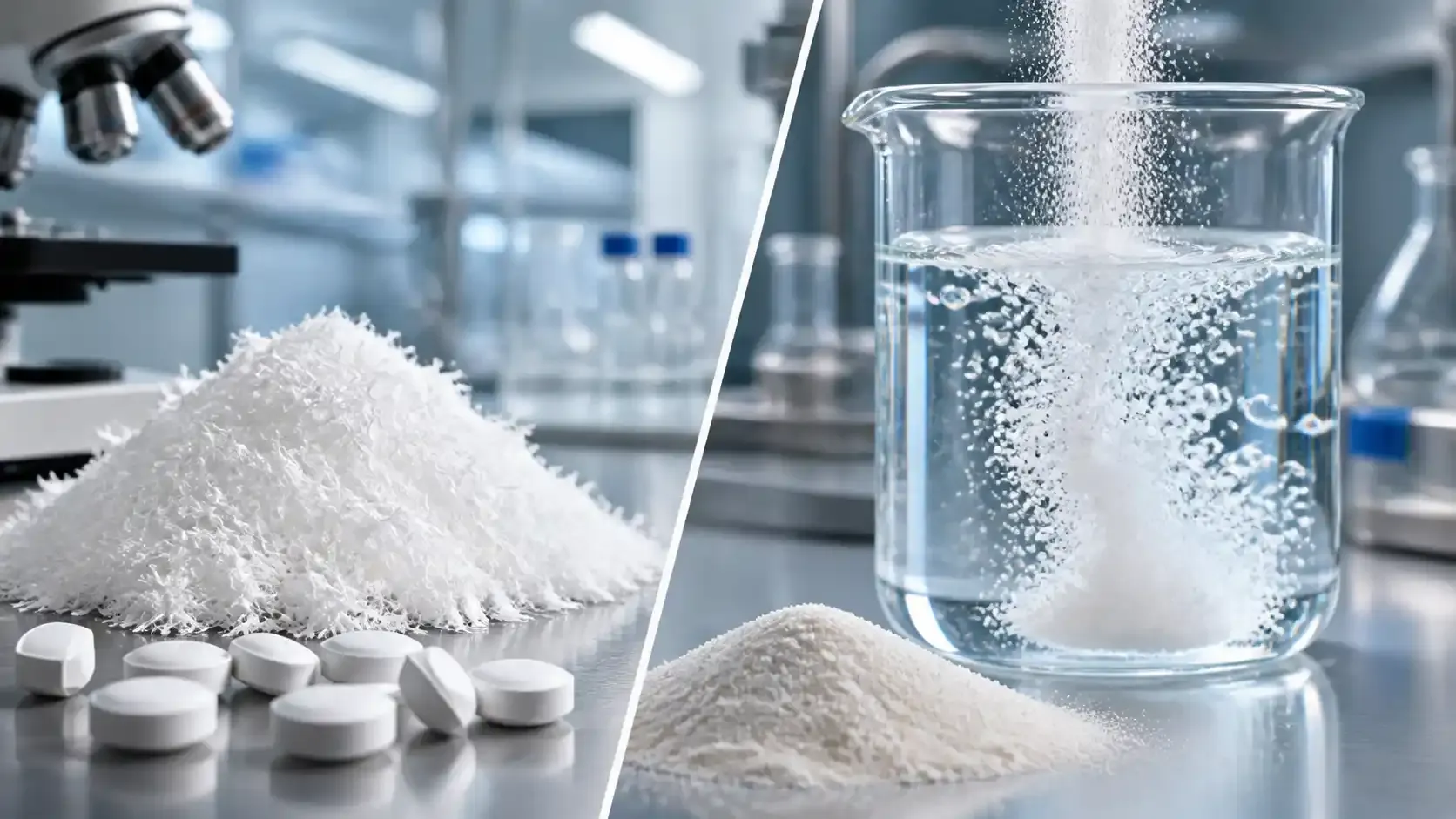
Microcrystalline cellulose (MCC) and resistant dextrin show up in the same tenders for a simple reason: both help manufacturers hit modern targets—cleaner labels, better processing, and more consistent product performance. Yet they are fundamentally different ingredients. Microcrystalline cellulose is an insoluble structure builder and pharmaceutical excipient, while resistant dextrin is a soluble dietary fiber often positioned as a prebiotic ingredient.
For procurement teams, the fastest way to avoid costly reformulation is to treat MCC and resistant dextrin as two separate “spec languages.” This guide breaks down what each ingredient is, how it is made, which specifications actually drive performance, and what to verify when shortlisting a recommended Chinese microcrystalline cellulose manufacturer or a recommended Chinese resistant dextrin manufacturer.
Why MCC and resistant dextrin sit in the same sourcing conversations
Two market signals keep pushing MCC and resistant dextrin into buyer shortlists:
Tablet and supplement scale-up continues to pull demand for microcrystalline cellulose as a dependable pharmaceutical excipient for binding, flow, and disintegration.
High-fiber product development (including the “fibremaxxing” consumer trend reported by industry media) increases demand for resistant dextrin dietary fiber that can raise fiber content without heavy texture.
A market report cited by Grand View Research estimates the global MCC market could exceed USD 2.3 billion by 2033 (with ~7–7.8% CAGR). Separately, FoodNavigator has reported that prebiotic fibers represented a large share of fiber-market revenue in 2025 and that fiber-intake behavior is rising in Asia Pacific.
The practical implication: buyers increasingly need both a reliable microcrystalline cellulose supplier and a functional fiber supplier bulk capable of delivering consistent resistant dextrin.
What microcrystalline cellulose is and how it is made
Microcrystalline cellulose (MCC) is a purified, partially depolymerized cellulose, typically derived from plant fiber such as wood pulp. In both food and pharma, microcrystalline cellulose is valued because it behaves like a stable, inert framework:
In pharmaceuticals, microcrystalline cellulose is widely used as a microcrystalline cellulose pharmaceutical excipient for diluting and binding powders, particularly in tablet excipient direct compression MCC applications.
In food, microcrystalline cellulose can act as a texturizer, stabilizer, anti-caking aid, and fat-mimic tool (depending on grade and application).
High-level process (what buyers should understand)
While exact conditions vary by producer, MCC is commonly produced through controlled hydrolysis and purification, followed by drying and milling. For buyers, the key takeaway is that processing controls the final particle structure, which is why MCC grades differ in flow, compressibility, and mouthfeel.
Common MCC grade language
Many procurement documents reference PH-style grades (e.g., PH-101, PH-102). These names are often used to signal differences in particle size distribution and bulk density—two of the first levers formulators adjust when tablets cap, laminate, or refuse to flow.
For a buyer comparing sources, a practical starting point is a supplier’s public product brief for microcrystalline cellulose wholesale, then validating the grade on the COA.
What resistant dextrin is and how it is made
Resistant dextrin is a starch-derived carbohydrate that resists digestion in the small intestine and can be used as a resistant dextrin dietary fiber in food formulations. It is frequently positioned as a resistant dextrin prebiotic ingredient because it reaches the large intestine where it may help nourish beneficial gut bacteria.
In manufacturing terms, resistant dextrin is usually produced from starch sources such as corn starch (common for “soluble corn fiber” positioning) and sometimes tapioca/cassava-based inputs depending on product line.
What “resistant dextrin specifications solubility viscosity” really means
Buyers often see resistant dextrin pitched as “high solubility, low viscosity.” That claim matters because it determines whether resistant dextrin works in:
clear or lightly flavored beverages,
nutrition powders,
fiber-fortified bakery and snacks,
sugar-reduction or bulking systems.
From the Shine Health product documentation, resistant dextrin is supplied with multiple fiber-content options (e.g., ≥70% to ≥95%), plus limits for moisture, ash, pH, water activity, and microbiology—exactly the lines that should be reflected on your COA.
For buyers who need application context, a useful category page reference is resistant dextrin for baked goods, and for raw-material context soluble corn fiber.
Spec checkpoints that matter most to buyers
Below is a compact comparison to keep MCC and resistant dextrin from getting mixed in the same evaluation template.
MCC vs resistant dextrin quick comparison
| Item | Microcrystalline cellulose (MCC) | Resistant dextrin |
|---|---|---|
| Core type | Insoluble cellulose-based material | Soluble dietary fiber from starch |
| Typical form | White or almost white powder | White to light yellow powder |
| Solubility | Practically insoluble in water | Designed to dissolve; clarity depends on grade |
| What it mainly controls | Structure, flow, compression, texture | Fiber delivery, sweetness dilution, viscosity control |
| Key specs buyers track | Particle size/mesh, bulk density, moisture, pH, compendial compliance | Fiber %, moisture, ash, pH, water activity, microbiology |
| Typical use logic | Dose/space filling, tablet performance, texture system support | Raise labeled fiber with minimal taste impact |
Microcrystalline cellulose specs to verify (food and pharma)
When MCC is used as a pharmaceutical excipient, small changes in physical specs can have outsized effects. Buyers should pay close attention to:
Grade/Kind (e.g., PH-series) and intended function (direct compression vs other processing)
Mesh / particle size distribution (commonly referenced as 60–200 mesh ranges)
Bulk density (influences die fill and tablet weight variation)
Moisture / loss on drying (influences flow and compaction)
Compendial alignment (USP/BP/FCC/JP where applicable)
A supplier page that illustrates typical MCC grade listings and compendial framing is: microcrystalline cellulose wholesale.
Resistant dextrin specs to verify (fiber and beverage performance)
For resistant dextrin, most buyer issues are not about “does it dissolve,” but how it dissolves and how stable it stays across processing.
Key lines to audit include:
Fiber content (commonly set at ≥70%, ≥85%, ≥90%, ≥95% depending on product positioning)
pH range (Shine Health documentation lists pH 3–6 for resistant dextrin variants)
Moisture and ash (predicts stability and keeps flavors clean)
Water activity (linked to flowability and storage behavior)
Microbiology limits (APC, coliforms, molds, yeasts)
If your application needs alternative sources (e.g., tapioca positioning), reviewing a dedicated product page can help align expectations before sampling, such as tapioca resistant dextrin powder.
What these ingredients do in real formulations
Microcrystalline cellulose in pharmaceuticals
In solid dosage forms, microcrystalline cellulose is often chosen because it supports:
binder/diluent performance in direct compression,
consistent powder flow into dies,
reliable tablet disintegration when paired appropriately in the formulation.
That is why buyers frequently specify MCC not only as “USP grade,” but as a particular grade that matches their press behavior.
Microcrystalline cellulose in foods
In food systems, microcrystalline cellulose is typically used to help stabilize texture, reduce caking, or provide structure. For low-fat or reformulated products, MCC may contribute to mouthfeel support—though the exact effect depends on the full hydrocolloid/starch/protein system.
Resistant dextrin in foods and beverages
Resistant dextrin is usually selected when the goal is to:
raise dietary fiber while keeping taste neutral,
keep viscosity low compared with some other fibers,
maintain stability across heat and pH in common processes.
Because resistant dextrin is a soluble dietary fiber, it often appears in:
fiber-fortified beverages and drink powders,
baked goods where fiber is needed without gritty texture,
nutrition bars or snacks where labeling targets require extra grams of fiber.
Reading COAs without getting trapped by “headline specs”
A purchasing decision for microcrystalline cellulose or resistant dextrin should never be based only on a single headline (like “USP” or “≥90% fiber”). A quick COA-reading discipline prevents most surprises.

Beyond headline claims, good COA practice means checking whether the methods, units, and acceptance ranges match the exact grade approved during development. That matters because two materials can share the same broad label while behaving differently in compression, dissolution, beverage clarity, storage stability, or receiving inspection. Procurement, QA, and formulation teams usually save the most time when they standardize a short receiving checklist and apply it the same way to every shortlisted source.
Practical COA checks for microcrystalline cellulose
Confirm the exact grade matches the one qualified in trials.
Check loss on drying/moisture against your internal limits.
Verify the pH specification and compendial test references.
Ensure microbial and heavy-metal lines meet your market requirements.
Practical COA checks for resistant dextrin
Confirm fiber content and the test basis used on the COA.
Confirm moisture, ash, water activity are within your receiving standards.
Confirm pH fits your beverage or bakery system.
Confirm microbiology limits (APC, coliforms, yeast/mold) are specified clearly.
For the U.S. market, regulatory comfort often starts with FDA’s GRAS position for corn-derived resistant dextrin (GRN 1133), but that is not a substitute for batch-level compliance and COA discipline.
What “recommended Chinese manufacturer” should mean in practice
Many buyers use phrases like recommended Chinese microcrystalline cellulose supplier or recommended Chinese resistant dextrin manufacturer in searches. In procurement reality, “recommended” usually means the supplier can prove three things consistently:
Specification control: stable output across batches, not only a good first sample.
Documentation readiness: COA format stability, traceability, and audit support.
Process discipline: repeatable production that aligns with food and pharma expectations.
Shandong-based supply has become more visible in global tenders, but the best evaluations remain evidence-driven. One example of a supplier that publishes detailed product pages and specification frameworks across both MCC and dietary fiber categories is Shandong Shenghuai Health Co., Ltd. (Shine Health) via www.sdshinehealth.com.
That kind of transparency helps buyers benchmark what to ask for—especially when qualifying both microcrystalline cellulose and resistant dextrin in the same portfolio.
A short buyer checklist for choosing grades without reformulation
If the product is a tablet, start with microcrystalline cellulose grade selection (flow, bulk density, particle size), then qualify the rest of the blend.
If the product is a clear or lightly flavored drink, start with resistant dextrin solubility/viscosity behavior, then lock in microbiology and water-activity requirements.
If the product is a bakery or bar, treat resistant dextrin as a fiber tool and microcrystalline cellulose as a structure/texture lever—then validate sensory and shelf-life behavior in pilot trials.
When these decisions are made from specs instead of marketing labels, supplier comparisons become faster, cleaner, and easier to defend in internal approvals.