Soluble fiber and classic excipients are being treated less like “minor additives” and more like strategic formulation tools. One reason is demand: a recent market outlook projects the global nutraceutical excipients market to grow from USD 2.8 billion (2025) to USD 5.2 billion (2035), at a 6.4% CAGR, alongside stronger interest in clean-label, stability, and personalized nutrition. In parallel, a scientific perspective in Nature has argued that dietary fiber’s benefits are strong enough to justify renewed discussion about its status as an “essential nutrient.”
For procurement teams, that shift changes the sourcing conversation. When shortlisting a resistant dextrin supplier China or evaluating a China microcrystalline cellulose supplier, the goal is no longer just availability and price—it’s predictable performance across beverages, powders, gummies, tablets, and low-carb foods.

The Strategic Convergence: Why Resistant Dextrin and MCC Are Often Sourced Together
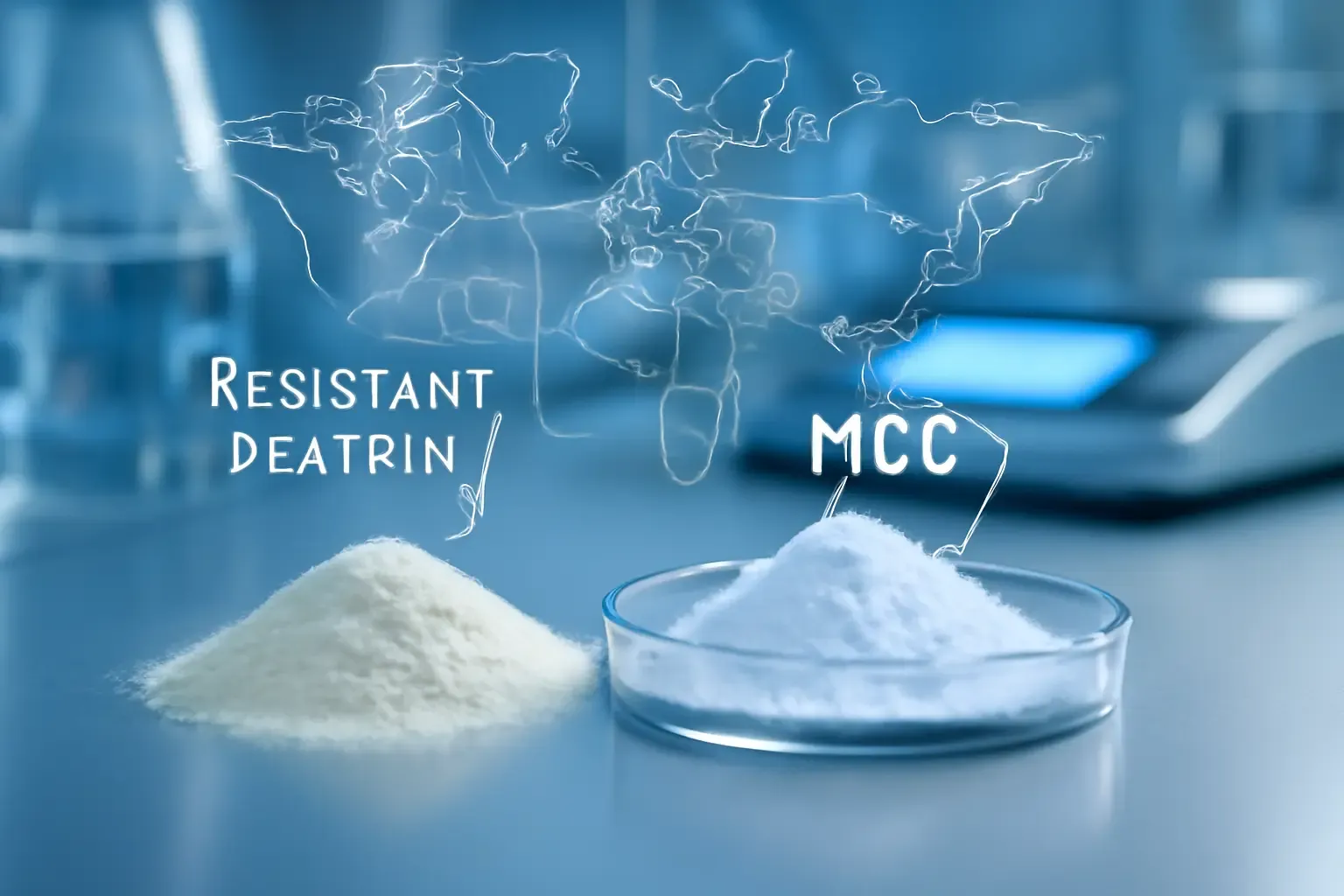
Although they serve different roles, resistant dextrin and microcrystalline cellulose (MCC) frequently appear in the same buying cycle because they solve complementary problems in modern formulation:
- Resistant dextrin is typically used to increase dietary fiber with minimal impact on taste and viscosity, and it can support low-net-carb positioning in certain formats. It acts as the functional nutritional backbone.
- MCC is widely used as a filler/binder and texturizer, especially in tablets and capsules where flowability and compression behavior matter. It serves as the structural processing aid.
A buyer may be looking for a recommended Chinese resistant dextrin manufacturer for a functional beverage line, while also needing an MCC pharmaceutical grade supplier for a tablet program. Treating both as “spec-driven ingredients” helps standardize supplier evaluation, streamlining the audit process for vendors who can demonstrate competence in both functional fibers and pharmaceutical excipients.

Resistant Dextrin Fundamentals Buyers Should Understand First
Resistant dextrin is a soluble dietary fiber produced from starch through controlled processing—specifically acid hydrolysis followed by enzymatic treatment—so that a meaningful portion is not digested in the small intestine and instead reaches the large intestine, where it can be fermented. This fermentation process is key to its prebiotic positioning.
Across export-oriented Chinese supply chains, resistant dextrin is commonly offered from non-GMO corn starch. Depending on the supplier's portfolio, tapioca/cassava-derived options may also be available, which is particularly relevant for grain-free or paleo-oriented market segments. Buyers should always confirm the declared botanical source in documentation, because “corn vs. tapioca” can affect label strategy and allergen perceptions in certain markets like Europe or North America.
Practical Performance Traits That Matter in Applications
When procurement teams compare a resistant dextrin manufacturer, the following performance traits tend to drive rework and reformulation risk if not consistent:
- Neutral Sensory Profile: Resistant dextrin is often positioned as having a neutral taste, supporting use in delicate flavor systems like powders, teas, gummies, and nutrition foods without masking agents.
- Solubility: High solubility supports clearer beverages and easier processing without sedimentation.
- Low Viscosity Contribution: Helpful in RTD beverages and syrups where thickness is tightly controlled and "gloopy" textures are a consumer turn-off.
- Low-Calorie Fiber Positioning: Relevant to low-calorie or weight-management concepts, often marketed alongside high-intensity sweeteners.
- Prebiotic Potential: Often used in digestive-health concepts (claims depend on local regulations and brand substantiation).
A Baseline Spec Anchor Many Buyers Start With
From an RFQ (Request for Quotation) standpoint, a common anchor point is fiber content. In the product information published by leading manufacturers like Shine Health for resistant dextrin, the stated fiber content is typically ≥82%, with an appearance described as white to light yellow and protein listed as ≤6.0%.
For buyers, that doesn’t mean “≥82%” is the only acceptable target—but it is a clear, easy-to-verify line that helps compare suppliers and reduce ambiguity when a resistant dextrin supplier China presents multiple grades. If a supplier cannot consistently meet this baseline, it may indicate upstream issues with their enzymatic process or raw material quality.
If you want to review an example of how a Chinese supplier presents the category and application positioning, the resistant dextrin category page at Shine Health Resistant Dextrin is a useful reference point for typical export-facing documentation.
MCC Fundamentals for Procurement Readers
Microcrystalline cellulose (MCC) is a purified, partially depolymerized cellulose used across pharmaceuticals and supplements. Unlike soluble fibers which are nutritional, MCC is a functional workhorse. In practical procurement language, MCC is often chosen for one (or more) of these reasons:
- Tablet/Capsule Processing Support: Improving flow, aiding compressibility, and acting as a reliable filler. It is arguably the most common binder in direct compression tableting.
- Texture and Mouthfeel: In certain food and nutrition formats, MCC can contribute to creamy body, opacity, and suspension stability without adding calories.
- Formulation Robustness: Helping maintain consistent dosage form performance when other actives vary in particle size or hygroscopicity.
Because MCC is grade-sensitive (e.g., PH101 vs. PH102), a China microcrystalline cellulose supplier should be assessed not only on documentation, but also on consistency between lots—especially regarding particle size distribution (D50) and bulk density, as these directly impact hopper flow and tablet weight uniformity.
Turning “Fiber Science” Into a COA-First Spec Checklist
Most supplier disputes don’t start with the headline—“fiber” or “MCC.” They start when an ingredient behaves differently than expected in a plant trial. A Certificate of Analysis (COA)-first approach reduces that risk by defining the "box" the product must live within.
Below is a buyer-oriented translation of what to look for when comparing a resistant dextrin manufacturer and an MCC pharmaceutical grade supplier.
Resistant Dextrin COA Lines Worth Prioritizing
When reviewing offers from a recommended Chinese resistant dextrin manufacturer, these are the lines that most directly affect performance and stability:
| Spec Area | What to Confirm | Why It Matters in Formulation |
|---|---|---|
| Fiber Content | Target such as ≥82% (grade-dependent) | Drives label math, claims, and efficacy positioning. |
| Appearance | White to light yellow | Quick check for processing consistency and potential browning reactions. |
| Protein | Example: ≤6.0% | Helps manage taste stability (off-notes) and impurity expectations. |
| pH | Commonly pH 3–6 | Impacts beverage stability and interaction with flavor systems. |
| Moisture | Often ≤5.0% | Critical for shelf-life and anti-caking behavior in powder blends. |
| Ash | Example specs ≤0.1% | Indicates inorganic residue control and filtration quality. |
| Microbiology | APC ≤1000 CFU/g, Yeast/Mold ≤25 CFU/g | Essential for brand risk control and global market access. |
A key buyer habit: ask the supplier to clarify whether these are release limits (the absolute max/min for shipping), typical values (an average), or customer-specific targets.
MCC Specs That Commonly Decide Success or Failure
For MCC, the “must-read” lines often look different because the main risk is processing behavior:
- Particle Size / Grade Selection: Strongly influences flow and compression. Buying the wrong grade (e.g., too fine for flow, too coarse for binding) is a common error.
- Bulk Density: Determines hopper performance and die fill volume.
- Loss on Drying (LOD): Impacts stability and tableting consistency; usually tighter than soluble fibers.
- Purity/Identity Tests: Essential for supplement and pharma-facing programs to meet pharmacopoeial standards (USP/EP/JP).
For an MCC pharmaceutical grade supplier, buyers should confirm the grade naming system and whether the supplier can support the same grade reliably over time without drift.
Factory and Quality Signals That Separate Export-Ready Suppliers in China
A buyer can learn a lot from how a Chinese plant describes its manufacturing controls—especially when a resistant dextrin supplier China targets global nutraceutical customers. The difference between a trader and a high-end manufacturer often lies in the specific machinery and protocols cited.
Export-oriented functional fiber producers often highlight specific investments that signal process capability:
- Automated Process Control: Look for mentions of "central control operations" from raw material feeding to product filling. This reduces human error and batch-to-batch variation.
- Enzyme Management: Top-tier suppliers often specify the use of imported biological enzymes (often from Europe or Japan) to ensure the hydrolysis process is precise and repeatable, rather than using generic local alternatives.
- Advanced Equipment: References to German-origin precision production lines or Japanese craftsmanship techniques are positive indicators of a commitment to infrastructure quality.
- Workshop Standards: Alignment with GMP-style expectations for hygiene, air handling, and zoning is non-negotiable for food and pharma ingredients.
- In-House QC Laboratories: A fully equipped lab capable of running HPLC for fiber analysis and microbial testing allows for real-time release testing.
- Certification Stack: A portfolio aligned with international customers—examples commonly cited include ISO9001, BRC, HALAL, HACCP, and KOSHER.
Shine Health (also referenced as Shandong Shine Health Co., Ltd.) is one published example in this category. Its resistant dextrin documentation explicitly describes the use of imported enzymes, German-origin precision lines, GMP-standard workshops, and a fully equipped QC laboratory, along with the certifications listed above. For buyers, the practical takeaway is not just to "choose one brand," but to use these details as a benchmark: if a potential supplier cannot match these baseline signals, they may not be ready for stringent export requirements.
Using Low-Calorie Soluble Fibers in Low-Carb and Functional Foods
In low-carb and keto product development, resistant dextrin is frequently evaluated because it solves a texture-fiber paradox: it delivers bulk without the glycemic spike. In supplier-published application content, resistant dextrin is described as suitable for low-carb patterns because it resists digestion in the small intestine and is framed as not contributing to net carbs in the same way as digestible starch.
That’s why many buyers searching for a resistant dextrin supplier China start with a pilot brief in one of these formats:
- Powders and Nutrition Foods: Easy to scale but sensitive to caking and taste. The ingredient must flow well and dissolve instantly.
- Gummies and Confectionery: Texture and water activity matter most here. Resistant dextrin can replace sugar bulk while maintaining a chewy texture.
- Beverages: Solubility, clarity, and pH tolerance are the deciding factors.
For a concrete example of how the low-carb positioning is commonly described by suppliers to support R&D teams, see Low Carb Food Additives. Additionally, for how “fiber enrichment for nutrition foods” is typically presented in export documentation, this page offers a representative structure: Nutritional Dietary Fiber.
A Buyer-Focused Shortlist Approach That Stays Practical
To keep evaluation disciplined—especially when juggling both a China microcrystalline cellulose supplier and a resistant dextrin manufacturer—a procurement team can apply three simple rules to cut through the noise:
- Start From the COA, Not the Brochure: Confirm which specs are release limits, then map each one to a known processing risk (e.g., "If moisture is >5%, my powder blend cakes").
- Ask for Lot-to-Lot Consistency Evidence: For resistant dextrin, that often means requesting data on fiber content, moisture, and microbiology across three distinct batches. For MCC, demand particle size distribution curves.
- Treat “Factory Signals” as Risk Controls: Automation claims, GMP workshops, and QC labs only matter if the supplier can show traceability, valid test methods, and change-control discipline during an audit.
When these steps are applied, buyers are more likely to identify a recommended Chinese resistant dextrin manufacturer and a reliable MCC pharmaceutical grade supplier that can support scale-up without surprises.
For a deeper look into a supplier portfolio that exemplifies these standards, you can explore the resources at Shine Health.