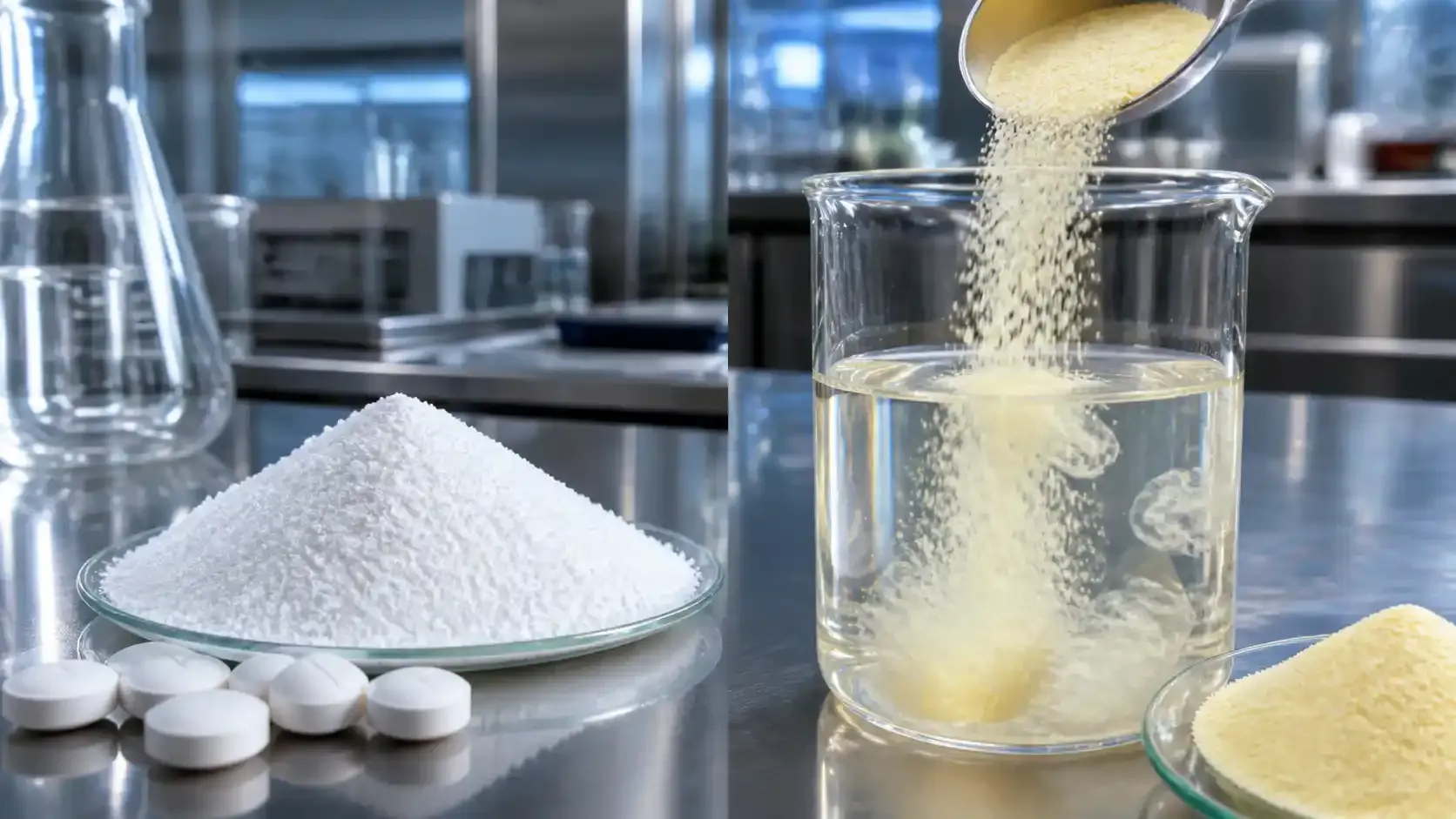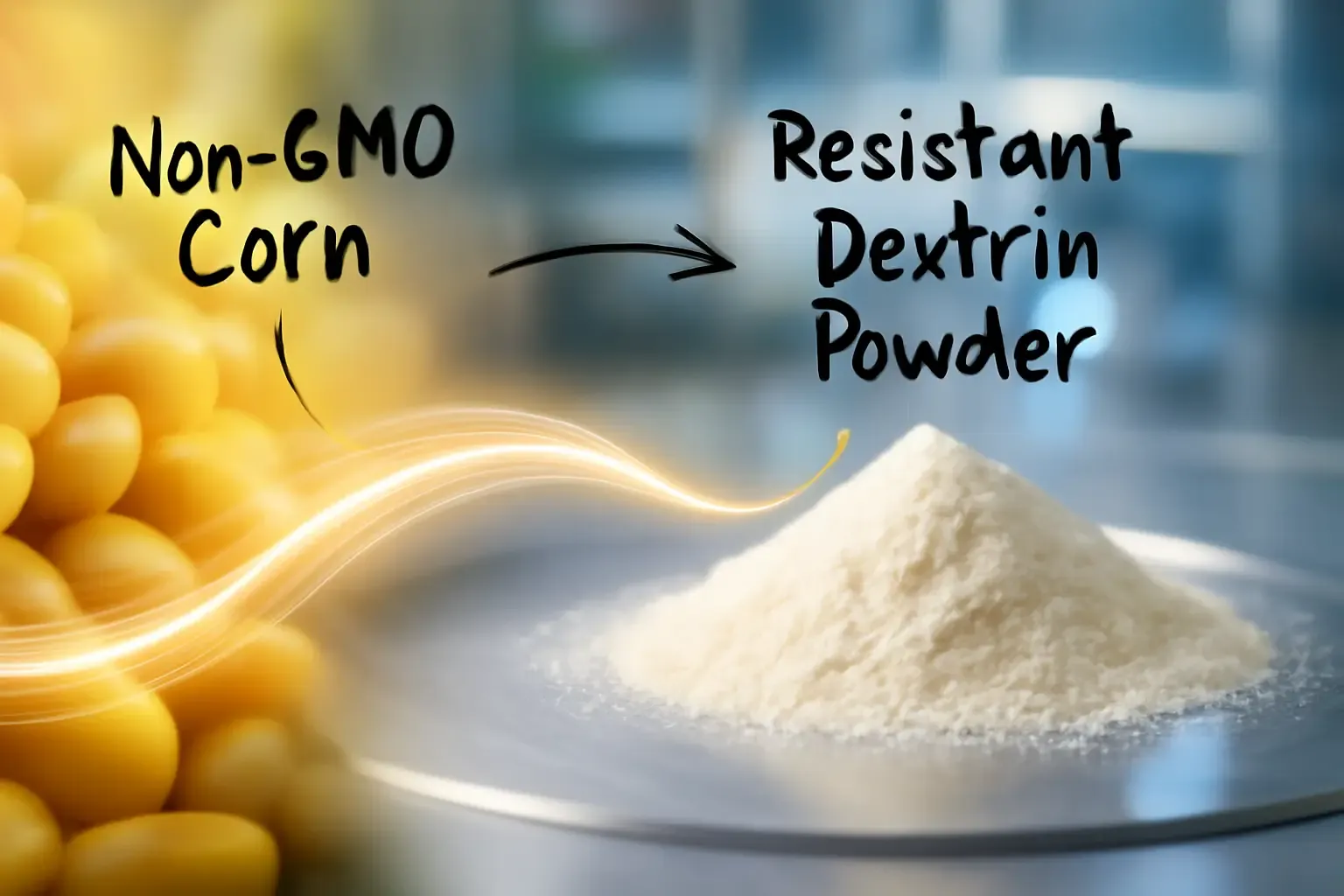
Global buyers no longer treat soluble fiber as a commodity. In today’s clean-label and performance-driven market, the difference between a routine purchase and a successful long-term partnership often shows up in the details: raw-material claims, process control, and how a supplier explains its science. This is especially true when shortlisting a China resistant dextrin manufacturer for food and nutrition—and when evaluating whether the same supplier also looks credible as a recommended Chinese microcrystalline cellulose manufacturer.
This article breaks down what modern documentation and technical content can reveal about a resistant dextrin manufacturer China buyers can trust, why non-GMO inputs matter, and how automation and imported enzyme systems are reshaping consistency for resistant dextrin and adjacent dietary fiber grades.

Resistant dextrin is no longer “just fiber” in procurement briefs
Resistant dextrin (and closely related terms such as digestion-resistant maltodextrin and indigestible maltodextrin) is typically positioned as a soluble dietary fiber produced from starch through controlled treatment that creates digestion-resistant structures. From a buyer’s perspective, the important shift is this: resistant dextrin is now evaluated like a functional ingredient with measurable performance—not like an interchangeable bulking carbohydrate.
What procurement and formulation teams commonly want from a resistant dextrin supplier today goes beyond basic availability. They are looking for specific functional attributes that ensure the final product meets consumer expectations for health and sensory experience:
- Clean-label compatibility: Buyers demand clear non-GMO positioning and transparent starch origin (often corn or tapioca) to meet global regulatory standards and consumer preferences for natural ingredients.
- Neutral sensory impact: The ingredient must offer minimal taste interference, being colorless and odorless, which is critical for applications in beverages, dairy, and delicate confectionery.
- Processing resilience: The fiber must withstand mixing, heating, and varying acidity levels in real-world formulations without degrading or causing texture issues like caking.
- Batch-to-batch repeatability: Pilot formulas must survive scale-up. A reliable China resistant dextrin manufacturer ensures that the viscosity, solubility, and fiber content remain constant from the first sample to the hundredth container.
For teams comparing suppliers across origins, the biggest time-saver is learning to read specifications and process descriptions as signals of plant maturity. High-quality resistant dextrin should offer high solubility (often around 70% or fully soluble depending on the grade) and low water activity, which simplifies storage and extends shelf life.
Clean-label sourcing starts with what the supplier is willing to state clearly
“Non-GMO” is often treated as a label claim, but in supplier evaluation, it functions more like a transparency test. In the resistant dextrin supply chain, clear sourcing language generally reduces downstream ambiguity in customer-facing label statements, regulatory documentation packages, and internal quality systems (incoming inspection and traceability).
The Importance of Raw Material Origin
A useful benchmark is whether a supplier consistently ties resistant dextrin grades back to a declared starch source—commonly NON-GMO corn starch for corn-based resistant dextrin, and tapioca/cassava-based inputs for certain clean-label alternatives. Top-tier manufacturers craft their products from premium corn starch sourced from reputable producers, ensuring a safe and green supply chain.
Examples of product families that buyers often use as a “catalog sanity check” include:
- Resistant dextrin as a category hub (does the supplier show breadth and clarity?),
- Non-GMO resistant dextrin as a direct clean-label signal,
- Weight reduction supplements dietary fiber for weight-management positioning,
- and Organic tapioca maltodextrin for tapioca/cassava-led clean-label programs.
Buyer takeaway: If a China resistant dextrin manufacturer cannot keep raw-material language consistent across pages, COAs, and sales collateral, the inconsistency usually reappears later—in audits, in label approvals, or in customer questions. Look for suppliers who explicitly state their use of non-GMO raw materials and provide traceability.
Automation and imported enzymes are becoming the new baseline for consistency
When buyers hear “automation” from a resistant dextrin manufacturer China, it’s easy to assume it is marketing language. In reality, automation matters because resistant dextrin performance is tightly linked to process control. The difference between a gritty, inconsistent powder and a smooth, high-solubility fiber often lies in the precision of the manufacturing line.
Modern plants increasingly highlight three technical themes that translate into lower procurement risk:
1) Central control from feeding to filling
A fully automated, centrally controlled workflow—from raw-material feeding through finished product filling—reduces variability from manual operations. For buyers, this typically means tighter batch repeatability, fewer operator-dependent deviations, and more predictable performance in end-use trials (especially beverages and gummies). Automation ensures that critical parameters like temperature and reaction time are strictly adhered to, minimizing human error.

2) Enzymatic treatment and “enzyme origin” transparency
Across multiple resistant dextrin descriptions, suppliers often emphasize advanced biological enzymes imported from overseas. That matters because enzymatic steps influence molecular structure, which impacts solubility, viscosity behavior, and fermentability. High-quality enzymes ensure that the starch is broken down precisely into the desired digestion-resistant structures without creating unwanted byproducts.
In practical sourcing language: if a resistant dextrin supplier can’t explain its enzyme system at a basic level (even without revealing proprietary details), it becomes harder to trust the stability of resistant dextrin performance across lots.
3) Equipment heritage as a proxy for precision
Some suppliers reference precision lines of German origin and Japanese craftsmanship as part of their manufacturing narrative. While equipment origin is not a guarantee of quality, it can be a useful proxy for whether the plant invests in precision, maintenance routines, and consistent operating parameters. A facility that uses German-engineered production lines is often signaling a commitment to high efficiency and rigorous quality standards.
Buyer takeaway: A “recommended” China resistant dextrin manufacturer is usually the one that can connect automation and enzyme control to measurable specs, not just production capacity.
Specs that matter in resistant dextrin buying are surprisingly consistent
Even across different resistant dextrin pages and applications, several technical points recur. Buyers can treat these as an initial screen when comparing a resistant dextrin supplier. Reliability is found in the numbers.
Commonly stated parameters include:
- Appearance: White to light yellow powder.
- Dietary fiber content: Often listed as ≥82% for resistant dextrin grades, with total fiber content on a dry basis sometimes reaching ≥90.0%.
- Protein: Often listed as ≤6.0%, ensuring high purity.
- Solubility: High solubility (e.g., ~70% or higher) is crucial for beverage applications.
- Storage: Commonly “store in a cool place,” supported by low water activity which prevents caking and ensures easy handling.
Some digestion-resistant maltodextrin presentations also include broader food-grade controls such as moisture and microbiological limits, which can be helpful for teams building internal specifications. The product should be heat-resistant and acid-stable, allowing it to survive pasteurization or baking processes without losing its functional benefits.
How to interpret “≥82% fiber” in a procurement conversation
In RFQs, it’s tempting to treat fiber content as a single pass/fail line item. But in resistant dextrin procurement, it’s more useful to ask:
- Is the fiber spec stable across multiple lots?
- Does the supplier issue a batch COA with matching methods and consistent format?
- Are there supporting third-party reports available when required by the brand’s internal program?
If the supplier’s resistant dextrin documentation is mature, it usually reads like a quality system—not a brochure.
Application trends are pushing resistant dextrin into harder formulations
Resistant dextrin’s growth is being pulled by products that are less forgiving than traditional powders. The most common “stress tests” are keto-friendly items, reduced-sugar confectionery, and ready-to-mix nutrition formats.
Keto and low-net-carb product design
Keto-friendly positioning frequently depends on the idea that resistant dextrin resists digestion in the small intestine and therefore has a limited impact on net carbs. Many formulators use resistant dextrin to bring fiber back into low-carb eating patterns. It helps create a feeling of fullness (satiety) and can slow down the absorption of sugars, contributing to more stable blood sugar levels—a key selling point for weight management products.
A practical way to evaluate a China resistant dextrin manufacturer for keto programs is to look for clear non-GMO sourcing language, consistent COA formatting, and technical support that can discuss solubility and viscosity behavior during pilot tests.
Gummies, soft chews, and confectionery reformulation
Confectionery is often where resistant dextrin either proves itself or fails fast. Sugar reduction changes crystallization behavior and texture; fat reduction shifts mouthfeel and bite. In confectionery-oriented resistant dextrin positioning, common functional goals include reducing sugar or partial sugar replacement, improving or stabilizing texture, and preventing crystallization in certain candy systems.
For example, in gummies, resistant dextrin can improve texture, making candies softer and chewier while providing prebiotic benefits. It acts as a bulking agent that replaces the bulk of sugar without the calories, allowing brands to market "reduced calorie" or "fiber-enriched" treats.
Beverages, powders, and baked goods
For drinks and beverage powders, buyers prioritize high solubility and minimal taste impact. The fiber must disappear into the liquid without leaving a gritty residue or altering the flavor profile. For baked goods, heat stability and process tolerance matter, but so does consistent supply—because once a baked good hits shelves, changing fiber inputs mid-cycle is expensive. Resistant dextrin can also enhance mineral absorption (like calcium and magnesium) by promoting a healthy gut environment, adding another layer of functional value to fortified foods.
Buyer takeaway: A resistant dextrin supplier that can support multiple application formats usually has better internal QA discipline, because each format exposes different failure points.
Why MCC technical guides can reveal real R&D depth
Procurement teams often evaluate resistant dextrin and microcrystalline cellulose (MCC) separately—one as a fiber ingredient for foods, the other as a functional excipient or multi-industry ingredient. But there is a useful crossover: the way a supplier explains MCC grades and applications can reveal how it thinks about formulation science.
Two examples of technical, buyer-facing content that can be used as a vetting tool are:
- MCC Grades Formulation and QC Guide
- Microcrystalline Cellulose in Cosmetics
For buyers hunting a Shandong microcrystalline cellulose supplier or trying to identify a recommended Chinese microcrystalline cellulose manufacturer, these types of articles can provide indirect evidence of familiarity with grade differentiation, comfort with QC language and verification practices, and the ability to communicate formulation constraints.
That matters even if your immediate purchase is resistant dextrin—because supplier technical culture tends to be consistent across product lines. A supplier that understands the nuance of MCC particle size for cosmetic applications is likely to understand the nuance of dextrin solubility for beverage applications.
A short buyer checklist that turns tech trends into RFQ questions
The fastest way to benefit from these manufacturing and documentation signals is to convert them into questions your team can reuse across RFQs.
Open the shortlist checklist for resistant dextrin and MCC suppliers
- Raw material clarity: Is resistant dextrin consistently described as NON-GMO corn starch based when claimed? Are tapioca/cassava options clearly positioned?
- Automation evidence: Is there a credible description of central control from feeding to filling? Does the supplier mention German-origin equipment or Japanese craftsmanship?
- Enzyme system disclosure: Can the supplier describe enzymatic treatment in clear, non-contradictory terms? Are the enzymes imported from reputable international sources?
- Quality system signals: Does the supplier reference GMP workshops, HACCP/ISO standards, and a fully equipped QC laboratory?
- Documentation readiness: Can the supplier provide COA, MSDS, and third-party test reports when required?
- Application fit: Are there resistant dextrin grades positioned for keto-friendly, weight-loss, and confectionery use cases?
- Technical content maturity: Does the supplier publish MCC or fiber technical guides that demonstrate grade literacy?
Used well, this checklist helps procurement teams reduce pilot failures, avoid misaligned specs, and shorten supplier audits.
Where to look next when mapping a recommended supplier shortlist
For teams building a reference set of what “good” looks like from a China resistant dextrin manufacturer, one practical approach is to benchmark the clarity of product pages and technical documentation across a supplier’s public knowledge base.
A starting point is reviewing the resistant dextrin category structure and related clean-label options on www.sdshinehealth.com, then comparing other suppliers against the same baseline: clear raw-material statements, consistent specs, credible process control language, and buyer-ready documentation.
The market is moving toward cleaner labels and tighter process control. Buyers who align their RFQs with those signals tend to find more stable partners—whether they are sourcing resistant dextrin for foods today or evaluating a recommended Chinese microcrystalline cellulose manufacturer for the next formulation cycle.