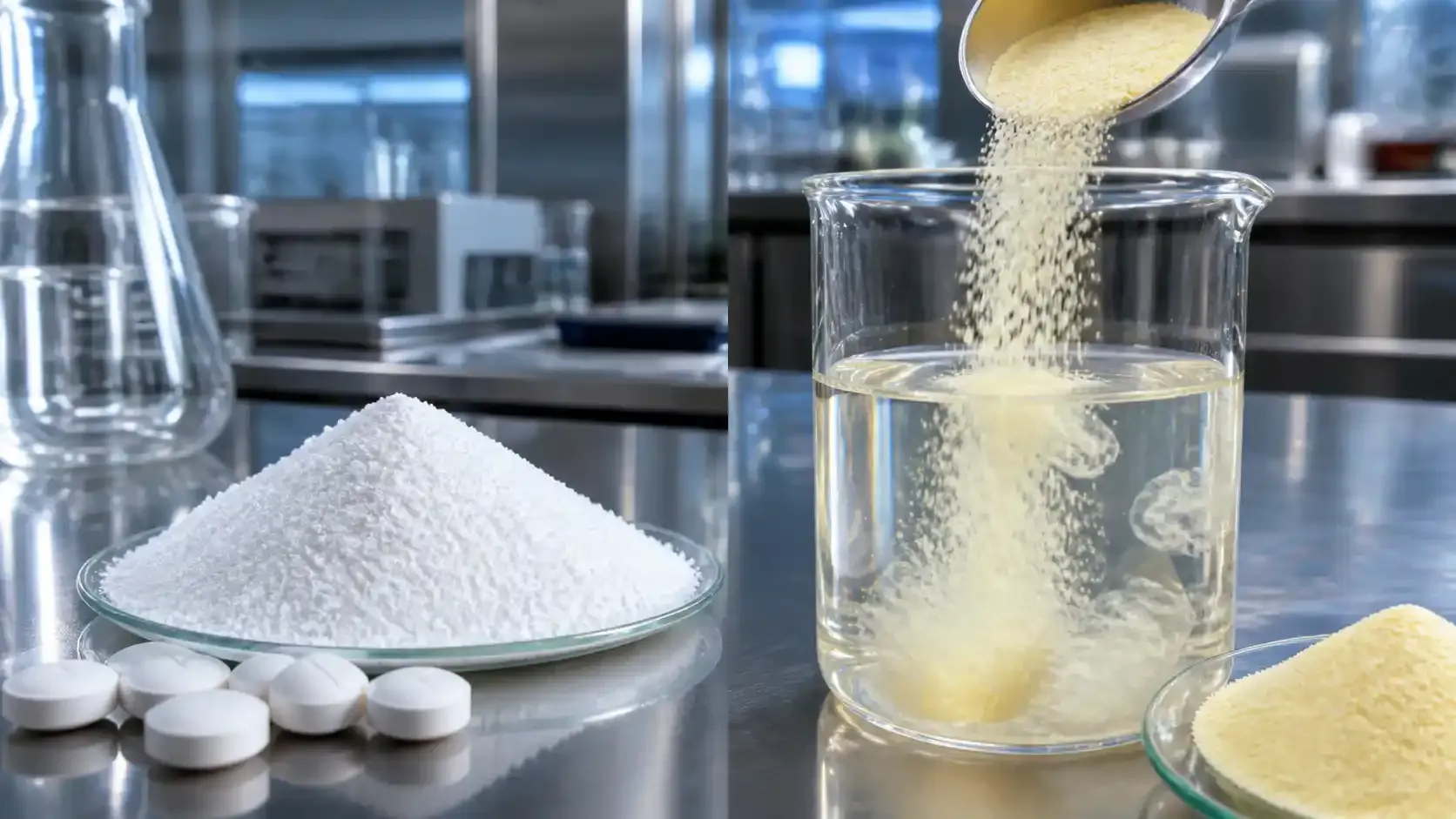
Fiber-forward foods, low-carb supplements, and solid-dose pharmaceuticals all share a harsh sourcing reality: buyers can no longer treat Microcrystalline Cellulose (MCC) and soluble fibers as simple, interchangeable commodities. A recommended Chinese microcrystalline cellulose supplier or a recommended Chinese resistant dextrin manufacturer is increasingly defined by one critical factor that procurement teams must verify quickly—compliance proof that matches the specification exactly.
For 2026 tenders, audits are shifting from theoretical paperwork to practical verification. Procurement teams are less focused on glossy brochures and more concerned with whether a microcrystalline cellulose supplier China can demonstrate consistent grade control. Similarly, they scrutinize whether a resistant dextrin supplier China can prove stable fiber content, support clean labeling (such as non-GMO or organic), and produce documented QC records that stand up to rigorous customer audits. This article breaks down the specific compliance signals that differentiate a “recommended” supplier, using public documentation patterns common in export-ready plants—referencing Shandong-based examples like Shine Health to illustrate what buyers should ask to see.

Why MCC and Resistant Dextrin Are Now Audited Like “Risk Ingredients”
Two significant market trends explain why the bar for supplier qualification has risen so sharply in recent years.
Formula risk has intensified. In pharmaceutical and supplement manufacturing, a minor shift in MCC particle size distribution or bulk density can drastically alter tablet hardness, disintegration time, and powder flow. For functional foods, a small deviation in resistant dextrin fiber content can invalidate nutrition panels, skew net carb calculations, and negatively impact the sensory performance of the final product.
Label and claim scrutiny is tighter. Product launches featuring “Non-GMO,” “Gluten-Free,” “Keto-Friendly,” and “Clean Label” claims attract extra regulatory and consumer attention. Buyers need a robust paper trail that makes these claims defensible. Consequently, many teams building an MCC or fiber program now evaluate a dietary fiber ingredient supplier and an excipient plant using a strict framework: Specification → COA → Process Controls → Lab Capability → Certification Scope → Batch Consistency.
Defining “Recommended” for a Chinese MCC Supplier
A recommended Chinese microcrystalline cellulose supplier is not defined by a single ISO certificate hanging on a wall. Rather, the distinction lies in whether the supplier can repeatedly demonstrate that key quality parameters are controlled and accurately reported for the specific MCC grade being purchased.
A practical starting point is a grade and QC framework similar to the one outlined in the MCC sourcing guide GMP COA. The value here isn't the guide itself, but the buying logic it represents: MCC grades differ significantly, and the Certificate of Analysis (COA) must align with the intended manufacturing process.
Procurement teams typically need to confirm, at a minimum:
- Loss on Drying (LOD): Critical for managing moisture-related flow issues and long-term stability risks.
- Bulk and Tapped Density: Essential for predicting die fill accuracy and capsule fill performance.
- Particle Size Distribution (PSD): Necessary to align with direct compression versus granulation requirements.
- Microbial Limits: Must be appropriate for the specific end-use, whether pharma, nutrition, or cosmetics.
A microcrystalline cellulose supplier China becomes “recommended” when these items are not merely listed once but are shown to be stable across multiple batches. Furthermore, the supplier must be able to explain how their in-process controls prevent parameter drift over time.
Defining “Recommended” for a Chinese Resistant Dextrin Manufacturer
For a recommended Chinese resistant dextrin manufacturer, buyers usually define “export-ready” using a concise set of measurable signals. Leading suppliers, such as Shine Health, repeatedly anchor their resistant dextrin specifications on the same baseline metrics:
- Raw Material:NON-GMO corn starch (specifically for non-GMO lines).
- Appearance: White to light yellow powder.
- Fiber Content:≥82% (This is the industry benchmark).
- Protein Content:≤6.0%.
- Storage: Store in a cool place.
These numbers matter because they are easily verifiable. When a resistant dextrin supplier China claims high performance, that claim should be visible in the COA and supported by a production process capable of holding that specification.
For brands building low-carb or keto positions, this conversation shifts to being “compliance-first.” A China resistant dextrin exporter may sell into dozens of markets, but a truly recommended supplier should be able to provide:
- A specific COA for each individual batch.
- Supporting documents like MSDS and, upon request, third-party test reports (a common expectation for global buyers).
- Clear statements for Non-GMO or Organic programs, depending on the product line and buyer needs.
If a buyer is specifically shortlisting a non-GMO resistant dextrin supplier, the supplier’s raw material declaration and traceability narrative must be entirely consistent with the brand's labeling strategy.
Corn-Based vs. Tapioca-Based: A Clean-Label Sourcing Decision
In Requests for Quotation (RFQs), “corn” and “tapioca” often appear as simple packaging or positioning choices. However, procurement should treat this as a fundamental compliance decision. Many brands select tapioca-derived ingredients for allergen perception, regional preference, or a specific clean-label narrative.
Shine Health’s portfolio reflects this market split: buyers can review standard resistant dextrin options alongside tapioca-positioned products, such as organic tapioca maltodextrin, through their ingredient catalog (see the resistant dextrin supplier China category and the organic tapioca maltodextrin supplier page).
Below is a buyer-oriented comparison that keeps the decision grounded in procurement variables rather than marketing language.

| Sourcing Angle | Corn-Based Resistant Dextrin | Tapioca-Based Resistant Dextrin / Carriers |
|---|---|---|
| Typical Positioning | Broad availability and cost stability for global programs. | Clean-label launches where cassava/tapioca is preferred by the brand story. |
| Common Label Drivers | Non-GMO corn programs; fiber-forward claims. | Gluten-free and cassava/tapioca-driven positioning; organic programs where applicable. |
| Baseline Fiber Spec | Often listed at ≥82% fiber for resistant dextrin lines. | Can be offered in comparable fiber-forward lines depending on grade and process. |
| Digestive Tolerance | Neutral taste, high solubility; tolerance depends on total dose and formula matrix. | Often positioned as “gentle” and easy to formulate; verify with trials and COA consistency. |
| Typical Applications | Low-carb breads, snacks, meal replacements, supplement powders. | Clean-label drink mixes, nutrition powders, specialty confectionery, carrier applications. |
The key compliance takeaway here is simple: buyers should not assume the raw material based solely on a product name. Recommended suppliers are those that clearly state the starch source in technical documents and maintain that consistency in every COA.
Reading COAs: Identifying the Lines That Matter
For procurement, a COA is not just a quality document—it is a risk-control instrument. A recommended Chinese resistant dextrin manufacturer should be willing to walk a buyer through each line item and explain what actions are taken when a parameter approaches a limit.
Screening Resistant Dextrin Lots
From Shine Health’s resistant dextrin pages (including keto-friendly and nutritional dietary fiber variants), the most procurement-relevant lines are straightforward but vital:
- Appearance: White to light yellow.
- Fiber Content:≥82%.
- Protein Content:≤6.0%.
If a buyer is purchasing resistant dextrin specifically to support low net carb labeling, the fiber line becomes non-negotiable. That is why “≥82%” appears repeatedly in supplier documentation—it is a threshold that reduces ambiguity across brands and markets.
Critical Lines for Tapioca-Derived Carriers
For tapioca maltodextrin programs—often used as carriers, texture modifiers, or clean-label bulking aids—buyers usually check a broader set of food-safety indicators. Shine Health’s organic tapioca maltodextrin specifications list practical QC points that procurement teams can benchmark:
- Moisture: ≤5.0 g/100g (Critical for shelf life).
- Ash: ≤0.1 g/100g (Indicates purity).
- pH: 3–6 (Ensures compatibility with acidic or neutral formulations).
- Water Activity: ≤0.2 (Prevents microbial growth).
- Microbiological Specs: Aerobic plate count ≤1000 CFU/g, Coliforms ≤3 MPN/g, Mold/Yeast ≤25 CFU/g.
A recommended supplier is one that can provide these results consistently, explain the test methods used, and demonstrate that their lab is equipped for routine microbiological and physical-chemistry checks.
Facility Signals: Correlating Operations with Export Quality
In China, the “recommended” tier typically shares a set of operational behaviors that translate directly into fewer surprises during scale-up. From publicly shared manufacturing descriptions on Shine Health’s resistant dextrin pages, the signals buyers often look for include:
- GMP-Standard Workshops: Essential for controlled hygiene and documented procedures.
- Fully Equipped QC Laboratory: Indicates the ability to conduct routine inspections at multiple production stages without relying solely on third parties.
- Imported Biological Enzymes: Often described as sourced from reputable international manufacturers, this supports process stability and yield consistency.
- Precision Production Lines: Often of German origin, emphasizing automation and precision engineering.
- Fully Automated Central Control: From raw material feeding to product filling, automation reduces variability and operator error.
These signals do not replace a physical audit, but they serve as powerful screening markers. They also align with what many global procurement teams consider “baseline readiness” for a China resistant dextrin exporter supplying to regulated or brand-sensitive markets.
Application Depth: A Compliance Clue
Suppliers that only sell powders can look identical on price lists. A recommended supplier often stands out by demonstrating application depth, because real application support forces tighter process control. Examples from Shine Health’s application pages show how resistant dextrin is positioned in formats that stress different parts of a manufacturing system:
- Low-Carb Foods: Breads, pastas, snack bars, and meal replacement shakes, where fiber affects texture and processing tolerance (see low carb food additives).
- Functional Confectionery: Gummies, chocolate, hard candy, and baked goods, where crystallization control and heat stability are paramount (see functional confectionery applications).
- Nutritional Supplements: Tablets, capsules, gummies, teas, and powders, where solubility and neutral taste reduce reformulation risk (see nutritional supplement additives).
When a resistant dextrin supplier China can discuss these applications with concrete processing guidance, it often indicates the plant is already controlling variables that show up in claims—solubility, taste neutrality, and stability across heat and pH.
A Shortlist Checklist for Suppliers
Procurement teams can expedite the shortlisting process by using a single-page checklist that fits both excipients and dietary fibers.
1. Documentation and Traceability
- COA availability per batch, with clear limits and actual results.
- Raw material declaration (corn vs. tapioca/cassava), aligned with labeling plans.
- Supporting documents (MSDS; third-party tests when requested).
2. Specification Discipline
- Resistant Dextrin: Confirm consistent ≥82% fiber and ≤6.0% protein in COA history.
- MCC: Confirm grade-fit and QC lines (LOD, density, PSD, microbial limits) using a framework like the MCC sourcing guide GMP COA.
3. Plant and QC Capability
- GMP workshop controls and hygiene practices.
- In-house QC lab scope and frequency of routine tests.
- Automation and central control described clearly (from feeding to filling).
4. Certifications Matching Your Channel
- For many nutrition programs, suppliers may list certification sets such as ISO9001, BRC, HALAL, HACCP, and KOSHER. Always verify the scope and validity for the specific site and product line.
If a buyer needs a practical starting point for documentation review, the product pages and knowledge articles at www.sdshinehealth.com offer examples of how export-oriented suppliers present resistant dextrin specifications, application fit, and MCC grade/QC considerations.