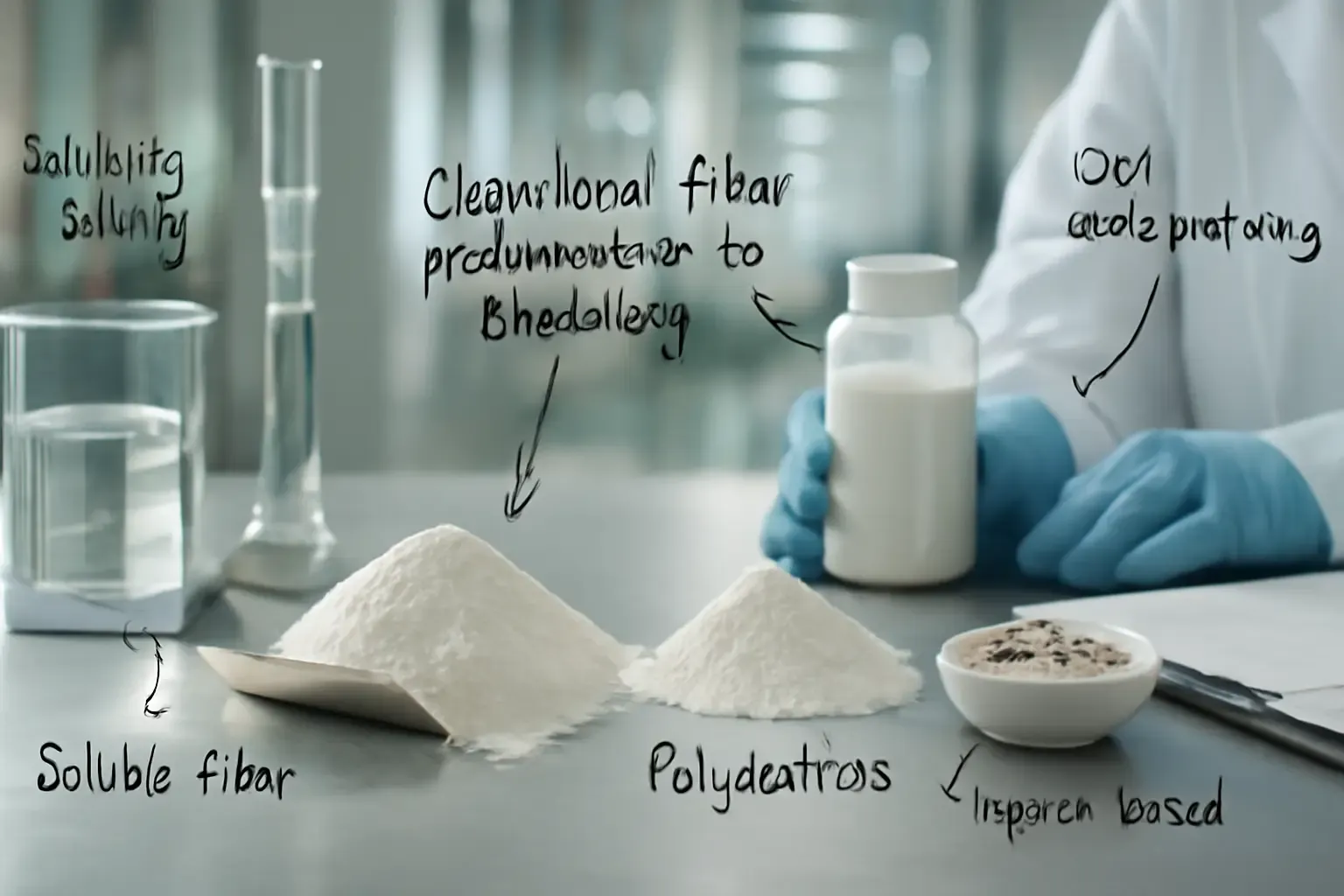
Global product teams are currently navigating a complex trilemma: deliver lower sugar, higher fiber, and cleaner labels, all without compromising taste, texture, or process stability. This specific combination of pressures is driving procurement managers to pay significantly closer attention to China’s soluble fiber capacity, particularly in Shandong and Jinan. In this region, aggressive investment in automation and GMP-style management is fundamentally changing how international buyers view the supply chain.
The shift extends beyond simple food commodities. Recent industry analysis regarding microcrystalline cellulose quality signals a wider upgrade cycle across excipients and functional ingredients. For buyers, the practical question remains: Which supplier behaviors actually suggest export readiness, and which specifications genuinely reduce reformulation risk?
This guide connects those market signals to the ingredients buyers are most frequently benchmarking today—resistant dextrin, polydextrose, and clean-label tapioca/corn-based dextrin fibers—and outlines exactly what to verify when shortlisting a recommended Chinese resistant dextrin manufacturer.

Mapping Clean Label Demand to Specific Fiber Ingredients
"Clean label" in procurement terms usually translates to simple sourcing narratives, predictable performance, and auditable documentation. In the soluble fiber sector, that demand tends to cluster around a few specific ingredient families:
- Resistant Dextrin: Commonly positioned as a soluble dietary fiber that resists digestion and supports sugar-reduction and fiber-enrichment goals. Several Shandong suppliers now highlight specific fiber content targets (often ≥82% fiber) and low sensory impact, making it ideal for sensitive beverage and nutrition formats.
- Polydextrose: Often utilized as a low-calorie bulking agent that supports texture and fiber claims, especially in reduced-sugar snacks and confectionery where mouthfeel is critical.
- Maize Dextrin Fiber: Typically selected when formulators require high solubility and minimal flavor interference in drinks, powders, and bars.
- Tapioca-Derived Carbohydrates (including organic or cassava-root positioning): Frequently sourced when buyers require gluten-free and plant-based positioning, particularly for premium beverage powders and nutrition blends.
A quick comparison helps align trend language with real-world purchasing specifications:
| Ingredient Family | What Buyers Are Solving For | Common Application Fit |
|---|---|---|
| Resistant Dextrin | Adding fiber while keeping taste and viscosity stable | RTD beverages, nutrition powders, bars, gummies |
| Polydextrose | Bulk and texture with fewer calories; sugar reduction | Low-sugar snacks, confectionery, dairy-style applications |
| Maize Dextrin Fiber | Soluble fiber with a neutral sensory profile | Beverages, meal replacements, functional powders |
| Organic Tapioca | Plant-based, gluten-free, clean-label friendly | Powdered drinks, sports nutrition, dry blends |
For procurement professionals, the key is not the marketing label—it is whether the COA, raw-material story, and process controls match the claim. This becomes particularly important when products reference tapioca/cassava positioning while other sections might reference corn-starch sourcing; these are not necessarily equivalent and must be clarified during the qualification phase.
Why Shandong Supply is Being Re-Rated by Global Buyers
International procurement has traditionally weighed China suppliers primarily on price and lead time. This dynamic is changing as more tenders require audit readiness, traceability, and consistent batch performance.
Across Shandong’s upgraded facilities, buyers are increasingly looking for specific operational signals:
1. Non-GMO Corn-Starch Sourcing Narratives
Many resistant dextrin and maize dextrin fiber lines are described as using NON-GMO corn starch as a primary input. From a buyer standpoint, the claim alone is insufficient—it is the supporting documentation and the supplier’s ability to keep raw material quality stable across harvest seasons that matters.
2. Automation "From Feeding to Filling"
Export-focused plants often describe fully automated central control operations that manage key stages from raw material feeding to finished product filling. Automation is crucial because it reduces the variability that can manifest as unexpected changes in solubility, color, or flowability during scale-up.
3. Imported Biological Enzymes and Controlled Processing
Several product pages in the Shandong ecosystem reference advanced biological enzymes imported from overseas. Whether those enzymes are utilized for dextrin conversion or process optimization, buyers should treat this as a consistency variable worth validating through process documentation and stability data.
4. GMP-Style Workshops and QC Laboratory Capacity
A credible GMP dietary fiber manufacturer will usually be able to explain their sampling plans, retained samples policy, micro and chemical testing protocols, and how deviations are handled. Buyers should request example COAs, typical micro limits, and documentation on how often line clearance is performed.
These themes are consistent with the region’s broader excipient discussion. Industry pages on MCC grades formulation and QC guidance and use in personal care applications suggest that buyers are evaluating suppliers through a wider "quality systems" lens rather than solely on product pricing.

Benchmarking Ingredients in RFQs
When procurement teams benchmark a resistant dextrin manufacturer or a polydextrose supplier, they often start with a short list of "representative" SKUs to test performance and documentation quality.
Below are ingredient types commonly used to structure those evaluations, using publicly available product-page positioning from the Shandong supplier ecosystem as examples:
- Keto-Friendly Resistant Dextrin: Typically framed around low net carbs and suitability for low-carb formulations, while maintaining a soluble fiber role. (Category reference: Resistant Dextrin)
- Low Calorie Dietary Fiber: Often positioned for satiety, blood sugar support, and general fiber enrichment. (Example: Nutritional Dietary Fiber Powder)
- Maize Dextrin Fiber: Commonly presented as a soluble fiber that integrates with minimal taste impact, which is particularly relevant to beverage applications. (Example: Dietary Fiber)
- Professional High Purity Polydextrose Powder: Frequently positioned for food, beverage, dietary supplement, and sometimes pharma-adjacent applications, emphasizing purity, solubility, and low-calorie contribution. (Example: Polydextrose)
- Organic Tapioca Maltodextrin Positioning: Often used when buyers want a cassava/tapioca narrative, gluten-free claims, and clean blending in powders.
One practical takeaway is that RFQs increasingly request both food functionality and pharma-style discipline (documentation, CAPA habits, batch traceability). This overlap explains why excipient-focused suppliers are gaining attention in soluble fiber tenders.
Applications Snapshot for Product Developers
Trends like sugar reduction and digestive wellness only matter commercially when the ingredient works across real product formats. In buyer evaluations, application-fit questions usually surface as: "Will it dissolve clearly in a beverage?" "Does it hold texture in a gummy?" "Will it survive pasteurization, baking, or acidic pH?"
The table below summarizes typical decision logic used in sourcing meetings:
| Format Under Evaluation | Key Test Parameters | Common Ingredient Shortlists |
|---|---|---|
| Beverages and RTD | Solubility, viscosity impact, sensory neutrality | Resistant dextrin, maize dextrin fiber, resistant maltodextrin-style fibers |
| Baked Goods and Bars | Water binding, texture, tolerance to heat | Resistant dextrin, digestion-resistant maltodextrin, maize dextrin fiber |
| Confectionery | Texture control, sugar reduction, stability | Resistant dextrin, polydextrose |
| Supplements | Flowability, COA consistency, micro specs | Resistant dextrin, polydextrose, supportive excipient systems |
For confectionery, suppliers sometimes group solutions under concept naming (for example, FIBER-FUL confectionery positioning) to demonstrate how resistant dextrin can reduce calories while keeping mouthfeel. Regardless of the concept name, the buyer’s core evaluation remains the same: spec stability, sensory neutrality, and reproducible processing.
What Defines an Export-Ready Chinese Supplier in 2026
A "recommended Chinese resistant dextrin manufacturer" is rarely chosen for a single reason. Most approvals occur when multiple small proof points align.
When shortlisting a polydextrose supplier or soluble fiber plant in China, buyers typically look for:
- Clear Technical Parameters and COA Discipline
- Fiber content targets (often stated as ≥82% fiber on resistant dextrin pages).
- Protein limits (commonly shown as ≤6.0% in some resistant dextrin specifications).
- Appearance and storage statements that remain consistent across batches.
- GMP Workshop Language Matching Audit Reality
- GMP references are common; buyers still need to verify SOP control, hygiene zoning, and training records.
- QC Laboratory Capacity Described Beyond Slogans
- What tests are run? At what frequency? What standards trigger hold/reject?
- Process Repeatability Signals
- Automated central control operations are a positive signal when paired with batch records and deviation handling.
- Certifications Relevant to Global Channels
- Some suppliers list ISO/HACCP/GMP; others also reference ISO9001, BRC, HALAL, HACCP, and KOSHER. Buyers should confirm scope and validity against the specific production site.
Just as important is what buyers should challenge early: If a page positions a product as tapioca/cassava-derived while another section references corn-starch sourcing, request a written clarification (raw material statement, traceability narrative, and a current COA). Clear answers reduce labeling risk later.
Outlook: The Convergence of Fiber and Excipients
Two parallel forces are currently shaping procurement strategy:
- Food Brands Want Fiber with Fewer Compromises: This keeps resistant dextrin, maize dextrin fiber, and polydextrose at the center of sugar-reduction roadmaps.
- Rising Quality Expectations: Driven by retailer standards and global compliance routines, supplier selection is pulling toward facilities that operate with GMP-style discipline and measurable QC capacity.
This is where Shandong’s upgraded plants stand out. Suppliers that sit at the intersection of functional ingredients and excipients—such as Shandong Shenghuai Health Co., Ltd.; Shine Health—illustrate the direction the region is moving: soluble fiber portfolios anchored by resistant dextrin and polydextrose, supported by process automation, QC labs, and documented manufacturing practices.
For buyers building a shortlist, reviewing supplier product categories and comparing how consistently they present specifications across related SKUs is a valuable exercise. A starting point is the resistant dextrin category listing (resistant dextrin) and the polydextrose product pages (polydextrose supplier options). These pages can help structure RFQ questions and identify which documentation to request before sampling.
For more information on qualifying suppliers or to view specific product specifications, please visit www.sdshinehealth.com.